Si deseas distinguir tus productos, servicios o ambos de los de otra empresa, es posible que necesites una marca o nombre comercial. Descubre qué son, en qué consiste su procedimiento de registro y qué implica.

Información sobre los plazos de presentación de solicitudes de transformación de marcas de la Unión Europea en marca nacional española. Más información


Si tienes un nuevo dispositivo, producto o procedimiento que resuelva un problema técnico o tenga una ventaja práctica, existen distintas formas de protegerlo en España y en otros países. Descubre cómo hacerlo.

¿Tu innovación reside en la estética, la ornamentación o la apariencia de tu producto? Protégela mediante un diseño industrial. Descubre qué derechos confiere el registro y cómo realizar la tramitación.

Las indicaciones geográficas protegen el nombre de un producto originario de una zona geográfica, a la cual le debe una determinada calidad, reputación u otra característica. Descubre qué son, en qué consiste su procedimiento de registro y qué beneficios conceden.

Las patentes publicadas en todo el mundo son una valiosa fuente de información científica, técnica y comercial.

Si eres emprendedor/a o una empresa y quieres potenciar y mejorar la rentabilidad de tu negocio protegiendo de forma adecuada los activos intangibles de tu organización, en este espacio encontrarás lo necesario.


 789
resultados
789
resultados
 Última actualización
15/09/2026 [08:08:00]
Última actualización
15/09/2026 [08:08:00]


 Resultados 175 a 200 de 789

Resumen de: EP4793410A2
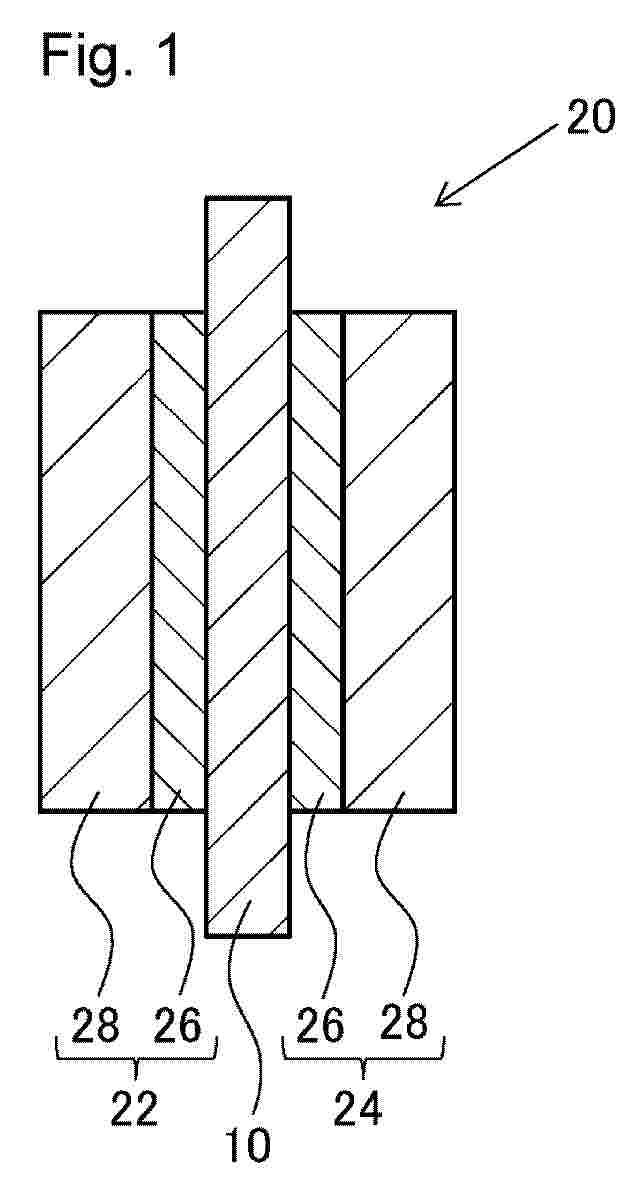
0001 To provide a membrane electrode assembly which is excellent in strength and is capable of reducing the electrolysis voltage when applied to a water electrolysis apparatus, and such a water electrolysis apparatus. 0002 The membrane electrode assembly of the present invention is a membrane electrode assembly for use in a water electrolysis apparatus, comprising an anode having a catalyst layer, a cathode having a catalyst layer, and a polymer electrolyte membrane disposed between the anode and the cathode, wherein the polymer electrolyte membrane comprises a fluorinated polymer having ion exchange groups, and a woven fabric, the aperture ratio of the woven fabric is at least 50%, the denier number of warp yarns and the denier number of weft yarns, constituting the woven fabric, are each independently at least 2, a relation of Y≦240X-170 is satisfied, where the membrane thickness of the polymer electrolyte membrane is Y µm, and the ion exchange capacity of the fluorinated polymer is X meq/g dry resin, the membrane thickness Y of the polymer electrolyte membrane is at least 20 µm and at most 150 µm, and the density of the warp yarns and weft yarns constituting the woven fabric is at least 19.7 yarns/cm (50 yarns/inch).

Resumen de: EP4792933A1
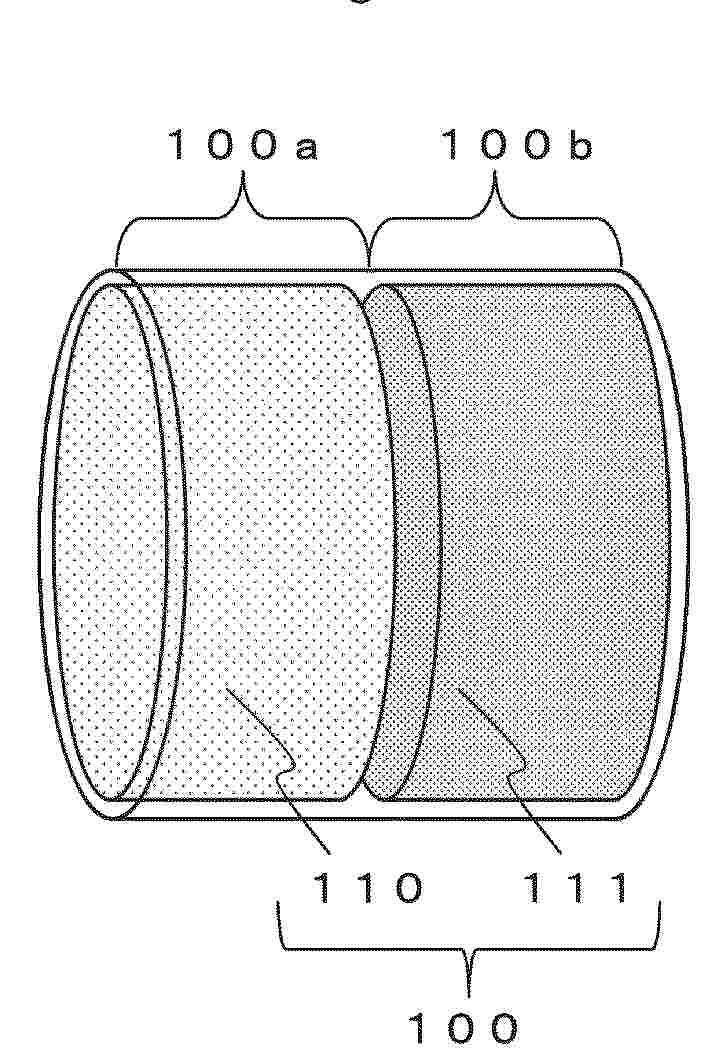
0001 A purpose of the present invention is to provide an ammonia decomposition catalyst device with which a conversion of ammonia (NH<3>) can be improved. An ammonia decomposition catalyst device 100 for producing hydrogen (H<2>) through decomposition of ammonia (NH<3>) has a gas-flow upstream-side region 100a and a gas-flow downstream-side region 100b, in which a base density of the gas-flow downstream-side region 100b is a higher than that of the gas-flow upstream-side region 100a.
Resumen de: WO2025078333A1
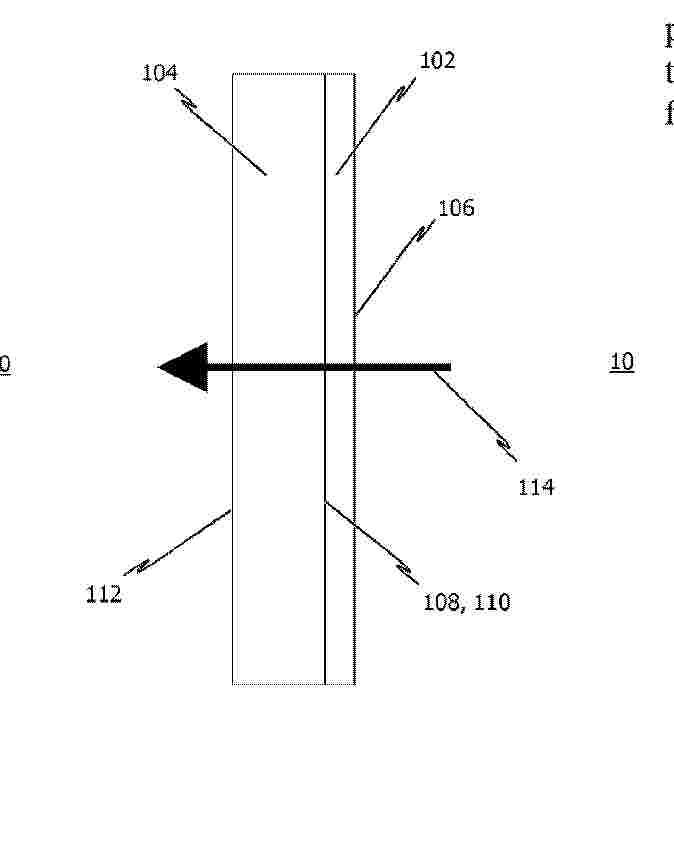
The present invention relates to an electrode (100) for electrolysis of electrolyte, said electrode comprising: first porous layer (102) permeable to electrolyte and gases produced by the decomposition of electrolyte; a second porous layer (104) permeable to electrolyte and gases produced by the decomposition of electrolyte, said second porous layer (104) being arranged adjacent to the first porous layer (102), wherein the first porous layer (102) comprises Nickel.
Resumen de: US20250243139A1
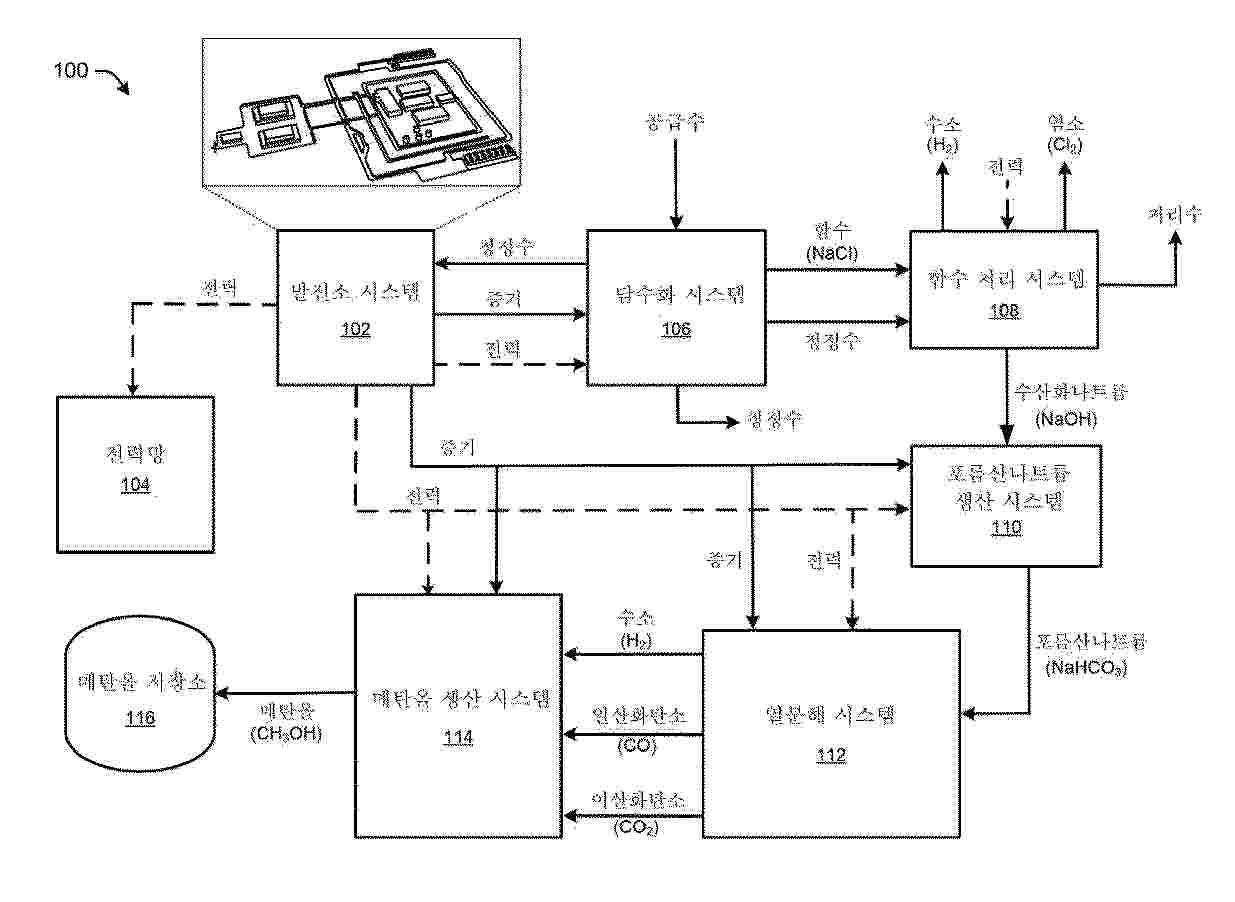
An integrated energy system including a power plant is discussed herein. In some examples, the integrated energy system may include at least one nuclear reactor and electrical power generation system configured to generate steam and electricity, a water treatment plant configured to produce Sodium Hydroxide (NaOH) from salt water, a Sodium Formate (HCOONa) production plant configured to receive the Sodium Hydroxide (NaOH) to produce Sodium Formate (HCOONa), a Thermal Decomposition reactor configured to receive the Sodium Formate (HCOONa) and configured to receive at least a first portion of the steam or at least a second portion of the electricity from the power plant to indirectly heat the Thermal Decomposition reactor to produce Hydrogen (H2), Carbon Dioxide (CO2), and Carbon Monoxide (CO) from the Sodium Formate (HCOONa), and a Methanol (CH3OH) reaction chamber configured to receive the Hydrogen (H2), the Carbon Dioxide (CO2), and the Carbon Monoxide (CO) to produce Methanol (CH3OH).
Resumen de: WO2025033904A1
The present invention relates to an electrode and a method for manufacturing same, the electrode comprising: a nickel-containing metal substrate; a first sol-gel coating layer formed on at least one surface of the metal substrate; and a second sol-gel coating layer formed on the first sol-gel layer, wherein the first sol-gel coating layer and the second sol-gel coating layer each independently include nickel and iron. According to the present invention, the provided electrode for anion exchange membrane water electrolysis can implement improved electrochemical performance and has excellent durability.
Resumen de: EP4574751A1
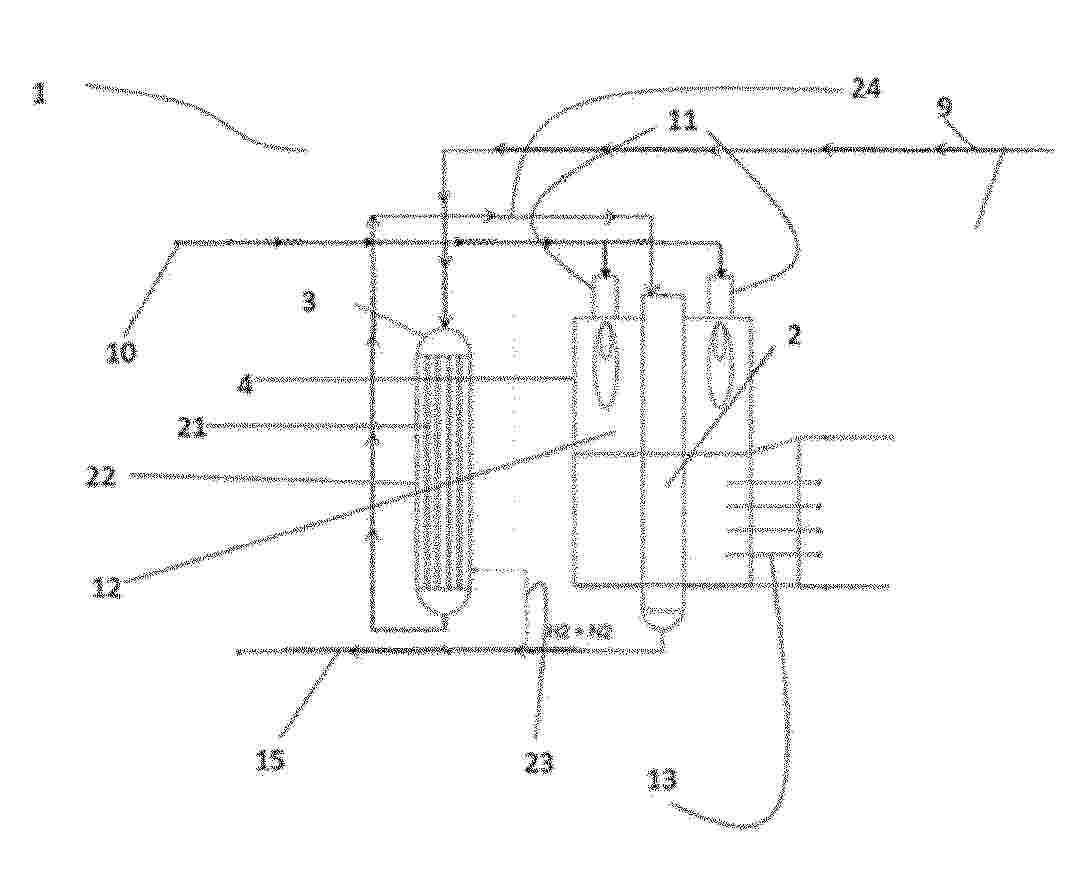
0001 A process for producing a cracked gas product comprising hydrogen from an endothermic cracking reaction of an ammonia feedstock stream, said process comprising the following steps: - Recovering heat from said cracked gas product flowing in a cracked gas conduit (23) in a heat recovery step, - Redirecting the recovered heat to at least one secondary reactor in a heat redirection step, the secondary reactor comprising a gas reaction section in which a secondary catalytic endothermic conversion of the ammonia feedstock stream into the partially converted ammonia stream is performed, - Transferring the redirected heat to the secondary catalytic endothermic conversion through a thermal conductive layer at least partly delimiting the gas reaction section, in a heat transfer step the process comprising : - Performing a heat exchanges step by performing heat exchanges between the cracked gas product and the main catalytic endothermic conversion.
Resumen de: JP2026132816A
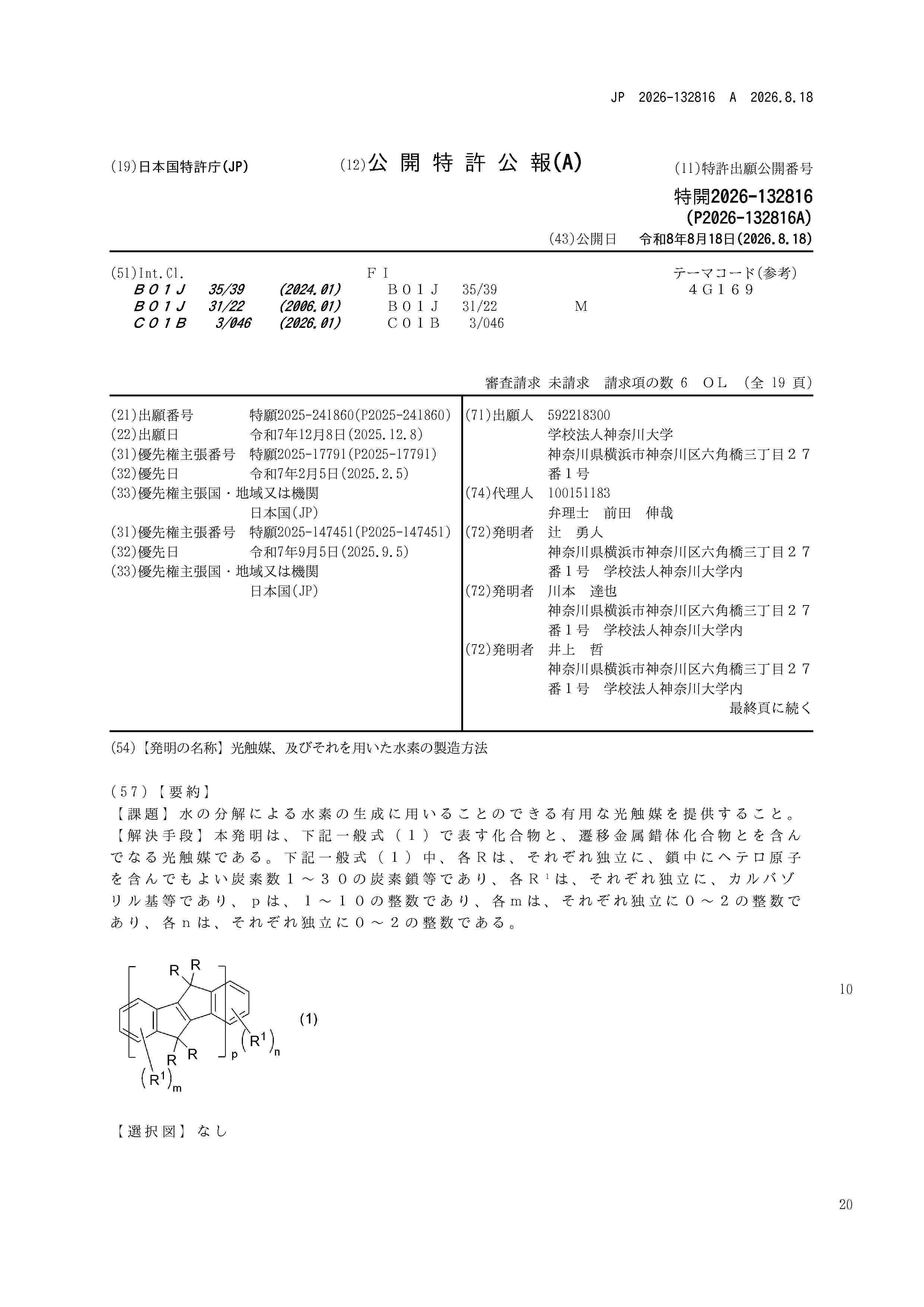
0001 【課題】水の分解による水素の生成に用いることのできる有用な光触媒を提供すること。 【解決手段】本発明は、下記一般式(1)で表す化合物と、遷移金属錯体化合物とを含んでなる光触媒である。下記一般式(1)中、各Rは、それぞれ独立に、鎖中にヘテロ原子を含んでもよい炭素数1~30の炭素鎖等であり、各R<1>は、それぞれ独立に、カルバゾリル基等であり、pは、1~10の整数であり、各mは、それぞれ独立に0~2の整数であり、各nは、それぞれ独立に0~2の整数である。 【選択図】なし
Resumen de: EP4574750A1
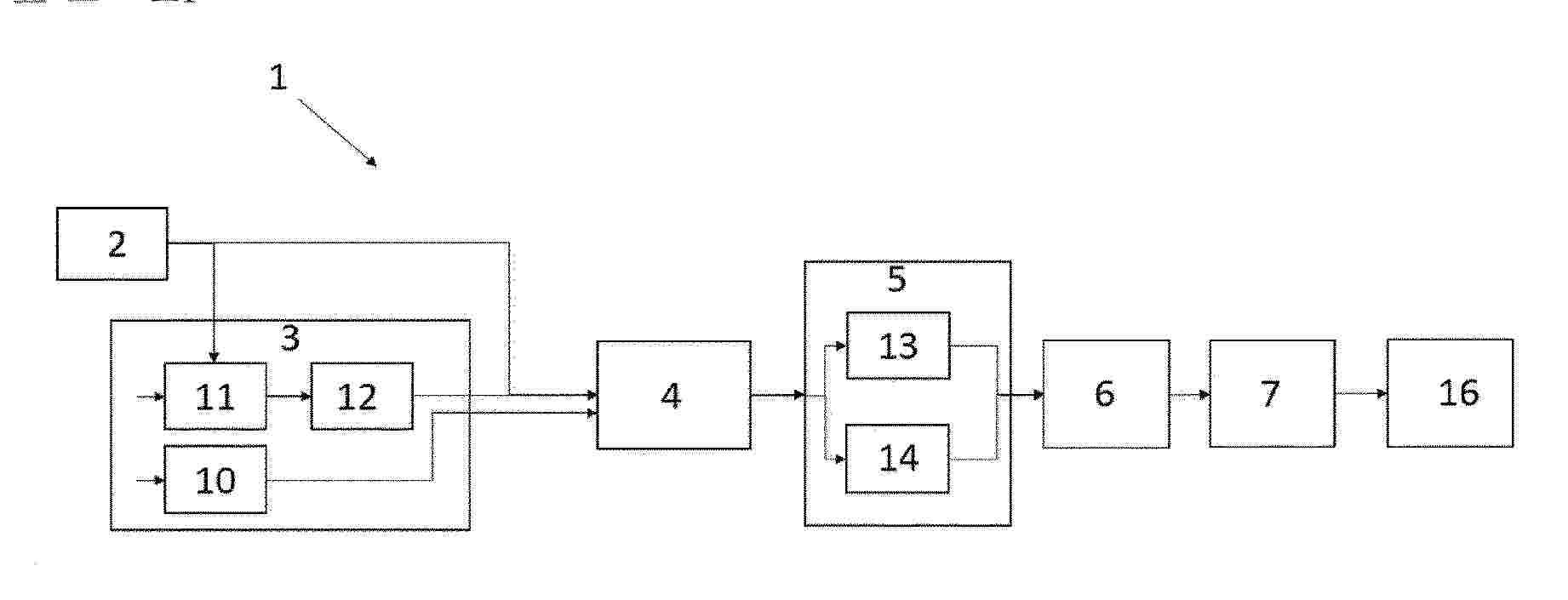
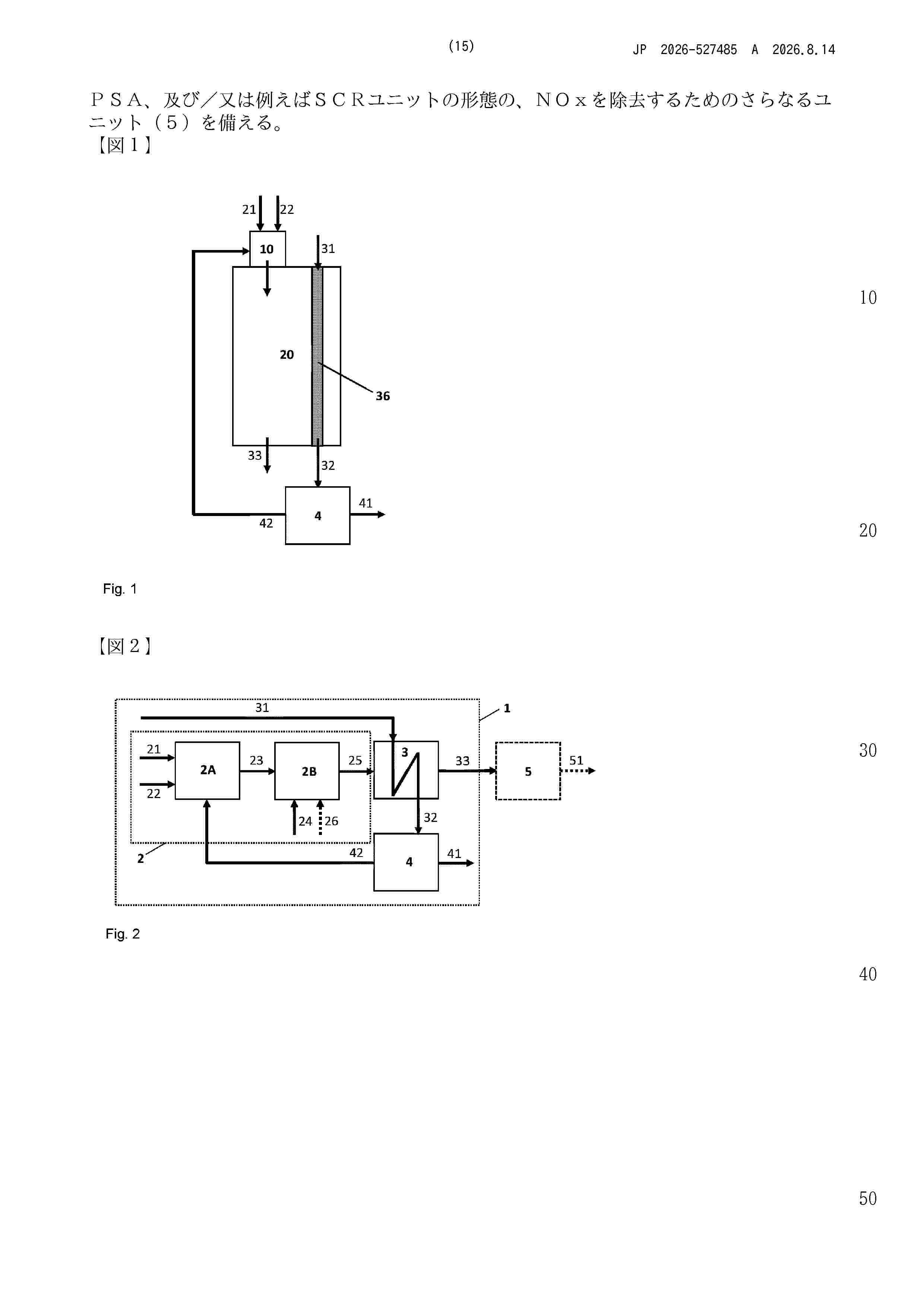
The invention relates to a process (1) for the production of hydrogen from ammonia comprising the following steps:- providing an ammonia feed stream to a reactor (2),- feeding an oxidant stream comprising oxygen to the reactor (3),- in a first zone of the reactor, non-catalytically partially oxidizing the ammonia feed stream with the oxidant stream (4), thus generating heat and producing a partially oxidized stream containing ammonia, nitrogen, water, amounts of nitrogen oxides, and potentially a residual portion of oxygen.- in a second zone of the reactor, homogenizing the temperature and concentration of the partially oxidized stream (5), thus producing an homogenized stream containing ammonia, nitrogen, and water,- in a third zone of the reactor, catalytically cracking ammonia contained in the homogenized stream in an endothermic reaction using the generated heat (6), thus creating a cracked gas product containing nitrogen and hydrogen- withdrawing the cracked gas product from the reactor (7).
Resumen de: WO2025033986A1
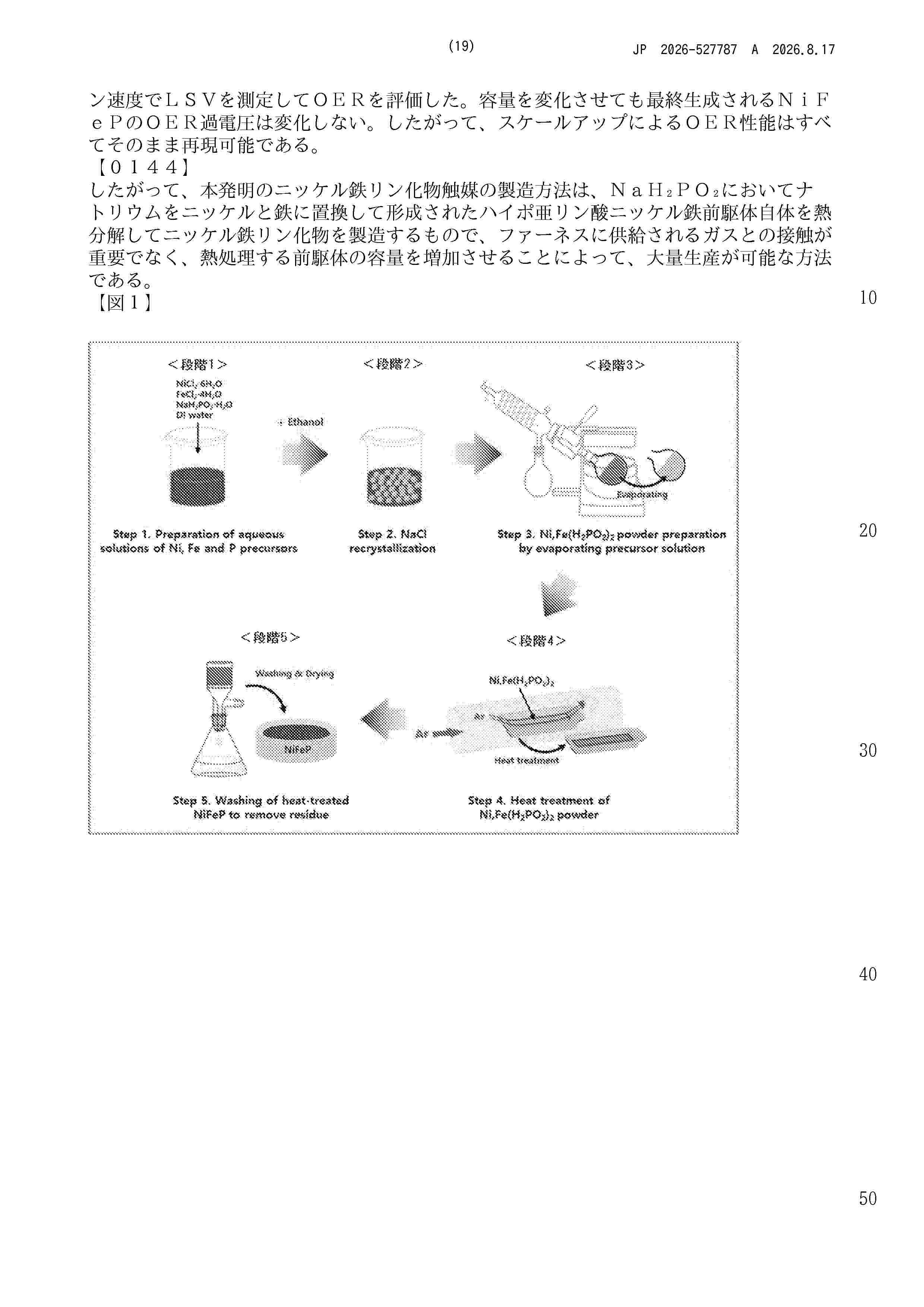
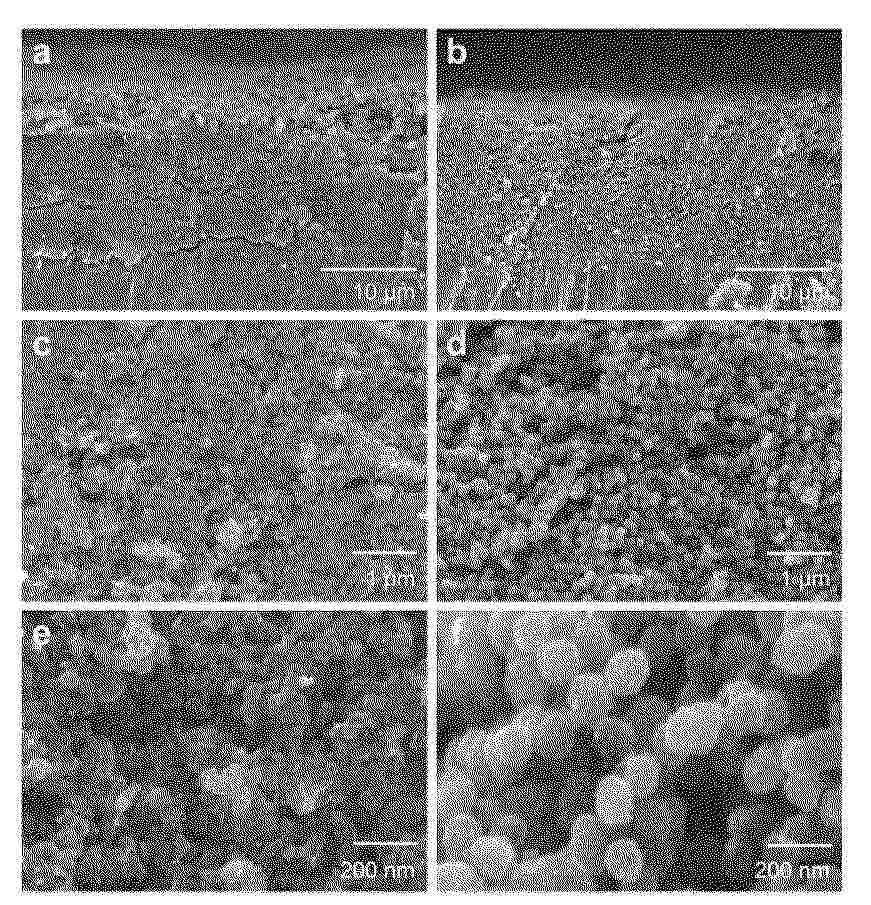
The present invention relates to a method for preparing a nickel-based phosphide catalyst for an oxygen evolution reaction of an alkaline water electrolysis anode using sodium hypophosphite (NaH2PO2) substitution and pyrolysis.
Resumen de: EP4550481A1
The present invention relates to porous catalyst layers comprising a metal nanoparticle loaded porous carbon structure, wherein the porous carbon structure is assembled from porous spherical carbon particles with a particle size dispersity (Ð) of 1.2 or less, and with a templated pore size with a templated pore size dispersity (Ð') of 1.2 or less. The invention further relates to the method of production of such porous catalyst layer, electrodes obtained from such porous catalyst layers and their use in fuel cells or electrolysers.
Resumen de: WO2025027031A1
The invention provides a process for producing hydrogen by thermal reforming of ammonia in an apparatus comprising an ammonia cracking reactor with a catalyst chamber and a staged combustion unit, wherein the catalyst chamber of the ammonia cracking reactor is heated indirectly by heat exchange with the hot flue gases from the staged combustion unit, comprising the steps of: a) incomplete combustion of a fuel comprising ammonia in the first stage of the staged combustion unit to generate a flue gas stream of elevated temperature T1 in the range of 750 to 2000°C, preferably in the range of 1200 to 2000°C; b) complete combustion of the fuel comprising ammonia in the second stage of the staged combustion unit to generate a flue gas stream of a temperature T3 that is less than T1; c) exchanging heat from the flue gas provided in step b) with the ammonia cracking reactor to raise the temperature in the catalyst chamber to a catalytic cracking temperature T2 in the range of 400 to 1000°C, more preferably in the range of 600 to 800°C; d) subjecting an ammonia stream in the heated ammonia cracking reactor of step c) to a catalytic ammonia-cracking step to yield a thermally cracked stream comprising hydrogen, and e) separating the thermally cracked stream into a reject gas stream and an enriched hydrogen stream and withdrawing the enriched hydrogen stream, wherein T3 is at least 50°C above T2 up to a maximum of 1600°C, and wherein T3 is at least 50°C below T1, and wherein the f
Resumen de: WO2025032310A1
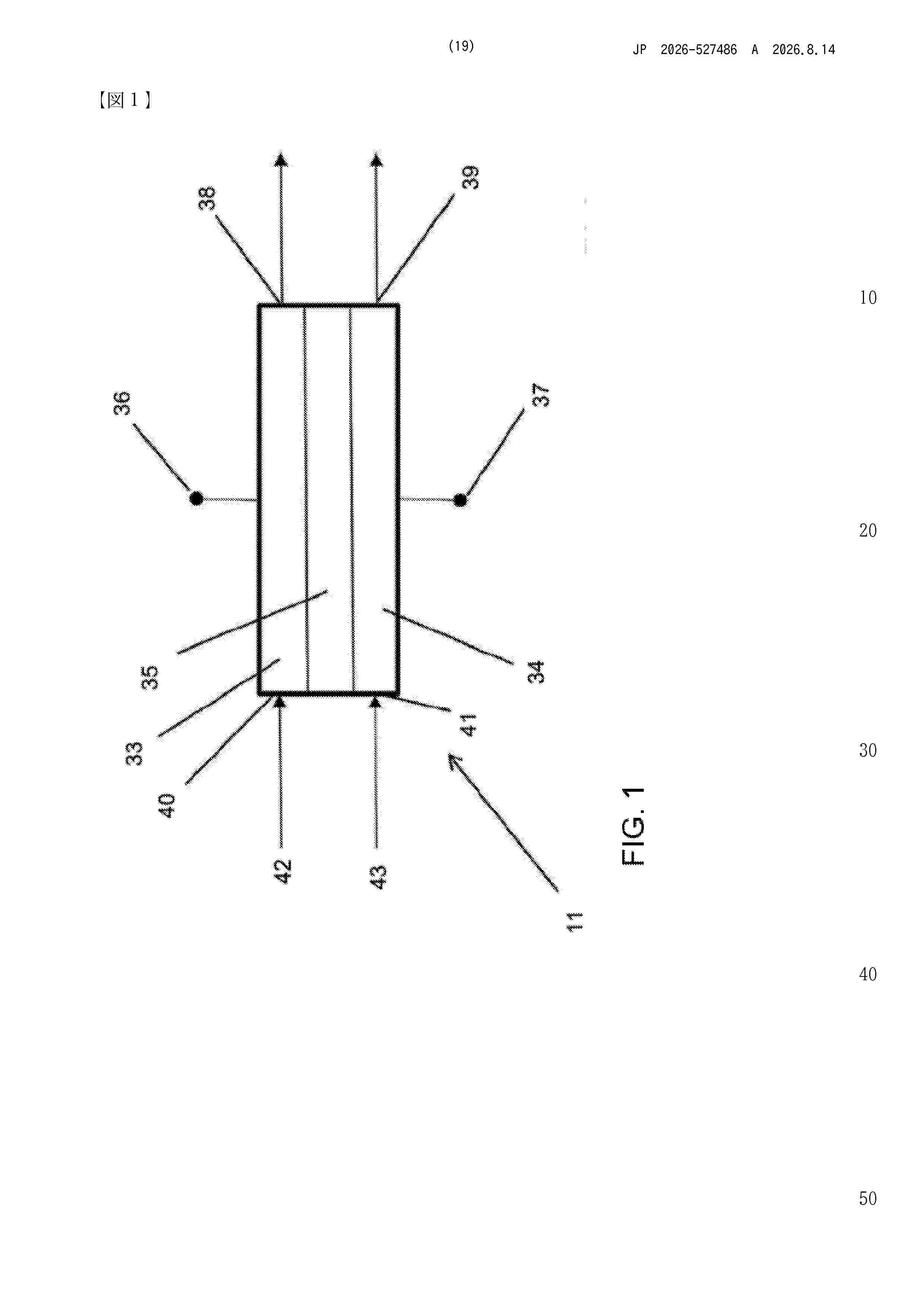
The present invention relates to a methanation method comprising providing an electrolyser system, the electrolyser system (20) comprising an electrolyser (10) that has at least one electrolyser cell (11), at least one fuel input (14) through which fuel enters the electrolyser (10) and at least one offgas output (46) from which offgas exits the electrolyser (10), the method further comprising supplying fuel to the at least one fuel inlet, the fuel comprising at least water and either or both carbon dioxide and carbon monoxide, operating the electrolyser system (20) by powering the electrolyser cell (11) with electricity to electrolyse the fuel in the at least one electrolyser cell (11) such that a part of the water splits into hydrogen and oxygen, wherein the electrolyser (10) is operated at a temperature at or in excess of 150 degrees C, and methanation occurs to the carbon dioxide and/or carbon monoxide in the electrolyser (10). The gas mixture can be released from the at least one offgas output (46) and then passed through a gas separation process to separate at least the methane from the gas mixture. The present invention also relates to an electrolyser system (20) configured to operate using the above method. The electrolyser system (20) comprises a fuel fluid flow path connecting a fuel inlet and a fuel outlet. The method may comprise providing to the fuel inlet a fuel gas containing water and a source of carbon selected from one or more of CO and CO2, operating the ele
Resumen de: CN122564629A
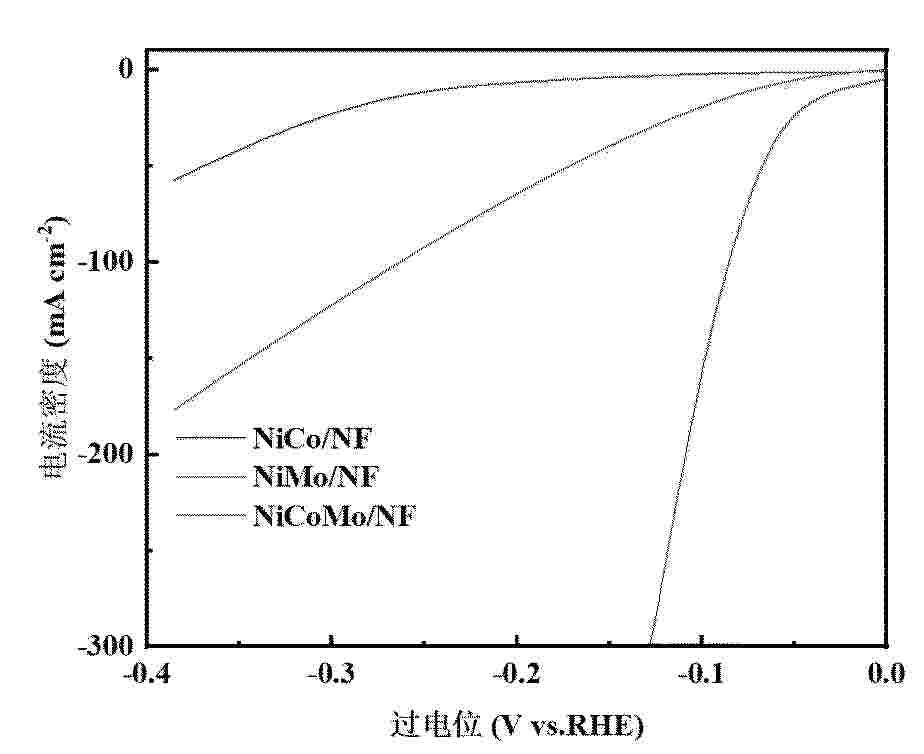
本发明公开了一种镍钴钼复合电催化剂、制备方法及其应用。该方法采用了简单的两步电沉积的方法,通过在泡沫镍上先后沉积钴和钼,形成复合结构,引入钼后,该催化剂表现出比商业催化剂(Pt/C)更低的过电位,在1 M KOH电解液中达到10 mA cm‑²电流密度仅需20 mV的过电位;并且在10 mA cm‑²电流密度下经过100小时的稳定性测试,电流衰减率仅为0.3%,在碱性电解水析氢反应中的具有优异的性能。本发明提供了一种价格低廉,简单且易制备的电解水析氢催化剂制备方法,为设计高效稳定的电催化析氢催化剂提供了新策略。
Resumen de: JP2026527456A
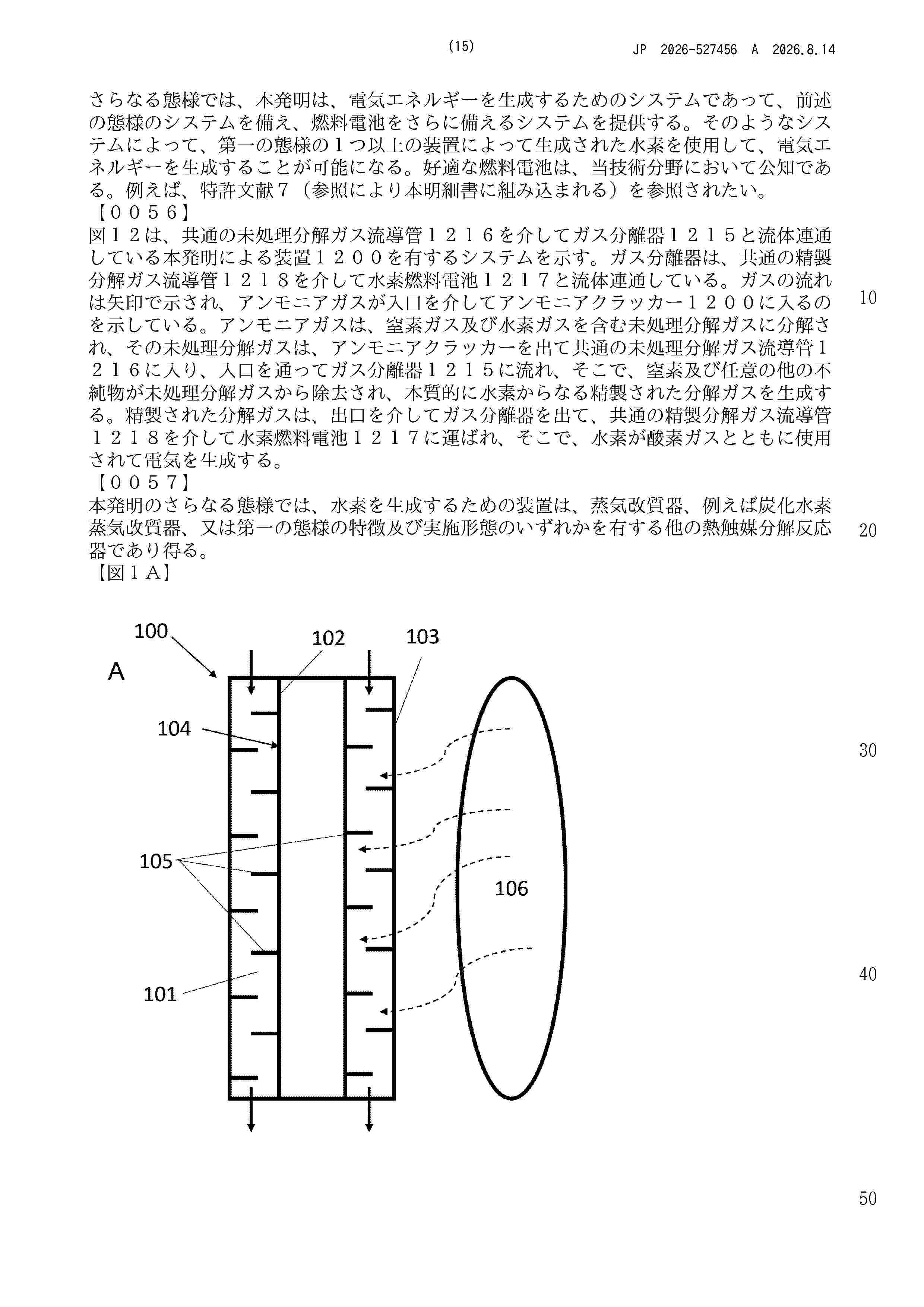
0001 アンモニアから水素リッチガスを生成するための水素生成装置であって、内壁と、内部容積を画定する外壁とを備える第一のチャンバであって、前記第一のチャンバは、前記内壁と前記外壁との間に配置されたアンモニア分解触媒を含み、前記第一のチャンバは、1つ以上のアンモニアガス入口と1つ以上の未処理分解ガス出口とを有し、前記1つ以上のアンモニアガス入口及び前記1つ以上の未処理分解ガス出口は、前記アンモニアが前記1つ以上のアンモニアガス入口から前記1つ以上の未処理分解ガス出口まで前記第一のチャンバを通って流れ、前記アンモニア分解触媒に接触するように配置される、第一のチャンバと、前記アンモニア分解触媒を加熱するための1つ以上の熱源と、を備え、前記第一のチャンバは、1つ以上のフィンを有し、前記1つ以上のフィンは、前記第一のチャンバの前記内壁と前記外壁との間に配置される、装置。 【選択図】図1
Resumen de: CN122577325A
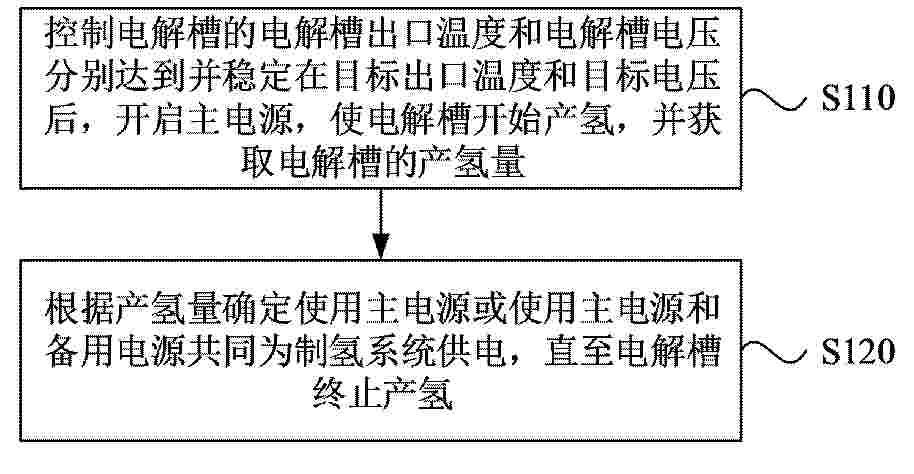
本发明公开了一种制氢系统及其供电控制方法,涉及新能源技术领域。制氢系统包括电解槽、空气加热器、水蒸气发生器、混合器、氢气冷旁通、主电源和备用电源,电解槽的供电输入端分别与主电源和备用电源连接,空气加热器的出气口与电解槽的阴极室进气口相连通,氢气冷旁通的氢气出口与混合器的第一进气口相连通,水蒸气发生器的蒸汽出口与混合器的第二进气口相连通,混合器的出气口与电解槽的阳极室进气口相连通;在控制电解槽的电解槽出口温度和电解槽电压分别达到并稳定在目标出口温度和目标电压后,开启主电源,使电解槽开始产氢,并获取电解槽的产氢量,以基于产氢量使用主电源或使用主电源和备用电源共同为制氢系统供电,直至电解槽终止产氢。
Resumen de: FR3172103A1
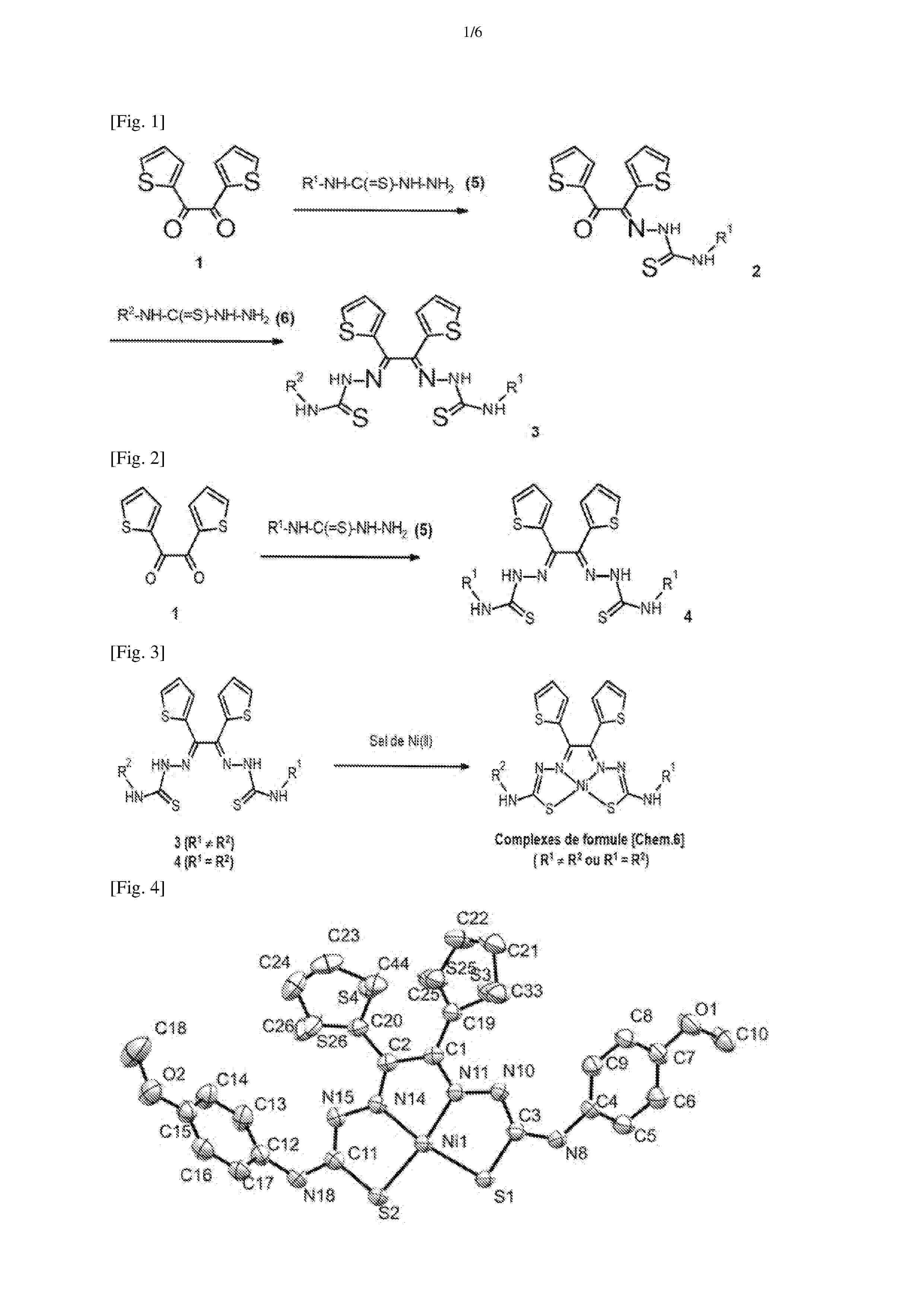
L’invention concerne un électrocatalyseur pour la réaction d’évolution d’hydrogène (HER), comprenant un support carboné conducteur, et un matériau catalytique disposé sur le support carboné conducteur, dans lequel le matériau catalytique comprend un complexe de nickel(II) répondant à la formule générale Chem. 4 suivante : Chem 4dans laquelle,R1 et R2 représentent chacun indépendamment un groupe phényle ayant optionnellement un ou plusieurs substituants R3 identiques ou différents, R3 est sélectionné parmi un halogène, un groupe hydroxy, groupe alkyle en C1-C4, un groupe alkoxy en C1-C4, un groupe thioalkyl en C1-C4, un groupe dialkylamino en C1-C4, un groupe cyano, un groupe CF3 et un groupe O-CF3.
Resumen de: NL2036587B1
The present application discloses a method for producing an iridium oxide film on a particulate substrate having an electrical conductivity of >0.01 S/cm (as detected by powder measurements) by chemical vapour deposition at a pressure in the range of from to 1010 KPa, comprising: (i) providing the particulate substrate in a reaction chamber; (ii) contacting the particulate substrate with a vaporized iridium oxide precursor gas, thereby forming a homogenously distributed film of iridium precursor material on the substrate; (iii) contacting the material comprising the homogenously distributed layer with a vaporized oxidant to allow the oxidant to react with the homogenously distributed iridium precursor film on the substrate; and (iv) optionally, repeating until steps (ii) to (v); to obtain a particulate material comprising a surface film of a desired thickness comprising homogeneously distributed discrete iridium oxide clusters with an average diameter in the range of from 0.5 to 5 nm.
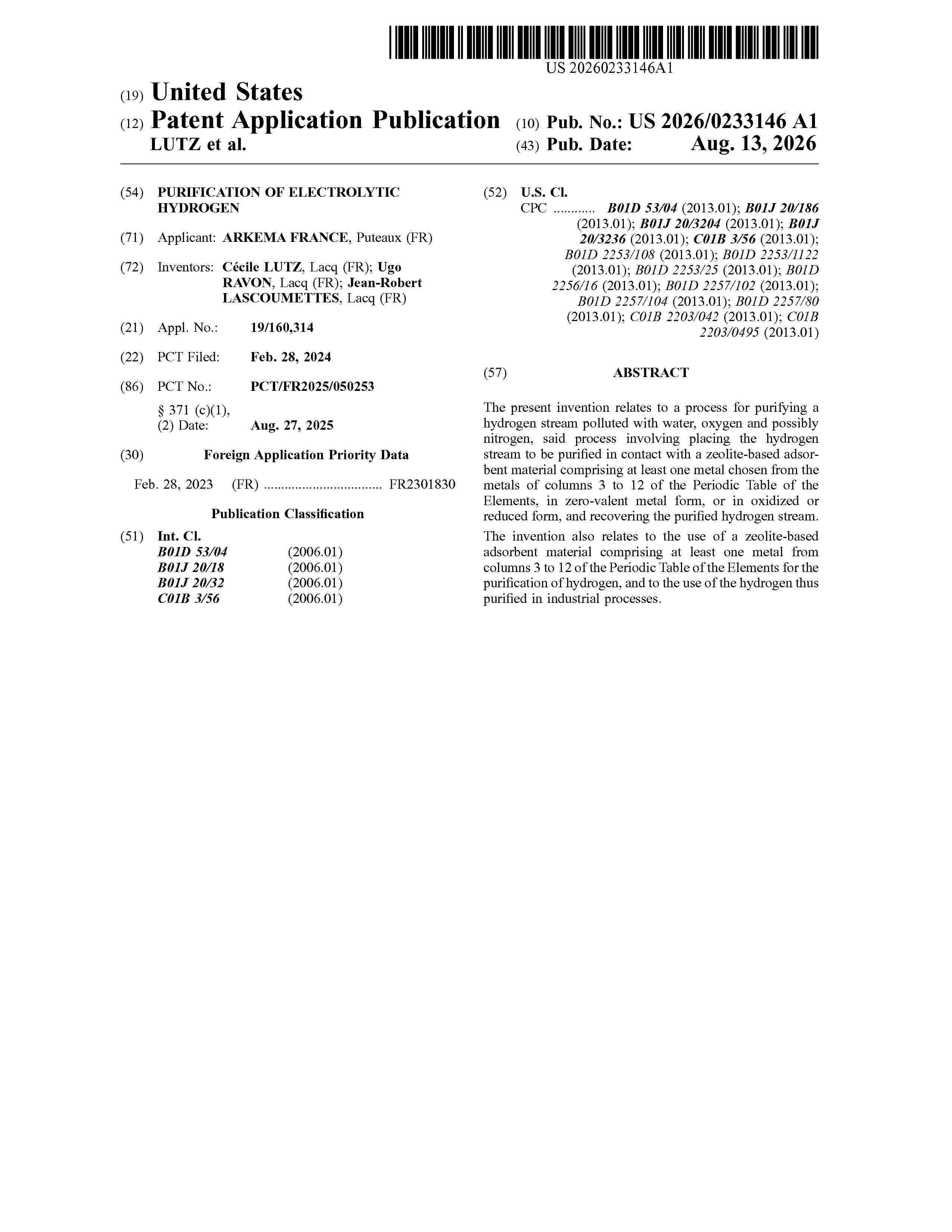
Resumen de: US20260233146A1
0000 The present invention relates to a process for purifying a hydrogen stream polluted with water, oxygen and possibly nitrogen, said process involving placing the hydrogen stream to be purified in contact with a zeolite-based adsorbent material comprising at least one metal chosen from the metals of columns 3 to 12 of the Periodic Table of the Elements, in zero-valent metal form, or in oxidized or reduced form, and recovering the purified hydrogen stream. 0000 The invention also relates to the use of a zeolite-based adsorbent material comprising at least one metal from columns 3 to 12 of the Periodic Table of the Elements for the purification of hydrogen, and to the use of the hydrogen thus purified in industrial processes.
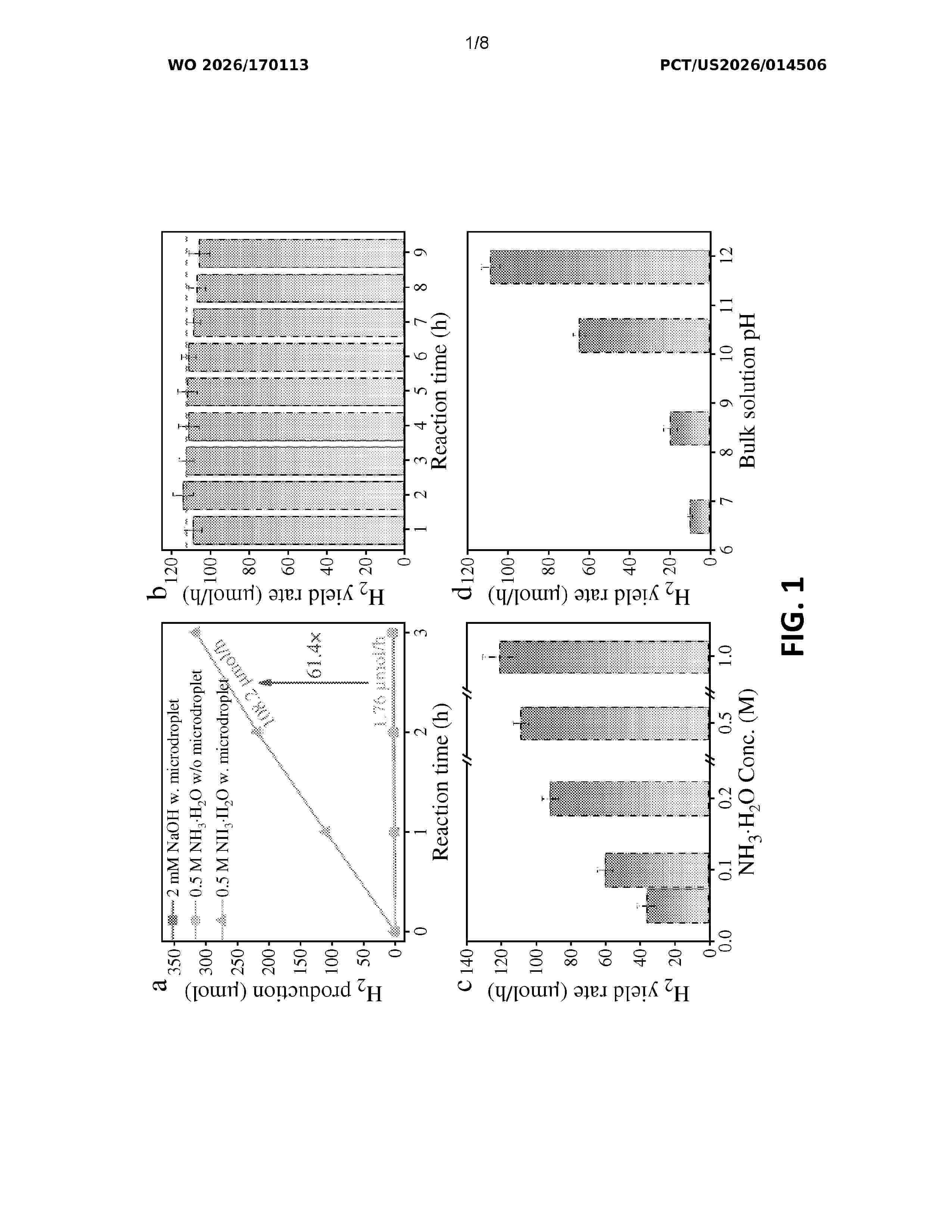
Resumen de: WO2026170113A1
A method for hydrogen production includes providing an aqueous solution comprising ammonia, generating a spray in a reaction chamber from the aqueous solution, the spray comprising water microdroplets, and collecting hydrogen from the reaction chamber produced via decomposition of the ammonia along a gas-liquid interface of the water microdroplets.
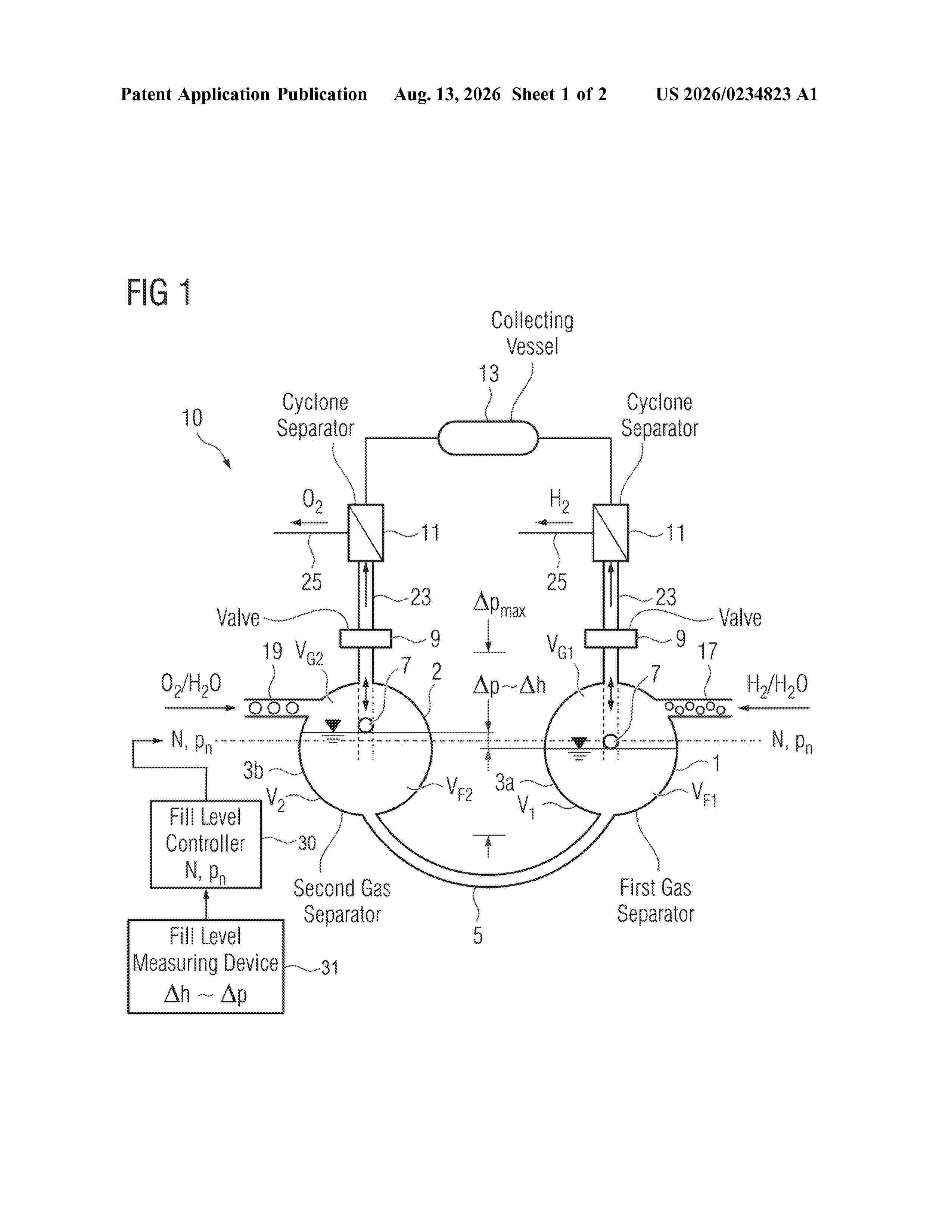
Resumen de: US20260234823A1
An arrangement for gas-liquid separation includes first and second gas separators for first and second gases, each having one vessel. The vessels have either the same or a different vessel volume, are in hydraulic communicating connection for a liquid via a connecting conduit and are at the same height. The operational configuration is such that a predefined standard fill level of the liquid is established when the pressure in the vessels is equal, and so a liquid volume is provided at the standard fill level, the vessel volume is composed of the liquid volume and the corresponding gas volume, and the liquid volume in the vessels is greater than the corresponding gas volume. A method of operating an electrolyzer, in particular in safe operation of an electrolysis plant with an electrolyzer for alkaline electrolysis, and an electrolysis plant, are also provided.
Resumen de: US20260234821A1
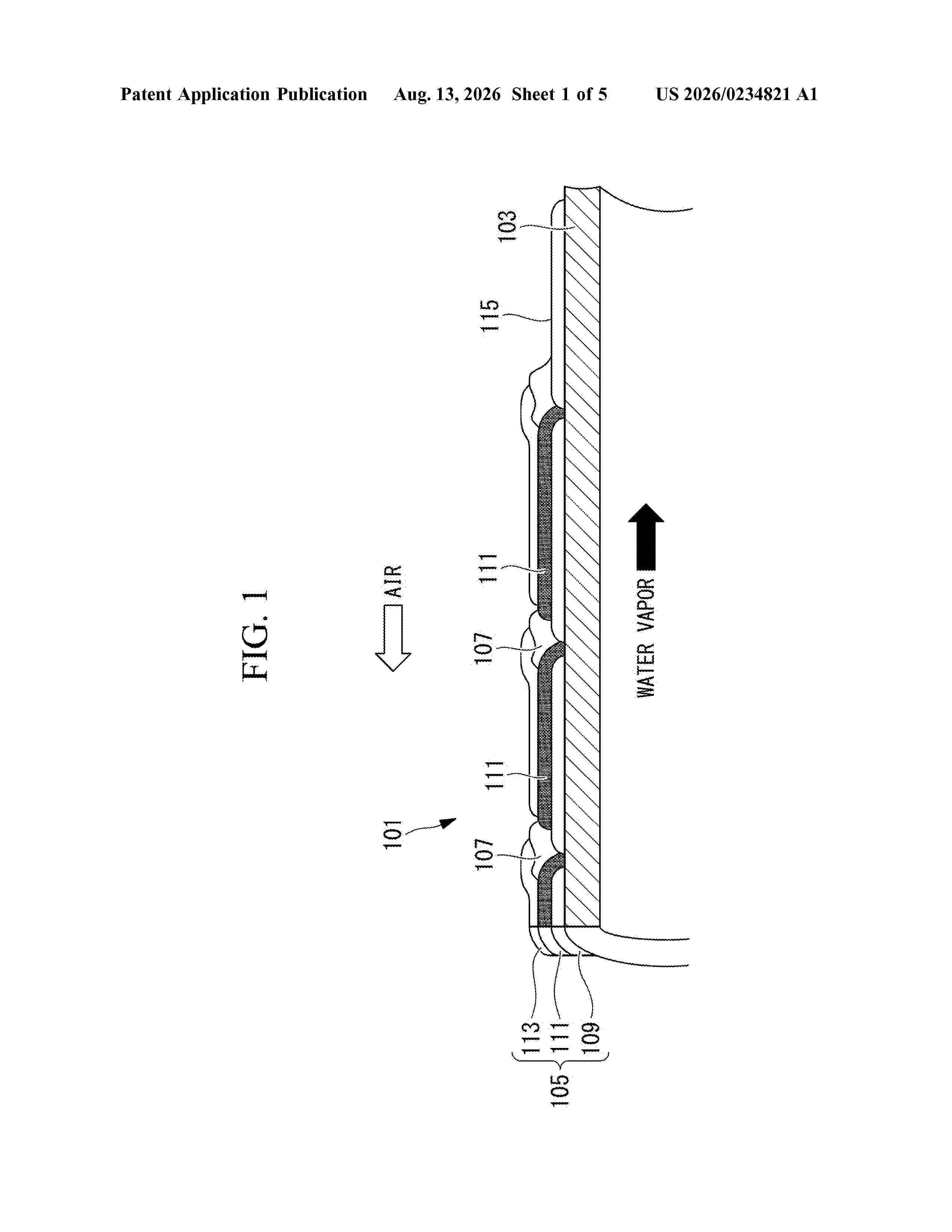
Provided is an electrolysis cell system with energy efficiency improved. An electrolysis cell system (10) includes: an electrolysis cell (11) that has an anode and a cathode and generates hydrogen on the cathode and oxygen on the anode by electrolyzing steam supplied to the cathode; a supply line (20) that supplies air that controls the temperature of the electrolysis cell (11), to the electrolysis cell (11); an exhaust line (30) through which the air exhausted from the electrolysis cell (11) flows; a circulation line (40) that guides the air exhausted to the exhaust line (30), to the supply line (20); and a supply air temperature control heat exchanger (28) that controls the temperature of the air to be supplied to the electrolysis cell (11).
Resumen de: US20260234824A1
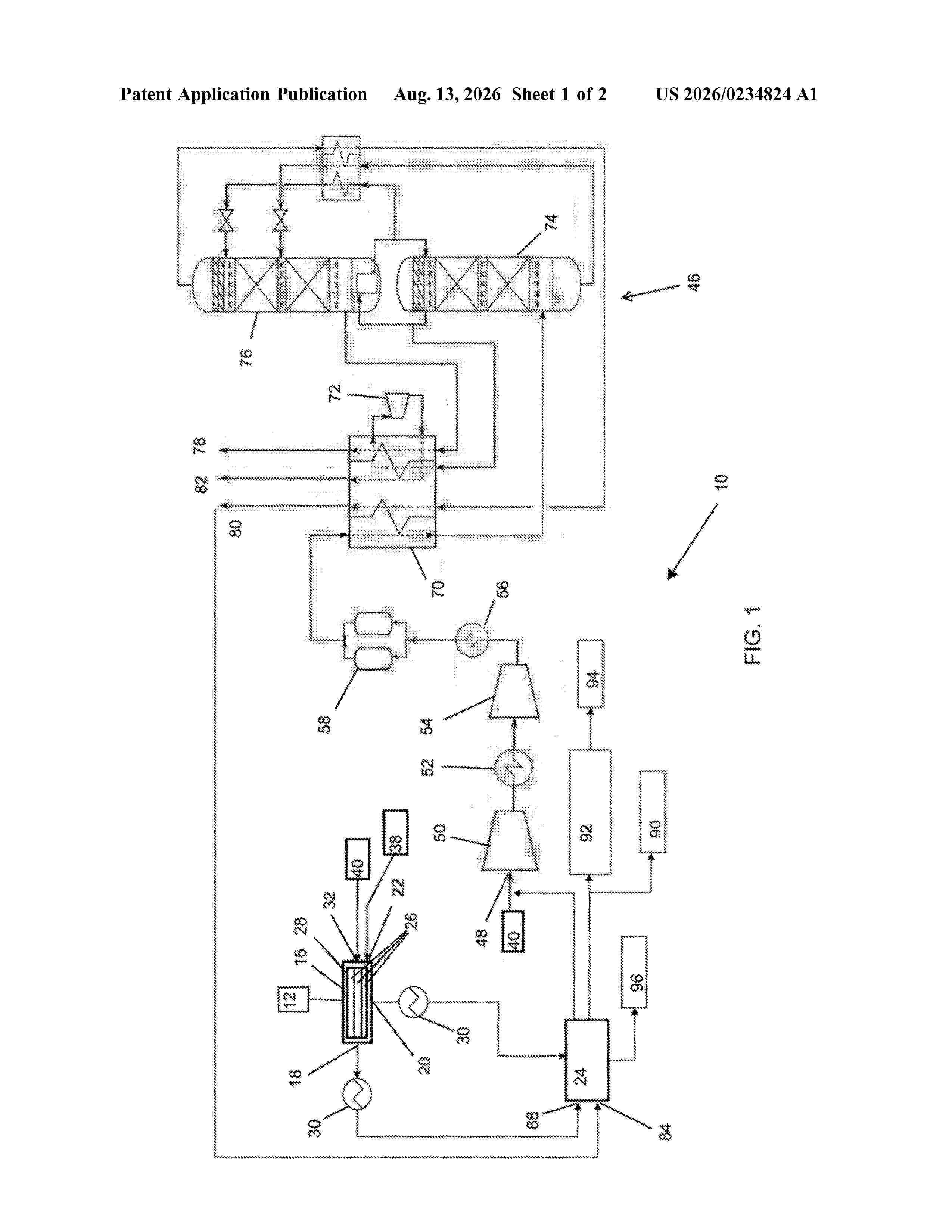
An electrolyser system (10) and a method of operating an electrolyser system (10), the electrolyser system (10) comprising an electrolyser (16) and a metal hydride or adsorption-desorption compressor (24), wherein the electrolyser (16) has at least one electrolyser cell with a steam input (22) and at least one gas output. The method comprises supplying steam through a first side of the electrolyser cell at the steam input (22), operating the electrolyser (16) to split part of the steam into hydrogen and oxygen in the at least one electrolyser cell, venting a mixture of the hydrogen and the remaining steam from the first side of the electrolyser cell at the at least one gas output (18), passing the mixture into the metal hydride or adsorption-desorption compressor (24), and cryo-adsorbing the hydrogen of the mixture in the metal hydride or adsorption-desorption compressor (24) to compress the hydrogen and desorbing the compressed hydrogen from the metal hydride or adsorption-desorption compressor (24). The electrolyser system (10) is connected
Resumen de: US20260234016A1
The present invention relates to a pyrogenic process for manufacturing metal oxides or metalloid oxides wherein a metal precursor and/or a metalloid precursor is introduced into a flame formed by burning a gas mixture comprising oxygen and hydrogen, wherein at least a part of the hydrogen has been obtained from electrolysis of water or an aqueous solution, using electrical energy, at least a part of which has been obtained from a renewable energy source, and wherein at least a part of the thermal energy of the flame is transferred to a first heat transmission medium by means of at least one exchanger, thereby heating the first heat transmission medium to a maximal temperature in the range between 8° and 150° C.
Resumen de: US20260234085A1
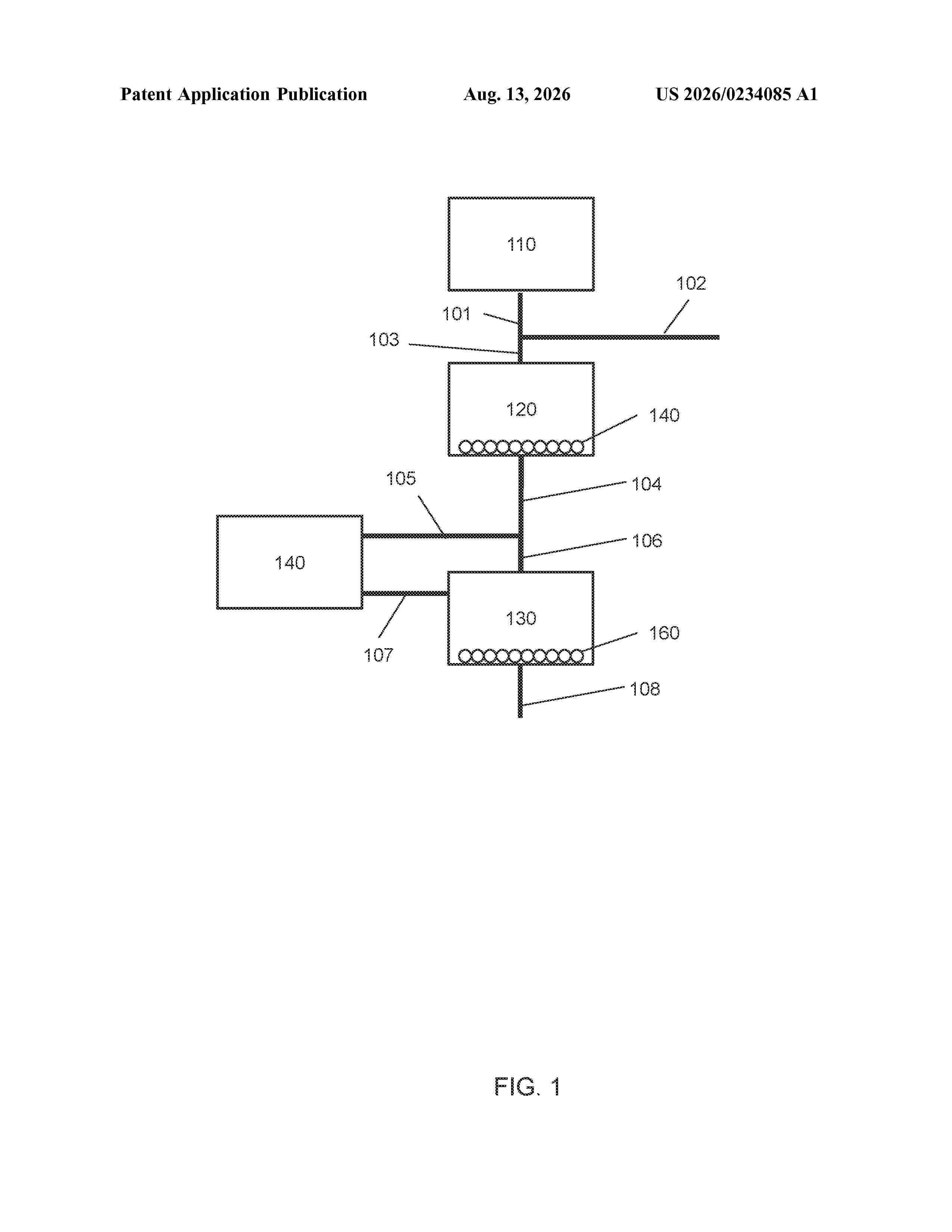
The present disclosure relates generally to integrated processes for the production, storage, and use of methanol. In one aspect, the present disclosure provides a process for producing a H2/CO stream, the process comprising for a first period of time, synthesizing methanol by hydrogenation of CO2, and decomposing a second feed stream including the methanol to form CO and H2; and for a second period of time, decomposing a third feed stream comprising stored methanol to form CO and H2. A synthesized methanol fraction of the second feed stream is substantially greater than a synthesized methanol fraction of the third feed stream.
Nº publicación: US20260234815A1 13/08/2026
Solicitante:
KOREA UNIV RESEARCH AND BUSINESS FOUNDATION [KR]
KOREA UNIVERSITY RESEARCH AND BUSINESS FOUNDATION
Resumen de: US20260234815A1
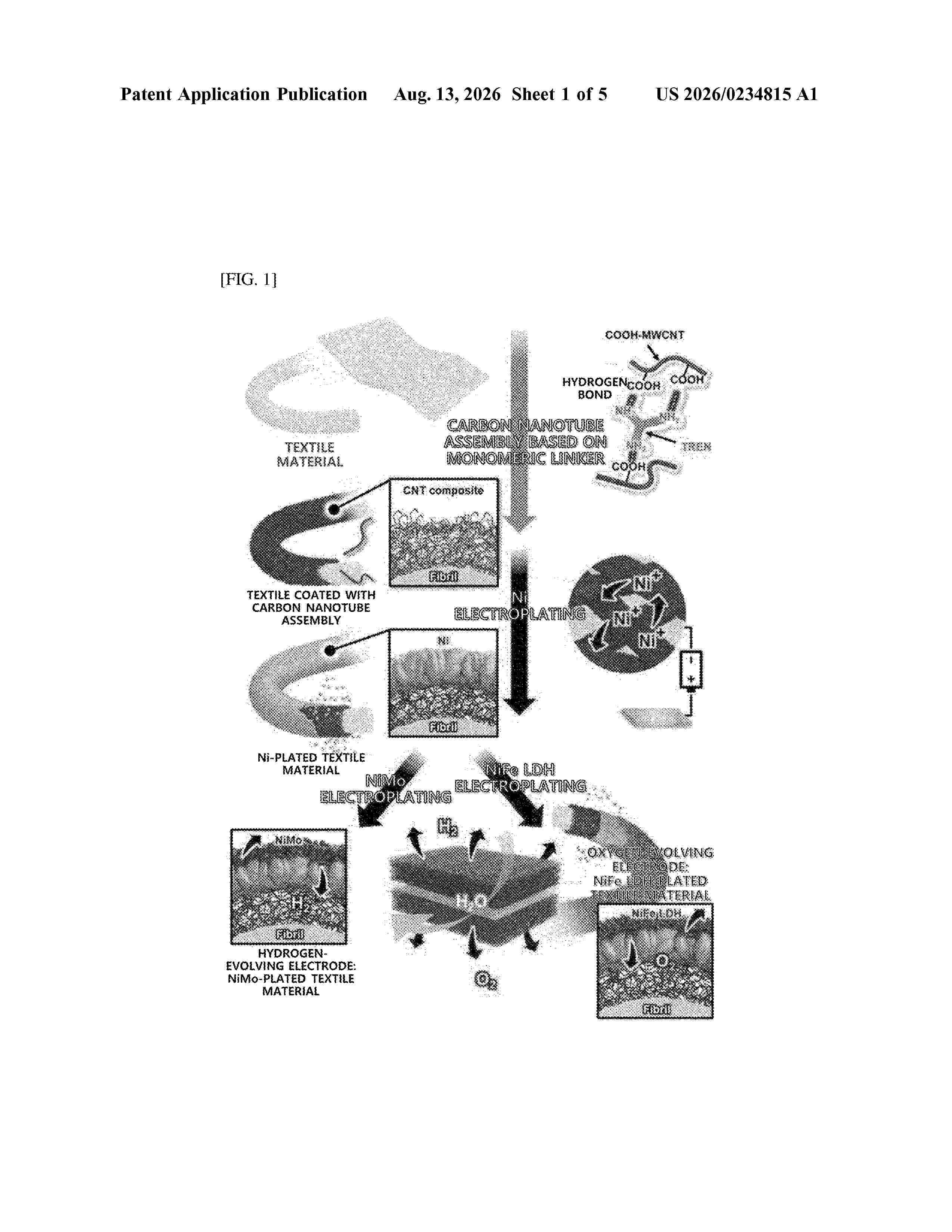
0000 The present invention relates to a porous water-splitting electrode including a support coated with a carbon nanotube assembly and a catalytic active layer formed on the coated support; a method of manufacturing the same; and a water electrolysis device including the same.
 BOPI
BOPI
 Sede Electrónica