Si deseas distinguir tus productos, servicios o ambos de los de otra empresa, es posible que necesites una marca o nombre comercial. Descubre qué son, en qué consiste su procedimiento de registro y qué implica.

Información sobre los plazos de presentación de solicitudes de transformación de marcas de la Unión Europea en marca nacional española. Más información


Si tienes un nuevo dispositivo, producto o procedimiento que resuelva un problema técnico o tenga una ventaja práctica, existen distintas formas de protegerlo en España y en otros países. Descubre cómo hacerlo.

¿Tu innovación reside en la estética, la ornamentación o la apariencia de tu producto? Protégela mediante un diseño industrial. Descubre qué derechos confiere el registro y cómo realizar la tramitación.

Las indicaciones geográficas protegen el nombre de un producto originario de una zona geográfica, a la cual le debe una determinada calidad, reputación u otra característica. Descubre qué son, en qué consiste su procedimiento de registro y qué beneficios conceden.

Las patentes publicadas en todo el mundo son una valiosa fuente de información científica, técnica y comercial.

Si eres emprendedor/a o una empresa y quieres potenciar y mejorar la rentabilidad de tu negocio protegiendo de forma adecuada los activos intangibles de tu organización, en este espacio encontrarás lo necesario.


 1422
resultados
1422
resultados
 Última actualización
28/06/2026 [07:11:00]
Última actualización
28/06/2026 [07:11:00]


 Resultados 900 a 925 de 1422

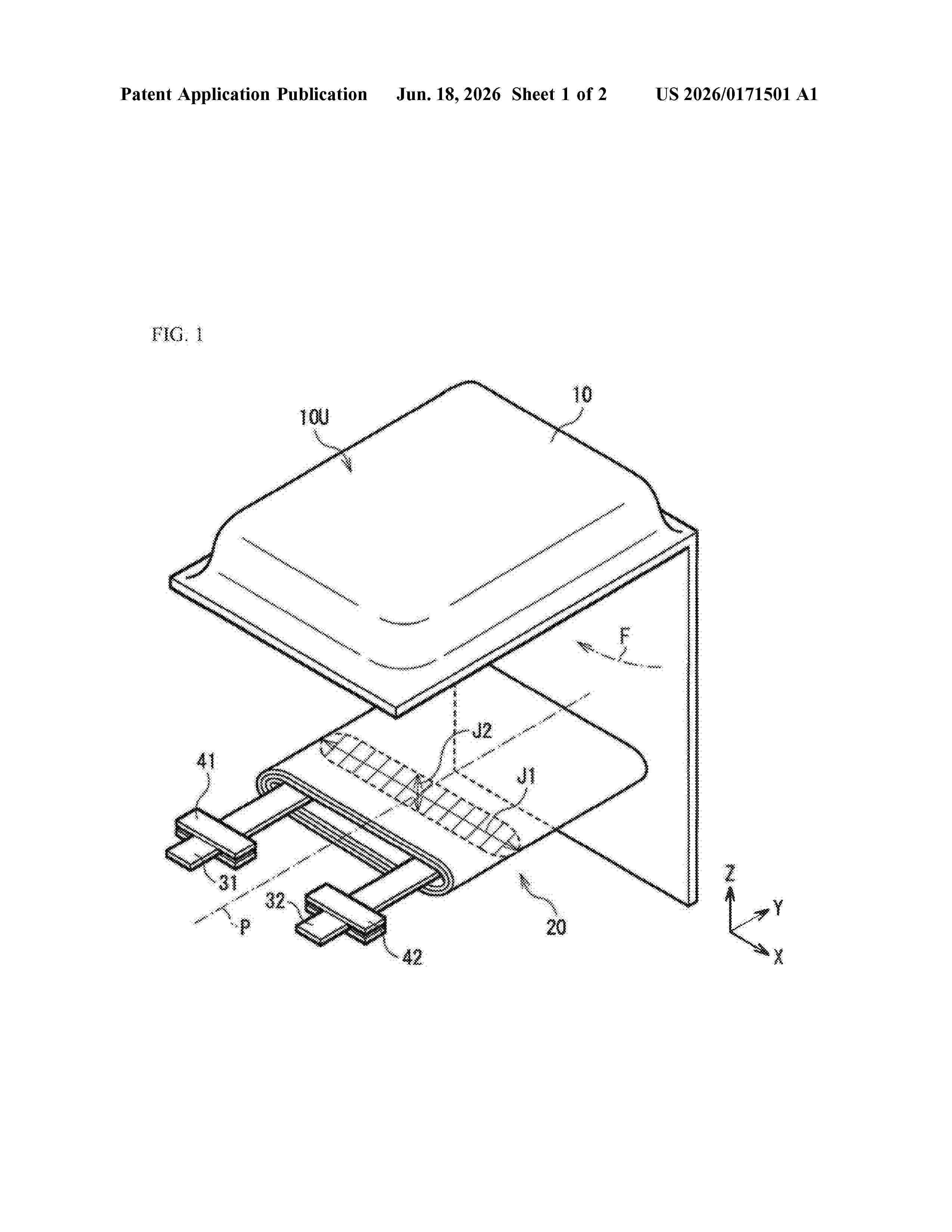
Resumen de: US20260171501A1
A secondary battery includes a positive electrode, a negative electrode, and an electrolytic solution. The electrolytic solution includes an anisole compound and a non-aqueous solvent. The anisole compound is represented by Formula (1). A molar ratio of the anisole compound to the non-aqueous solvent is 1.6 or greater.

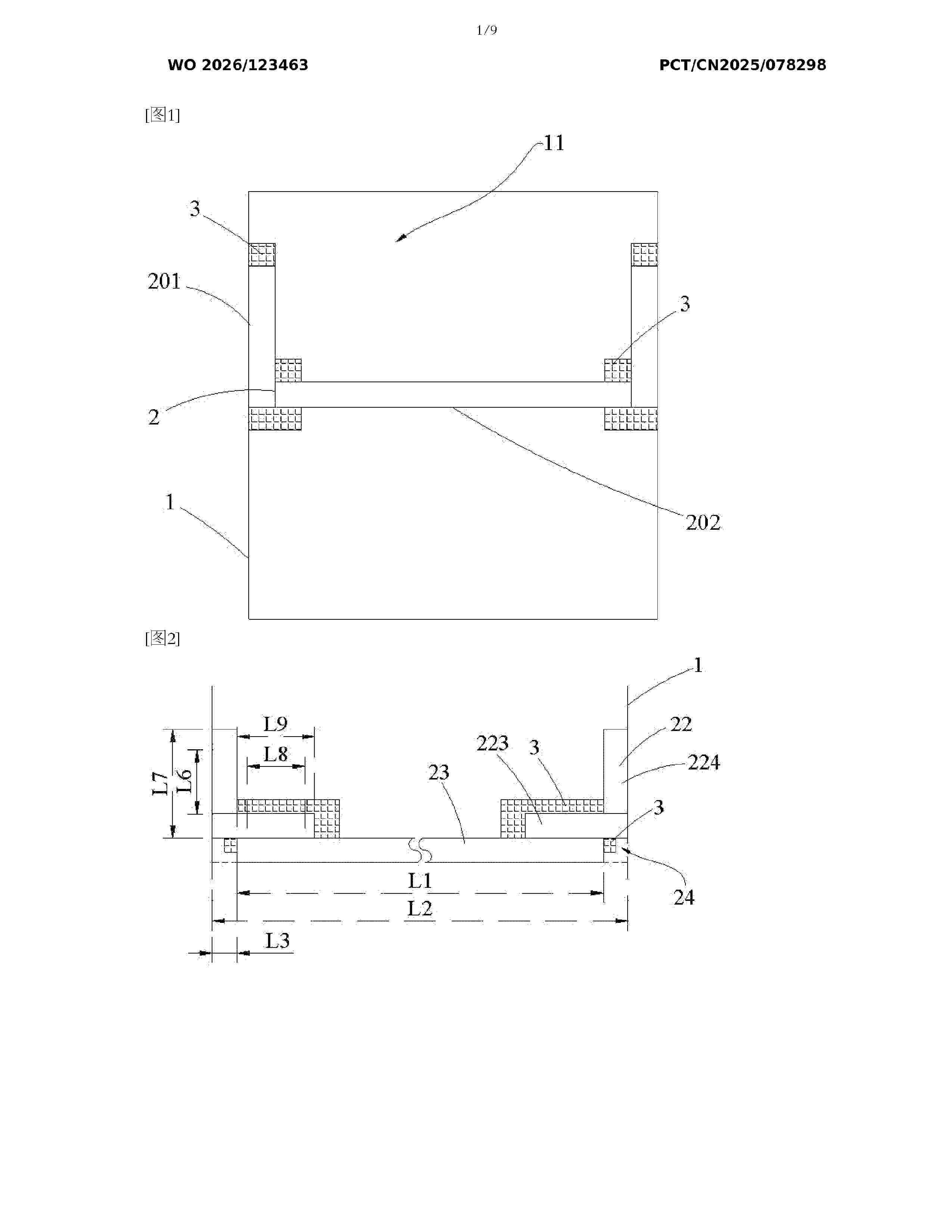
Resumen de: WO2026123463A1
Provided in the present application are a battery and an electric device. The battery comprises a connector and a packaging portion. The connector has an electrode lead-out portion configured for connection to an electrode of the battery and a tab connecting portion configured for connection to a tab of the battery. At least part of the structure of the packaging portion is arranged at the junction between the electrode lead-out portion and the tab connecting portion, and/or at least part of the structure of the packaging portion is arranged at the junction between the electrode lead-out portion and the electrode of the battery.
Resumen de: WO2026123452A1
An electrolyte solution, an electrolyte and a preparation method therefor, and a lithium-ion battery. The electrolyte solution comprises an organic solvent, a lithium salt, and a polymer monomer, wherein the polymer monomer comprises an acrylate monomer and a thioether monomer. The thioether monomer can introduce disulfide bonds into a generated solid polymer, and the disulfide bonds have dynamic reversibility, allowing the reformation of a solid polymer interface protection layer at a crack in a solid electrolyte interphase.
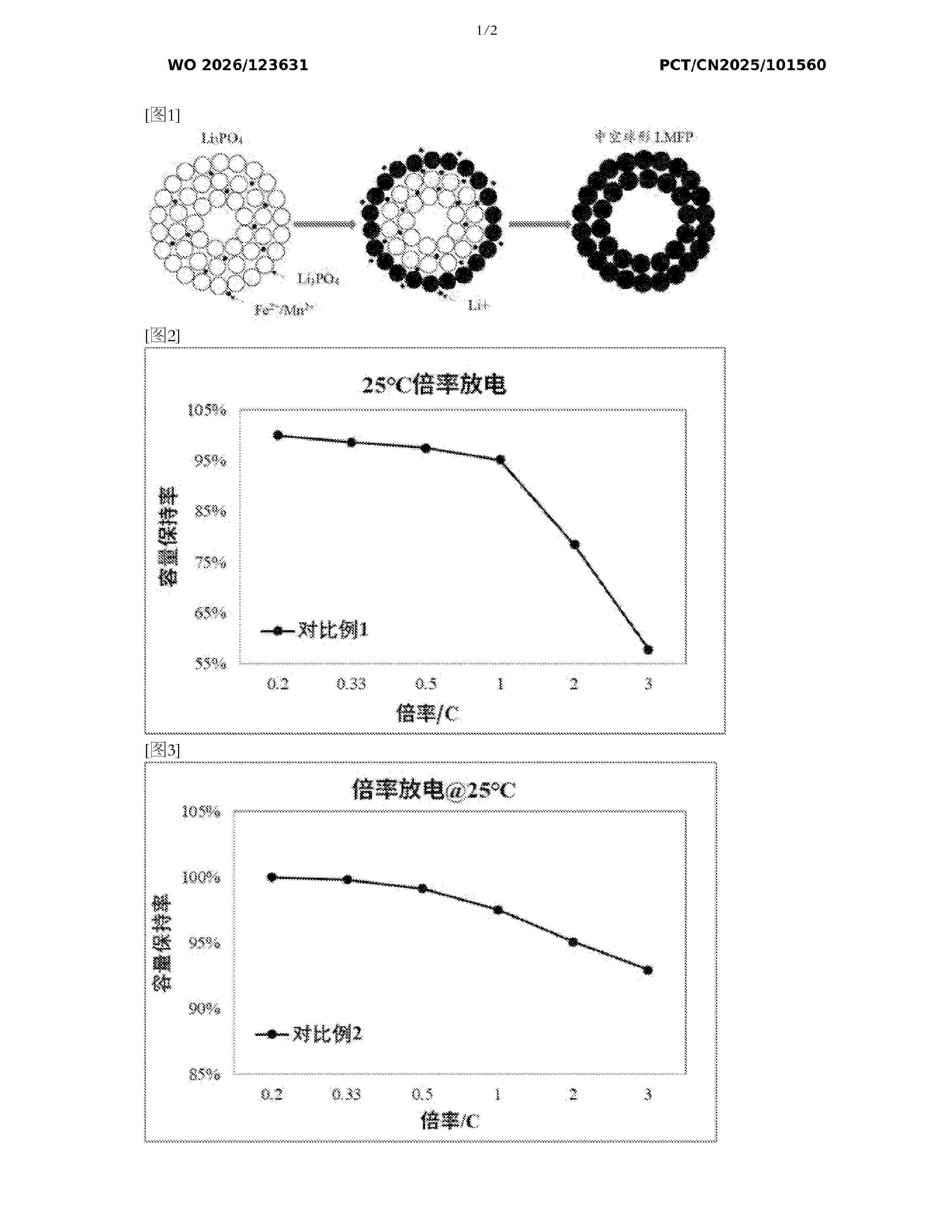
Resumen de: WO2026123631A1
The present application relates to the technical field of batteries, and provides a positive electrode active material and a preparation method therefor, a positive electrode sheet, and a battery. The positive electrode active material comprises a ternary material and lithium manganese iron phosphate, wherein the mass of lithium manganese iron phosphate is A and the total mass of the ternary material and lithium manganese iron phosphate is B, both of which satisfy: 0
Resumen de: US20260171549A1
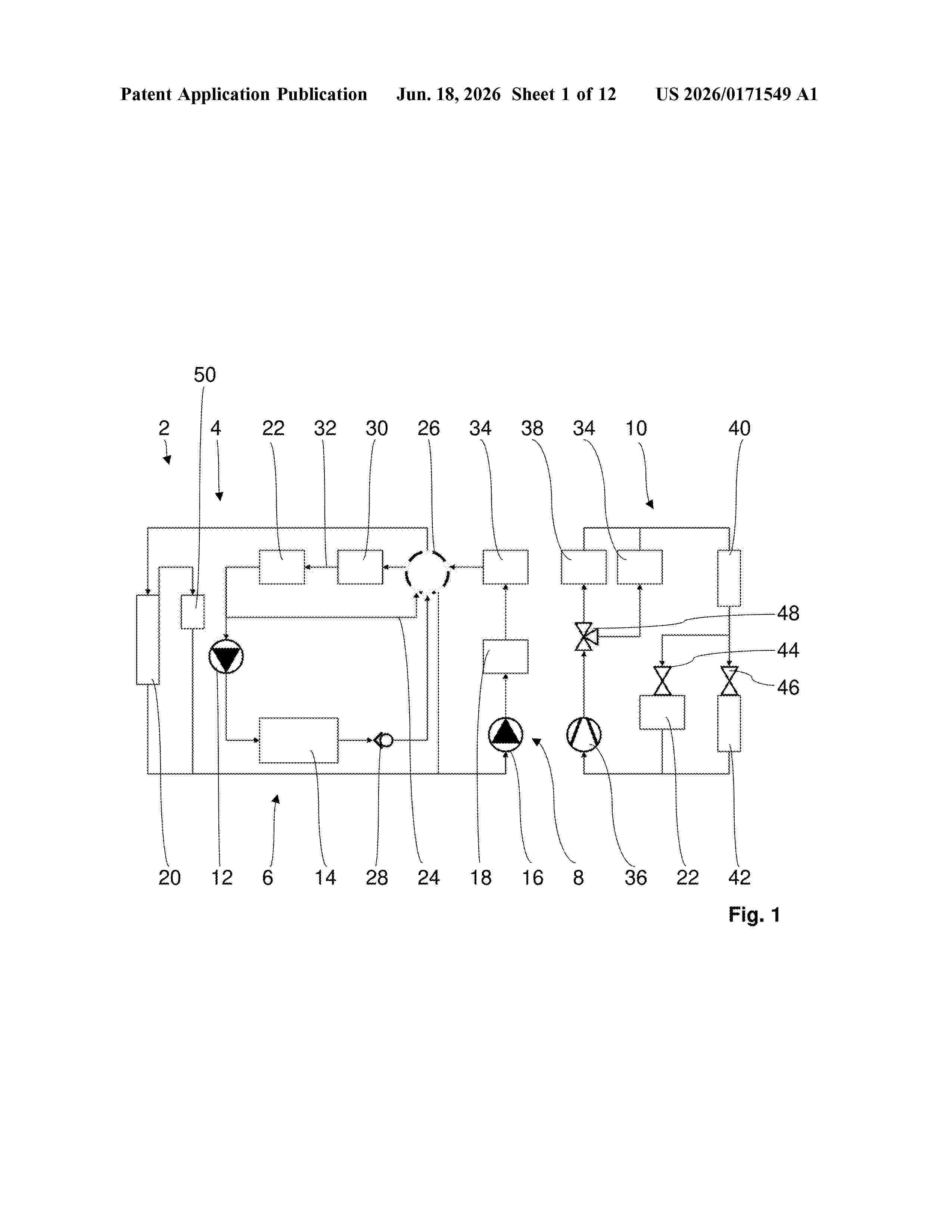
A coolant system for an electric vehicle for circulating a coolant, comprising a multiplicity of components through which the coolant can flow and can be connected to one another in terms of coolant flow via at least one valve and coolant lines. The multiplicity of components are arranged in a distributed manner in at least two coolant circuits of the coolant system that can be connected and disconnected by the at least one valve. A single expansion tank is arranged in only one of the coolant circuits. The coolant system is designed such that this coolant circuit is disconnected fluidically from at least one other coolant circuit of the at least two coolant circuits by the at least one valve, at least in one operating state of the coolant system, and, in this operating state, this other coolant circuit can be connected to the coolant circuit having the expansion tank.
Resumen de: WO2026123339A1
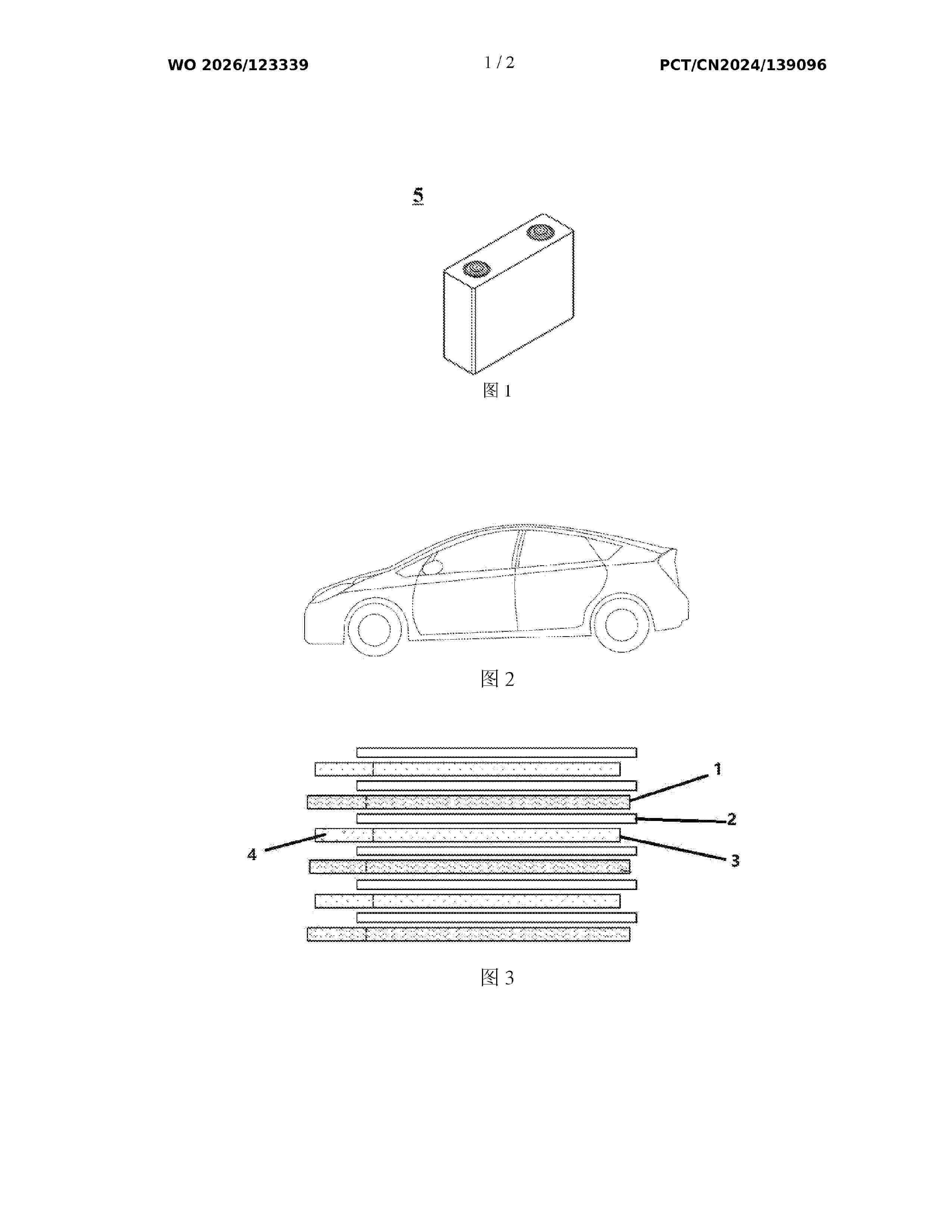
The present application discloses a battery cell, an electrolyte, a battery device, and an electrical device. The battery cell comprises a positive electrode sheet, a negative electrode sheet, and an electrolyte. The electrolyte comprises a lithium salt, a solvent, and a sulfonate ester additive. Based on the total mass of the electrolyte, a mass percentage of the solvent is 65 wt% to 85 wt%, a mass percentage of the lithium salt is 8 wt% to 15 wt%, and a mass percentage of the sulfonate additive is 0.1 wt% to 5 wt%. The solvent comprises a cyclic carbonate having a mass content of 20 wt% to 35 wt% and a linear carboxylate having a mass content of 60 wt% to 80 wt%. The lithium salt comprises a first lithium salt and a second lithium salt in a mass ratio of 1:10 to 4:1. A length of the battery cell is 200 mm to 1600 mm, a width of the battery cell is 100 mm to 500 mm, and a thickness of the battery cell is 20 mm to 80 mm. The length-to-thickness ratio of the battery cell is 5 to 150. According to the embodiments of the present application, both the high-rate charging and discharging performance and the cycle life of a battery cell can be ensured.
Resumen de: DE102025152640A1
Die vorliegende Erfindung offenbart ein Verfahren und eine Vorrichtung zur Vorhersage von Ausdehnungskräften in Batteriezellen und betrifft den Bereich der Batteriezellenprüftechnik. Das Verfahren umfasst: das Sammeln von ersten Ausdehnungskraftdaten eines bestimmten Batterietyps innerhalb eines vordefinierten Gesundheitsbereichs; das Aufstellen einer ersten linearen Regressionsgleichung für den bestimmten Batterietyp auf der Grundlage der ersten Ausdehnungskraftdaten und der im vordefinierten Gesundheitsbereich enthaltenen Gesundheitszustandsdaten; und das Vorhersagen der Ausdehnungskraftdaten über den gesamten Lebenszyklus des bestimmten Batterietyps auf der Grundlage der ersten linearen Regressionsgleichung, die dem bestimmten Batterietyp entspricht, um Designreferenzdaten für Batteriemodule bereitzustellen, die den bestimmten Batterietyp verwenden. Diese Implementierungsmethode kann den Prozess der Erfassung von Daten zur vollständigen Ausdehnungskraft über den gesamten Lebenszyklus vereinfachen und die Erfassungszeit verkürzen.
Resumen de: WO2026123398A1
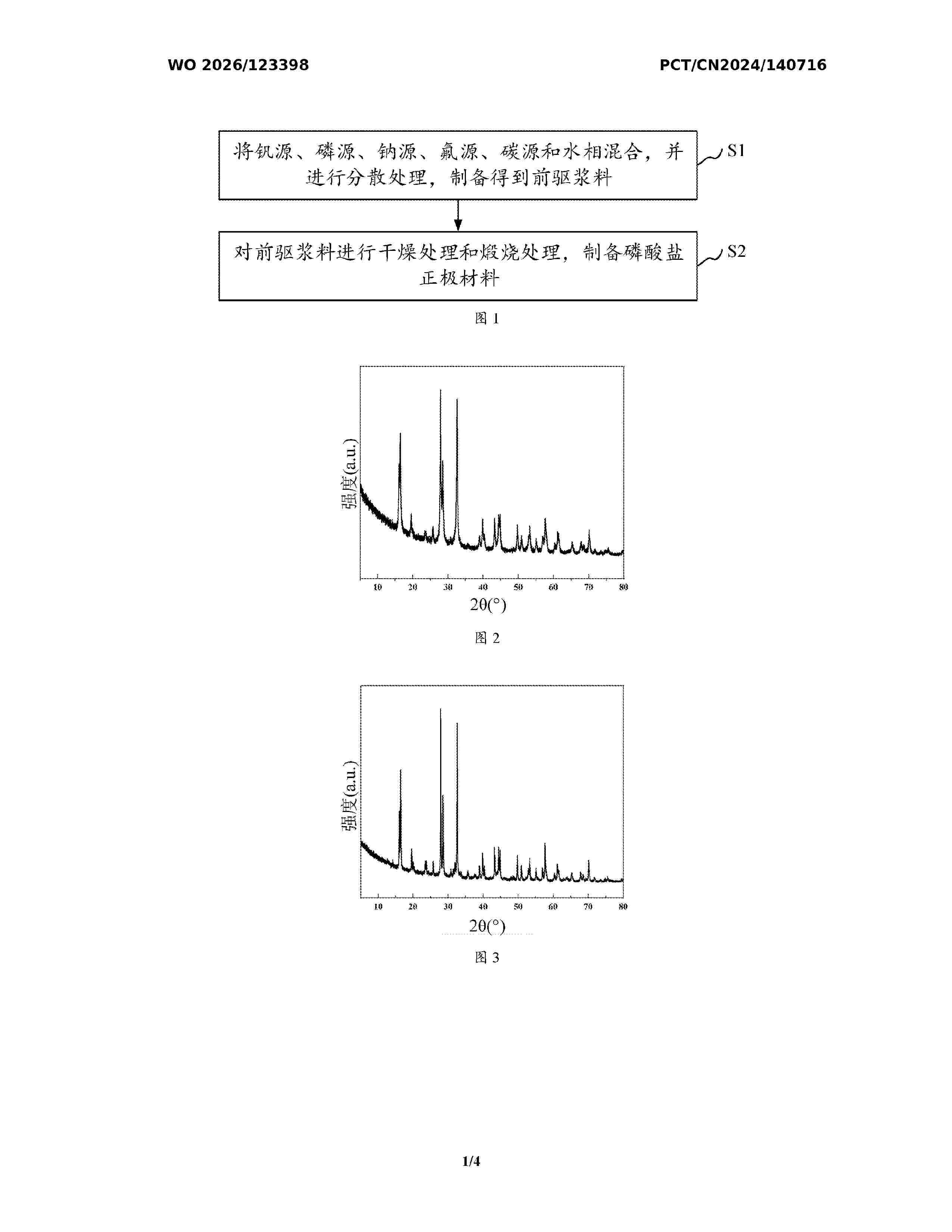
The present application relates to the field of battery materials, and provides a phosphate positive electrode material and a preparation method therefor, a positive electrode sheet, and a secondary battery. The phosphate positive electrode material comprises an inner core and a carbon layer coating the inner core. The inner core comprises a sodium vanadium fluorophosphate material. The compaction density of the phosphate positive electrode material is greater than or equal to 1.78 g/cm3, and the BET specific surface area thereof is greater than or equal to 9 m3/g. The Raman spectrum of the phosphate positive electrode material has a D peak and a G peak, and the intensity ratio of the D peak to the G peak is (1.03-1.05):1. In the present application, the provided phosphate positive electrode material uses a sodium vanadium fluorophosphate material having a high working voltage as an inner core, and the inner core is coated with a carbon layer having a high crystallinity, which not only provides the phosphate positive electrode material with better electron conductivity and structural stability, but also improves the compaction density and BET specific surface area thereof, thereby facilitating the preparation of a secondary battery having high energy density.
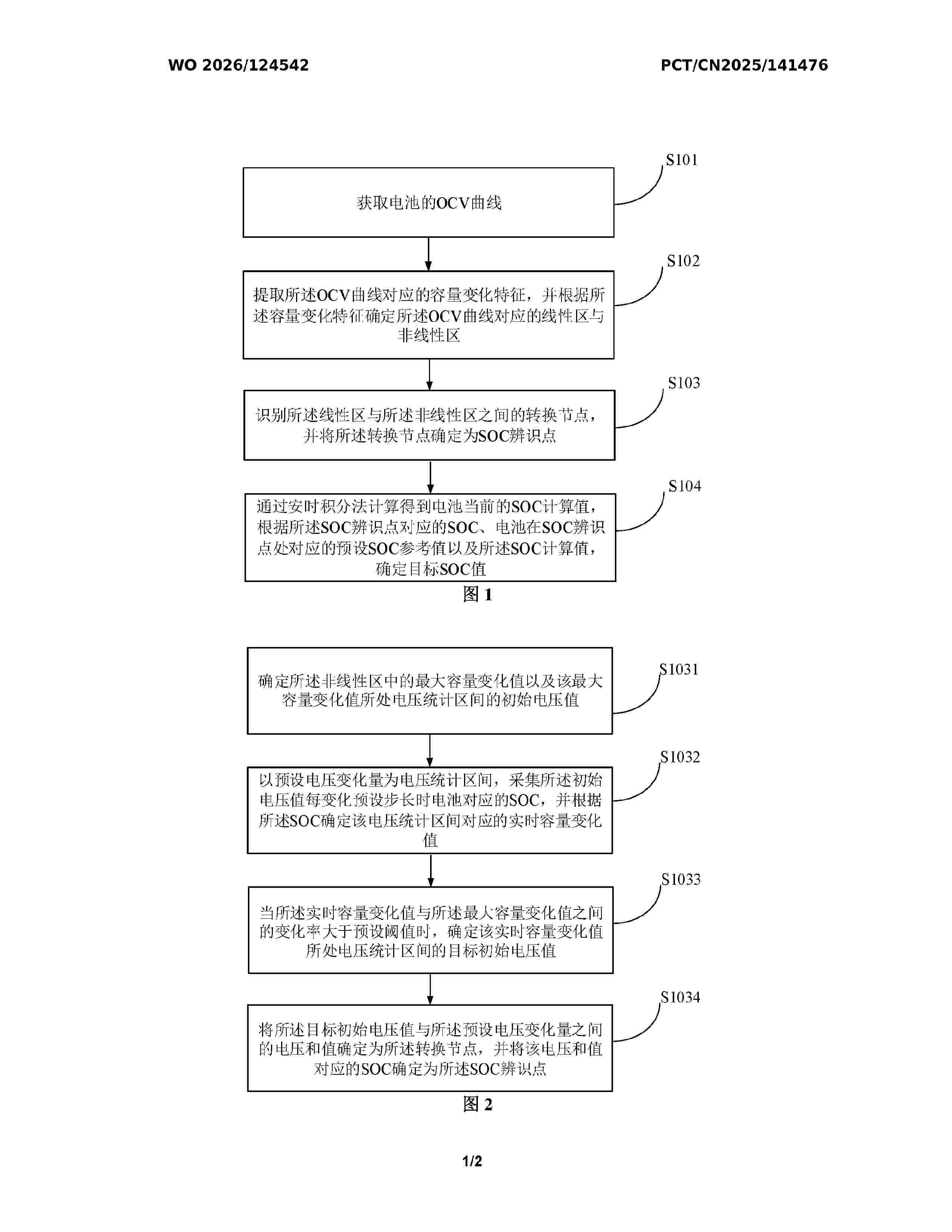
Resumen de: WO2026124542A1
A method and apparatus for determining a battery SOC, and an electronic device. The method comprises: acquiring an OCV curve of a battery; extracting a capacity variation feature corresponding to the OCV curve, and on the basis of the capacity variation feature, determining a linear region and a non-linear region which correspond to the OCV curve; identifying a conversion node between the linear region and the non-linear region, and determining the conversion node as an SOC identification point; and determining the current calculated SOC value of the battery, and determining a target SOC value on the basis of an SOC corresponding to the SOC identification point, a preset SOC reference value, and the calculated SOC value.
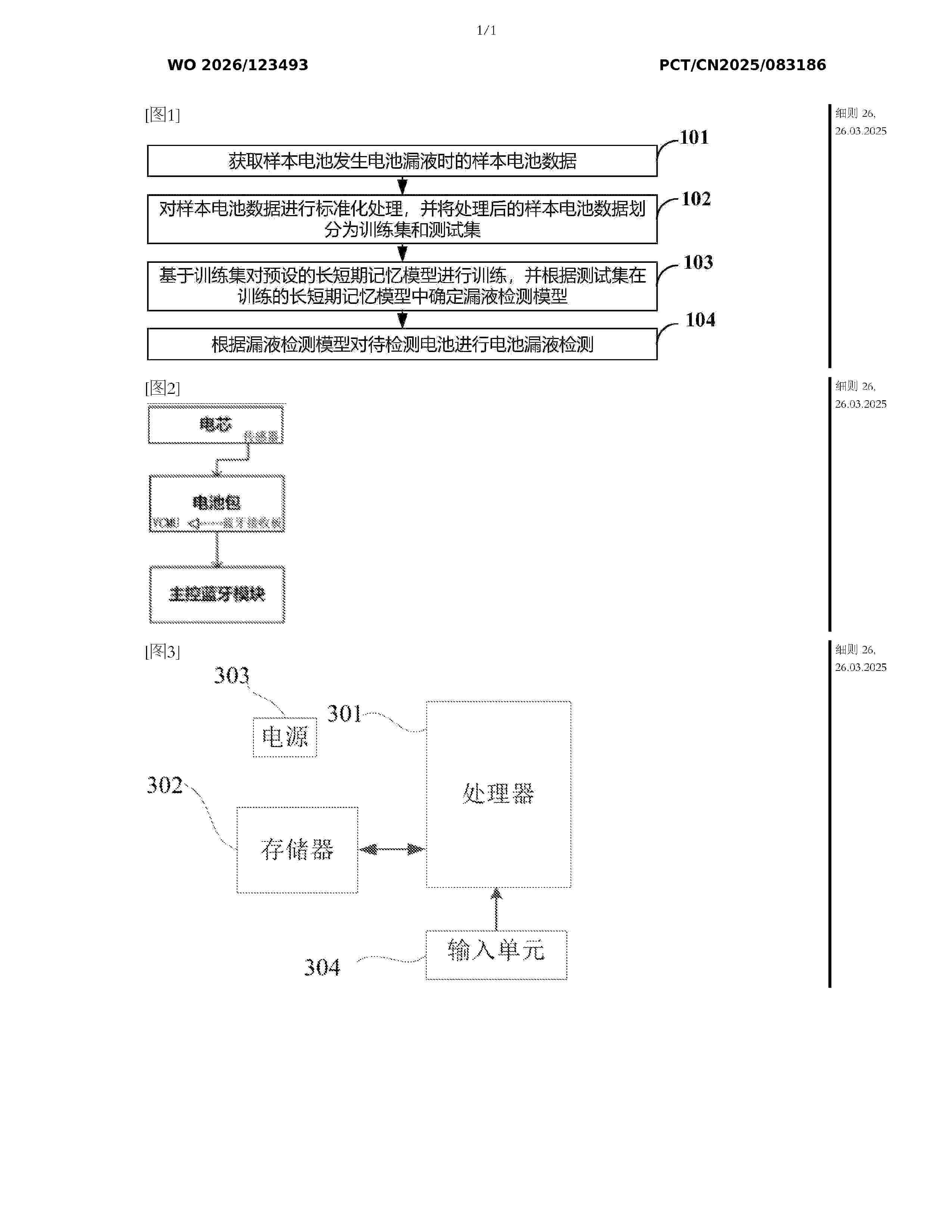
Resumen de: WO2026123493A1
The present application discloses a battery liquid leakage detection method, an electronic device, and a storage medium. The method comprises: acquiring sample battery data when battery liquid leakage occurs in a sample battery; performing standardization processing on the sample battery data, and dividing the processed sample battery data into a training set and a test set; on the basis of the training set, training a preset long short-term memory model, and, on the basis of the test set, determining a liquid leakage detection model in the trained long short-term memory model; and, on the basis of the liquid leakage detection model, performing battery liquid leakage detection on a battery under test. The described solution can improve the timeliness of battery liquid leakage detection.
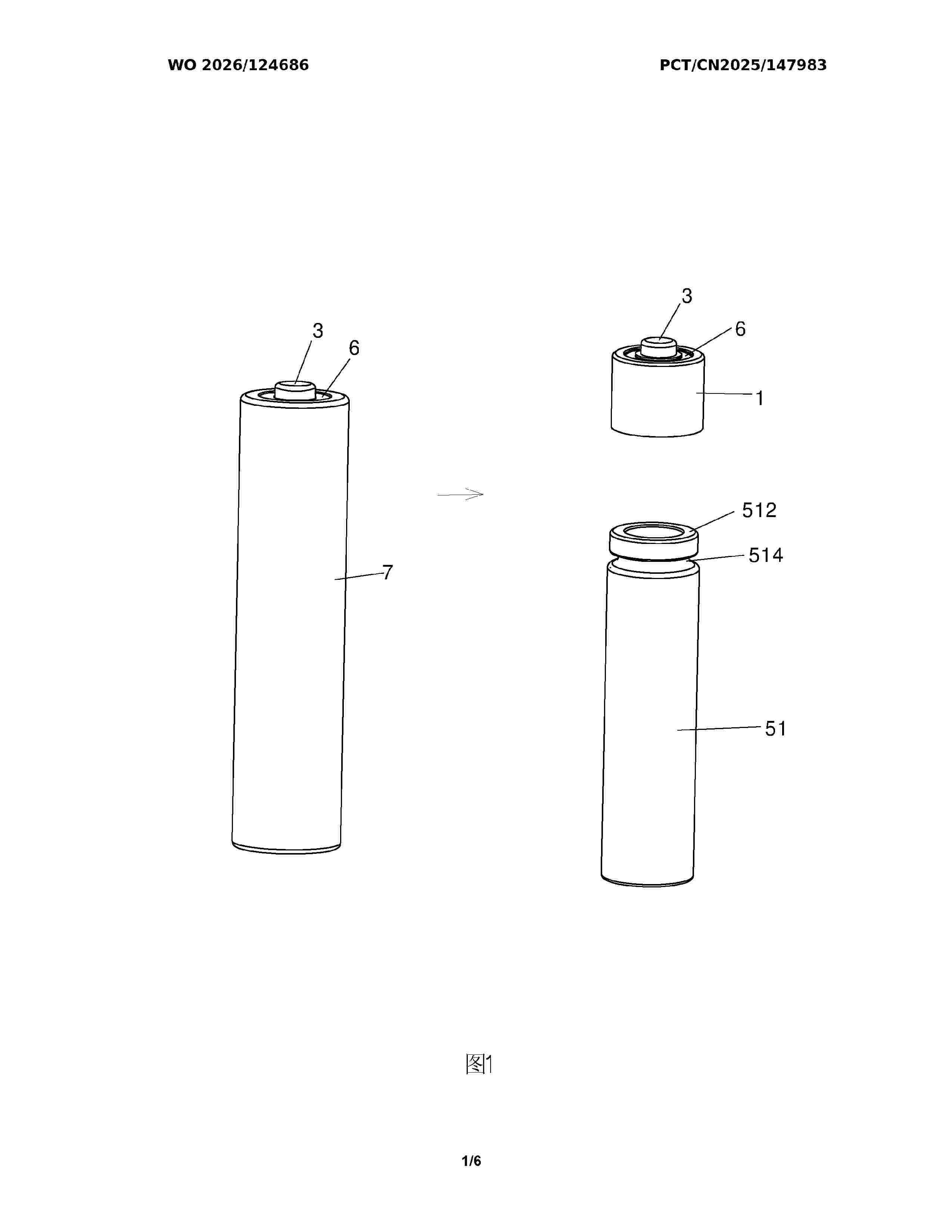
Resumen de: WO2026124686A1
The present application relates to the technical field of lithium batteries. Disclosed are a charging-port-free rechargeable lithium battery and a manufacturing method therefor. The lithium battery comprises a first negative metal housing, a voltage adjustment circuit board, a low-voltage positive cap, a high-voltage positive connector, a lithium battery cell, a low-voltage positive and negative insulating separator and an insulating housing. A first flange is provided inwards at the upper end of the first negative metal housing; a negative copper ring and a positive copper ring are provided on the upper surface of the voltage adjustment circuit board; the voltage adjustment circuit board is welded to the inner side of the first flange on the first negative metal housing by means of the negative copper ring; and the high-voltage positive connector is arranged on the inner surface of the voltage adjustment circuit board. The lithium battery in the present application can stably output a low voltage, and the voltage adjustment circuit board is welded to the inner side of the first flange, such that the electrical connection performance is very reliable, and sealing is achieved by means of solder; there is no need to provide an insulating support below the voltage adjustment circuit board for support, thereby omitting the insulating support, and reducing a height space occupied by the voltage adjustment circuit board; and the capacity of the lithium battery cell is increased by
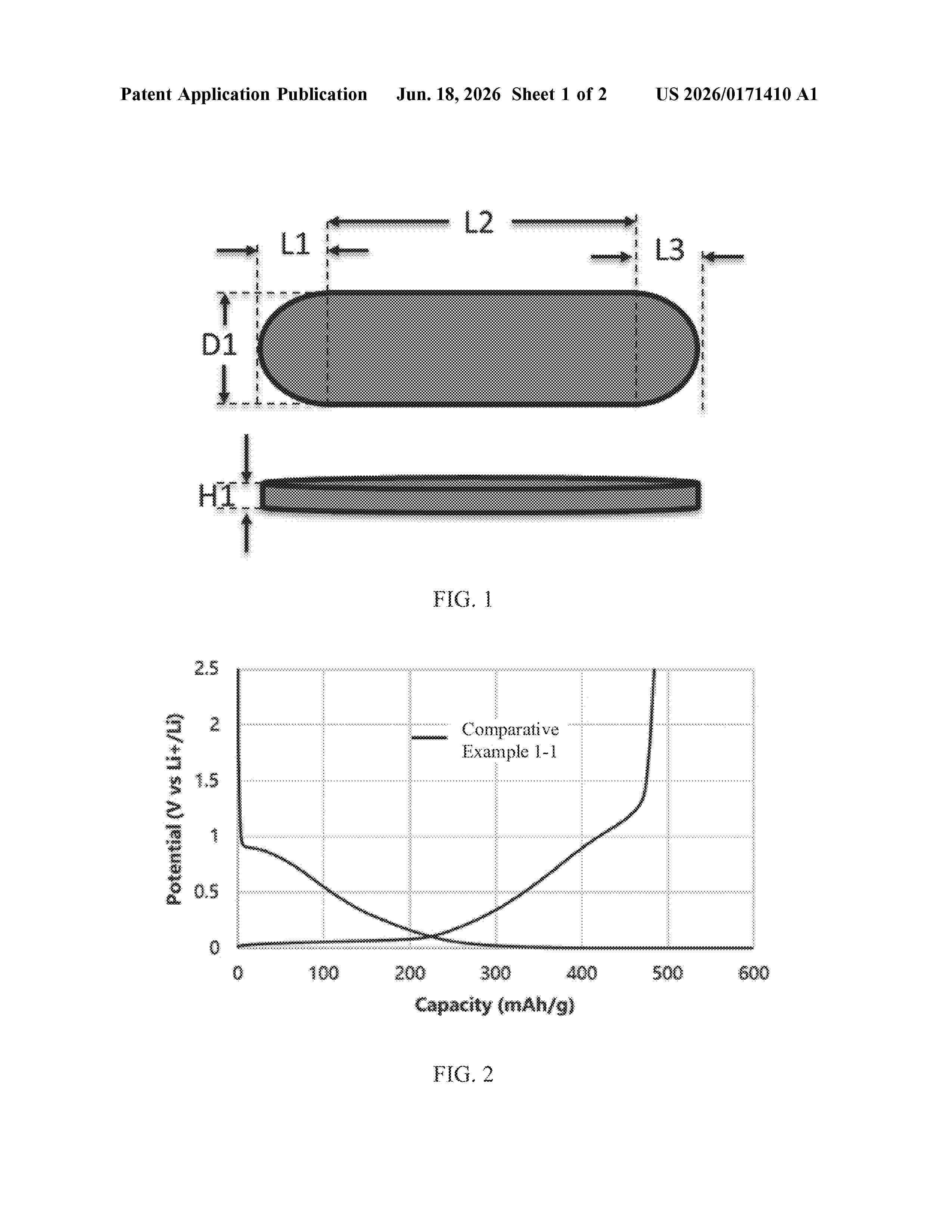
Resumen de: US20260171410A1
A hard carbon material has a flake-like structure, where a length of the flake-like structure is denoted as L, and a width of the flake-like structure is denoted as D1, where L satisfies: 2 μm≤L≤16 μm; and D1 satisfies: 0.1 μm≤D1≤3 μm. The hard carbon material can have good contact between particles thereof, better processing performance, and a higher gram capacity, thereby further increasing the compacted density of the battery electrode plate, reducing electrode plate resistance, and improving the energy density of the secondary battery while improving the rate performance, and cycling performance of the secondary battery.
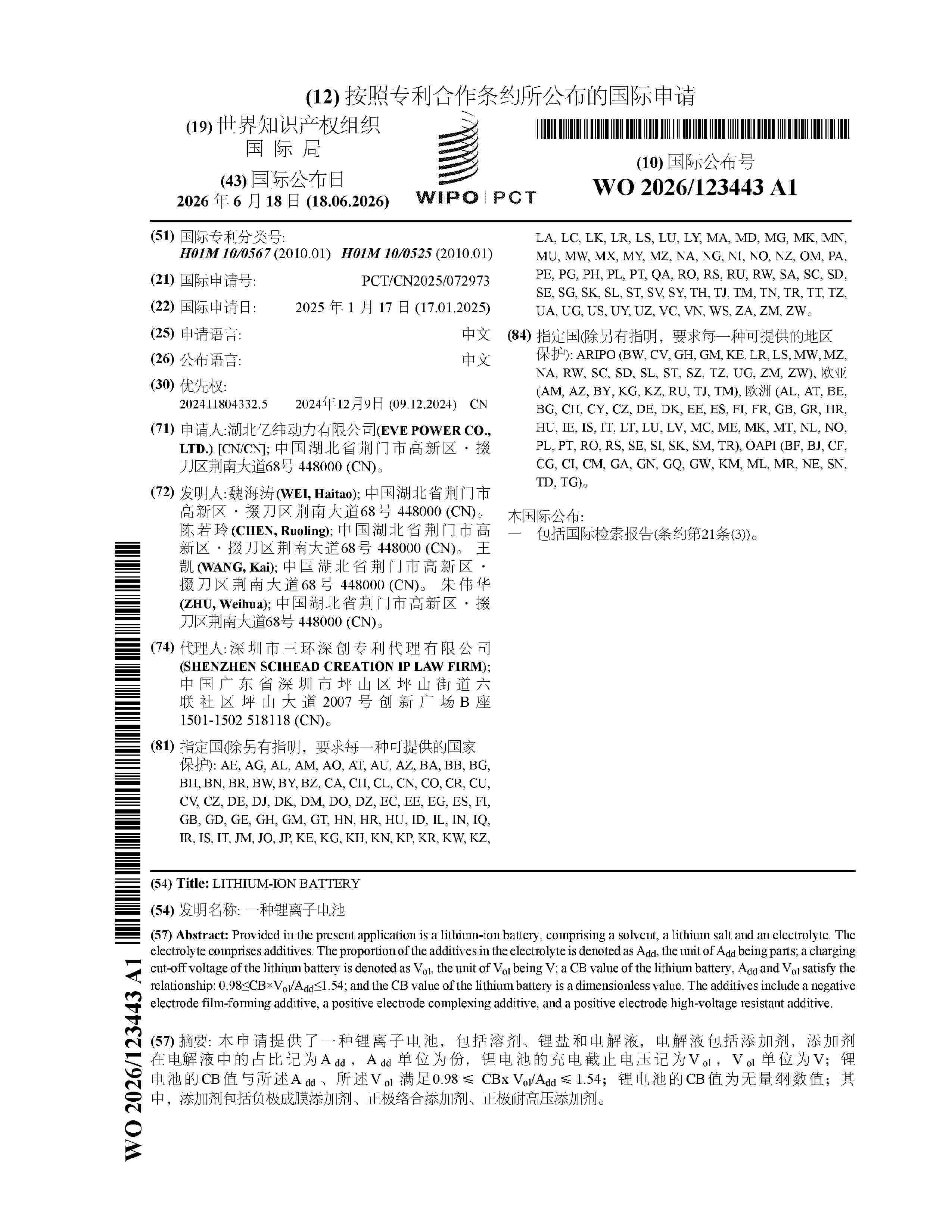
Resumen de: WO2026123443A1
Provided in the present application is a lithium-ion battery, comprising a solvent, a lithium salt and an electrolyte. The electrolyte comprises additives. The proportion of the additives in the electrolyte is denoted as Add, the unit of Add being parts; a charging cut-off voltage of the lithium battery is denoted as Vol, the unit of Vol being V; a CB value of the lithium battery, Add and Vol satisfy the relationship: 0.98≤CB×Vol/Add≤1.54; and the CB value of the lithium battery is a dimensionless value. The additives include a negative electrode film-forming additive, a positive electrode complexing additive, and a positive electrode high-voltage resistant additive.
Resumen de: AU2024385690A1
An all-solid-state battery negative electrode layer according to one embodiment of the present invention includes a negative electrode active material and a solid electrolyte. The negative electrode active material is a silicon-based material, and the solid electrolyte is a boron cluster-type solid electrolyte.
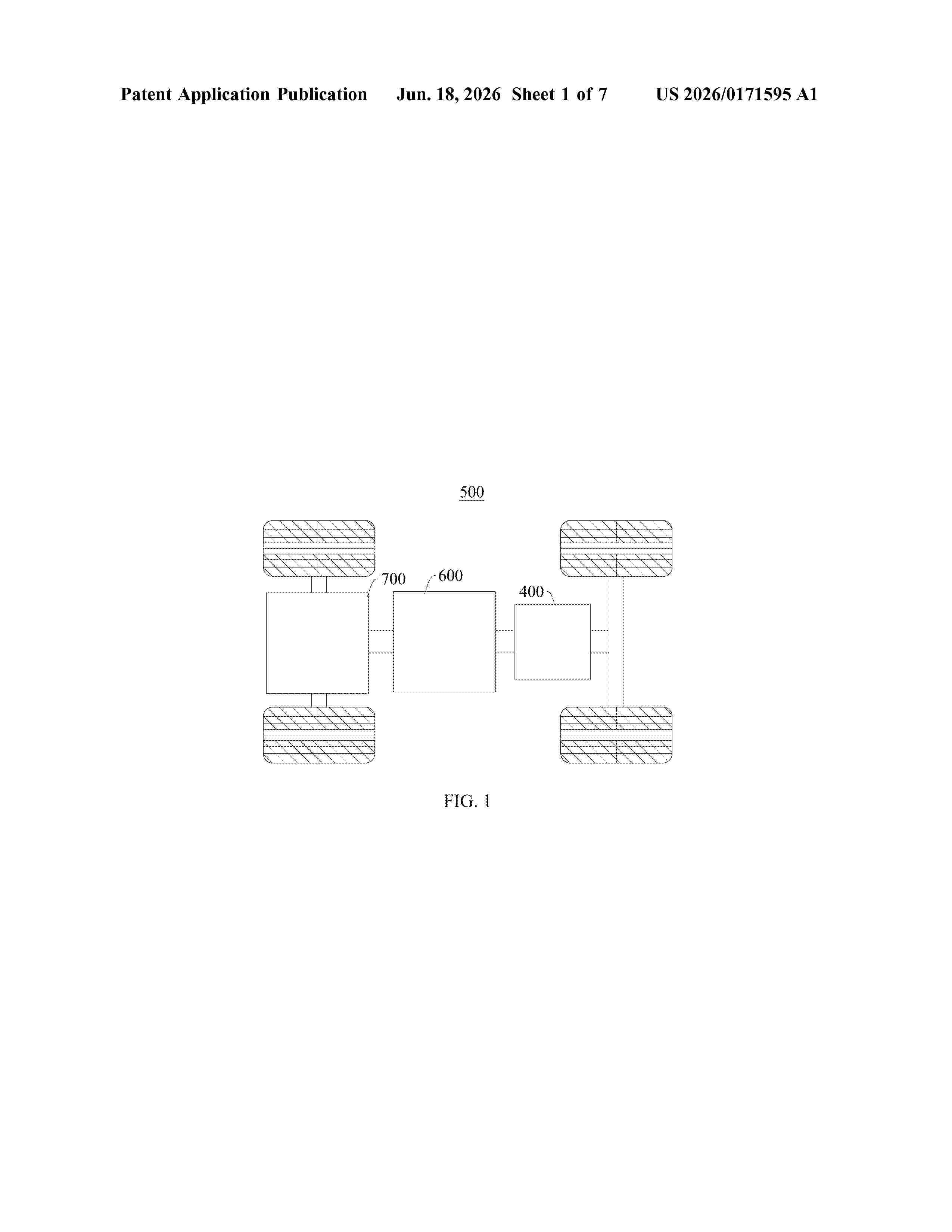
Resumen de: US20260171595A1
A battery cell, a battery, and an electric device. The battery cell comprises: an electrode assembly comprising a positive electrode sheet and a negative electrode sheet, the positive electrode sheet and the negative electrode sheet form a flat region; and a housing comprising a first wall portion and two second wall portions, the two second wall portions being respectively located on two sides of the flat region in a first direction. The first wall portion comprises a shell body and a pressure relief portion, wherein the shell body is arranged around the periphery of the pressure relief portion, a notch groove is formed in the pressure relief portion and has a first groove wall section obliquely extending in the first direction on a bottom wall thereof, and the first groove wall section is at an angle to the first direction.
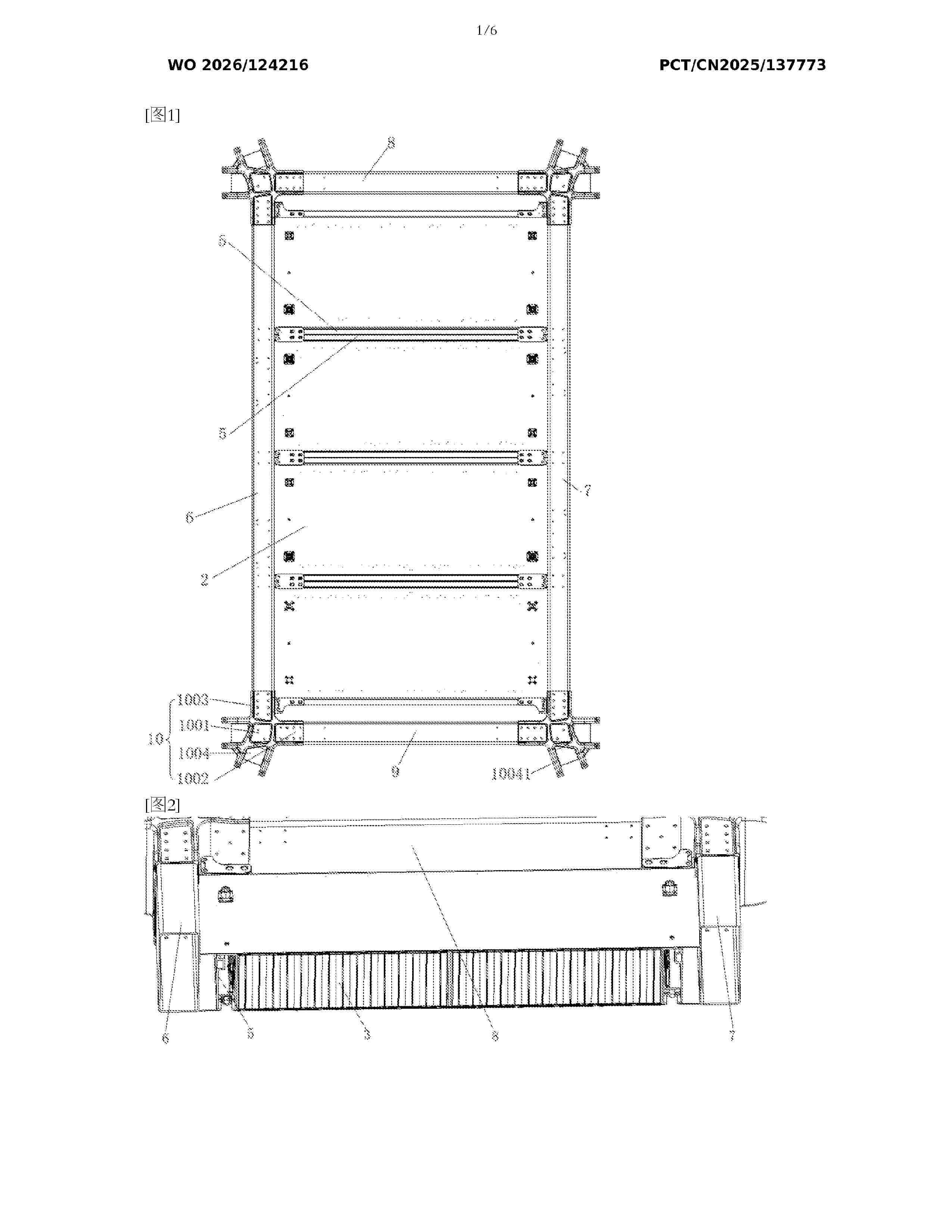
Resumen de: WO2026124216A1
The present invention relates to the technical field of aircrafts, and provides an aircraft fuselage module, comprising a frame, bottom plate modules (1), cover plates (2) and batteries (3). The bottom plate modules (1) and the cover plates (2) are located on the inner side of the frame, and are connected to the frame to form cavities (4). The batteries (3) are arranged in the cavities (4), and are used for supplying power to an aircraft. The batteries (3) are integrated with a fuselage. The frame, the bottom plate modules, and the cover plates serve as both a load-bearing structure for the fuselage and a load-bearing structure for the batteries (3), are conducive to reducing the overall weight of the aircraft to realize light weight, and can provide higher fuselage rigidity and strength for the aircraft and the batteries (3), and help to solve the problem of thermal runaway of the aircraft. In the aircraft, several airframe modules (13) are connected to the fuselage module to form an aircraft body, thereby realizing modular assembly. At the end of the service life of the batteries (3) of the aircraft, the fuselage module can be rapidly replaced to realize the replacement of a new aircraft body and new batteries (3); alternatively, during operation, rapid replacement of the fuselage structure of the batteries (3) can be achieved to realize efficient operation, thereby providing an efficient design for later maintenance, after-sales service, and operation.
Resumen de: WO2026123909A1
An electrolyte for a lithium-ion battery and a preparation method therefor, and a lithium-ion battery. The electrolyte comprises an organic solvent, a lithium salt, and a functional additive. The functional additive comprises an additive A. The lithium salt comprises a lithium salt B. The lithium salt B is selected from one or more of lithium bis(trifluoromethanesulfonyl)imide, lithium bis(fluorosulfonyl)imide, lithium bis(oxalato)borate, lithium difluoro(oxalato)borate, lithium difluorobis(oxalato)phosphate, lithium trifluoromethanesulfonate, and lithium 4,5-dicyano-2-(trifluoromethyl)imidazole. The additive A can be oxidized to form a film on a surface of the positive electrode, thereby stabilizing the crystal structure of the positive electrode and improving high-temperature cycling performance. Compared with conventional lithium salts, the lithium salt B has an anionic group with a larger radius, which weakens the binding capacity for lithium ions, improves the dissociation capacity of the lithium salt, and increases the conductivity of the electrolyte, thereby improving low-temperature discharge power performance.
Resumen de: WO2026123410A1
Disclosed in the present invention are a negative electrode sheet and a secondary battery. The negative electrode sheet comprises a negative electrode current collector and a negative electrode active material layer coated on at least one surface of the negative electrode current collector, wherein the negative electrode current collector is a porous current collector, and the negative electrode active material layer comprises silicon and a carbon material. Within an area of 250 μm*150 μm, parameters of the negative electrode sheet as characterized by EDS scanning satisfies the relationship: 5%≤Cu/(Si+C)≤30%. In the present invention, by controlling the mass proportion of carbon, silicon, and copper elements in the negative electrode sheet to satisfy the relationship 5%≤Cu/(Si+C)≤30%, the porosity and liquid retention coefficient of the negative electrode sheet is controlled within set ranges, thereby solving the problem of balancing energy density and cycling performance while ensuring consistency of liquid retention.
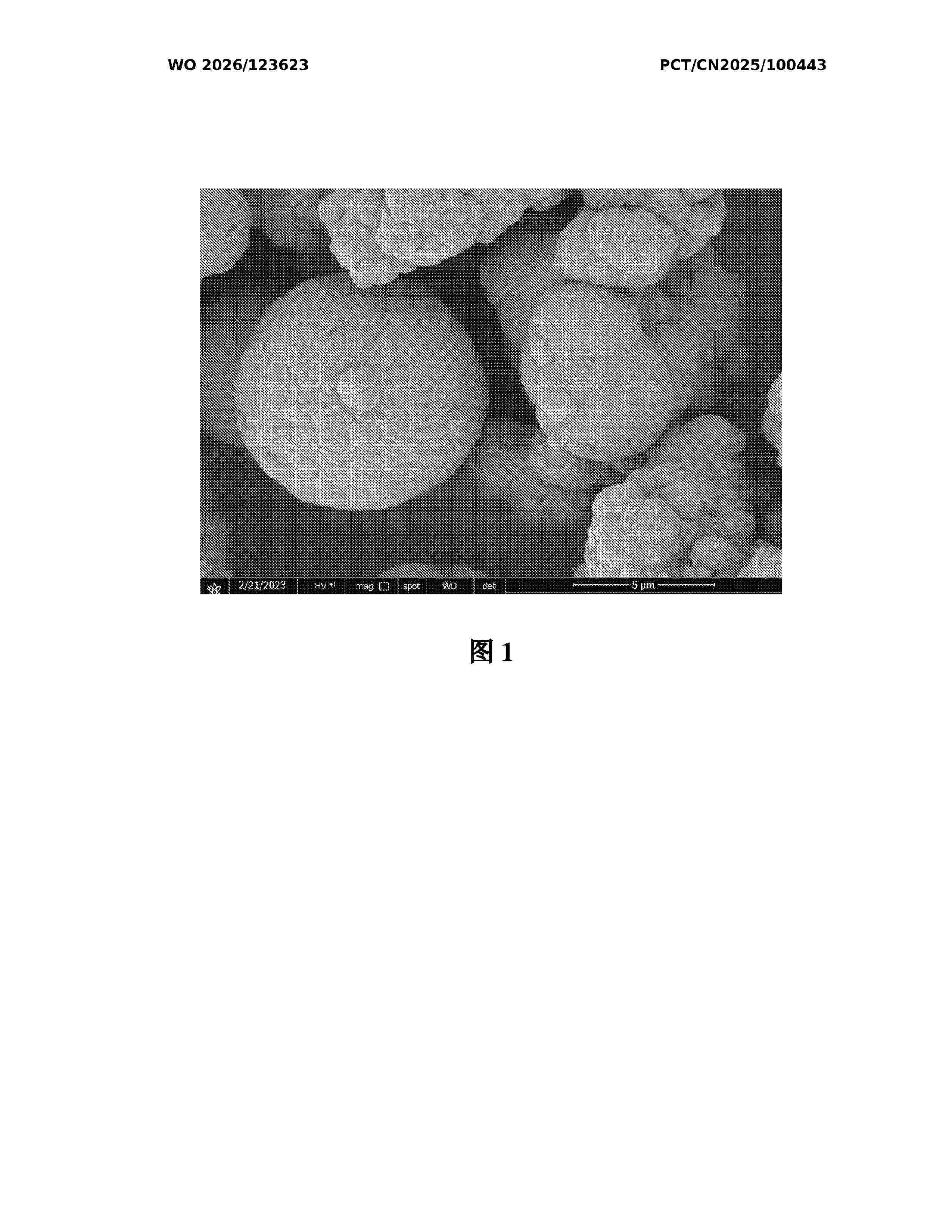
Resumen de: WO2026123623A1
The present application provides a lithium manganese iron phosphate positive electrode material, and a preparation method therefor and a use thereof. The lithium manganese iron phosphate positive electrode material comprises a doped manganese iron phosphate core and a coating layer coated on the surface of the doped manganese iron phosphate core, the coating layer being a lithium-containing carbon layer; and the doped manganese iron phosphate core comprises doping ions, and in particles of the doped manganese iron phosphate core, from inside to outside, the content of manganese ions and the content of iron ions gradually decrease and the content of the doping ions gradually increases. The lithium manganese iron phosphate positive electrode material having the described structure can effectively improve the poor phase structure stability and poor conductivity in lithium manganese iron phosphate positive electrode materials, and mitigate the series of problems caused by the Jahn-Teller effect and manganese dissolution that occur in the material itself, thereby improving the conductivity of the lithium manganese iron phosphate positive electrode material, and the comprehensive performance in various aspects such as gram capacity and cycle stability when the lithium manganese iron phosphate positive electrode material is used in batteries.
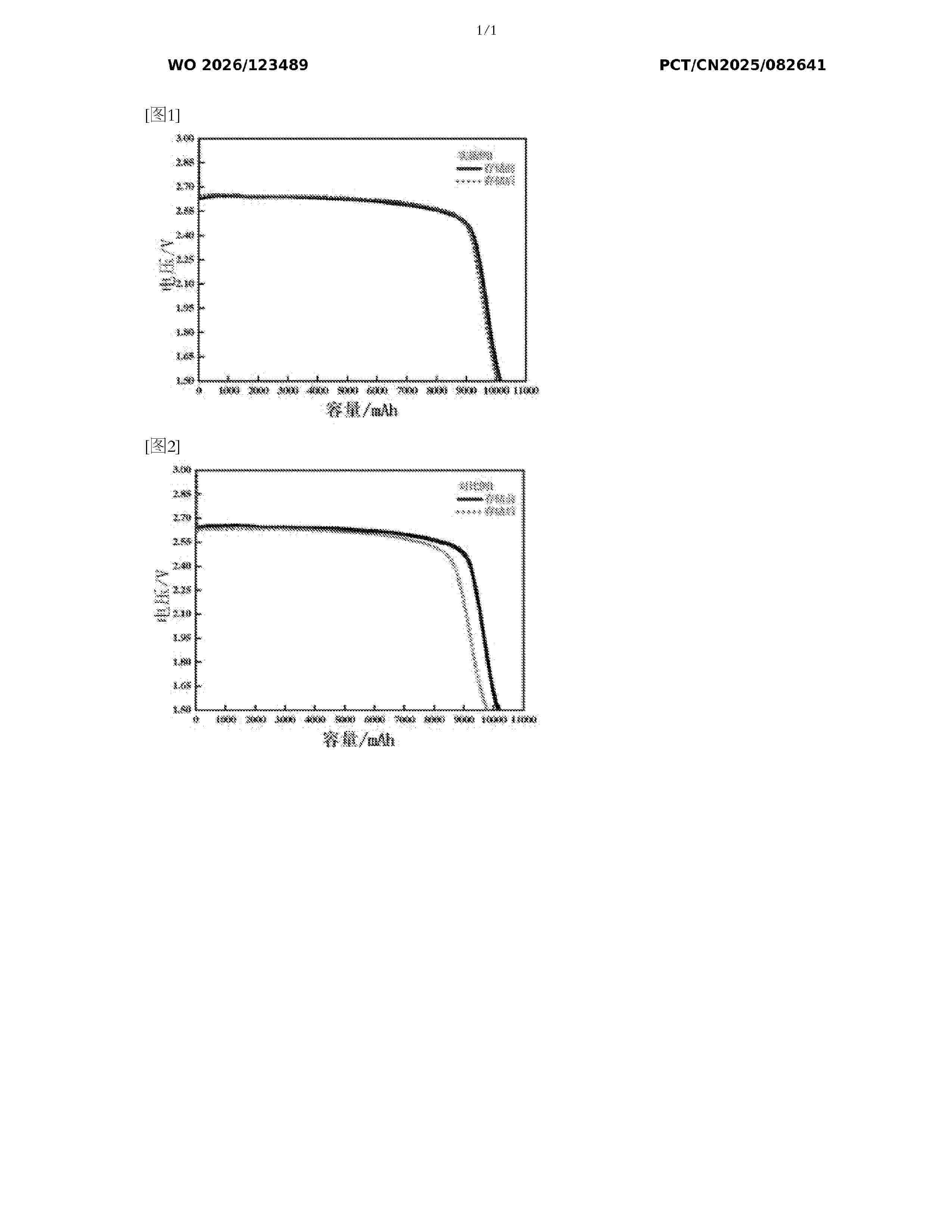
Resumen de: WO2026123489A1
Disclosed in the present application is a lithium/carbon fluoride battery. The battery comprises a positive electrode sheet, a negative electrode sheet and an electrolyte, wherein the positive electrode sheet comprises a positive electrode active material layer comprising a positive electrode active material, the positive electrode active material comprising a carbon fluoride material; and the electrolyte comprises additives, and the additives comprise a first additive and a second additive, with the first additive comprising a double-bond silane compound. The general chemical formula of the double-bond silane compound is R1 bSiaR2 2a+2-b, wherein a is an integer of 1-2, b is an integer of 1-6, R1 is at least one of vinyl, propenyl and butenyl, and R2 is at least one of methyl, ethyl and butyl.
Resumen de: WO2026123660A1
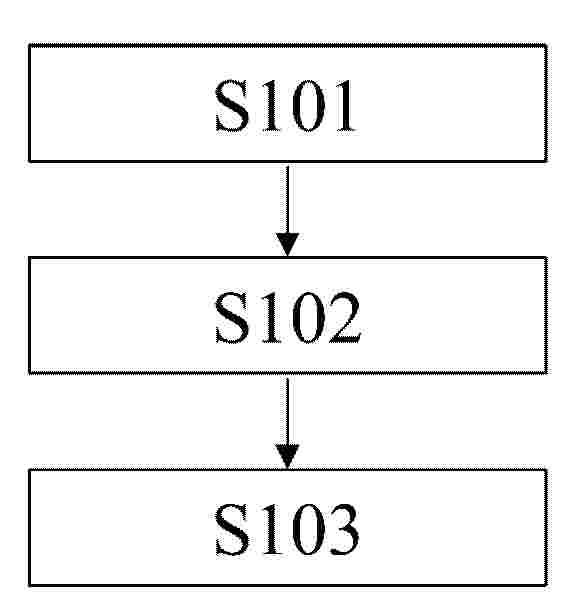
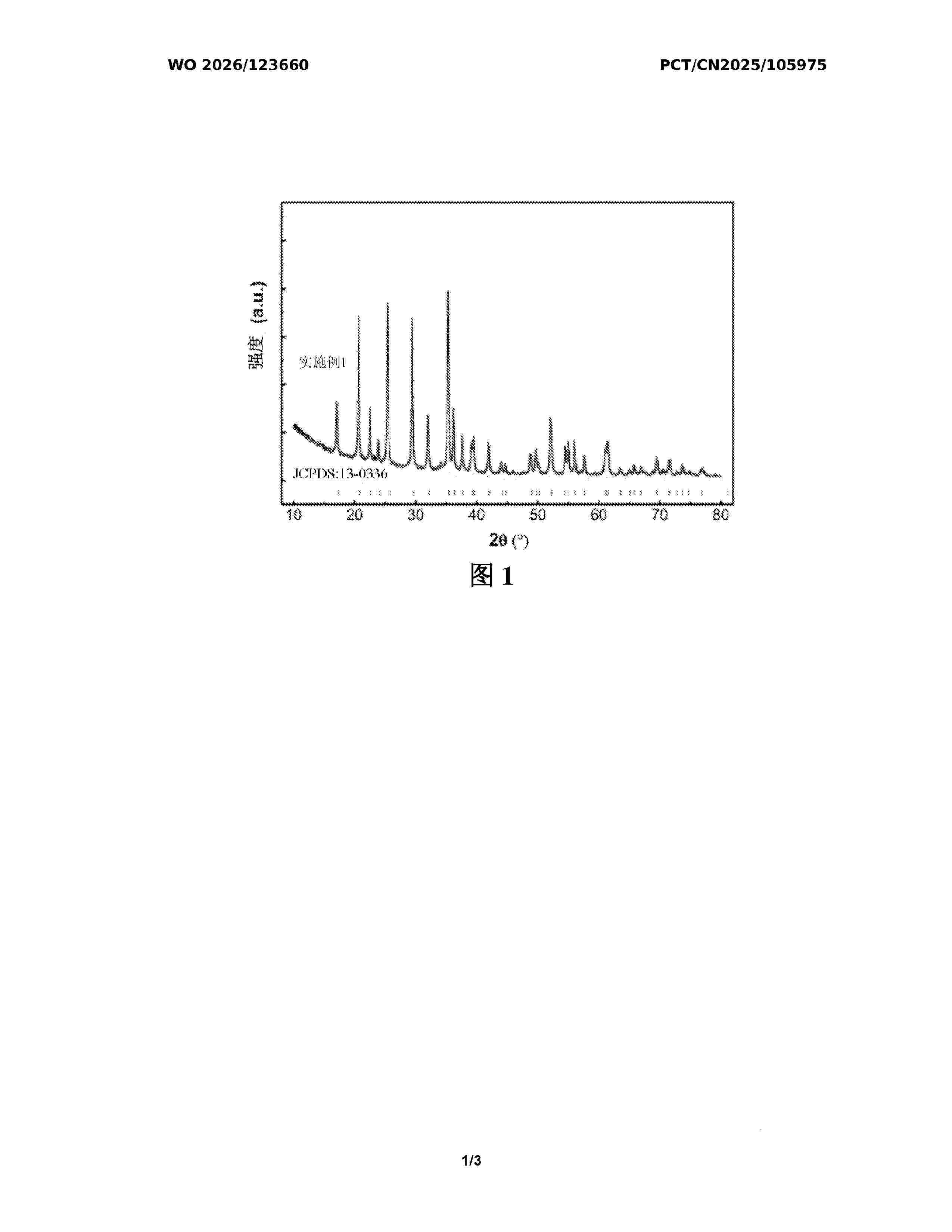
Provided in the present application are a lithium manganese iron phosphate material, a preparation method therefor, and use thereof. The preparation method comprises the following steps: step S1, mixing a manganese source, an iron source, and a phosphorus source with water via ball milling to obtain a first mixed slurry; step S2, subjecting a lithium source, pyrophosphoric acid, and sucrose to ball milling with the first mixed slurry to obtain a second mixed slurry; step S3, subjecting the second mixed slurry to a spray drying treatment to obtain a composite precursor with a microsphere structure; and step S4, calcining the composite precursor with the microsphere structure in an inert gas atmosphere at a calcination temperature of 520-700 ℃ to obtain the lithium manganese iron phosphate material. On the basis of the preparation method of the present application, the problems of low bulk density, low conductivity, low specific energy, and complex process of lithium manganese iron phosphate materials in the prior art can be solved.
Resumen de: AU2024410005A1
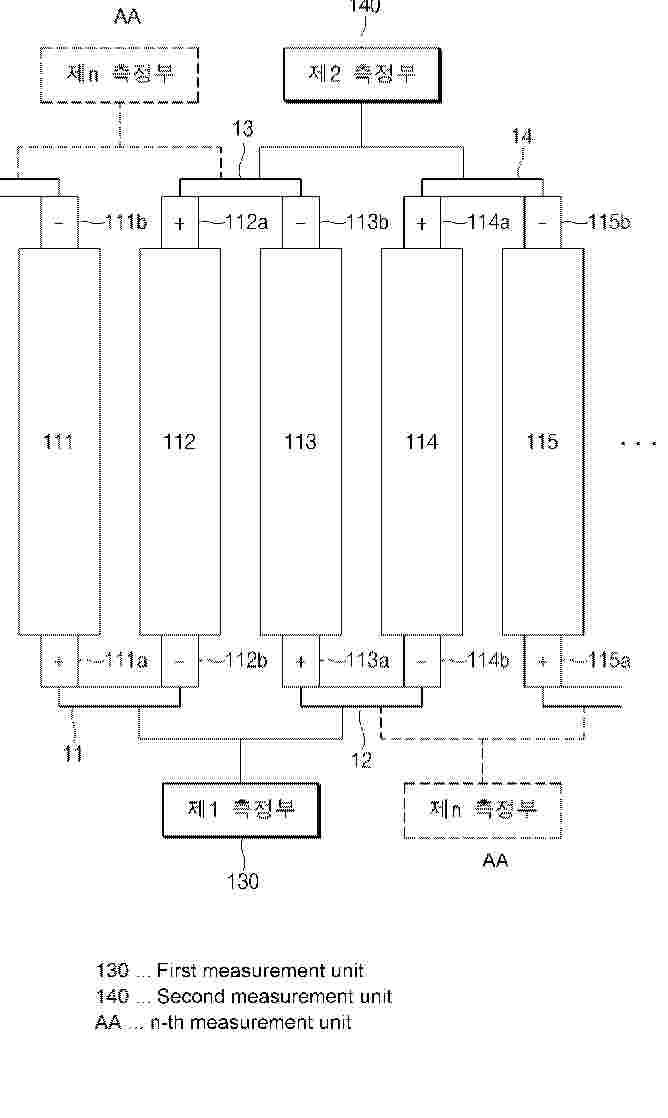
A battery according to an embodiment disclosed in the present document may comprise: a first measurement unit for measuring a first voltage which is the voltage between a first bus bar connecting a first battery cell and a second battery cell and a second bus bar connecting a third battery cell and a fourth battery cell and transferring the first voltage to a management unit; a second measurement unit for measuring a second voltage which is the voltage between a third bus bar connecting the second battery cell and the third battery cell and a fourth bus bar connecting the fourth battery cell and a fifth battery cell and transferring the second voltage to the management unit; and the management unit for calculating the voltage of the third battery cell by performing a mathematical operation for the first voltage and the second voltage.
Resumen de: US20260171541A1
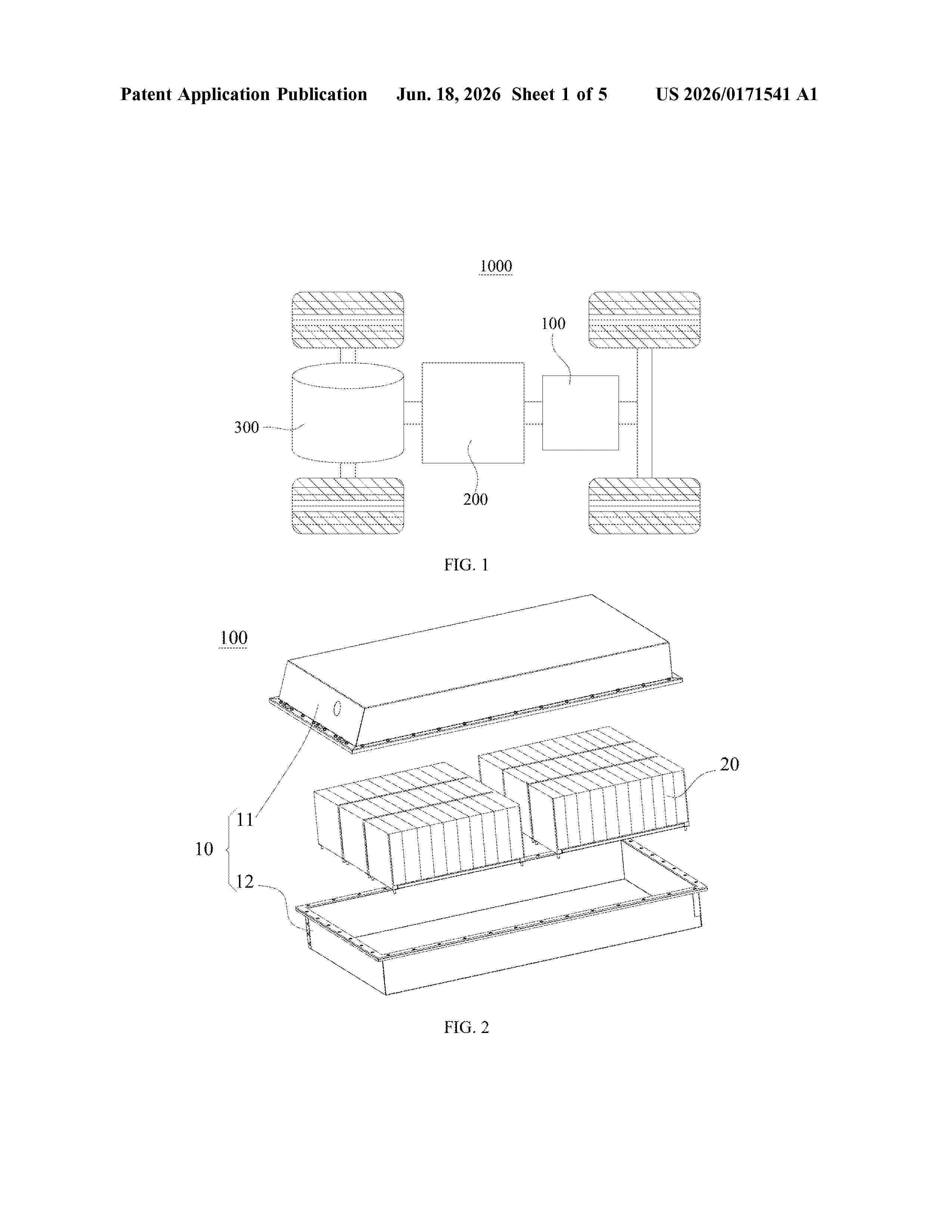
0000 A fluid collecting component includes an apparatus body, where the apparatus body is provided with a main inlet, a main outlet, a plurality of branch inlets, and a plurality of branch outlets, where the plurality of branch outlets are in communication with the main outlet; an extension flow channel is formed inside the apparatus body; one end of the extension flow channel is in communication with the main inlet, and the other end thereof extends toward a side away from the main inlet; one of the plurality of branch inlets are in communication with the main inlet, and the others are in communication with the extension flow channel; the number of the branch inlets is equal to the number of the branch outlets, and the branch inlets are in one-to-one correspondence to the branch outlets; and the branch inlets are adjacent to the corresponding branch outlets.
Resumen de: WO2026123479A1
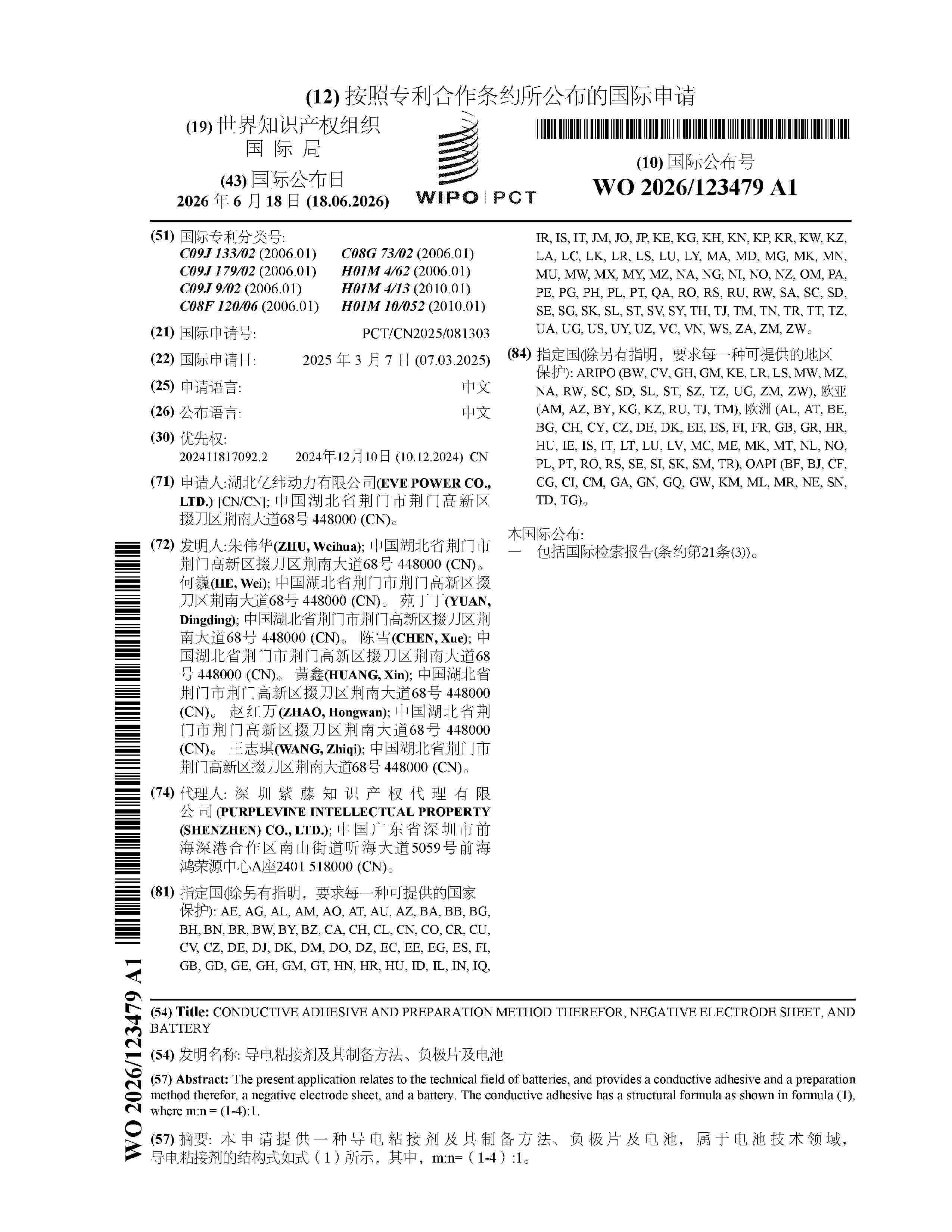
The present application relates to the technical field of batteries, and provides a conductive adhesive and a preparation method therefor, a negative electrode sheet, and a battery. The conductive adhesive has a structural formula as shown in formula (1), where m:n = (1-4):1.
Nº publicación: US20260171637A1 18/06/2026
Solicitante:
SAMSUNG ELECTRO MECH CO LTD [KR]
SAMSUNG ELECTRO-MECHANICS CO., LTD.
Resumen de: US20260171637A1
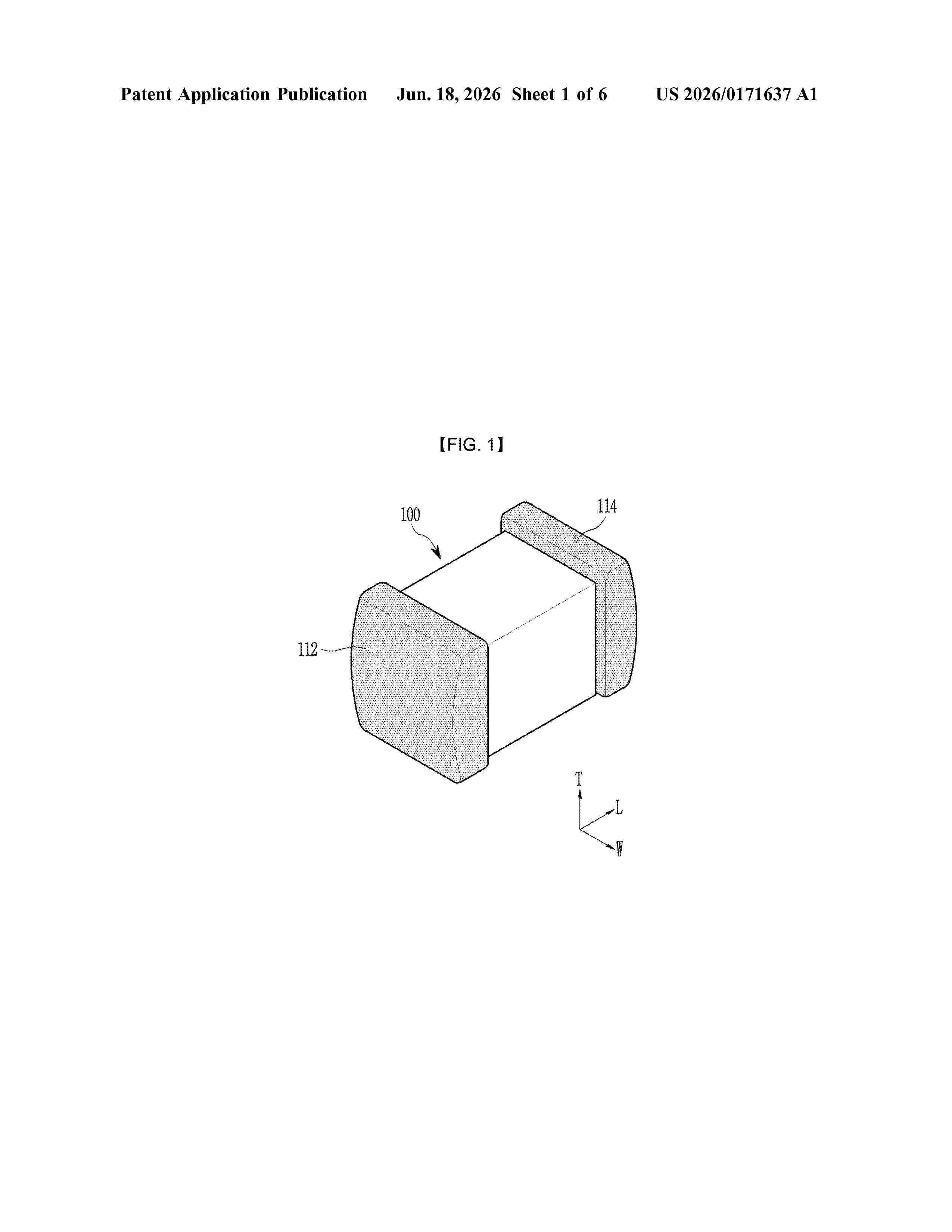
0000 An all-solid-state battery according to an embodiment includes: a cell laminate including a solid electrolyte layer; a positive electrode layer and a negative electrode layer disposed with the solid electrolyte layer interposed therebetween; and margin layers disposed at edges of the positive electrode layer and the negative electrode layer in a lateral direction, wherein the margin layer includes aluminosilicate particles (Al<2>SiO<5>), the margin layer includes ceramic glass that does not contain lithium, and the aluminosilicate particles are included in an amount of 10 vol % to 70 vol % based on the entire volume of the margin layer.
 BOPI
BOPI
 Sede Electrónica