Si deseas distinguir tus productos, servicios o ambos de los de otra empresa, es posible que necesites una marca o nombre comercial. Descubre qué son, en qué consiste su procedimiento de registro y qué implica.

Información sobre los plazos de presentación de solicitudes de transformación de marcas de la Unión Europea en marca nacional española. Más información


Si tienes un nuevo dispositivo, producto o procedimiento que resuelva un problema técnico o tenga una ventaja práctica, existen distintas formas de protegerlo en España y en otros países. Descubre cómo hacerlo.

¿Tu innovación reside en la estética, la ornamentación o la apariencia de tu producto? Protégela mediante un diseño industrial. Descubre qué derechos confiere el registro y cómo realizar la tramitación.

Las indicaciones geográficas protegen el nombre de un producto originario de una zona geográfica, a la cual le debe una determinada calidad, reputación u otra característica. Descubre qué son, en qué consiste su procedimiento de registro y qué beneficios conceden.

Las patentes publicadas en todo el mundo son una valiosa fuente de información científica, técnica y comercial.

Si eres emprendedor/a o una empresa y quieres potenciar y mejorar la rentabilidad de tu negocio protegiendo de forma adecuada los activos intangibles de tu organización, en este espacio encontrarás lo necesario.


 574
resultados
574
resultados
 Última actualización
15/09/2026 [08:53:00]
Última actualización
15/09/2026 [08:53:00]


 Resultados 450 a 475 de 574

Resumen de: WO2025125713A1
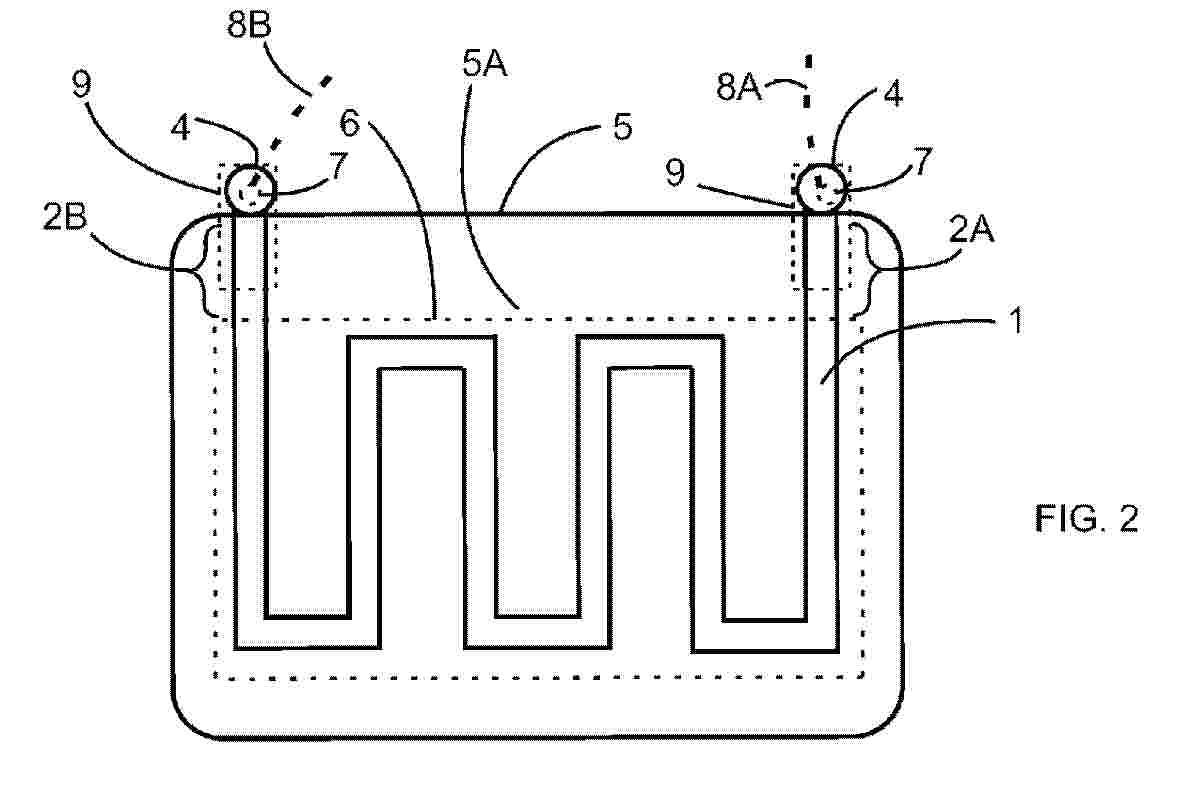
A battery or battery cell according to the invention has a heater on it. The heater is a foil transfer technology manufactured metal foil. The metal foil is flexible, conductive, and solderable material. Further, the metal foil heater comprises pads for soldering.

Resumen de: EP4804254A1
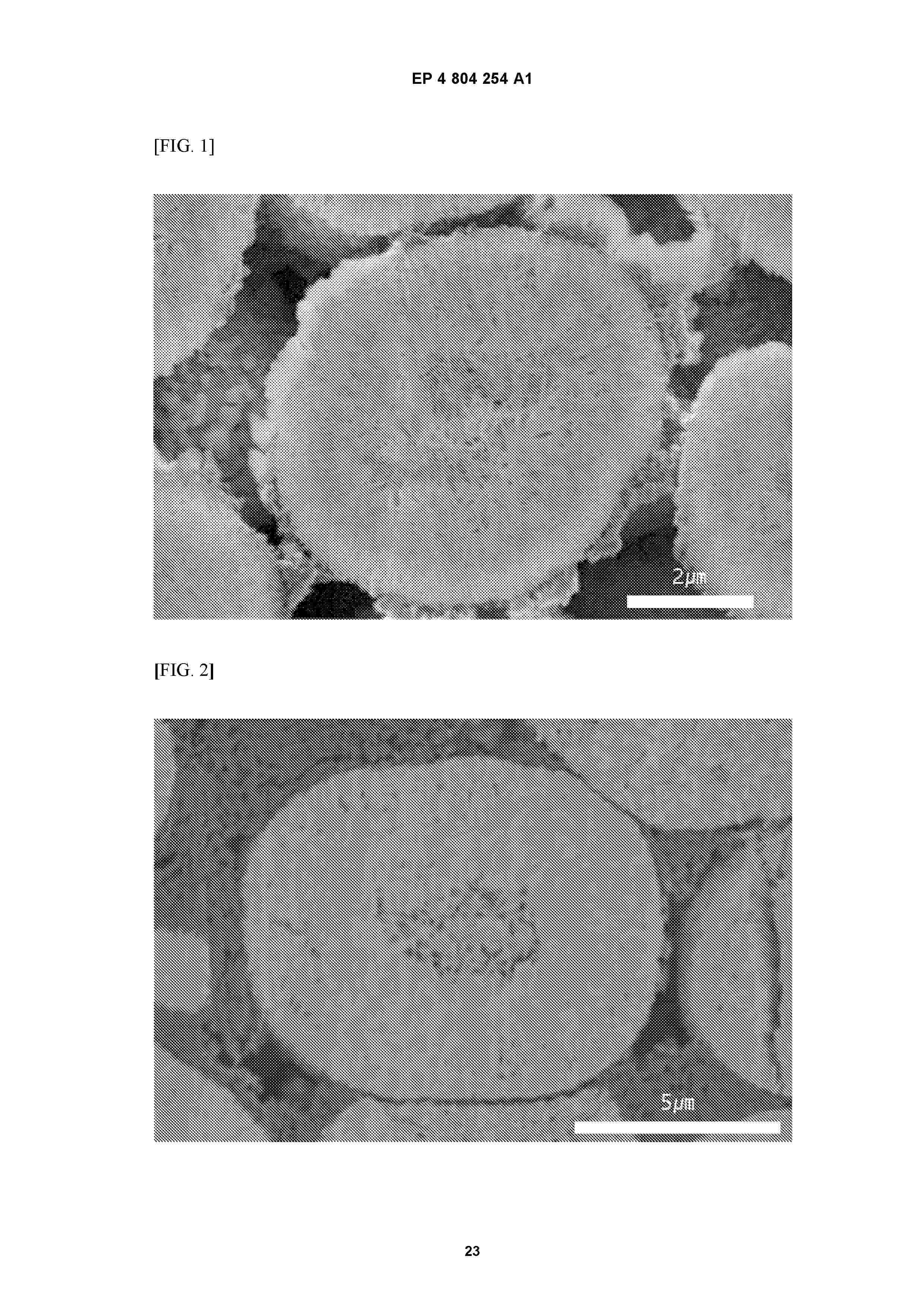
The present invention relates to a high-density positive electrode active material precursor, a method for manufacturing the positive electrode active material precursor, a high-density positive electrode active material, and a method for manufacturing the positive electrode active material, and provides a positive electrode active material precursor comprising: a manganese-nickel-based hydroxide including manganese and nickel, wherein the manganese-nickel-based hydroxide includes a porous core part (A); a first shell part (A1) formed on the core part; and a porous second shell part (A2) formed on the first shell part, wherein the first shell part (A1) has a thickness satisfying Equation 1 described herein, and wherein the positive electrode active material precursor has a tap density of 1.75 g/cm3 to 2.0 g/cm3 and a BET specific surface area of 18 m2/g to 25 m2/g, a method for manufacturing the same, a positive electrode active material manufactured using the same, and a method for manufacturing the positive electrode active material using the same.
Resumen de: EP4804502A1
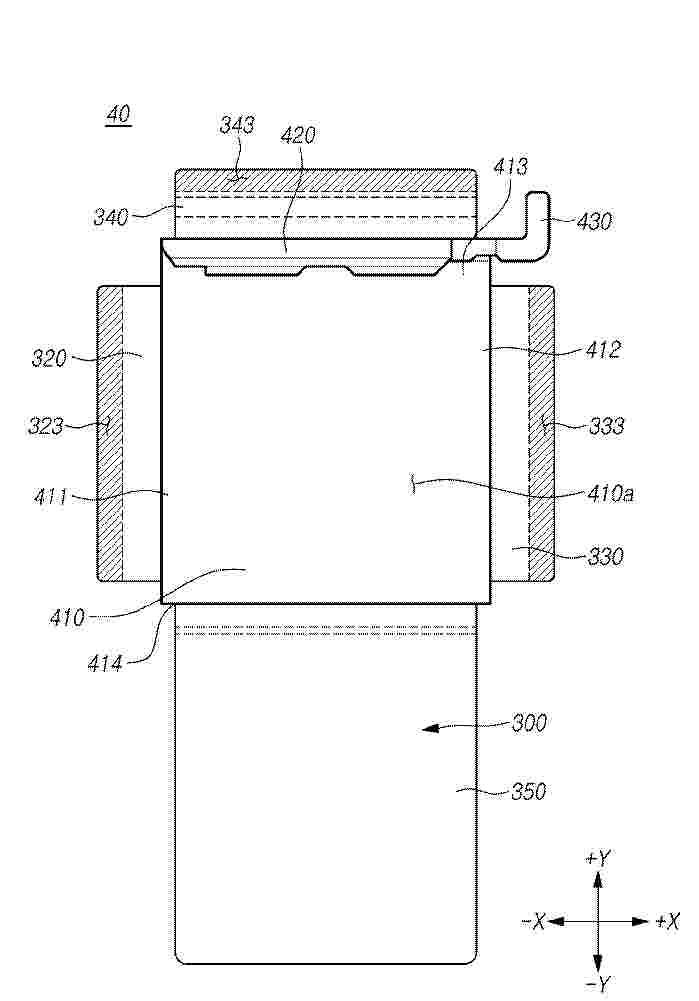
0001 An electronic device according to one embodiment of the present disclosure may comprise: a housing; and a battery assembly which is disposed in the housing, and which includes a battery cell and a cover member disposed to encompass at least a portion of the battery cell. The cover member of the battery assembly can include: a main cover portion which is disposed to encompass the front surface of the battery cell and which includes an inner surface facing the battery cell and an outer surface opposite to the inner surface; a first cover portion which extends from the main cover portion, and which is disposed to encompass from the edge of one side of the battery cell to a portion of the front surface of the battery cell; and a second cover portion which extends from the main cover portion, and which is disposed to encompass from the edge of the other side of the battery cell to the portion of the front surface of the battery cell. A first adhesive area of the first cover portion and a second adhesive area of the second cover portion can be attached to the front surface of the battery cell. When viewing the front surface of the battery assembly, the first cover portion and the second cover portion can be spaced apart from each other.
Resumen de: WO2025122603A1
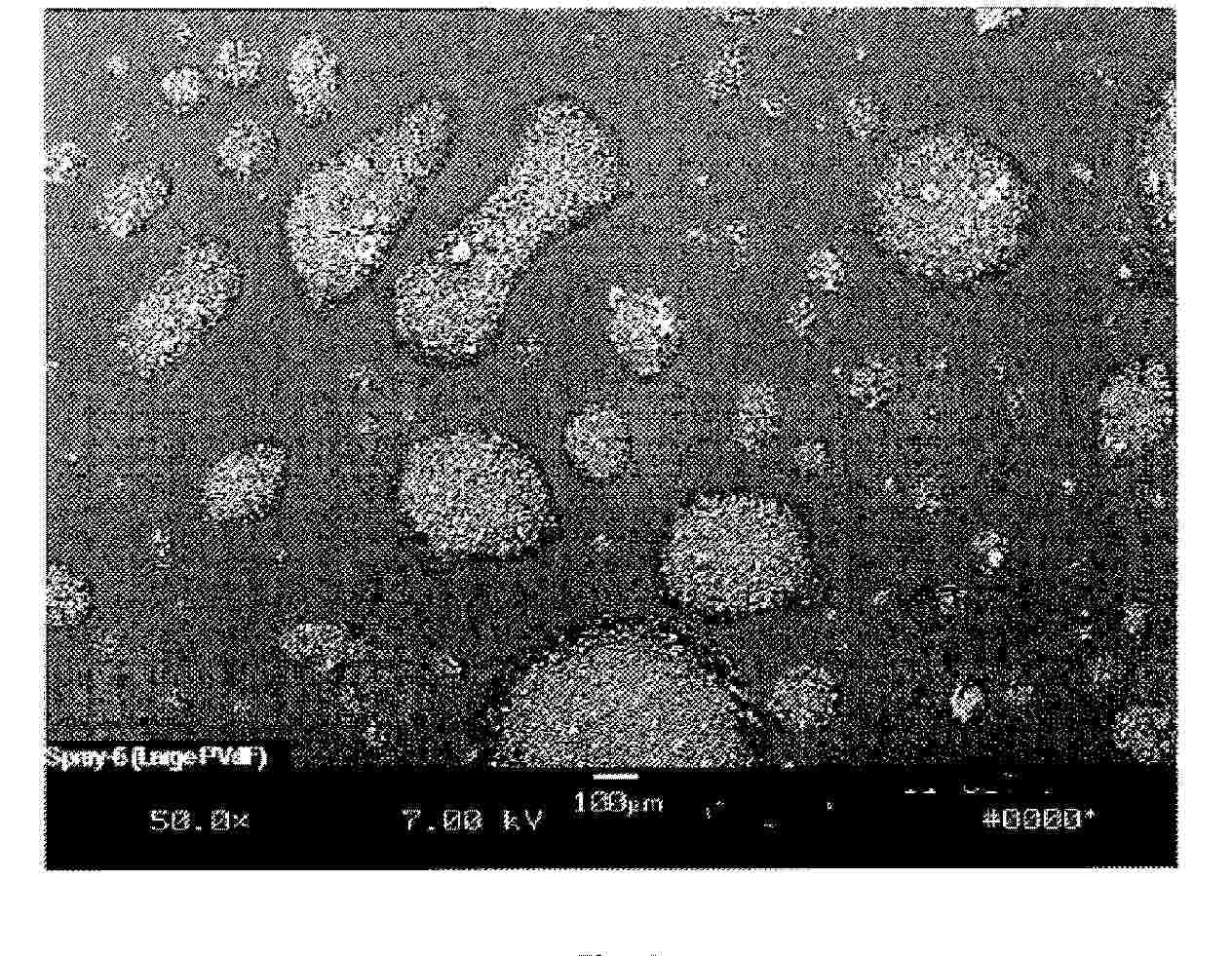
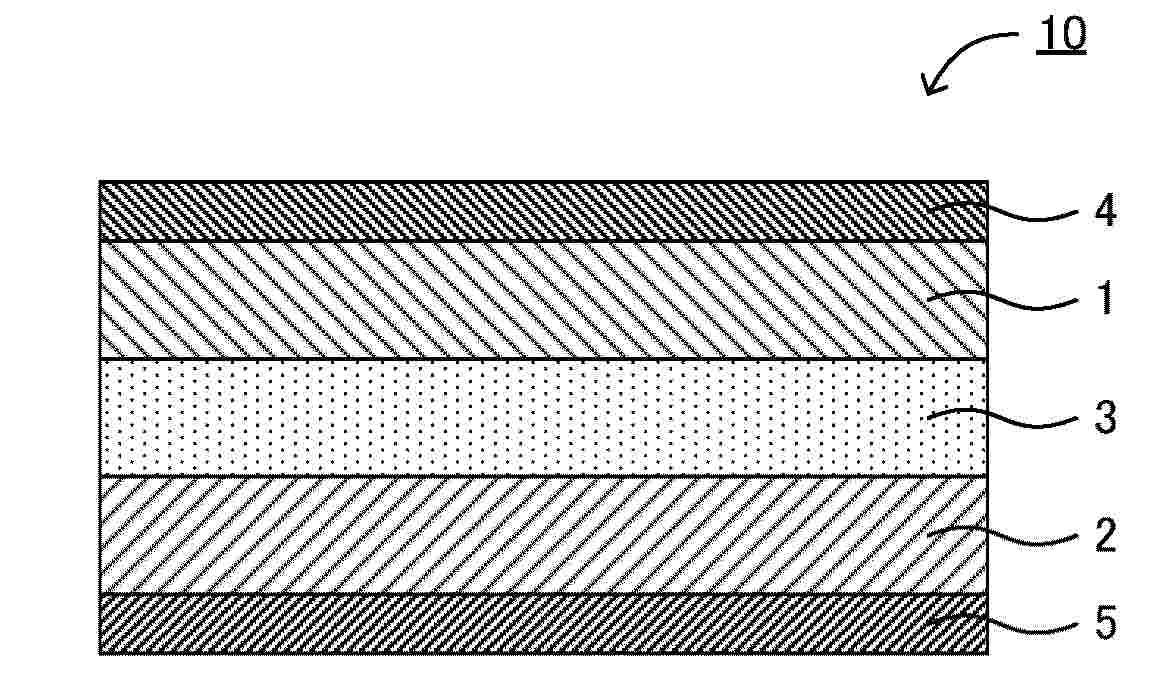
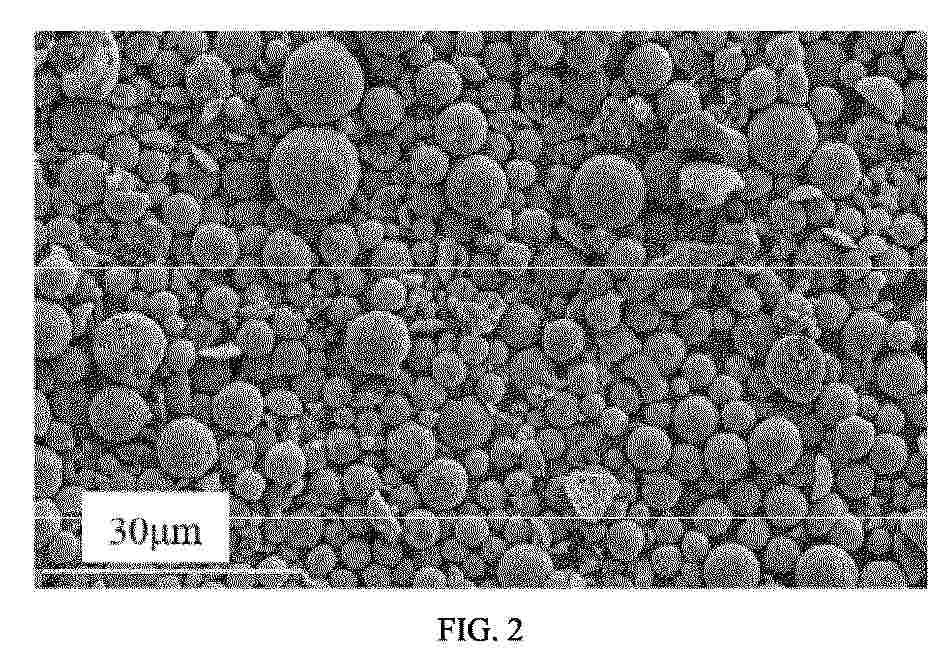
Disclosed is an improved non-continuous and water-based adhesive coating containing large polymeric particles or agglomerate with an average particle size (D50) greater than 5 microns. The coating may be applied onto one or both sides of a porous film. A method of forming the coating involves applying an aqueous slurry containing the large polymeric particles with a D50 greater than 5 microns onto a porous membrane. The method of application may be a spray coating method.
Resumen de: EP4804322A1
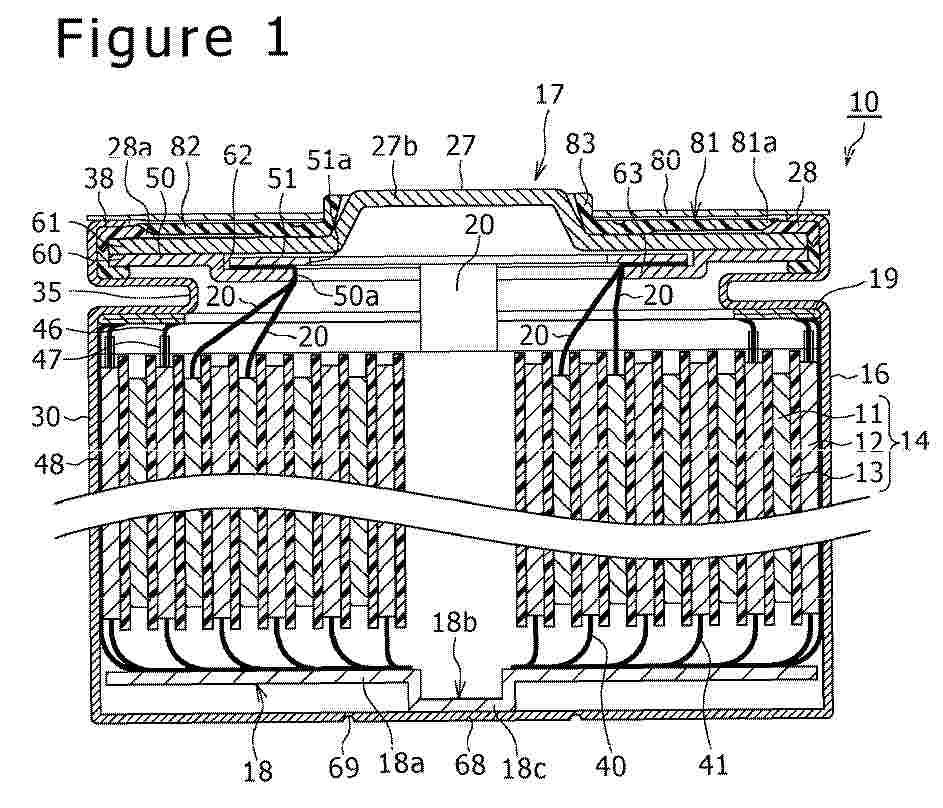
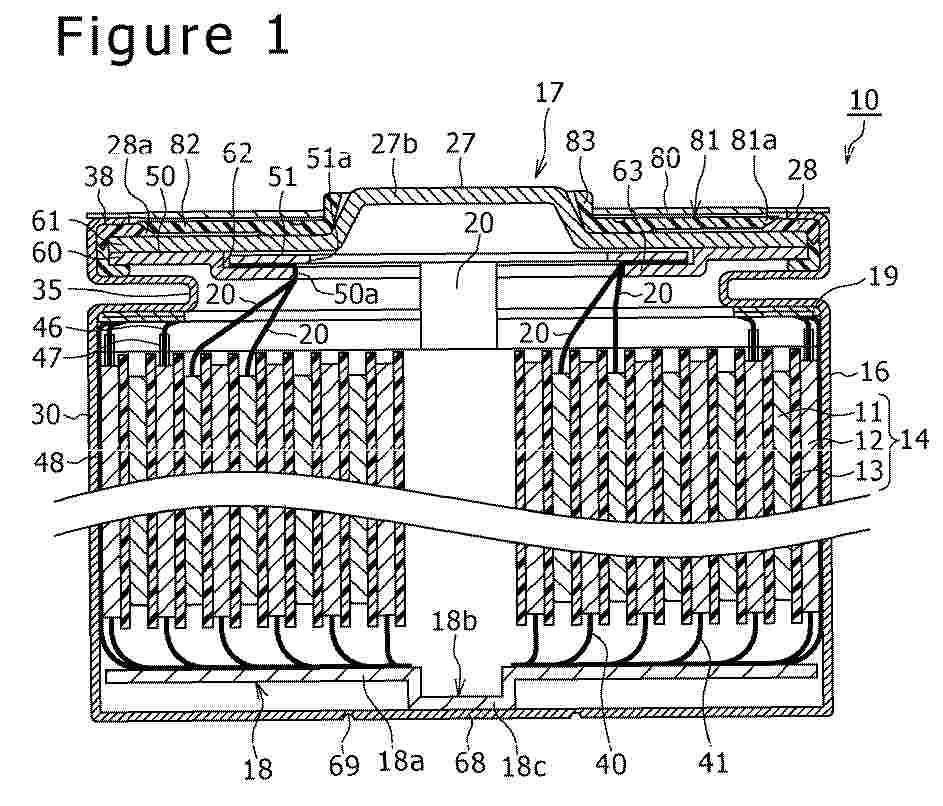
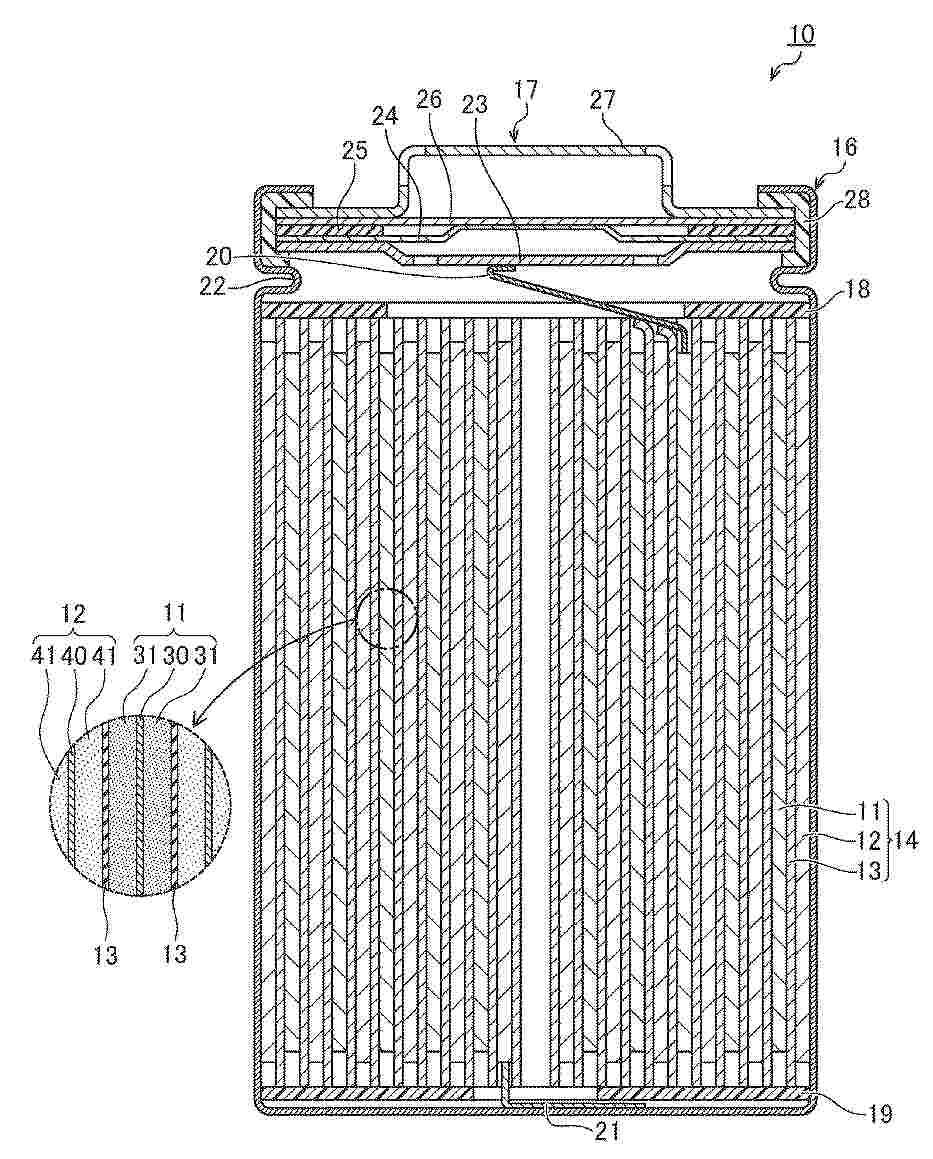
0001 A battery (10) comprises: an electrode body (14) in which a belt-shaped positive electrode (11) and a belt-shaped negative electrode (12) are wound with a belt-shaped separator (13) in between; an outer can (16) that accommodates the electrode body (14) and includes a cylindrical part (30); and a sealing body (17) that closes an opening part of the outer can (16). In the axial direction of the electrode body (14), the negative electrode (12) has a first end and a second end. Power is collected from the negative electrode (12) through the first end side. At the second end, there is formed a second exposed part (shock-absorbing part) (46) where a region on the outer peripheral side of the electrode body (14) protrudes outward in the axial direction more than a region on the inner peripheral side. The second exposed part (46) constitutes a shock-absorbing part.
Resumen de: EP4804210A1
0001 A main object of the present disclosure is to provide a sulfide solid electrolyte capable of inhibiting increase of battery resistance along with charge and discharge cycle.
0002 The present disclosure achieves the object by providing a sulfide solid electrolyte including a Li element, a P element, and a S element, wherein, in a TOF-SIMS analysis, a ratio (C
Resumen de: EP4804246A1
0001 The present invention provides a nonaqueous electrolyte secondary battery which is capable of achieving high output. A nonaqueous electrolyte secondary battery according to one embodiment of the present disclosure includes: a wound electrode body which is obtained by winding a belt-shaped positive electrode and a belt-shaped negative electrode, with a separator being interposed therebetween; and an outer package which houses the electrode body. The positive electrode has a positive electrode current collector and a positive electrode mixture layer that is formed on the surface of the positive electrode current collector. A positive electrode current collector exposed part, in which the positive electrode current collector is exposed, is formed in the surface of the positive electrode. A positive electrode tab is connected to the positive electrode current collector exposed part. The positive electrode mixture layer has a normal part and thick parts that are thicker than the normal part. The thick parts are close to both ends of the positive electrode current collector exposed part in the longitudinal direction of the positive electrode.
Resumen de: EP4804324A1
A battery (10) comprises: an electrode body (14) in which a belt-like positive electrode (11) and a belt-like negative electrode (12) are wound via a belt-like separator (13); an outer can (16) that accommodates the electrode body (14) and includes a cylindrical part (30); and a sealing body (17) that closes an opening part of the outer can (16). In the axial direction of the electrode body (14), the negative electrode 12 has a first end and a second end. There are: a first current collecting path for electrically connecting the negative electrode (12) and the outer can (16) on the first end side; and a second current collecting path for electrically connecting the negative electrode (12) and the outer can (16) on the second end side.
Resumen de: EP4804249A1
The present application provides a cathode material, a method for preparing the same, a cathode plate, a sodium-ion battery, and an electrical device, belonging to the battery field. The cathode material includes a core and a carbon-containing coating layer coated on at least part of a surface of the core. The core contains sodium vanadium fluorophosphate. A button battery is prepared using the cathode material and is subjected to an Nth charge-discharge test. In a discharge curve of the Nth charge-discharge test, a discharge specific capacity is C0; and a discharge specific capacity of a discharge platform corresponding to a voltage of 3.3 V to 3.4 V is C1, C1/C0<6.7%, where N is an integer equal to or greater than 1. The Nth charge-discharge test is performed at 20°C to 30°C by charging the button battery at a constant current of 0.2C rate to 4.3 V and then discharging the button battery at a constant current of 0.2C rate to 2 V. The cathode material provided in the present application has relatively high discharge specific capacity and electronic conductivity.
Resumen de: EP4804241A1
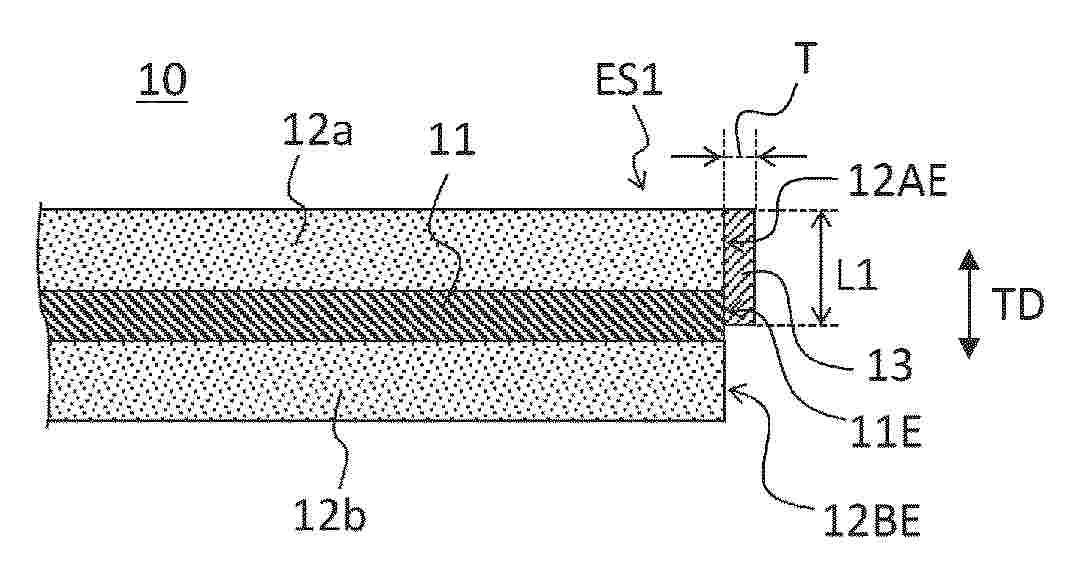
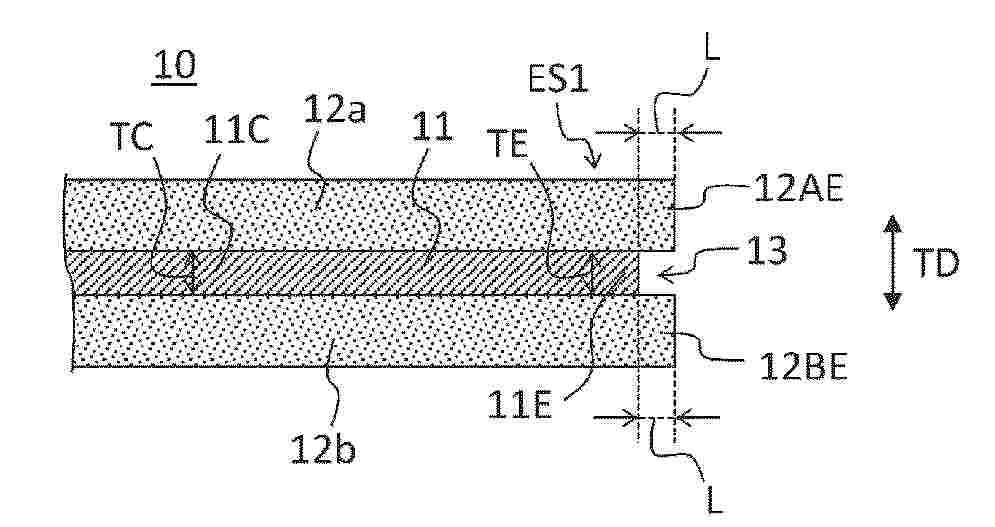
0001 An electrode for secondary batteries includes: an electrode current collector in the form of a sheet, an electrode mixture layer supported on a principal surface of the electrode current collector, and having an end face ME continuous with an end face CE of the electrode current collector; and a protective layer partially covering the end face CE of the electrode current collector from a boundary between the electrode current collector and the electrode mixture layer, in the thickness direction of the electrode current collector.
Resumen de: WO2025091090A1
Doped layered cathode materials for an electrochemical device are disclosed, which comprises a layered cathode material and a dopant, wherein the dopant is selected and added so that the electrochemical device delivers a capacity retention of about 78% to about 88% after 500 cycles at 1 C.
Resumen de: EP4804240A1
An electrode for secondary batteries includes a sheet-shaped electrode current collector, a first electrode mixture layer supported on one main surface of the electrode current collector; and a second electrode mixture layer supported on another main surface of the electrode current collector. An end portion of the electrode includes end portions of the first electrode mixture layer and the second electrode mixture layer and an end portion of the electrode current collector. The end portions of the first electrode mixture layer and the second electrode mixture layer each protrude beyond the end portion of the electrode current collector.
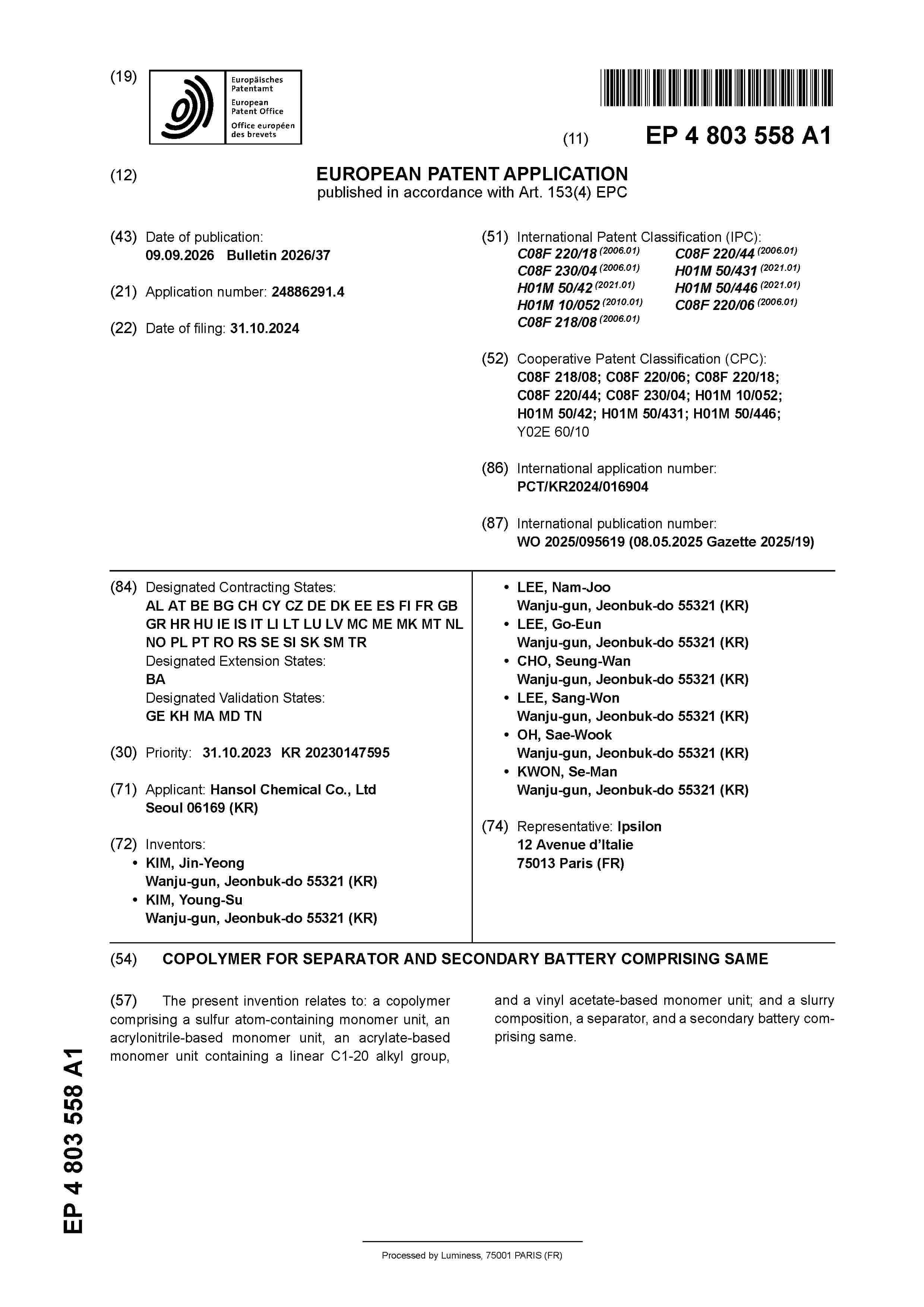
Resumen de: EP4803558A1
0001 The present invention relates to: a copolymer comprising a sulfur atom-containing monomer unit, an acrylonitrile-based monomer unit, an acrylate-based monomer unit containing a linear C1-20 alkyl group, and a vinyl acetate-based monomer unit; and a slurry composition, a separator, and a secondary battery comprising same.
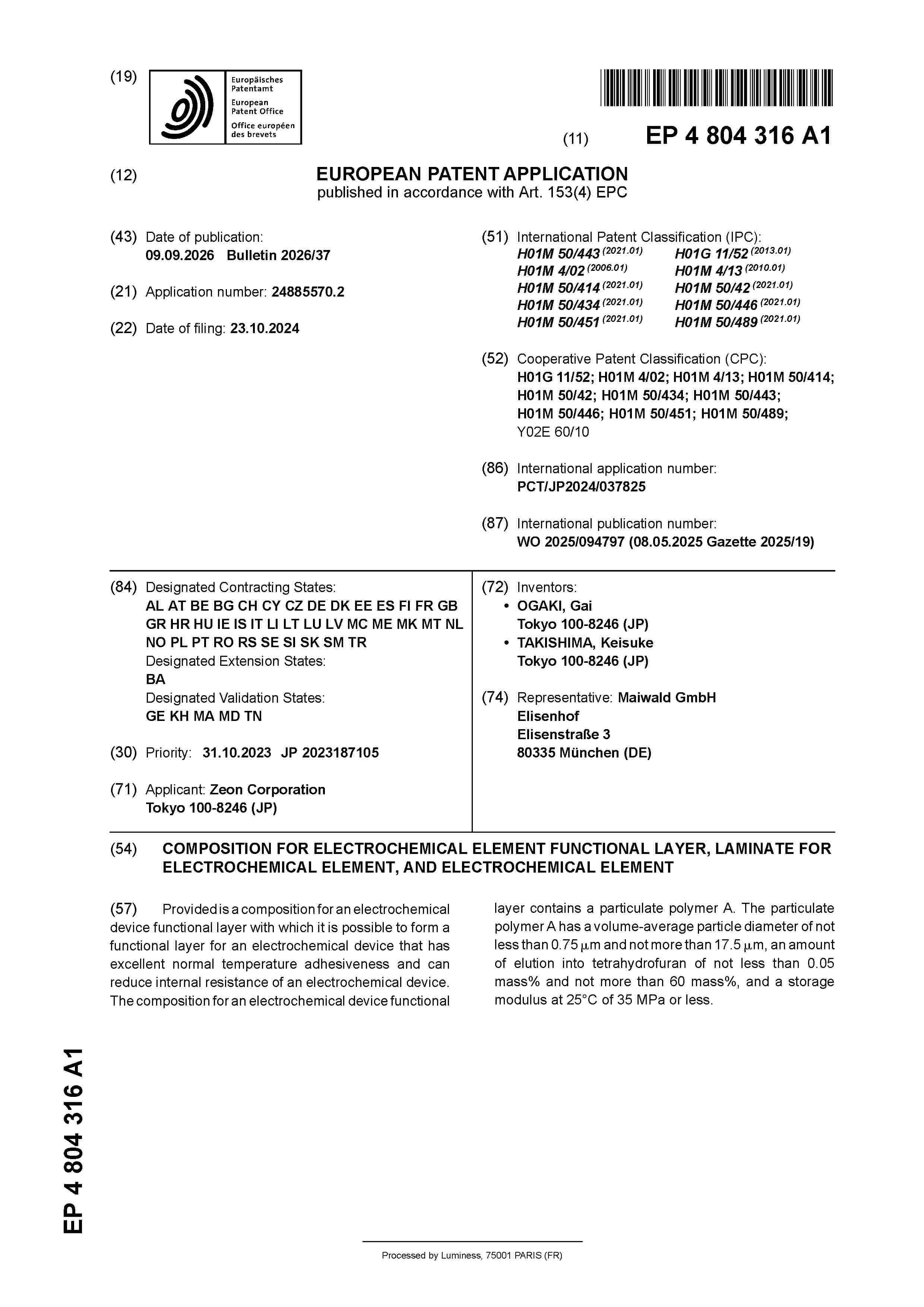
Resumen de: EP4804316A1
Provided is a composition for an electrochemical device functional layer with which it is possible to form a functional layer for an electrochemical device that has excellent normal temperature adhesiveness and can reduce internal resistance of an electrochemical device. The composition for an electrochemical device functional layer contains a particulate polymer A. The particulate polymer A has a volume-average particle diameter of not less than 0.75 µm and not more than 17.5 µm, an amount of elution into tetrahydrofuran of not less than 0.05 mass% and not more than 60 mass%, and a storage modulus at 25°C of 35 MPa or less.
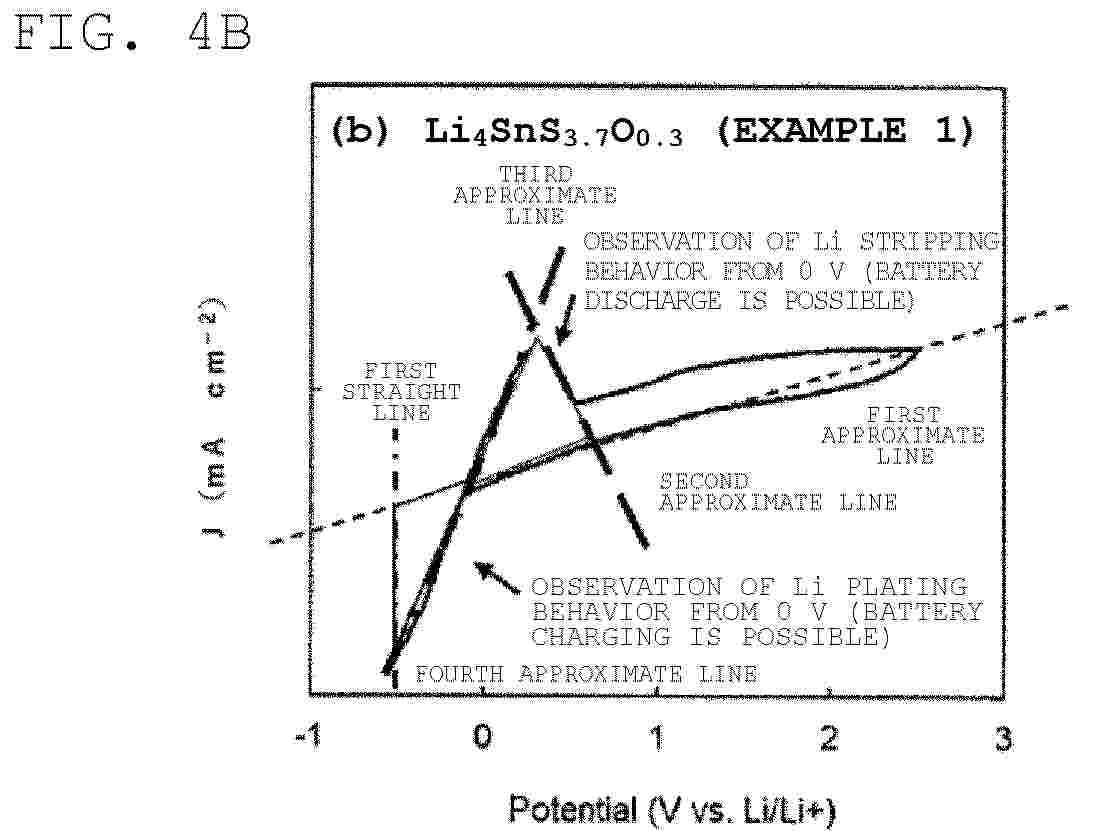
Resumen de: EP4804211A1
0001 The solid-state battery according to an embodiment of the present disclosure is provided with a sulfide solid electrolyte including at least Li, Sn, S, and O and having a tetragonal crystal structure.
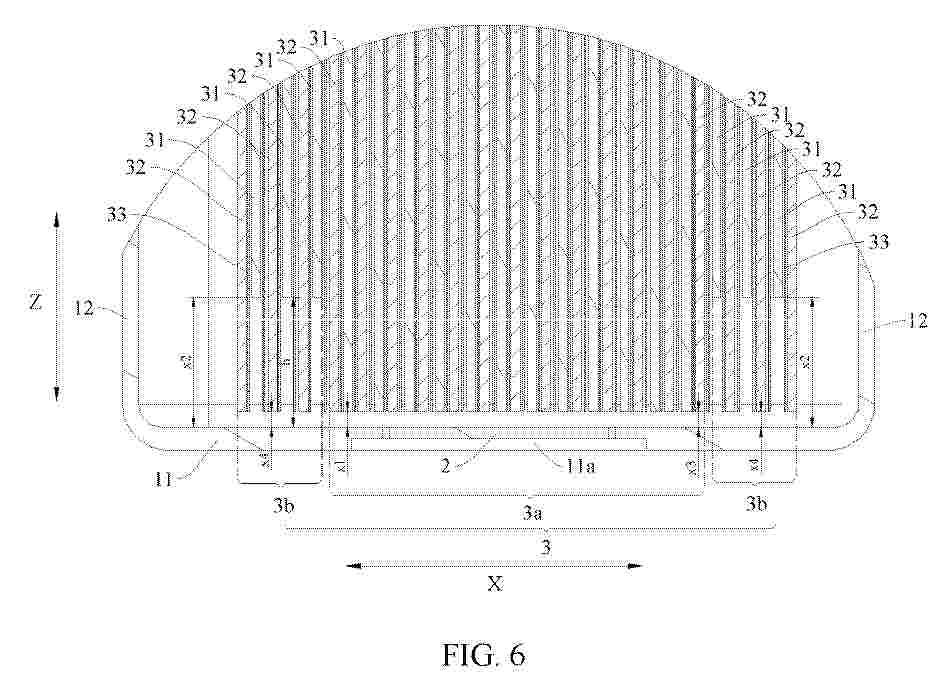
Resumen de: EP4804268A1
Disclosed are a battery cell (100), a battery (200), and an electric apparatus (1000). The battery cell (100) includes a case (1), a pressure relief mechanism (2), and an electrode assembly (3). The case (1) has a first wall (11) and a second wall (12) that are adjacent and connected to each other. The pressure relief mechanism (2) is provided on the first wall (11). The electrode assembly (3) is provided in the case (1), the electrode assembly (3) has a first portion (3a) and a second portion (3b) sequentially arranged along a first direction (X), the first portion (3a) and the second portion (3b) each include multiple anode electrode sheet layers (32) and multiple cathode electrode sheet layers (31), the multiple anode electrode sheet layers (32) and the multiple cathode electrode sheet layers (31) are alternately stacked one-to-one along the first direction (X), the second portion (3b) is disposed between the first portion (3a) and the second wall (12), a distance from the cathode electrode sheet layer (31) of the second portion (3b) to the first wall (11) is greater than a distance from the cathode electrode sheet layer (31) of the first portion (3a) to the first wall (11), and the first direction (X) is perpendicular to the second wall (12).
Resumen de: WO2025093838A1
The present invention relates to a composition comprising a fluorinated polymer P1 comprising monomer units derived from a fluorinated monomer M1a and a copolymer P2 comprising monomer units derived from a monomer M2a of formula (Ia) R1R2C=C(R3)C(O)R or (Ib) R1R2C=C(R3)R'' and monomer units derived from a monomer M2b of formula (II). The composition is used as an electrode binder.
Resumen de: US20250146981A1
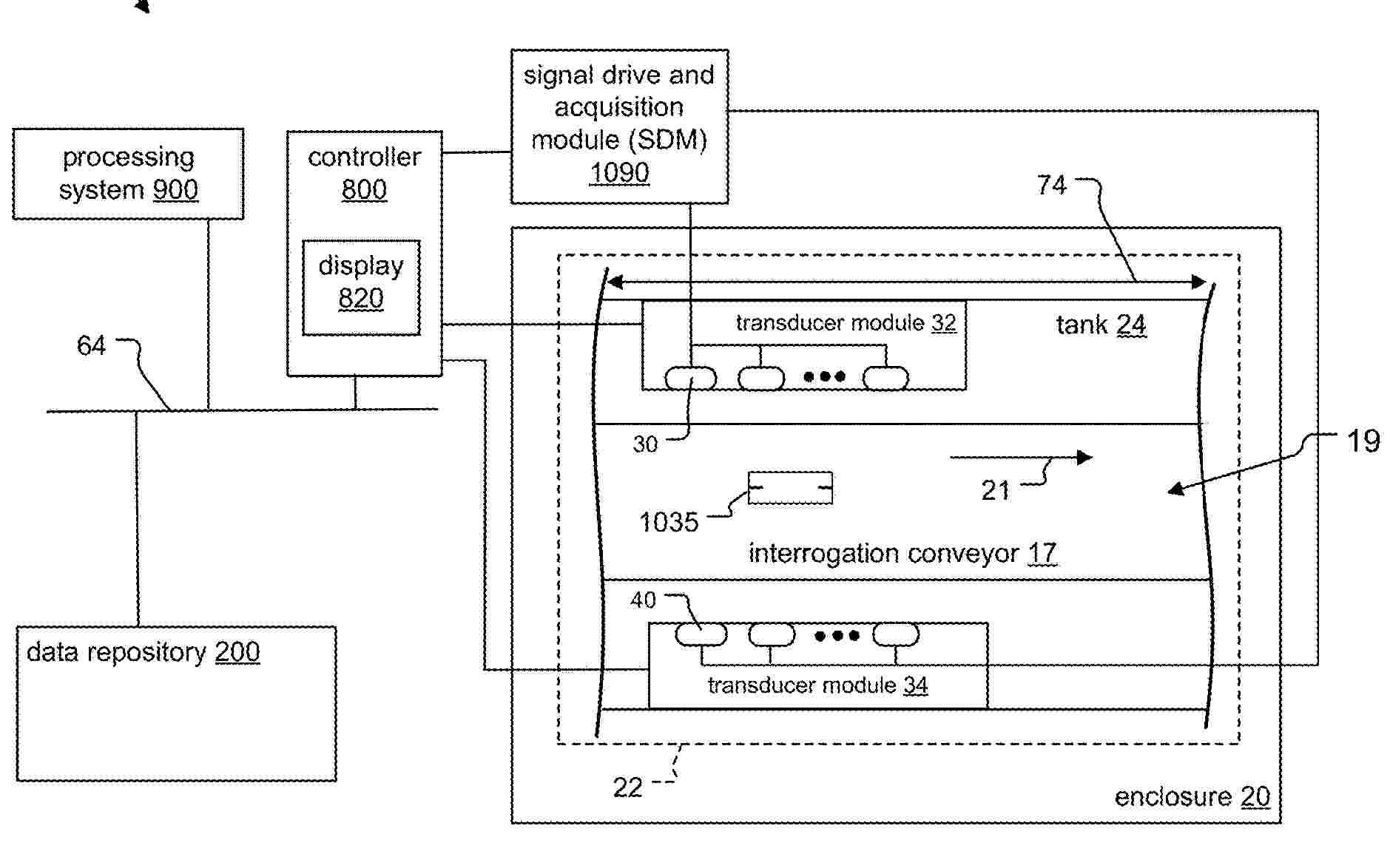
0000 A battery cell inspection system and method are disclosed. The system performs an ultrasound interrogation session of a cell by directing ultrasound at different frequencies at target points across surfaces of the cell, detecting ultrasound at the target points that is transmitted through and/or reflected from the cell, generating response signals from the detected ultrasound at each of the target points, and determining characteristics of the cell including defects, anomalies and cell capacity based upon the response signals. During the session, the transducers are not in contact with the surfaces of the cell, and the transducers and the cell are immersed in an electrically non-conductive fluid. The system can also configure the ultrasound transmitted at the target points into focused beams. Alternatively, an inspection system can be configured to determine characteristics of a cell during a formation stage of the cell.
Resumen de: EP4804307A1
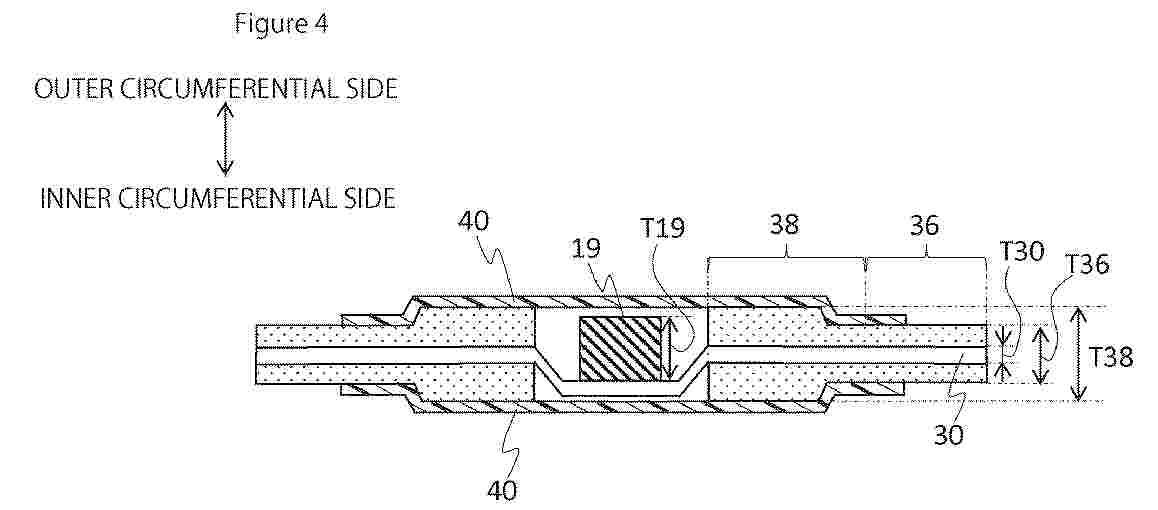
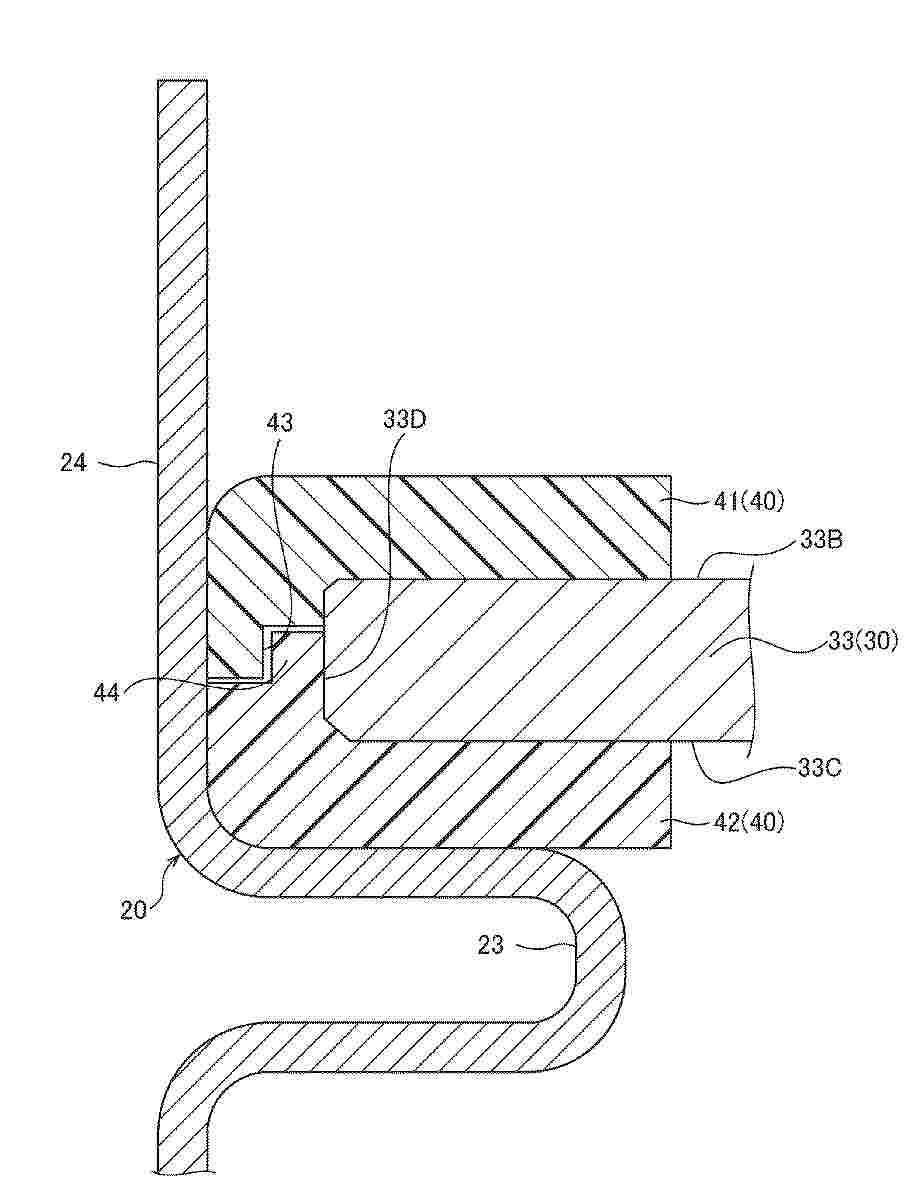
0001 This secondary battery comprises: an electrode body that is obtained by winding a positive electrode and a negative electrode with a separator interposed therebetween; a cylindrical outer can (20) that has a bottom part and that houses the electrode body; a sealing body (30) that closes an opening (24) of the outer can (20); and an annular gasket (40) that is interposed between the outer can and the sealing body (30), the sealing body (30) being fixed by crimping to the opening (24) of the outer can (20) with the gasket (40) interposed therebetween. The secondary battery is characterized in that: the gasket includes a first gasket (41) and a second gasket (42) disposed on the bottom side of the first gasket (41); the sealing body (30) is sandwiched between the first gasket (41) and the second gasket (42) from both sides in the axial direction of the outer can (20); and at least a portion of the first gasket (41) is adjacent to the second gasket (42) in the radial direction of the outer can (20).
Resumen de: EP4803658A1
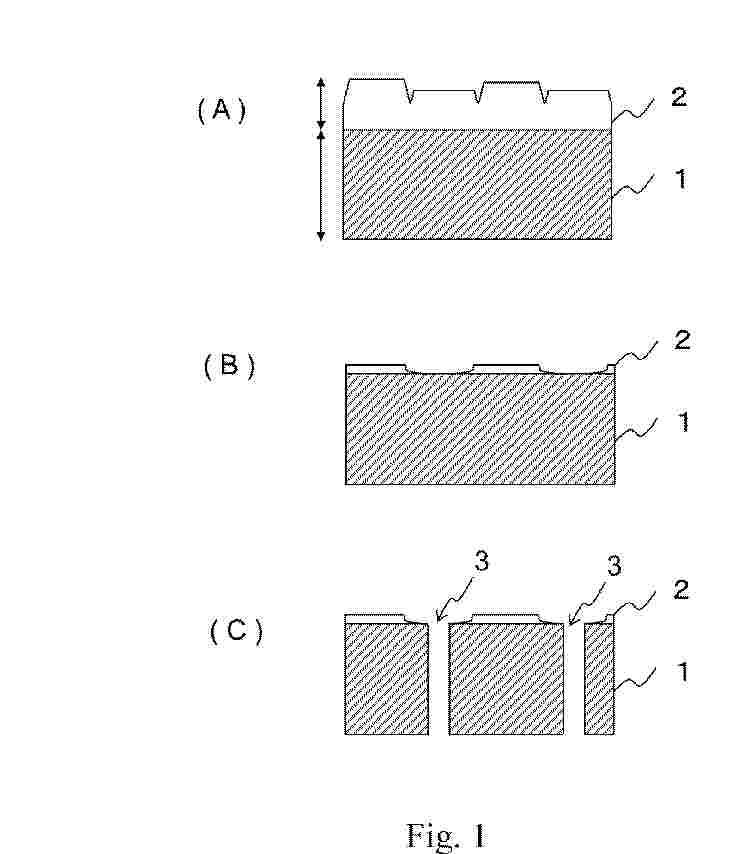
The present invention relates to: a perforated aluminum foil suitably used for a current collector for a power storage device; and a method for manufacturing same. The present invention provides a method for manufacturing a perforated aluminum foil having a plurality of through-holes penetrating in the thickness direction thereof, the method comprising: an alkaline cleaning step for bringing a first aqueous composition containing 1-10 mass percent inclusive of an alkali into contact with the surface of an aluminum foil; and a through-hole forming step for forming the through-hole in the thickness direction of the aluminum foil by bringing a second aqueous composition containing 1-30 mass percent inclusive of halide ions into contact with the surface of the aluminum foil within 20 minutes after the alkaline cleaning step. Also provided is a perforated aluminum foil having a prescribed breaking strength, average pore diameter, and maximum pore diameter/average pore diameter.
Resumen de: EP4804373A1
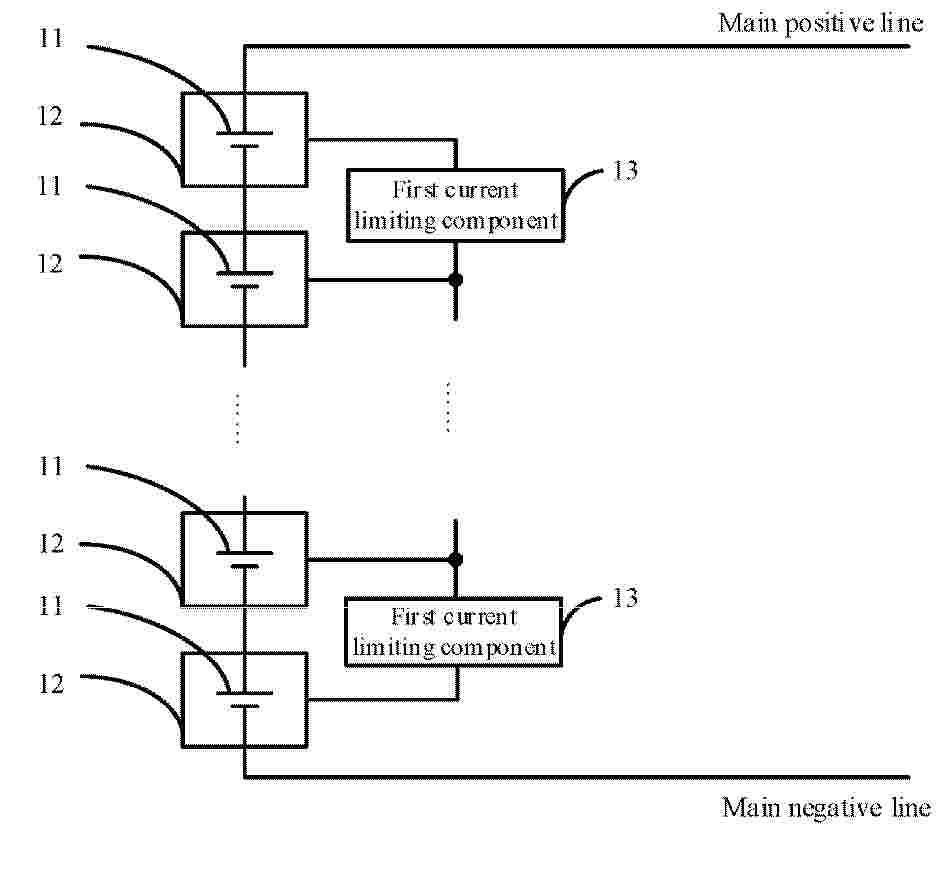
0001 An energy storage circuit and a power supply apparatus, belonging to the technical field of power supplies. The energy storage circuit comprises a main positive line, a main negative line, at least one first current limiting component and a battery module connected between the main positive line and the main negative line. The battery module comprises a plurality of battery components which are sequentially connected in series; the plurality of battery components are respectively supported in a one-to-one correspondence by a plurality of support members; the battery components are insulated from the support members; and each first current limiting component is connected between two adjacent support members and is used for limiting the current between the two adjacent support members. Therefore, in case of double-point insulation failures across electrical boxes (support members), the present application reduces short-circuit currents, thus reducing the possibility of causing high-voltage sparking and battery combustion or explosion.
Resumen de: EP4803657A1
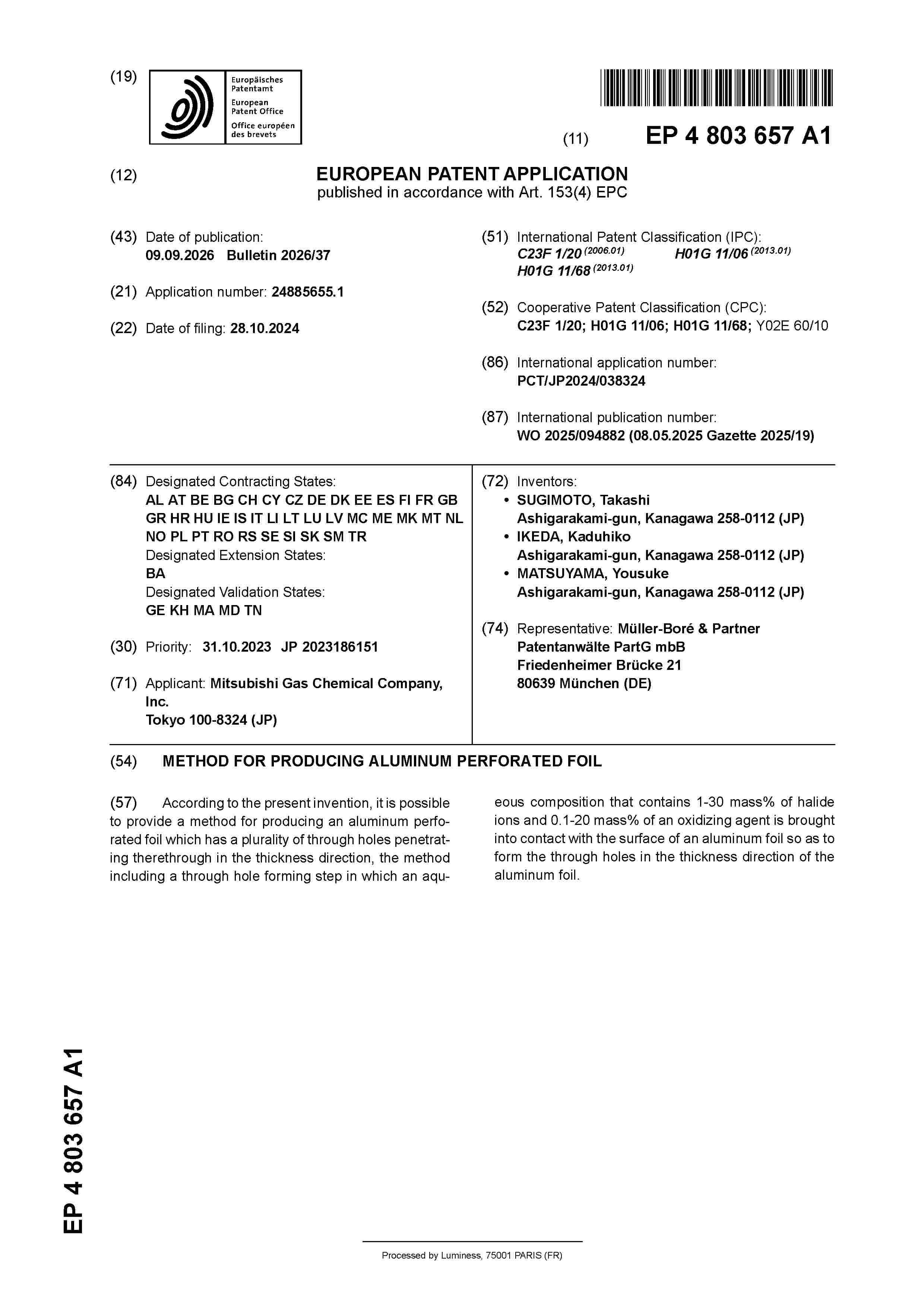
According to the present invention, it is possible to provide a method for producing an aluminum perforated foil which has a plurality of through holes penetrating therethrough in the thickness direction, the method including a through hole forming step in which an aqueous composition that contains 1-30 mass% of halide ions and 0.1-20 mass% of an oxidizing agent is brought into contact with the surface of an aluminum foil so as to form the through holes in the thickness direction of the aluminum foil.
Resumen de: EP4804255A1
Disclosed is a negative electrode (12) for secondary batteries, which includes a negative electrode current collector (40) and a negative electrode mixture layer (41) that is formed on the surface of the negative electrode current collector (40). This negative electrode (12) for secondary batteries is characterized in that: the negative electrode mixture layer (41) includes, as a negative electrode active material, a carbon material and an Si-containing material; the negative electrode mixture layer (41) includes, as a conductive agent, a first conductive agent that has a G/D ratio of not less than 20 but less than 65 as determined by Raman spectroscopic measurement, and a second conductive agent that has a G/D ratio of not less than 0.7 but less than 20 as determined by Raman spectroscopic measurement; and the ratio (W2/W1) of the mass (W2) of the second conductive agent to the mass (W1) of the first conductive agent is less than 2.0.
Resumen de: EP4804242A1
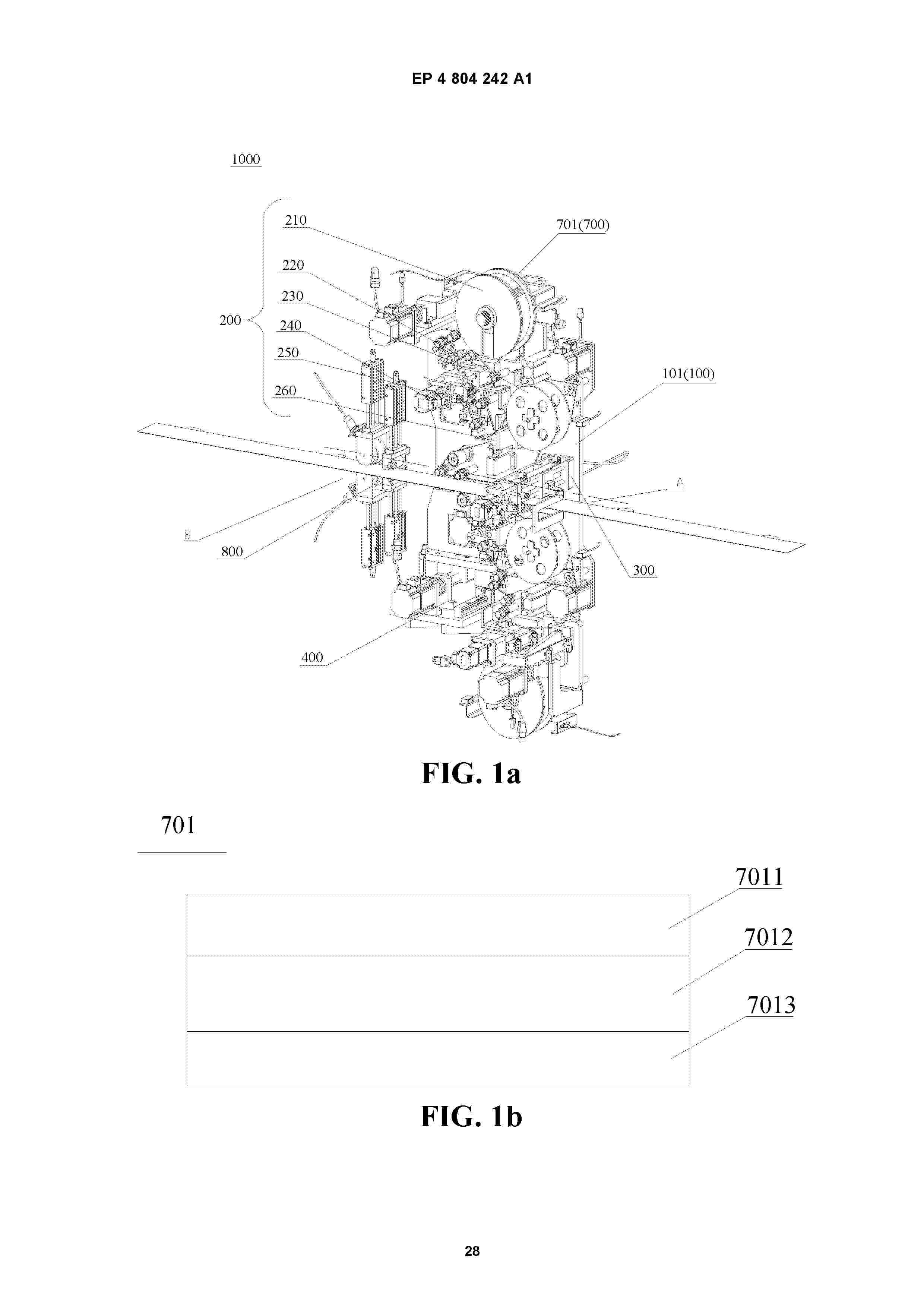
0001 Disclosed in the present application are a hot-pressing roller mechanism, a pressing roller mechanism, an adhesive application device and a battery production system. The hot-pressing roller mechanism comprises a hot-pressing roller and a heating assembly, wherein the heating assembly and the hot-pressing roller are spaced apart from each other; and the heating assembly is configured to perform non-contact heating on the hot-pressing roller. By means of non-contact heating, no structural member is introduced to the surface of the hot-pressing roller, such that the phenomenon of foreign matter being introduced to the surface of an electrode sheet during the process of the hot-pressing roller performing hot pressing on the electrode sheet can be alleviated, thus increasing the adhesive application yield. The hot-pressing roller mechanism is used to perform hot pressing on an electrode sheet to which an adhesive has been applied, and to smooth and compact an adhesive tape on the surface of the electrode sheet, thus enhancing the bonding tightness between the adhesive tape and the electrode sheet, and increasing the adhesive application yield.
Nº publicación: EP4803225A1 09/09/2026
Solicitante:
POSCO CO LTD [KR]
POSCO Co., Ltd
Resumen de: EP4803225A1
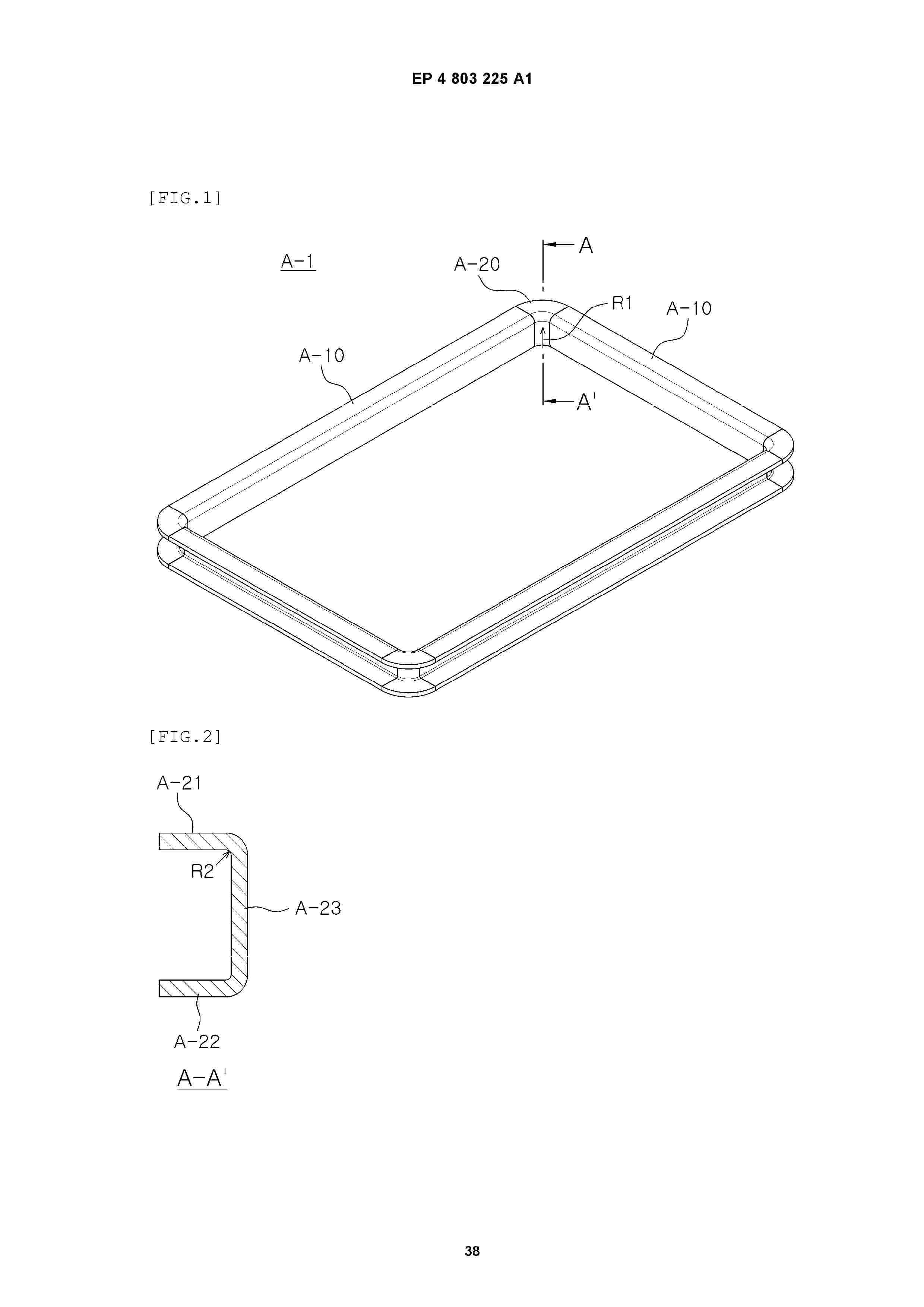
One aspect of the present invention relates to a steel suitable for hot press forming and, more specifically, to an aluminum-based plated steel sheet for hot press forming, a hot press-formed member and manufacturing methods therefor. In addition, another aspect of the present invention relates to: a forming device for forming a high-strength steel; a forming method; a battery case bracket formed thereby; and a battery pack module.
 BOPI
BOPI
 Sede Electrónica