Si deseas distinguir tus productos, servicios o ambos de los de otra empresa, es posible que necesites una marca o nombre comercial. Descubre qué son, en qué consiste su procedimiento de registro y qué implica.

Información sobre los plazos de presentación de solicitudes de transformación de marcas de la Unión Europea en marca nacional española. Más información


Si tienes un nuevo dispositivo, producto o procedimiento que resuelva un problema técnico o tenga una ventaja práctica, existen distintas formas de protegerlo en España y en otros países. Descubre cómo hacerlo.

¿Tu innovación reside en la estética, la ornamentación o la apariencia de tu producto? Protégela mediante un diseño industrial. Descubre qué derechos confiere el registro y cómo realizar la tramitación.

Las indicaciones geográficas protegen el nombre de un producto originario de una zona geográfica, a la cual le debe una determinada calidad, reputación u otra característica. Descubre qué son, en qué consiste su procedimiento de registro y qué beneficios conceden.

Las patentes publicadas en todo el mundo son una valiosa fuente de información científica, técnica y comercial.

Si eres emprendedor/a o una empresa y quieres potenciar y mejorar la rentabilidad de tu negocio protegiendo de forma adecuada los activos intangibles de tu organización, en este espacio encontrarás lo necesario.


 158
resultados
158
resultados
 Última actualización
22/09/2026 [07:27:00]
Última actualización
22/09/2026 [07:27:00]


 Resultados 100 a 125 de 158

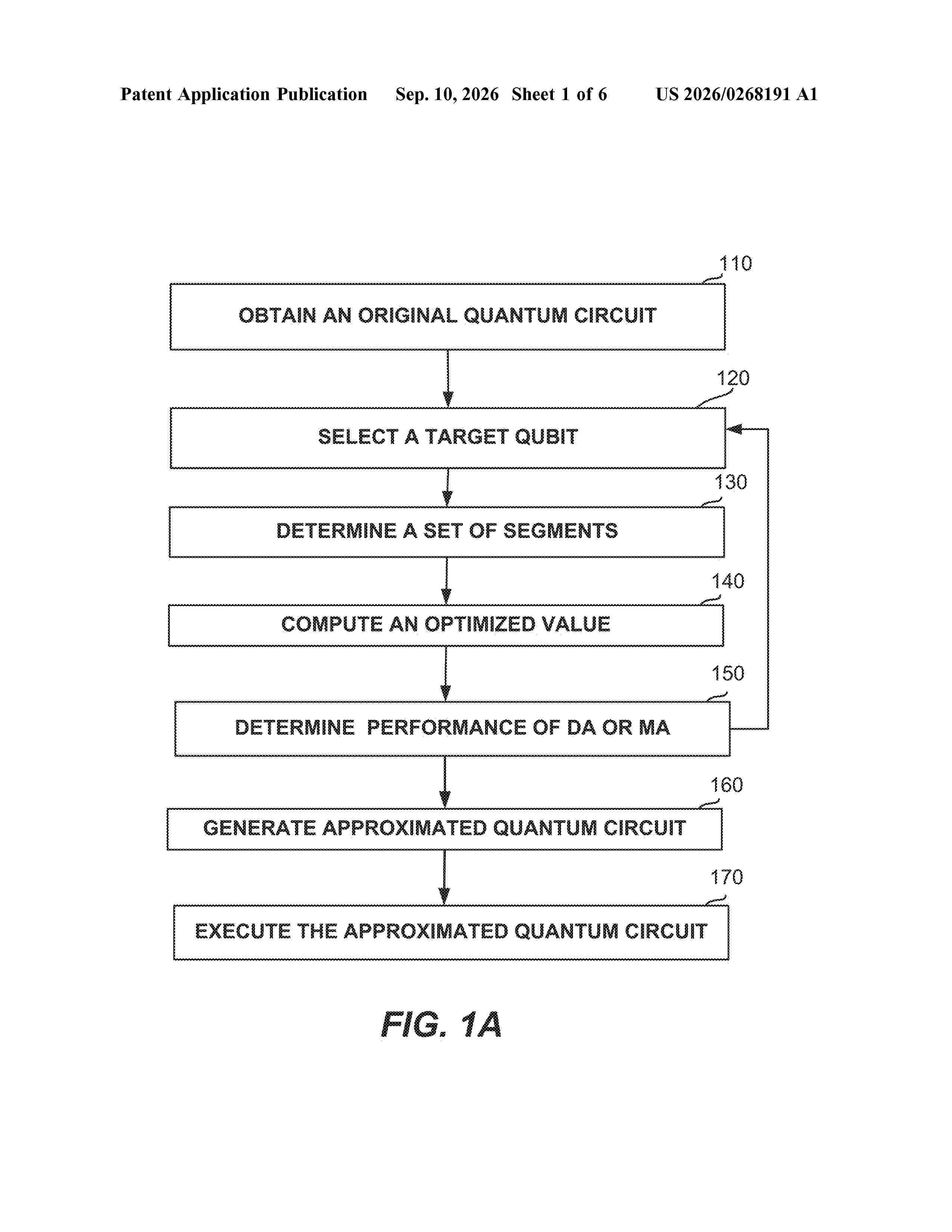
Resumen de: US20260268191A1
0000 A method, apparatus, and non-transitory computer readable medium comprising: obtaining an original quantum circuit comprising a plurality of quantum gates and qubits; selecting a target qubit; determining a set of segments for the target qubit based on 2-qubit gates operating on the target qubit. Further comprising: computing an optimized value of a target function comprising decision variables, each corresponding to a different segment, said computing comprising determining a value assignment for each decision variable; determining, for each segment, based on the value assignment for a corresponding decision variable, whether to perform magnitude approximation; and generating an approximated quantum circuit based on the determining.

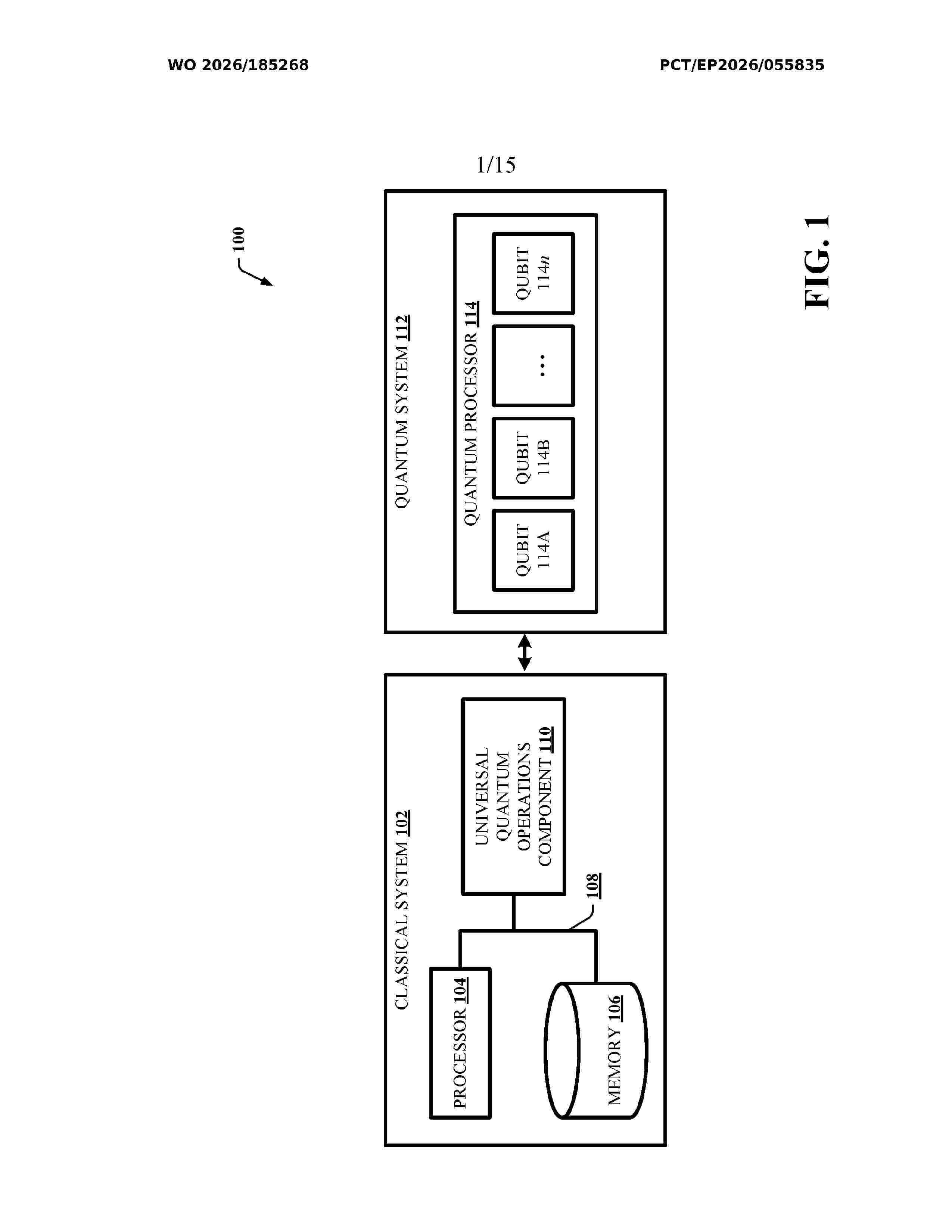
Resumen de: WO2026185268A1
One or more systems, devices, computer program products and/or computer-implemented methods of use provided herein relate to modular fault-tolerant quantum computing. For example, a system can comprise a memory that can store computer executable components and a processor that can execute the computer executable components stored in the memory. The computer executable components can comprise an operation component that performs, on a quantum processor, stabilizer operations on logical qubits encoded in a quantum error correction code. The computer executable components can further comprise an execution component that performs, on the quantum processor, universal quantum operations on the logical qubits using the stabilizer operations, wherein the stabilizer operations consume magic state.
Resumen de: DE102025108884A1
Ein Verfahren zur Erhöhung einer Kohärenzzeit während einer Quantenberechnung mit mindestens zwei Qubits ist angegeben, wobei das Verfahren umfasst:- Anlegen eines Quantengatters an die mindestens zwei Qubits,- Anlegen einer Signalsequenz an die mindestens zwei Qubits zumindest während einer Evolutionszeit des Quantengatters, so dass die Kohärenzzeit der mindestens zwei Qubits während der Quantenberechnung erhöht wird, wobei- die Signalsequenz mindestens zwei Signalsequenzblöcke umfasst,- jeder Signalsequenzblock eine Amplitude und eine Phase aufweist,- mindestens zwei Phasen von aufeinanderfolgenden Signalsequenzblöcken voneinander verschieden sind, und- die Amplitude vorbestimmt ist, um Rabi-Oszillationen für die mindestens zwei Qubits zu induzieren, wobei die Rabi-Oszillationen eine verstimmte Frequenz haben, die nah-resonant mit einer Fallenfrequenz ist.Ferner werden eine Vorrichtung, ein Quantencomputer, ein Computerprogramm und ein computerlesbares Speichermedium angegeben.
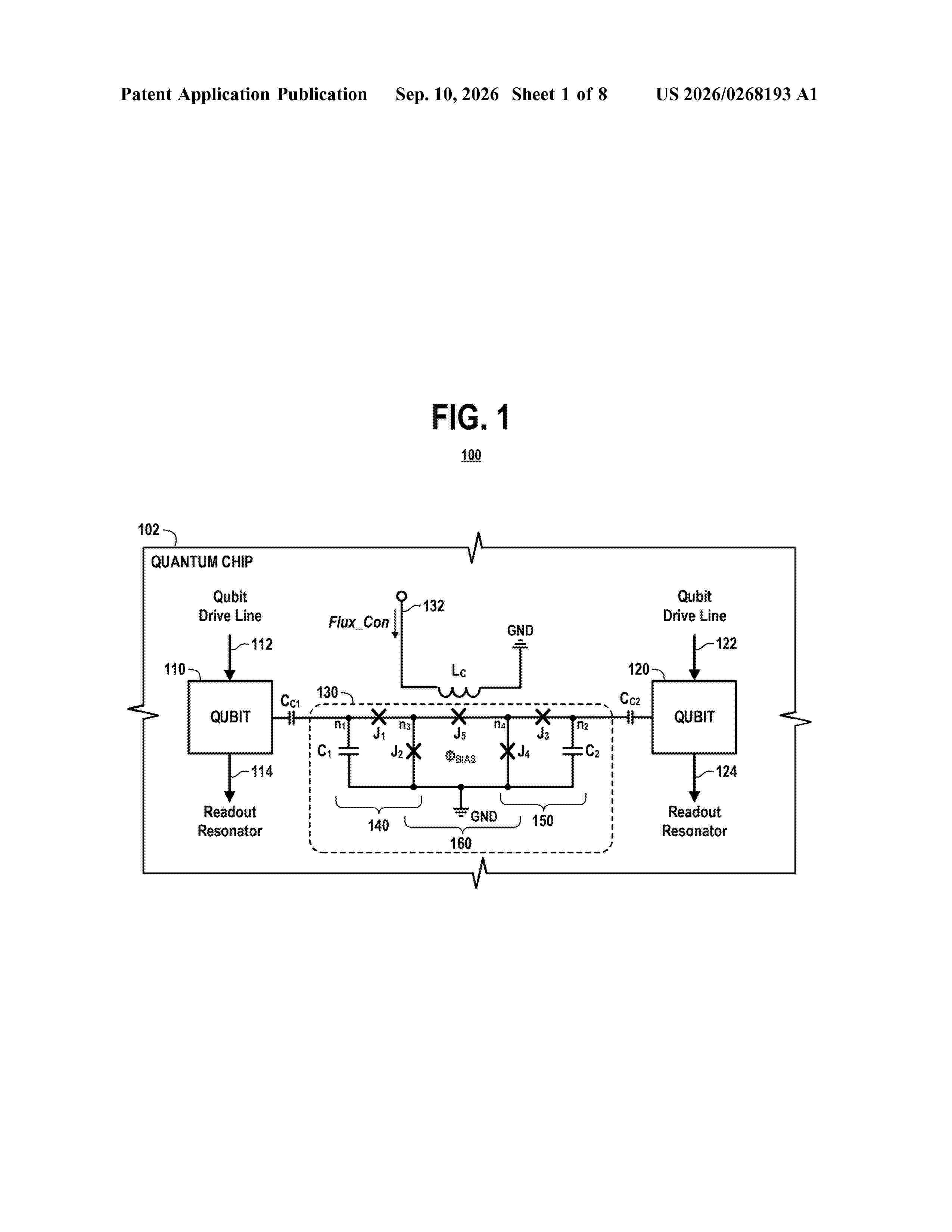
Resumen de: US20260268193A1
A device comprises a superconducting integrated circuit which comprises a tunable coupler. The tunable coupler comprises a first node, a second mode, a first transmon, a second transmon, and a flux-tunable inductive coupler. The first node is coupled to a first quantum bit, and the second node is coupled to a second quantum bit. The first transmon comprises a first Josephson junction, and the second transmon comprises a second Josephson junction. The flux-tunable inductive coupler comprises a superconducting loop that couples the first transmon and the second transmon. The superconducting loop comprises a third Josephson junction. The first Josephson junction, the second Josephson junction, and the third Josephson junction are coupled in series between the first node and the second node of the tunable coupler.
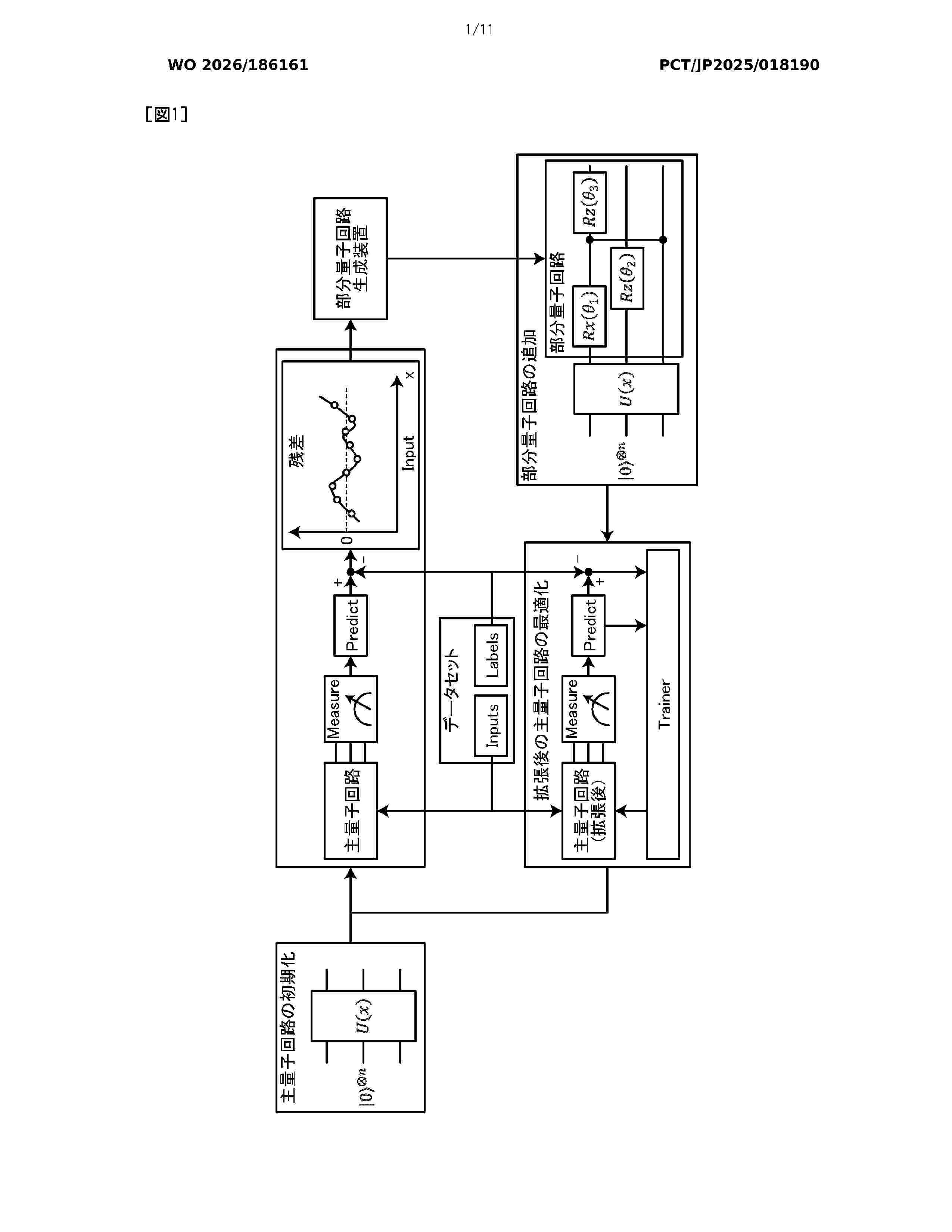
Resumen de: WO2026186161A1
This quantum circuit optimization method includes: a step for generating a data input circuit; a step for calculating a residual pattern of output data of a target task by a main quantum circuit including the data input circuit; a step for generating a partial quantum circuit by using a partial quantum circuit generation device; a step for expanding the main quantum circuit by adding the generated partial quantum circuit to the end of the main quantum circuit; and a step for optimizing the main quantum circuit in a state where a parameter of the most-recently-added partial quantum circuit is set as an optimization target and where a parameter of a part other than the most-recently-added partial quantum circuit is set to have been optimized. The step for calculating the residual pattern, the step for generating the partial quantum circuit, the step for expanding the main quantum circuit, and the step for optimizing the main quantum circuit are repeated until a termination condition is satisfied.
Resumen de: WO2026188112A1
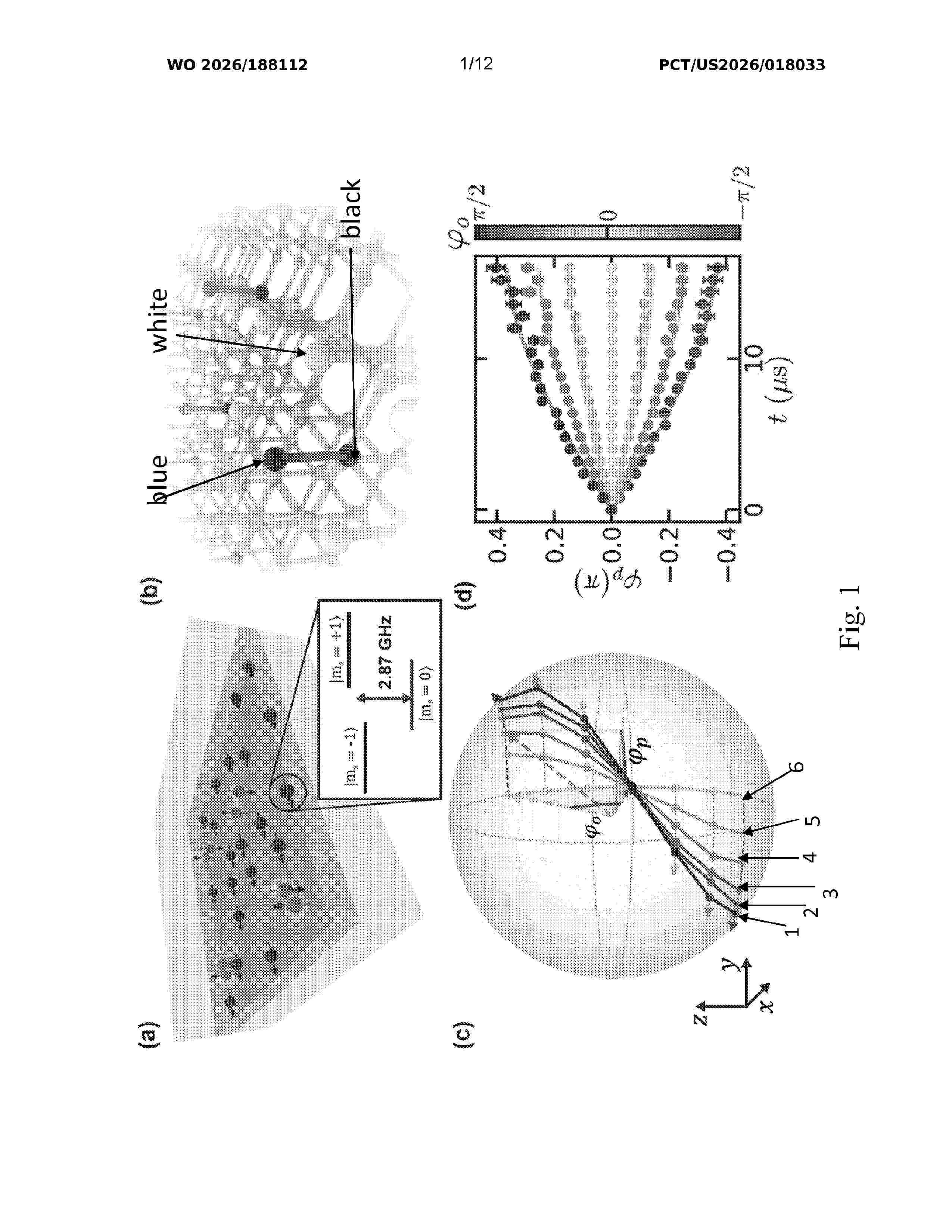
Described herein are methods of generation of metrologically useful many-body entanglement, for example, spin squeezing, in a solid-state spin ensemble.
Resumen de: EP4804087A1
0001 According to an aspect of an embodiment, operations include obtaining initial quantum circuit comprising entangling gates to generate first randomized quantum circuits by applying RC protocol on initial quantum circuit. The operation further includes obtaining first combined measurement results by executing first plurality of randomized quantum circuits on quantum computer. The operation includes generating plurality of random noise-magnified quantum circuits by applying ZNE protocol on initial quantum circuit. The operation further includes generating second randomized quantum circuits by applying RC protocol on each random noise-magnified quantum circuit and obtaining second combined measurement results by executing second plurality of randomized quantum circuits on quantum computer. Finally, operation includes generating final measurement results for initial quantum circuit by applying extrapolation method on first combined measurement results and second combined measurement results.
Resumen de: EP4804088A2
The present disclosure relates to a device and a method for quantum computing using a plurality of neutral atoms in an array of optical traps, wherein a first internal state of the neutral atoms serves as qubit ground state |o>, and a second internal state serves as qubit excited state |1>. According to the present disclosure, a local single-qubit gate operation on a qubit may be performed comprising locally and selectively illuminating the qubit prepared in a superposition state |s> of qubit ground state |o> and qubit excited state |1> with a qubit addressing laser at a first qubit addressing laser frequency to cause a differential Stark shift for the qubit ground state |o> and the qubit excited state |1>, Further, a local two-qubit gate operation may be performed on a pair of qubits comprising locally and selectively illuminating the pair of qubits prepared in the qubit ground state |o> with the qubit addressing laser at a second qubit addressing laser frequency for coupling the pair of qubits to a Rydberg state |r> of the neutral atoms preferably via a third internal state c> of the neural atoms that can serve as an intermediate state of a two-photon transition from the qubit ground state |o> to the Rydberg state |r>.
Resumen de: EP4804089A1
A method of correcting errors in a repetition code protected quantum memory, comprising an initial step of measuring parities between adjacent qubits along a one dimension presentation of the code, and locating apparent defects on a map of said one dimension presentation of the code on the basis of the measured parities, and a subsequent treatment step during which each site of the map is associated with a local automaton, the local automaton displacing apparent defects along the map on the basis of a simulated attractive interaction between apparent defects, said interaction being simulated with local memory and communicated from site to site, the automaton erasing apparent defects by pairs when pairs of apparent defects become adjacent on the map.
Resumen de: WO2025096317A1
Various embodiments provide methods, apparatuses, systems, or computer program products for providing dynamic control of a signal. In an example embodiment, a system comprises a signal generator, a controller configured to control operation of the signal generator, a first signal path between the signal generator and an output connected to an electrode of an ion trap, and a selectively connectable second signal path between the signal generator and the output to bypass the low pass filter. The signal generator is configured to generate a signal comprising a first frequency component having a first range of frequencies and/or a second frequency component having a second range of frequencies higher than the first range of frequencies. The first signal path comprises a low pass filter to filter noise above the first range of frequencies. The second signal path comprises a bandpass filter to permit the second frequency component to pass from the signal generator to the output.
Resumen de: WO2025091073A1
Aspects of the present disclosure provide a quantum processing device comprising: a nuclear spin register comprising at least two nuclear spin qubits; at least one unpaired electron coupled to the nuclear spin register; and a control system configured to: control and/or readout the electron spin qubit; control and/or readout a nuclear spin qubit; and reduce errors arising from dipolar coupling between the nuclear spin qubits and/or between the electron spin and nuclear spins.
Resumen de: WO2025093256A1
Define a plurality of qubit collision types and a plurality of constraints. For a group of qubits, use a computerized mixed-integer programming solver to, subject to the constraints, iteratively minimize collisions by minimizing a sum of products of weights multiplied by an amount of frequency collisions for given ones of the constraints of each one of the collision types. Output a frequency tuning plan for the group of qubits, based on the iterative minimization. Facilitate tuning physical qubits in accordance with the frequency tuning plan.
Resumen de: US20250148335A1
0000 With a computerized frequency plan generator, for each node in a quantum lattice: determine a list of possible frequencies subject to at least one of nearest neighbor and next nearest neighbor collision constraints; and assign a highest possible frequency; apply a collision cleaning routine to the quantum lattice with the assigned frequencies until at least one of a condition where there are no remaining collisions and a condition where collision count ceases to improve; and apply a frequency perturbation routine to the collision-cleaned quantum lattice to move apart at least one of a high-risk nearest neighbor collision and a high risk next nearest neighbor collision.
Resumen de: WO2025094047A1
Apparatus (20) for quantum computing includes an ion trap (24), which is configured to hold a first array of ions (40) in respective positions along an array axis (38). A radiation source (28) is configured to emit a second array of beams of coherent radiation, including first beams having respective first intensities (64) and having frequencies chosen to excite selected internal transitions of the ions and second beams having second intensities (66) at least ten times greater than any of the first intensities, and to switch respective locations of the first and second beams within the second array. Optics (82) focus the beams into the ion trap such that each beam in the second array is incident on a respective ion in the first array.
Resumen de: WO2025093134A1
The present invention is related to a quantum computing arrangement comprising a plurality of qubits, to a quantum computing system comprising a plurality of said quantum computing arrangements, to a method of implementing, on a quantum computing system, a quantum error correction code, said quantum computing system comprising the quantum computing arrangement, and to the use of a quantum computing system or a quantum computing arrangement for implementing a quantum error correction code.
Resumen de: WO2025096761A1
In a general aspect, quantum programs are executed on modular quantum processing units in a quantum computing system. In some implementations, a method includes receiving a quantum program including a sequence of quantum logic operations; decomposing the sequence of quantum logic operations into an equivalent sequence of quantum logic gates; and segmenting the sequence of quantum logic gates into an equivalent sequence of quantum circuit widgets. Each quantum circuit widget includes a subset of the quantum logic gates in the sequence and corresponds to a time slice of the quantum program. The quantum circuit widgets are compiled to produce a set of compiled quantum circuit widgets to be executed on multiple quantum processor modules of the quantum computing system.
Resumen de: WO2025101869A1
Methods, systems and apparatus for determining an effect of uncontrolled quantum state transitions in a noisy quantum computation performed by a quantum computing device, where the noisy quantum computation comprises execution of a quantum circuit that is represented by one or more quantum channels. In one aspect, the uncontrolled quantum state transitions are approximated as incoherent uncontrolled quantum state transitions through application of a random phase approximation to the one or more quantum channels to obtain a modified quantum circuit that is represented by one or more incoherent quantum channels. The incoherent quantum channels preserve incoherence between computational subspaces and environmental subspaces for the one or more quantum channels. A simulation of the modified quantum circuit is then performed using a qubit simulation of the modified quantum circuit.
Resumen de: GB2704546A
An ion shuttling control system 300 is disclosed for use in trapped ion quantum computing. The ion shuttling control system includes a controller 302 configured to generate a first operation code, the first operation code indicating a first ion manipulation operation of a plurality of ion manipulation operations and a first set of electrodes of a plurality of sets of electrodes 362 of an ion trap; a plurality of digital-to-analog converters (DACs) 354 configured to generate a first set of analog waveforms, the first set of analog waveforms being selected based on the first operation code; and a switching network 356 configured to provide the first set of analog waveforms to the first set of electrodes, the first set of electrodes being selected based on the first operation code. Figure 3
Resumen de: US12288293B1
A virtual facility system may include a storage system, a data engine, an integration system, a virtual facility interface system, and a simulator engine. The storage system may store data including video of the real facility. The data engine may train a neural rendering model of the real facility based on the data providing a photorealistic three-dimensional representation of the real facility. The integration system may provide one or more interfaces facilitating communication with one or more control systems associated with the real facility including a management system providing historical or live inventory tracking data and facility operations process data characterizing of locations and tasks corresponding with inventory items or materials stored or handled in the real facility. The virtual facility interface system may provide access to information stored in a virtual facility. The simulator engine may simulate novel views generated based on the neural rendering model.
Resumen de: US20250142796A1
0000 An interference reduction device is provided. The interference reduction device may include a magnetic shield positioned in proximity of a magnetic field. The magnetic shield is configured to reduce interference on the magnetic field along the direction of the magnetic field. The magnetic shield may include a cutout approximately parallel to the direction of the magnetic field, the cutout is configured to reduce a distortion caused by the magnetic shield on the magnetic field.
Resumen de: US20260260711A1
A non-transitory computer-readable recording medium stores therein a program that causes a computer to execute a process including dividing a molecule into a plurality of fragments, calculating, for each of the fragments, a first eigenvalue for each of bath orbitals included in the fragments, calculating a second value for each of the bath orbitals based on the first eigenvalue, sorting the second values in a descending order and deriving a cumulative distribution function of the second values, determining the number of the bath orbitals for which a cumulative probability of the cumulative distribution function is greater than a predetermined threshold value, selecting the bath orbitals corresponding to the second values from a largest one among the second values sorted in the descending order, in the number equal to the determined number of the bath orbitals, and calculating an energy of the molecule using the selected bath orbitals.
Resumen de: US20260260710A1
A computer-readable recording medium stores therein a program for causing a computer to execute a process, the process includes calculating an energy of a molecule, based on an energy of each of a plurality of fragments obtained by dividing a structure of the molecule by a molecule dividing method, the calculating the energy including: calculating, for a first fragment among the plurality of fragments, a first problem using a first Hamiltonian corresponding to the first fragment, and calculating a first energy corresponding to the first fragment using a result of calculating the first problem; and calculating, for a second fragment among the plurality of fragments and corresponding to a second Hamiltonian identical or similar to the first Hamiltonian, a second energy corresponding to the second fragment using a result of calculating the first problem.
Resumen de: US20260260152A1
0000 A computer-readable recording medium stores therein a program for causing a computer to execute a process, the process including: calculating energy of a molecule based on energy of each of multiple fragments obtained by dividing a structure of the molecule by a molecule dividing method, the calculating including: estimating, for each of the multiple fragments, a candidate value from which noise has been removed, based on multiple candidate values that are calculated by a variational quantum eigenvalue solver, each of the multiple candidate values being calculated for each of a multiple parameters of a first variational quantum circuit representing a Hamiltonian of the each of the multiple fragments, the each of the multiple candidate values being a potential solution of the parameter; and calculating, for each of the multiple fragments, an energy thereof based on the candidate value from which noise has been removed and estimated for each of the multiple parameters.
Resumen de: EP4804086A1
0001 A method may include generating directed graphs, each of the directed graphs representing a quantum circuit. The method may also include evaluating each of the directed graphs according to operation of the quantum circuit represented by each of the directed graphs. The method may include selecting one of the directed graphs based on the evaluations. The method may further include transforming the selected directed graph to generate a second directed graph.
Nº publicación: EP4802868A1 09/09/2026
Solicitante:
MICROSOFT TECHNOLOGY LICENSING LLC [US]
Microsoft Technology Licensing LLC
Resumen de: WO2025093114A1
First and second device terminals of a multi-terminal quantum device (200) are coupled to first and second external measurement terminals respectively, whilst a device ground terminal is coupled to an external ground terminal. The device ground terminal is coupled to the external ground terminal via two parallel ground lines (101, 102). A first of these ground lines (101) includes a voltage measurement device (105), and a second ground line (102) comprises a voltage generator (106). A controller (103) receives as input a time-varying voltage measurement on the first line (101), and uses this measurement to generate a control signal to the voltage generator (106). The control signal causes the voltage generator (106) to generate a time-varying stabilization voltage on the second ground line (106) in order to mitigate or cancel any residual voltages on the device ground terminal.
 BOPI
BOPI
 Sede Electrónica