Resumen de: US20260152531A1
0000 Provided herein is a synthetic polypeptide derived from High Mobility Group Box 1 (HMGB 1) host protein that can both disrupt bacterial biofilms and prevent Neutrophil Extracellular Trap (NET) formation. Also provided herein are methods to disrupt aberrant or excessive NET formation that are particularly well-suited to treat high-risk populations such as those infected with SARS CoV-2, sepsis, autoimmune diseases e.g., systemic lupus erythematosus, rheumatoid arthritis, Type I diabetes mellitus, small vessel vasculitis, autoinflammatory diseases e.g., gout, inflammatory bowel disease, and metabolic diseases e.g., Type 2 diabetes and obesity.
Resumen de: WO2026112937A1
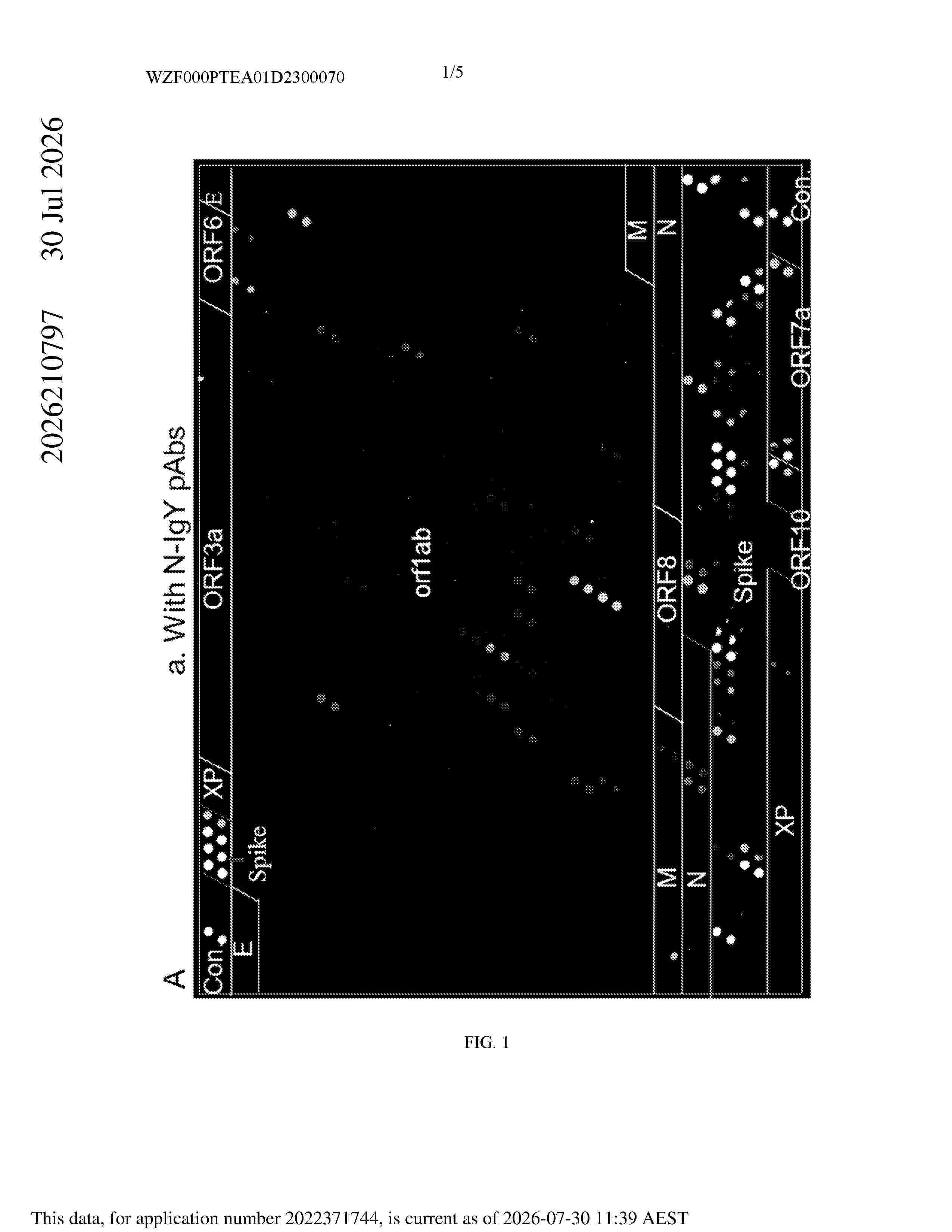
Relate to an isolated vNAR single domain antibody that specifically binds to SARS-CoV-2 nucleocapsid protein, and a process for preparing the same.This isolated vNAR single domain antibody are also included.
Resumen de: WO2025022303A1
The present invention relates to monoclonal antibodies or antigen-binding portion thereof that have a potent neutralizing activity against Coronavirus, in particular against at least one virus selected from SARS-CoV-2, SARS-CoV-1 and variants thereof. The invention relates also to the use of such monoclonal antibodies or antigen-binding portion thereof in therapy, prophylaxis, and diagnosis of Coronavirus, in particular SARS-CoV-2 and/or SARS-CoV-1 dependent diseases.
Resumen de: EP4751641A2
Disclosed are methods and devices for analyzing non-volatile organics in exhaled breath and other aerosols using various diagnostic tools that enable rapid, low cost point of care assays for several diseases including respiratory tract diseases such as COVID-19. The disclosed methods and systems selectively capture non-volatile organics in exhaled breath and other aerosols in a packed bed column. The non-volatile organics are eluted and samples are analysis using diagnostic devices including MALDI-TOFMS. The disclosed systems and methods provide for a diagnostic test result in less than about 20 minutes and provides for autonomous operation with minimal human intervention.
Resumen de: EP4751733A2
The present invention relates to method of producing a lipidated protein, a pharmaceutical composition comprising the protein of any of SEQ ID NOs: 1, 2, and/or 3 and/or the lipidated form of a protein comprising the protein of SEQ ID NO: 7 (C-TAB.GS) and/or SEQ ID NO: 8 (C-TAB.G5.1), especially the protein of SEQ ID NO: 12 (Lip-C-TAB.G5.1), and/or a lipidated form of a protein comprising the protein of SEQ ID NO: 15 (Spike protein of SARS-CoV-2) and/or a lipidated form of a protein comprising the any of the proteins of SEQ ID NOs: 16-22 (hMPV F protein), and the pharmaceutical composition for use as a medicament, particularly a vaccine and/or for use in a method for eliciting an immune response in a human against Lyme disease, a disease caused by Clostridium difficile or hMPV and/or of SARS-CoV-2 (COVID-19).
Resumen de: KR20260080874A
본 발명은 코로나19에 따른 제주 입도수요 충격 데이터 보정 방안을 기반으로한 모델 학습을 위한 충격 데이터 보정 방안 연구 에 관한 것으로서 제주 관광 수요 예측 정확도를 높이고 외부 충격에 대한 대응 능력을 강화하는 데 기여한다. 또한 체계적 표준화가 미흡한 현 관광 산업의 데이터 분석 환경에 새로운 방법론을 제시함으로써, 데이터 기반의 과학적 분석과 의사 결정이 가능한 체계를 구축하는 데 기여할 것으로 기대된다.하도록 함으로써 기존의 제주도 관광 산업은 지역 GRDP의 21%를 차지하며 2023년 관광객 1,400만 명을 기록했다. 그러나 관광 수요예측은 계절, 경제, 사회적 요인의 영향 및 복잡한 비선형 관계를 가지고 있어 선형 중심의 전통적 통계모형으로는 외생 요인들의 영향을 효과적으로 반영하기 어렵다. 특히 코로나19와 같은 충격 데이터를 단순 제거하면 중요한 정보가 손실될 수 있다. 따라서 본 연구는 통계모형과 기계학습을 결합해 충격 데이터의 특성을 반영한 새로운 관광 수요 예측 방법을 제시한다. 문제점을 해소 하도록 한 것이다.즉 본 발명은, 기존 관광 산업의 수요예측은 기본적 통계모델(Arima)로만 진행됨 에 있어서 통계모형과 기계학습을 결합해 충격 데이터의 특성을 반영한 새로운 관광 수�
Resumen de: US12643063B1
0000 The present development is a nanofilter, i.e. a filter material that comprises inorganic nanowires impregnated into a non-woven polymer or cloth fabric material. The nanofilter comprises a fabric infiltrated with a nanowire powder slurry selected from anatase titania (TiO<2>), zinc oxide (ZnO), silica, tin oxide, alumina (Al<2>O<3>), or combinations thereof. Exemplary fabrics include a non-woven polymer and a cotton fabric cloth. The nanowire powder slurry effectively produces a coating on the fabric. Optionally, the nanowires may be functionalized using nanoparticles and/or disinfecting salt particles. The infiltrated nanowires form a porous network with sub-micron scale openings and provide filtration of any airborne particles, liquid droplets and viruses including COVID 19. The nanofilter may be used in a variety of applications, such as a nanofilter respirator as described herein.
Resumen de: MX2026005926A
This disclosure relates to the field of RNA to prevent or treat coronavirus infection. In particular, the present disclosure relates to methods and agents for vaccination against coronavirus infection and inducing effective coronavirus antigen-specific immune responses such as antibody and/or T cell responses. Specifically, in one embodiment, the present disclosure relates to methods comprising administering to a subject RNA encoding a peptide or protein comprising an epitope of SARS-CoV-2 spike protein (S protein) for inducing an immune response against coronavirus S protein, in particular S protein of SARS-CoV-2, in the subject, i.e., vaccine RNA encoding vaccine antigen.
Resumen de: WO2025090605A1
The present disclosure provides compounds, pharmaceutically acceptable compositions thereof, and methods of using the same.
Resumen de: MX2026005520A
Disclosed are monoclonal antibodies, antigen binding fragments, and multi-specific antibodies that specifically bind a coronavirus spike protein, such as SARS-CoV-2. Also disclosed is the use of these antibodies and multi-specific antibodies for inhibiting a coronavirus infection, such as a SARS-CoV-2 infection. In addition, disclosed are methods for detecting a coronavirus, such as SARS-CoV-2, in a biological sample, using the disclosed antibodies and multi-specific antibodies.
Resumen de: CN122104579A
The invention discloses a method for inducing Breg cell proliferation in vitro. Comprising the following steps: (1) culturing a B cell from a mammal in a culture medium containing a CD40 antibody; (2) adding an SARS-CoV-2 virus antigen into the culture system, wherein the SARS-CoV-2 virus antigen is selected from one or more of N protein, S protein specific epitope peptide fragment or S protein S1 subunit containing RBD region; and (3) culturing for 24-96 hours to realize the induction of the Breg cells. According to the invention, the SARS-CoV-2 specific protein antigen is used to significantly increase the ratio of transformation from B cells to Breg cells, and specific induction of Breg (CD19 + IL-10 +) cell proliferation and differentiation under in vitro conditions is realized.
Resumen de: CN122103351A
The invention belongs to the technical field of biological medicine, and particularly relates to an anti-ACE2 antibody and application thereof. The antibody or the antigen binding fragment of the antibody provided by the invention comprises HCDR1, HCDR2 and HCDR3 which are contained in VH as shown in SEQ ID NO: 1, and LCDR1, LCDR2 and LCDR3 which are contained in VL as shown in SEQ ID NO: 2. The antibody provided by the invention can block the combination of spike proteins of all variants and ACE2 in a broad spectrum on the premise of not interfering the enzymatic activity of ACE2, and has an excellent SARS-CoV-2 treatment effect.
Resumen de: KR20260078113A
본 발명은 오시머티닙(osimertinib)을 유효성분으로 포함하는 SARS-CoV-2 바이러스 또는 SARS-CoV-2 변이체 바이러스에 대한 항바이러스용 조성물에 관한 것으로서, 세포 생존율 감소와 무관하게 hACE2를 발현하는 세포 및 3D 스페로이드에 처리 시 야생형뿐만 아니라 변이체 바이러스의 감염이 감소되는 효과를 가지므로, ARS-CoV 바이러스 또는 SARS-CoV-2 변이체 바이러스의 감염 예방, 개선 및 치료에 사용할 수 있을 것으로 기대된다.
Resumen de: CN122122163A
Disclosed are glycan compounds and their use for treating or inhibiting the development of viral infections, particularly coronavirus infections, such as SARS-CoV-2 infections, in a subject, or for treating a condition associated with a viral infection, such as an acute inflammatory condition, cytokine release syndrome (CRS) or cytokine storm, severe acute respiratory syndrome (SARS) or acute respiratory distress syndrome (ARDS).
Resumen de: CN122103255A
The invention discloses a human respiratory coronavirus cross-reactive T cell epitope map and a delivery method thereof. A core theoretical basis and an experimental basis are provided for development of broad-spectrum HCoVs immune targets by drawing a cross-reactive T cell epitope map among seven kinds of HCoVs and further screening epitope fragments with high conservative property from identified cross epitopes; then, aiming at conservative epitope fragments obtained through screening, a Venezuela equine encephalitis virus replicon vaccine precise delivery system capable of expressing a single conservative epitope is constructed, targeted delivery of the single conservative cross-reactive T cell epitope is achieved, and the key technical bottleneck of low cross-epitope delivery efficiency in existing HCoVs vaccines is solved.
Resumen de: CA3126560A1
A method of treating or preventing a Coronaviridae infection in a subject comprising administrating a therapeutically effective amount of a compound of Formula I or a stereoisomer, a tautomer, an N-oxide, a solvate, a metabolite, a pharmaceutically acceptable salt or a prodrug thereof, and the Coronaviridae comprises at least one selected from 2019-nCov virus, HCov 229E virus, SARS virus, MERS virus,
Resumen de: WO2026108766A1
Provided herein are live attenuated viruses for protection against respiratory syncytial virus (RSV) and/or coronavirus Sars-CoV-2. The live attenuated chimeric virus strains utilize a master backbone based on a live attenuated influenza virus (LAIV), which includes a deletion of the viral virulence element, the NS1 (non-structural protein 1) (DeLNS1). These chimeric strains are engineered to express one or more antigens of RSV alone or in combination with Sars-CoV-2. The chimeric virus strain can protect a subject in need thereof against a challenge from any of RSV, Sars-CoV-2, influenza, or a combination thereof. This viral vector system offers an important strategy for developing highly attenuated and immunogenic live attenuated vaccines with the capacity to induce protective immunity against the three respiratory infections.
Resumen de: WO2026112441A1
The present disclosure relates to compositions and methods, including prodrugs of (S)-3-(3-(((3,4- dimethoxybicyclo4.2.0octa-1,3,5-trien-7-yl)methyl)(methyl)amino)propyl)-7,8-dimethoxy-1,3,4,5-tetrahydro-2H- benzodazepin-2-one that find use in the treatment of diseases and disorders, such as therapies for cardiovascular disease, including cardiac arrhythmias, including, without limitations, sinus tach (e.g. inappropriate sinus tachycardia (IST)), postural orthostatic tachycardia syndrome (POTS), coronavirus (COVID-19) (e.g. long COVID) and COVID-associated cardiovascular abnormalities, supraventricular tachycardia (SVT), tachycardia (e.g. rapid heart rate, atrial tachycardia), heart failure (e.g. congestive heart failure (CHF), systolic heart failure, pediatric heart failure, chronic heart failure), myocardial ischaemia, angina (e.g. angina pectoris), myocardial infarct, rhythm disturbances (e.g. supraventricular rhythm disturbances), chest pain, cardiomyopathy, coronary artery disease, and left ventricular dysfunction (LVD).
Resumen de: WO2026110758A1
Problem To provide a VHH which specifically binds to receptor binding domains of spike proteins of various types of variants of SARS-CoV2. Solution A VHH having any one or more of the characteristic properties mentioned below can recognize various types of variants of SARS-CoV2. (a) The VHH binds to Wuhan-Hu-1, delta variant, or micron variant of SARS-CoV2. (b) CDR1, CDR2, and CDR3 include the amino acid sequences represented by SEQ ID NOs: 1, 2, and 3, respectively; and/or (c) the VHH recognizes the amino acid sequence represented by SEQ ID NO: 4 and/or the amino acid sequence represented by SEQ ID NO: 5. This fusion protein which is obtained by fusing the VHH with ACE2 or an Fc form thereof enhances the SARS-CoV2 neutralizing capability and can be used in a pharmaceutical composition for treating or preventing COVID-19.
Resumen de: US20260146077A1
0000 Disclosed are monoclonal antibodies, antigen binding fragments, and bi-specific antibodies that specifically bind SARS-CoV-2. Also disclosed is the use of these antibodies for inhibiting a coronavirus infection, such as a SARS-CoV-2 infection. In addition, disclosed are methods for detecting a coronavirus, such as SARS-CoV-2, in a biological sample, using the disclosed antibodies. In some embodiments, the SARS-CoV-2 is the BA.4 or BA.5 variant.
Resumen de: US20260146062A1
0000 Compositions and methods are provided for inhibiting the replication of severe acute respiratory syndrome coronavirus 2 (SARS-CoV-2).
Resumen de: US20260144861A1
0000 This disclosure relates to the field of RNA to prevent or treat multiple infectious agents. In particular, the present disclosure relates to methods and agents for vaccination against coronavirus infection, influenza infection, and/or RSV infection and inducing effective coronavirus, influenza virus, and/or RSV antigen-specific immune responses such as antibody and/or T cell responses. Specifically, in one embodiment, the present disclosure relates to methods comprising administering to a subject (i) a bivalent RNA vaccine encoding peptides or proteins comprising epitopes of SARS-CoV-2 spike proteins (S proteins) and (ii) a tetravalent RNA vaccine encoding peptides or proteins comprising epitopes of hemagglutinin (HA), for inducing an immune response against coronavirus S proteins, in particular S proteins of SARS-CoV-2, and influenza proteins, in particular HA proteins of type A and type B influenza viruses, in the subject.
Resumen de: AU2024395949A1
The present disclosure relates to methods of diseases and/or conditions associated with Covid-19 infection, including long COVID, comprising administration of a COX-2 inhibitor, an antiviral compound, and one or more additional active ingredients, such as a combination of nirmatrelvir and ritonavir, molnupiravir, BCG vaccine, or ivermectin.
Nº publicación: ZA202301746B 27/05/2026
Solicitante:
TEXAS SOUTHERN UNIV [US]
TEXAS SOUTHERN UNIVERSITY
Resumen de: ZA202301746B
Severe Acute Respiratory Syndrome Coronavirus 2 (SARS-CoV-2), the etiological agent for coronavirus disease 2019 (COVID-19), has emerged as an ongoing global pandemic. Presently, there are no clinically approved vaccines nor drugs for COVID-19. Hence, there is an urgent need to accelerate the development of effective antivirals. One or more members of the 8-Hydroxyquinoline and Benzylamine structural classes inhibited SARS-CoV-2 infection induced cytopathic effect in vitro, inhibited the exopeptidase activity of angiotensin converting enzyme 2 (ACE2), and disrupted the binding between ACE2 and the Spike protein of SARS-CoV-2. This abstract is intended as a scanning tool for purposes of searching in the particular art and is not intended to be limiting of the present invention.