Si deseas distinguir tus productos, servicios o ambos de los de otra empresa, es posible que necesites una marca o nombre comercial. Descubre qué son, en qué consiste su procedimiento de registro y qué implica.

Información sobre los plazos de presentación de solicitudes de transformación de marcas de la Unión Europea en marca nacional española. Más información


Si tienes un nuevo dispositivo, producto o procedimiento que resuelva un problema técnico o tenga una ventaja práctica, existen distintas formas de protegerlo en España y en otros países. Descubre cómo hacerlo.

¿Tu innovación reside en la estética, la ornamentación o la apariencia de tu producto? Protégela mediante un diseño industrial. Descubre qué derechos confiere el registro y cómo realizar la tramitación.

Las indicaciones geográficas protegen el nombre de un producto originario de una zona geográfica, a la cual le debe una determinada calidad, reputación u otra característica. Descubre qué son, en qué consiste su procedimiento de registro y qué beneficios conceden.

Las patentes publicadas en todo el mundo son una valiosa fuente de información científica, técnica y comercial.

Si eres emprendedor/a o una empresa y quieres potenciar y mejorar la rentabilidad de tu negocio protegiendo de forma adecuada los activos intangibles de tu organización, en este espacio encontrarás lo necesario.


 142
resultados
142
resultados
 Última actualización
14/09/2026 [08:09:00]
Última actualización
14/09/2026 [08:09:00]


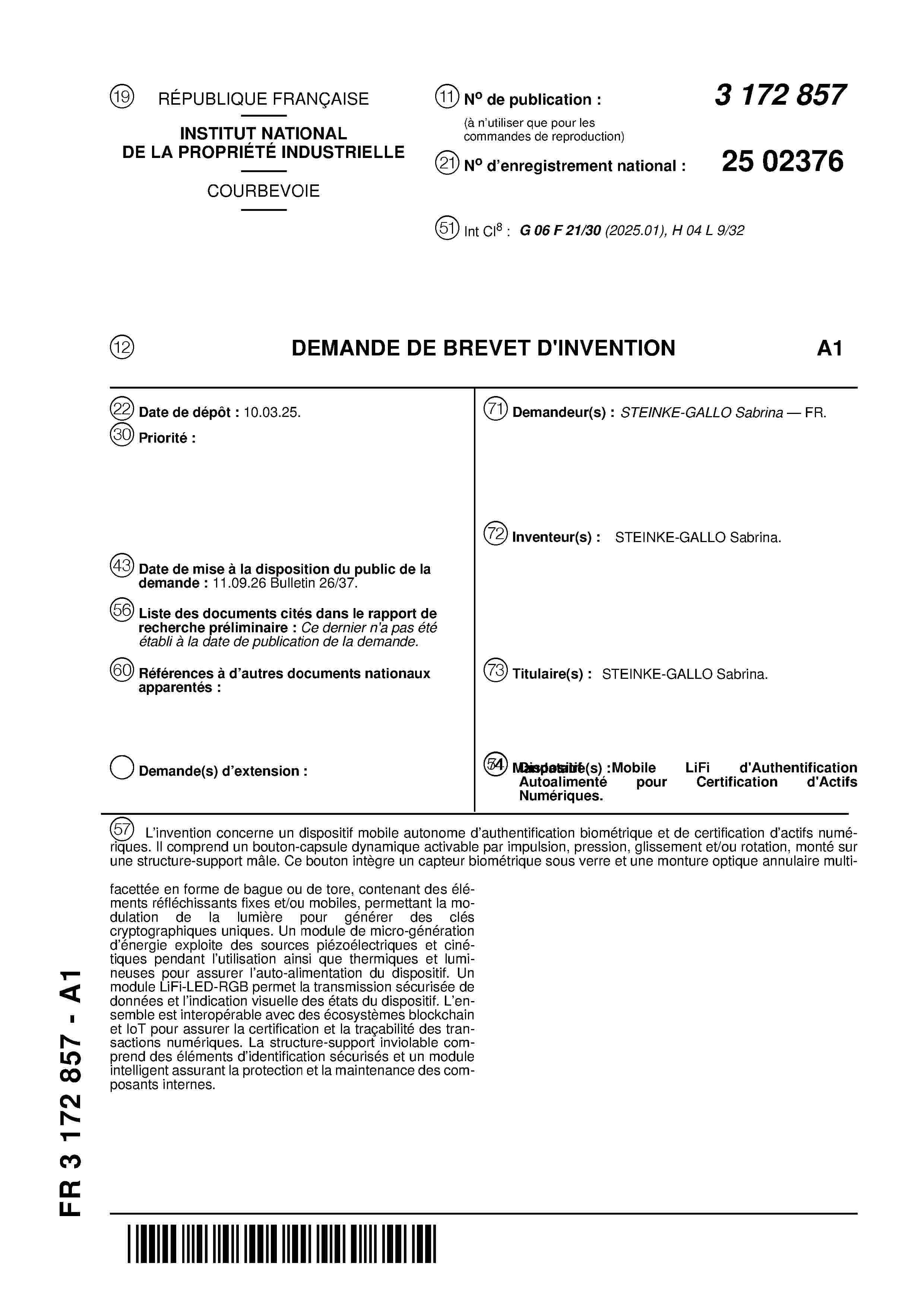
Resumen de: FR3172857A1
L’invention concerne un dispositif mobile autonome d’authentification biométrique et de certification d’actifs numériques. Il comprend un bouton-capsule dynamique activable par impulsion, pression, glissement et/ou rotation, monté sur une structure-support mâle. Ce bouton intègre un capteur biométrique sous verre et une monture optique annulaire multi-facettée en forme de bague ou de tore, contenant des éléments réfléchissants fixes et/ou mobiles, permettant la modulation de la lumière pour générer des clés cryptographiques uniques. Un module de micro-génération d’énergie exploite des sources piézoélectriques et cinétiques pendant l’utilisation ainsi que thermiques et lumineuses pour assurer l’auto-alimentation du dispositif. Un module LiFi-LED-RGB permet la transmission sécurisée de données et l’indication visuelle des états du dispositif. L’ensemble est interopérable avec des écosystèmes blockchain et IoT pour assurer la certification et la traçabilité des transactions numériques. La structure-support inviolable comprend des éléments d’identification sécurisés et un module intelligent assurant la protection et la maintenance des composants internes.

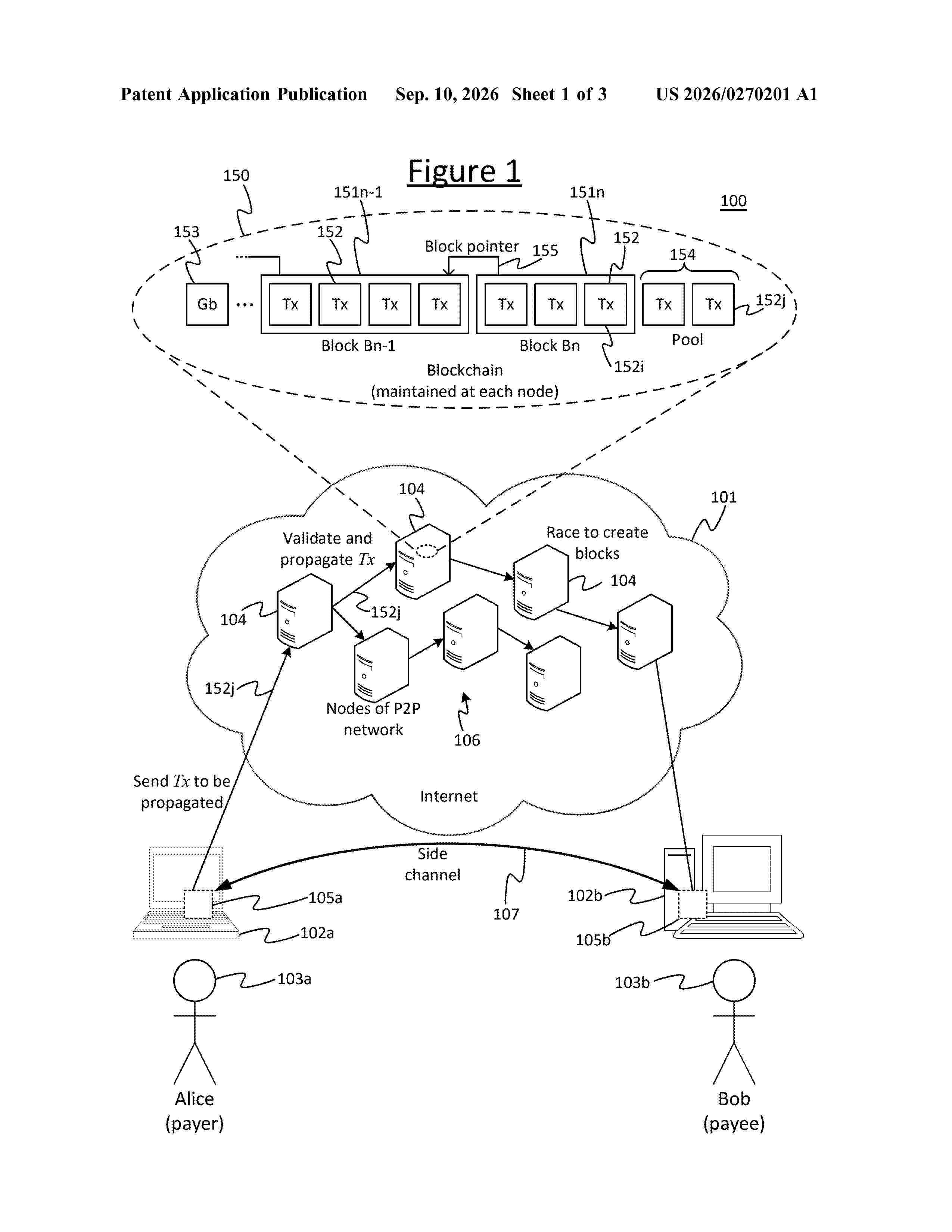
Resumen de: US20260270201A1
A computer-implemented of propagating blockchain messages, wherein at least one blockchain node is associated with one or more respective range of numbers and one or more respective sets of blockchain nodes, wherein each respective range of numbers is associated with a respective set of blockchain nodes, and wherein the method comprises: for at least one of a plurality of respective blockchain messages, determining a respective number based on the respective blockchain message, wherein the respective number of one or more respective blockchain messages falls within a respective one of the one or more respective ranges; andfor each respective range in which the respective number of one or more respective blockchain transactions falls, making available some or all of the one or more respective blockchain messages to each blockchain node belonging to the respective set of blockchain nodes associated with the respective node.
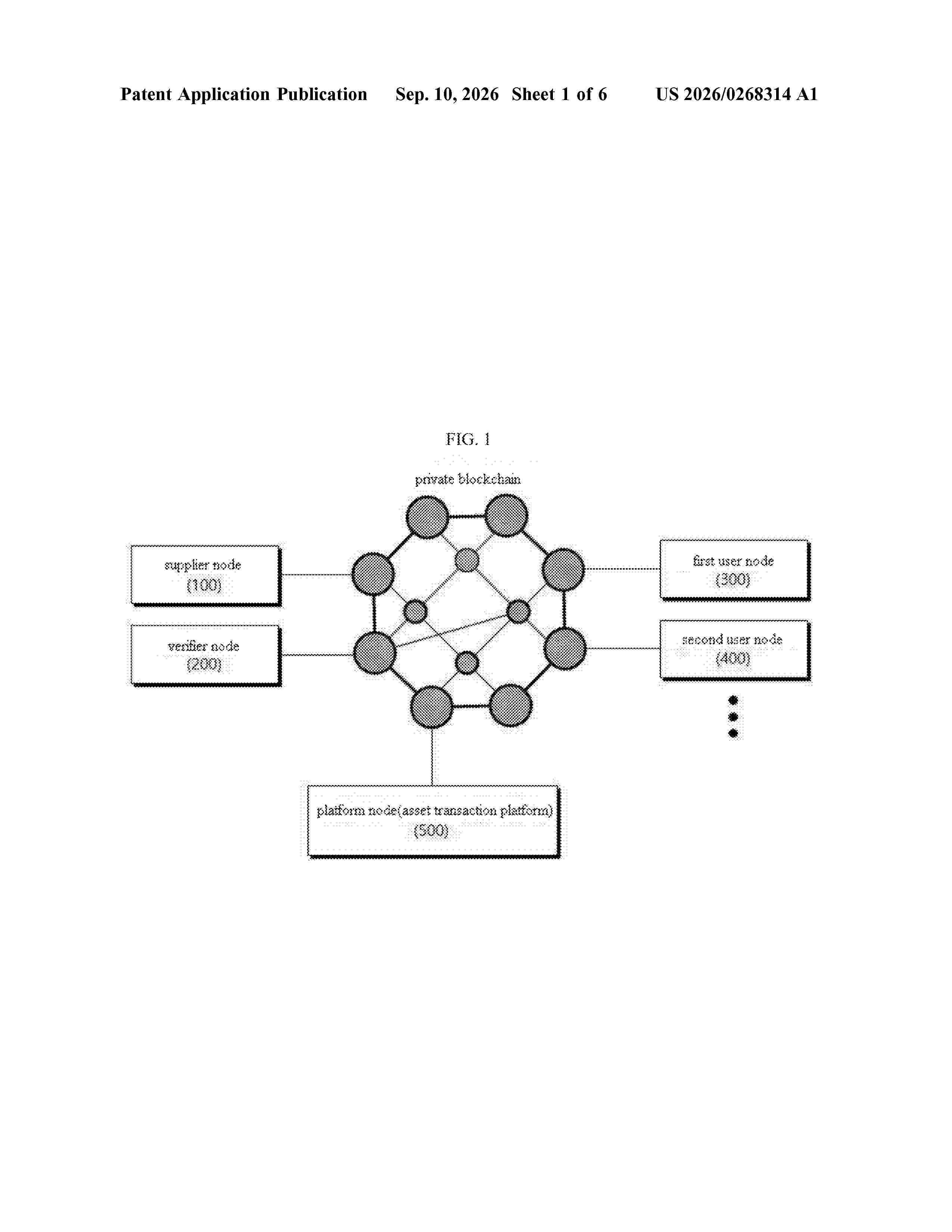
Resumen de: US20260268314A1
Proposed is a private blockchain-based digital asset distribution method performed by a plurality of nodes constituting a private blockchain. The method includes issuing, by a verifier node, a certificate for trusting a face-to-face digital asset transaction to a first user node through a blockchain network in a certificate issuance step, submitting, by the first user node, transaction statement data about digital assets owned by a first user obtained through short-range wireless communication with a second user node to the blockchain network in a transaction statement submission step, and verifying, by the verifier node, the submitted transaction statement data and applying the same to a distributed ledger in a distributed ledger update step.
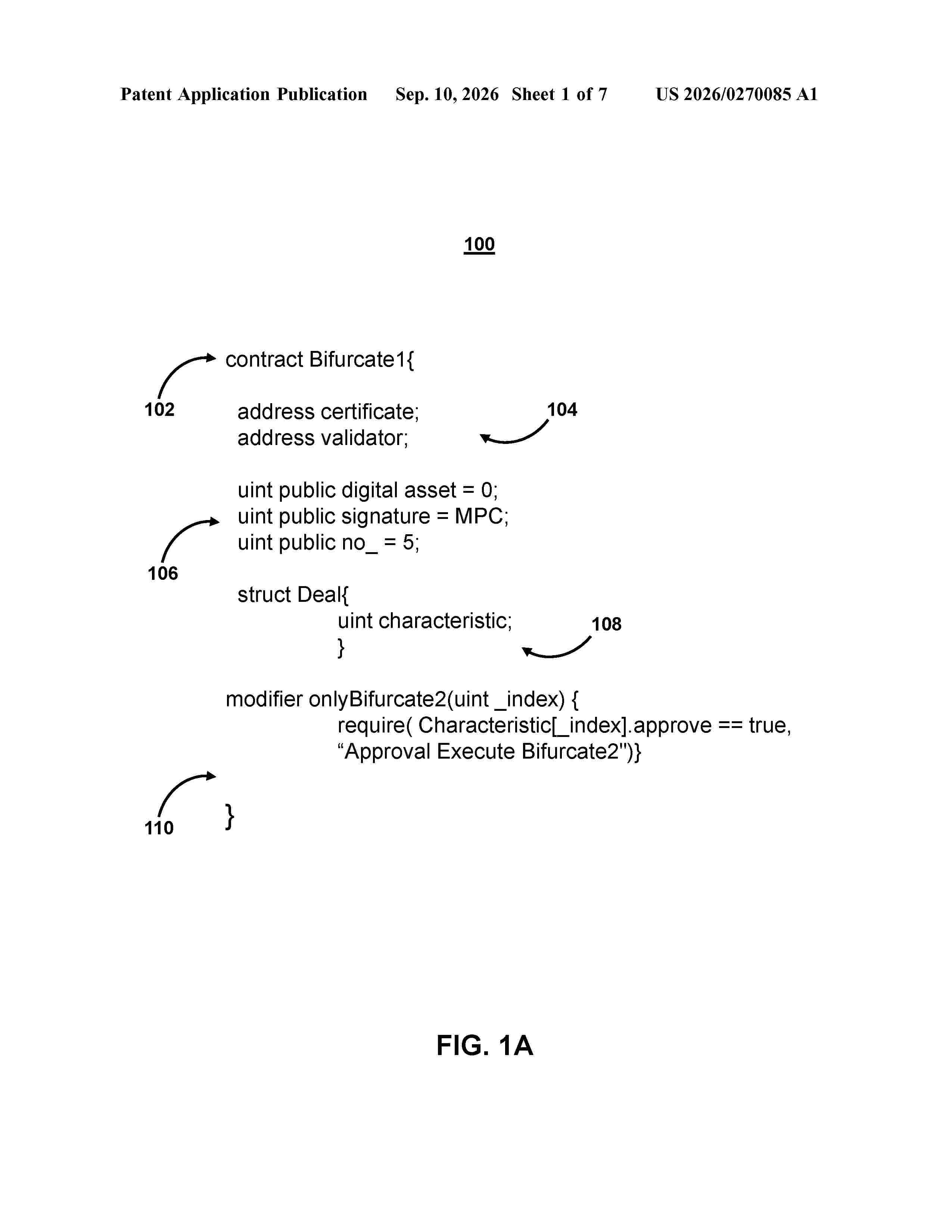
Resumen de: US20260270085A1
Systems and methods for a bifurcated self-executing program that wraps a first self-executing program (e.g., a first smart contract) on a blockchain within a second self-executing program (e.g., a second smart contract), in which the second self-executing program enforces the digital signature requirement. The bifurcated self-executing program comprises a single compiled self-executing program that combines the first self-executing program and the second self-executing program.
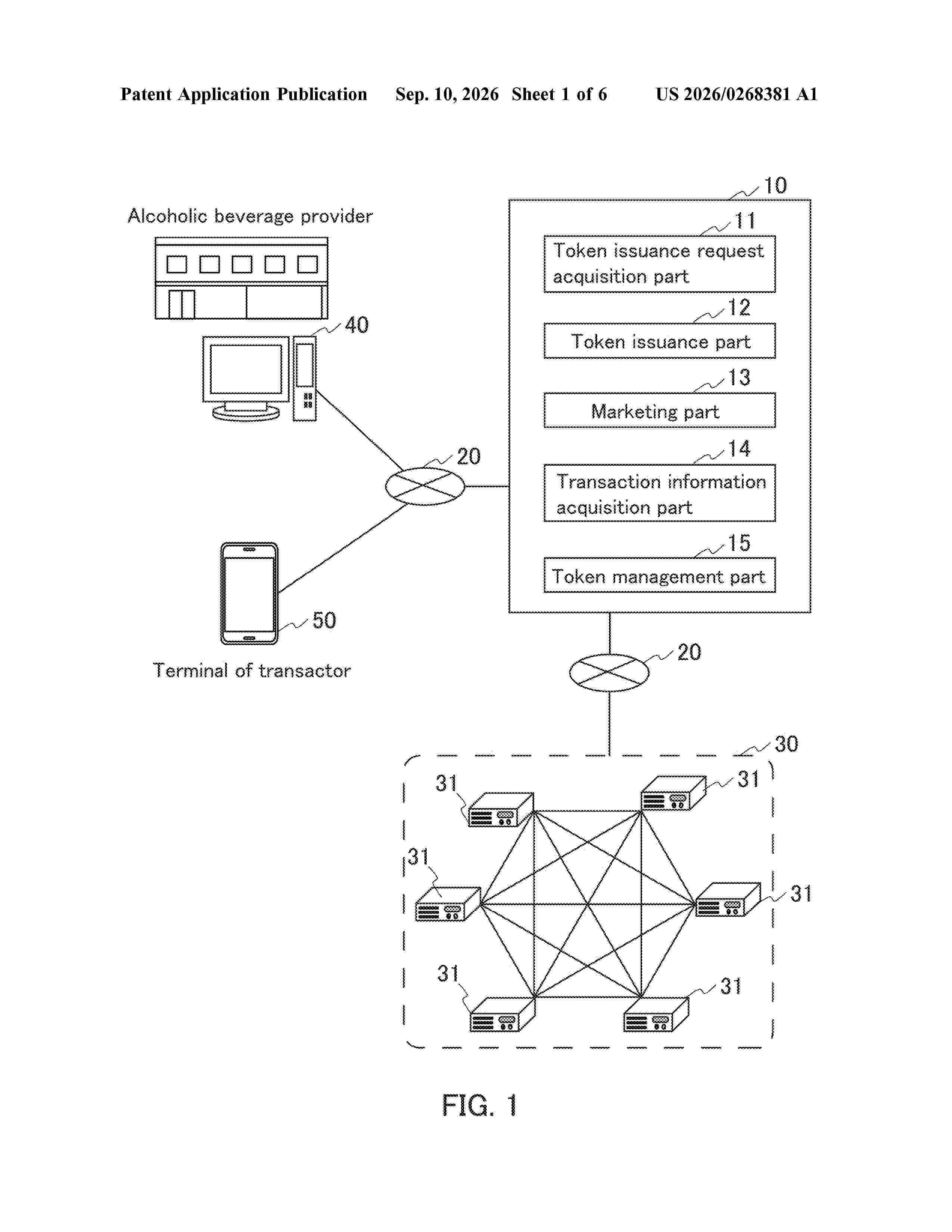
Resumen de: US20260268381A1
An alcoholic beverage token transaction support apparatus that includes: a token issuance request acquisition part; a token issuance part; a marketing part; a transaction information acquisition part; and a token management part. The token issuance request acquisition part acquires token issuance request information, the token issuance request information includes product identification information of an alcoholic beverage product that is a transaction target, the token issuance part issues alcoholic beverage token information on a blockchain based on the token issuance request information for the alcoholic beverage product specified by the product identification information, the marketing part releases the alcoholic beverage token information on a market, the transaction information acquisition part acquires transaction information of the alcoholic beverage token information in the market, and the token management part updates owner information of the alcoholic beverage token information on the blockchain based on the transaction information.
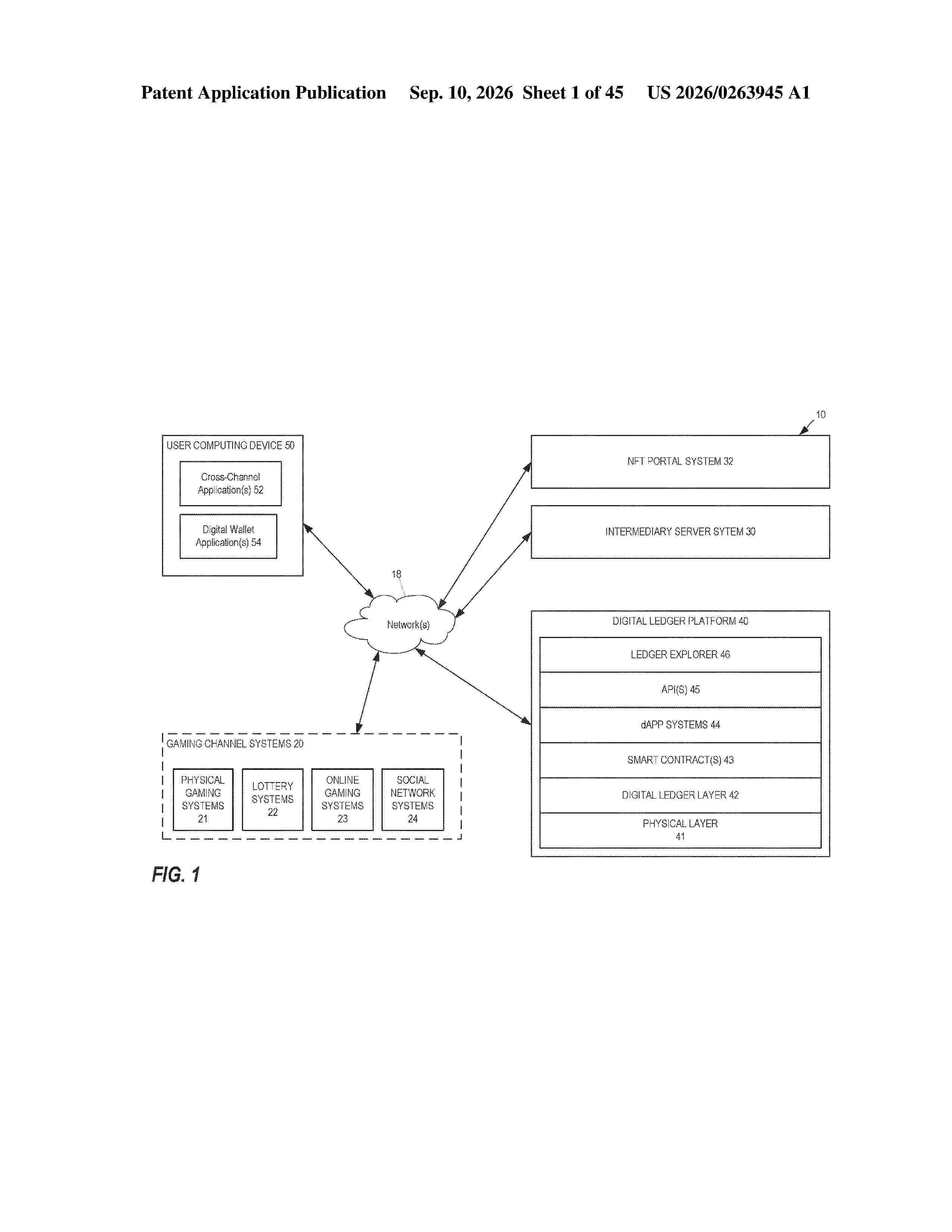
Resumen de: US20260263945A1
0000 Systems and methods are provided for gaming solutions across different gaming channels, different entities, and different environments using blockchain and/or non-fungible token (NFT) components and/or functionality. In an embodiment, a computing system can associate an NFT with a game session executed via a gaming device associated with a gaming environment, where the NFT is configured to allow for recreation of the game session via a local device associated with the gaming environment or a remote device associated with a second environment being different from the gaming environment. In another embodiment, a computing system and/or a gaming device can: perform a blockchain mining process and concurrently execute a game; track one or more game participation metrics corresponding to a player participating in the game and provide the player with a defined percentage of a token based at least in part on the one or more game participation metrics.
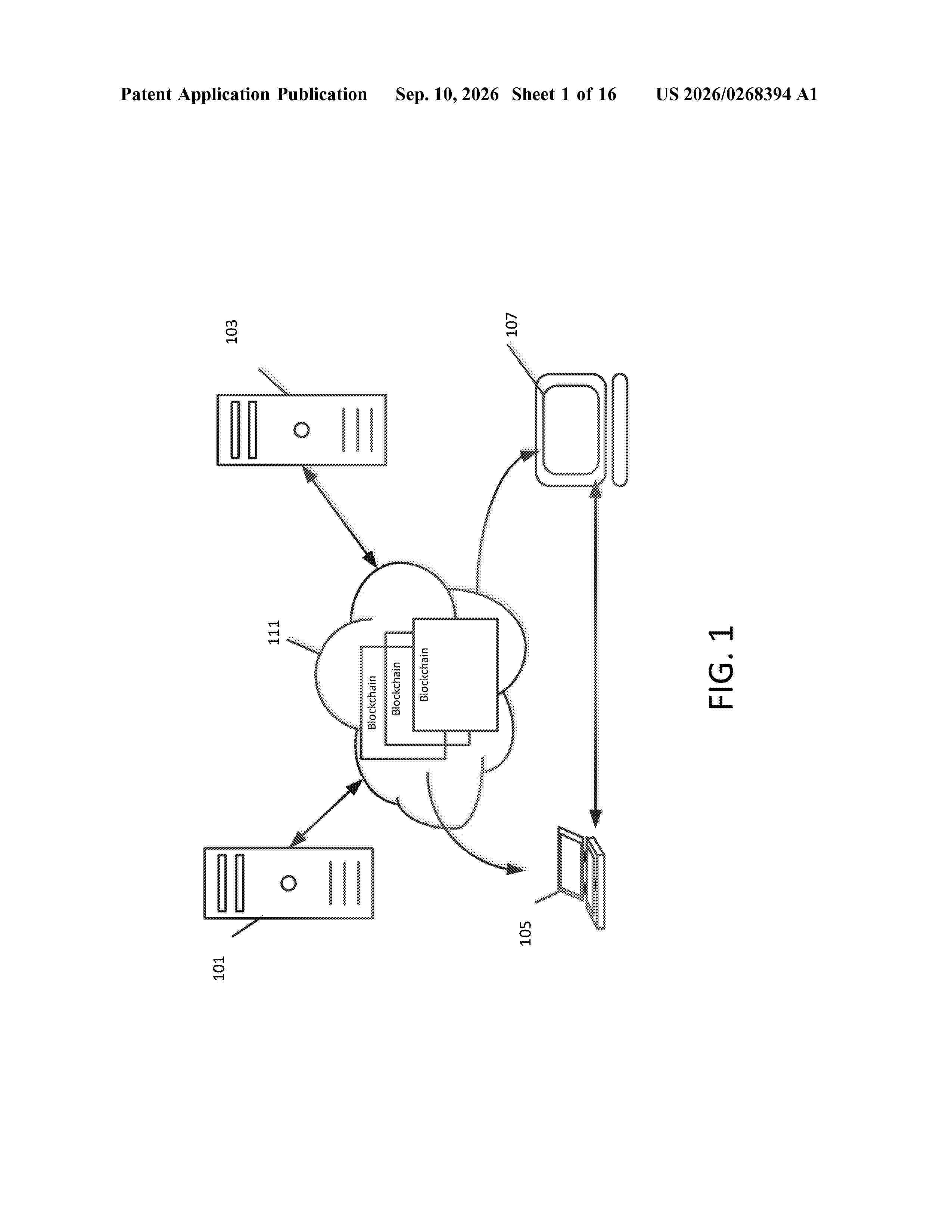
Resumen de: US20260268394A1
0000 A computer-based bidding system, computer readable medium and method is provided for bidding on a project or service. A first client creates a project specification. Second clients bid on the project. A second client encrypts bid information immediately after creating a bid information file, calculates a first hash value for the bid information file, and submits the first hash value for linking as a block in a blockchain. A blockchain system performs a second encryption upon receiving the encrypted bid information, calculates a second hash value for the encrypted bid file, and submits the second hash value for linking as a block in the blockchain. The second client performs a third encryption when the bid information file is opened to generate an encrypted opened bid information file. The second client performs a bidding process with the first client using the bid information file.
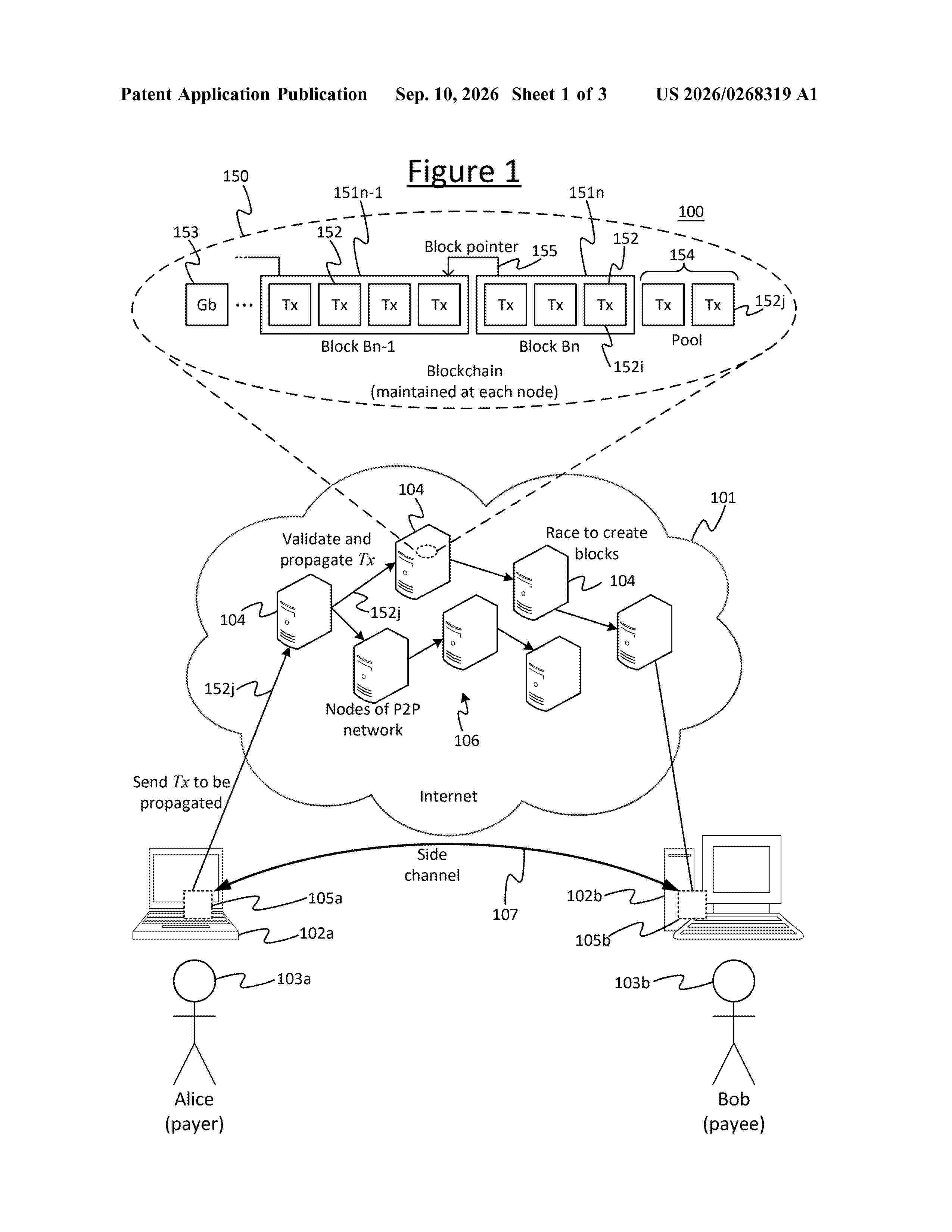
Resumen de: US20260268319A1
A computer-implemented method of determining a state of a system using one or more blockchain transactions, wherein each blockchain transaction comprises one or more outputs, and wherein the method is performed by a first party and comprises: determining a respective status of one or more respective outputs of one or more blockchain transactions; and determining the state of the system based on the respective status of the one or more respective outputs.
Resumen de: US20260270097A1
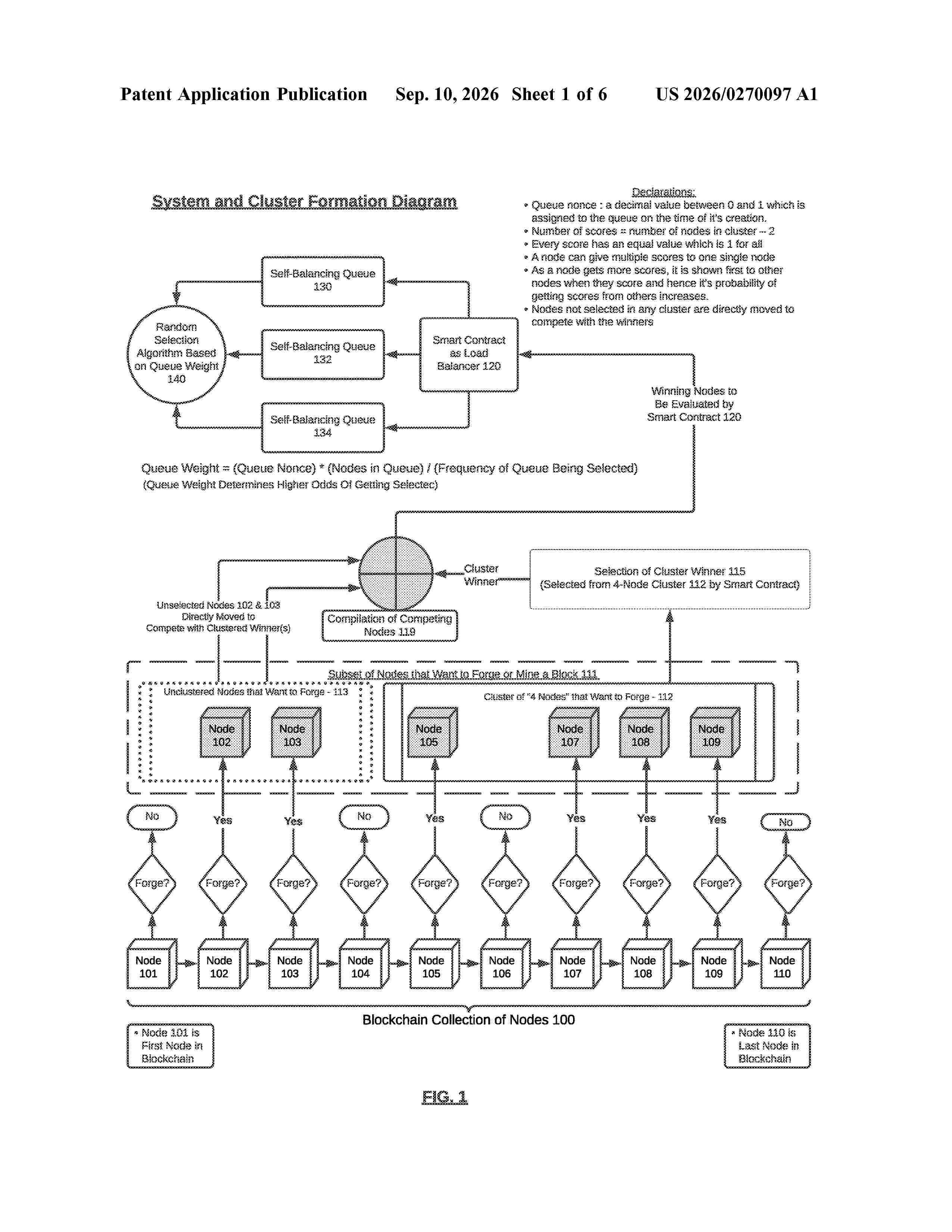
0000 Systems and methods for adding a new block to a blockchain are disclosed. A processor follows previous-hash pointers from a current block toward a genesis block, and at each block identifies a volunteer node indicating a desire to participate. Identified nodes are grouped, in traversal order, into clusters of a network-determined size n. Within each cluster, each node distributes n-2 scores among other nodes and is prohibited from self-scoring. A cluster winner is selected based on cumulative score and assigned to a self-balancing queue. A weighted-random selection algorithm computes a queue weight for each of a plurality of self-balancing queues as a product of a queue nonce assigned at queue creation and a count of nodes in the queue, divided by a frequency at which the queue has previously been selected. A node assigned to the selected queue is caused to add the new block to the blockchain.
Resumen de: AU2025269041A1
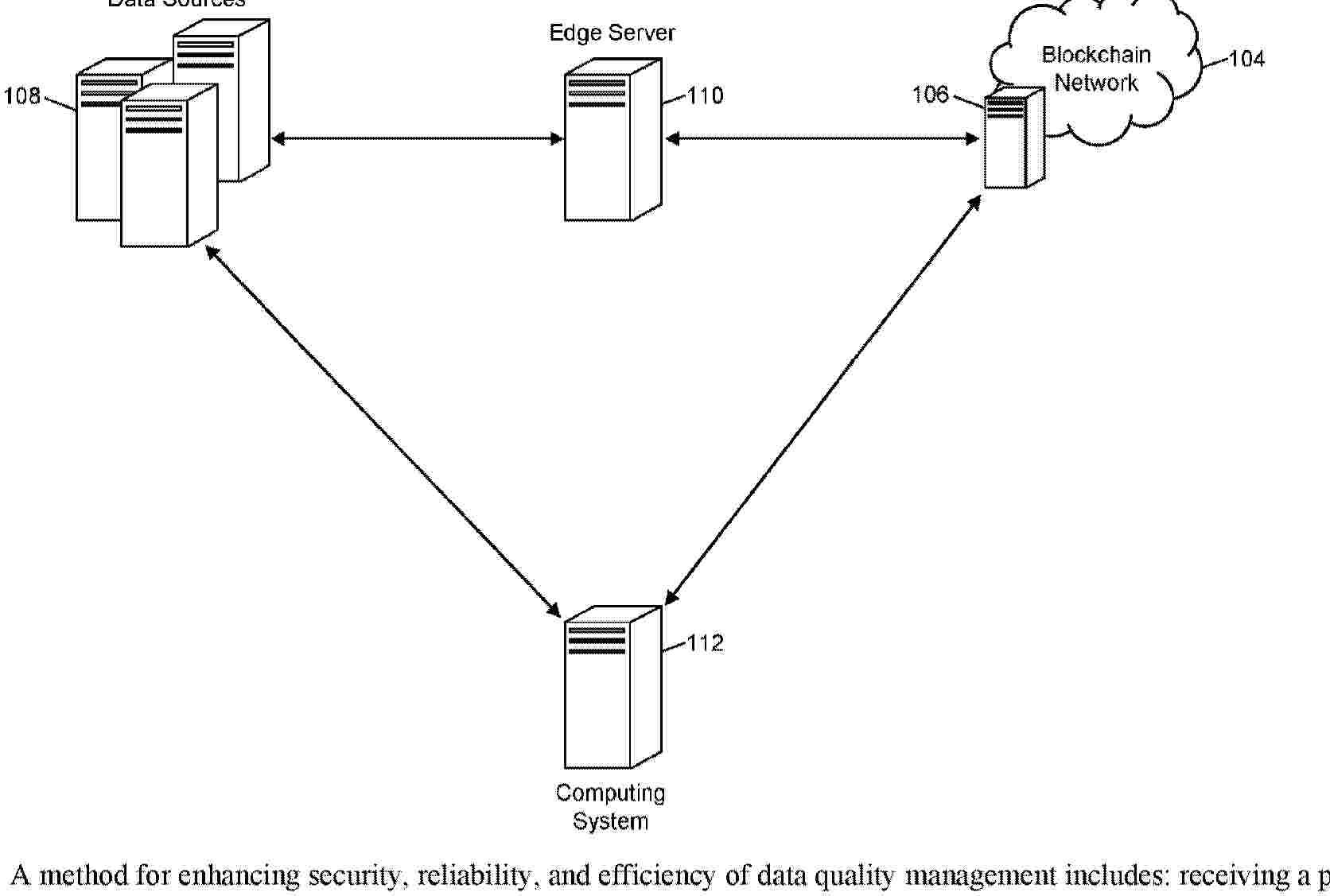
A method for enhancing security, reliability, and efficiency of data quality management includes: receiving a plurality of data entries; executing a smart contract on a blockchain using the data entries as input, where the smart contract performs error correction on the data entries according to one or more predefined rules and analyzes the data entries for data quality, and, if the data quality is below a threshold value, generates and transmits a data quality report to an external computing system, or, if the data quality is above the threshold value, generates a new blockchain data entry that includes the data entries for storage on the blockchain; receiving changes or additions to the predefined rules; updating the predefined rules in the smart contract according to the changes or additions; and repeating execution of the smart contract with the updated predefined rules.
Resumen de: AU2025378027A1
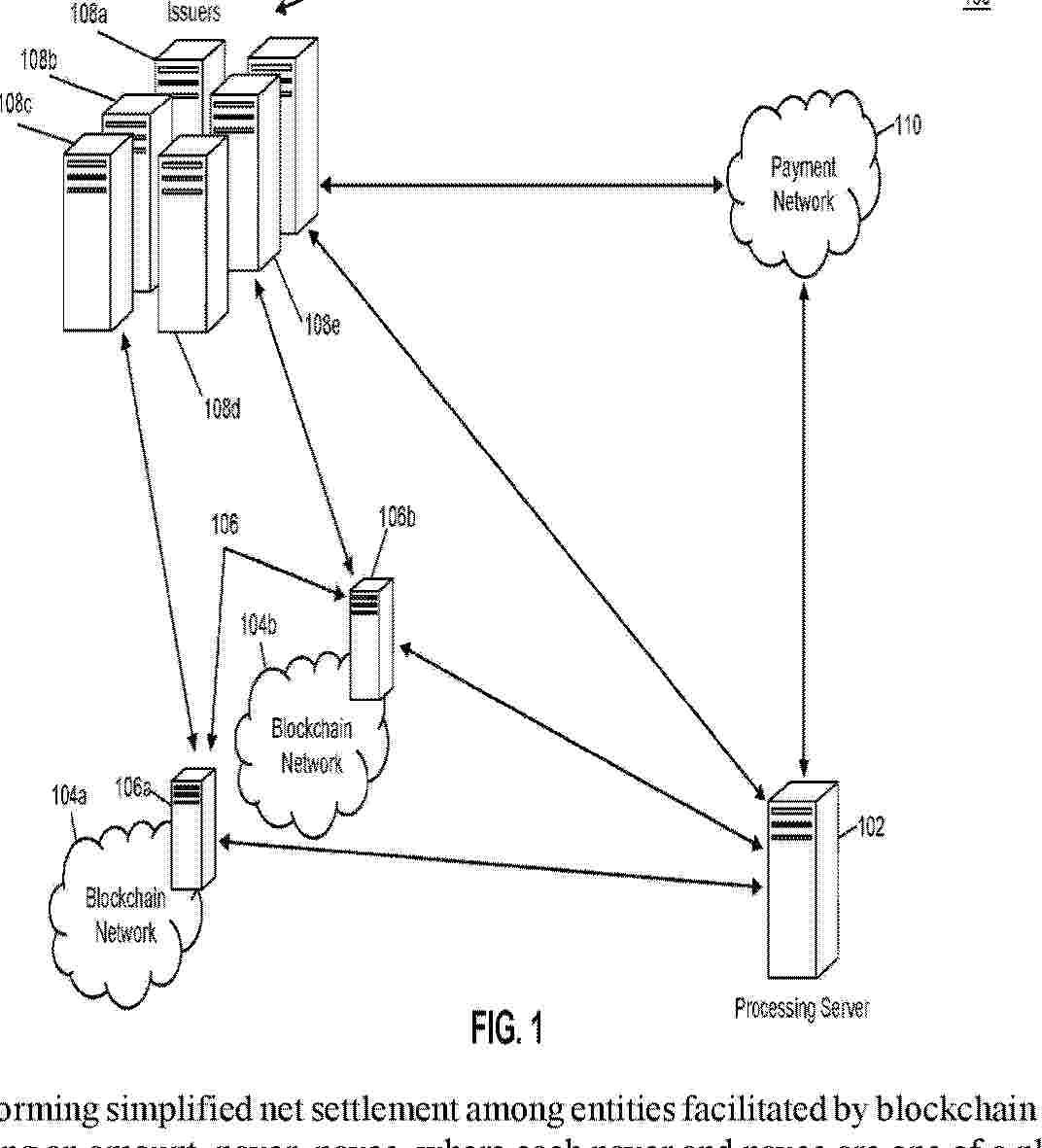
A method for performing simplified net settlement among entities facilitated by blockchain includes: receiving a plurality of settlement transactions including an amount, payer, payee, where each payer and payee are one of a plurality of entities; processing the settlement transactions to determine an amount owed or an amount due for each of the plurality of entities; determining a minimum amount of transactions for settlement among the plurality of entities based on the determined amounts owed or due; generating a list of net settlement transactions of the determined minimum amount, each net settlement transaction including an amount, payer, and payee based on the determined amounts owed or due for each entity; and transmitting the generated list of net settlement transactions to a blockchain node in a blockchain network for inclusion in a new blockchain data entry added to a blockchain associated with the blockchain network.
Resumen de: US20260268315A1
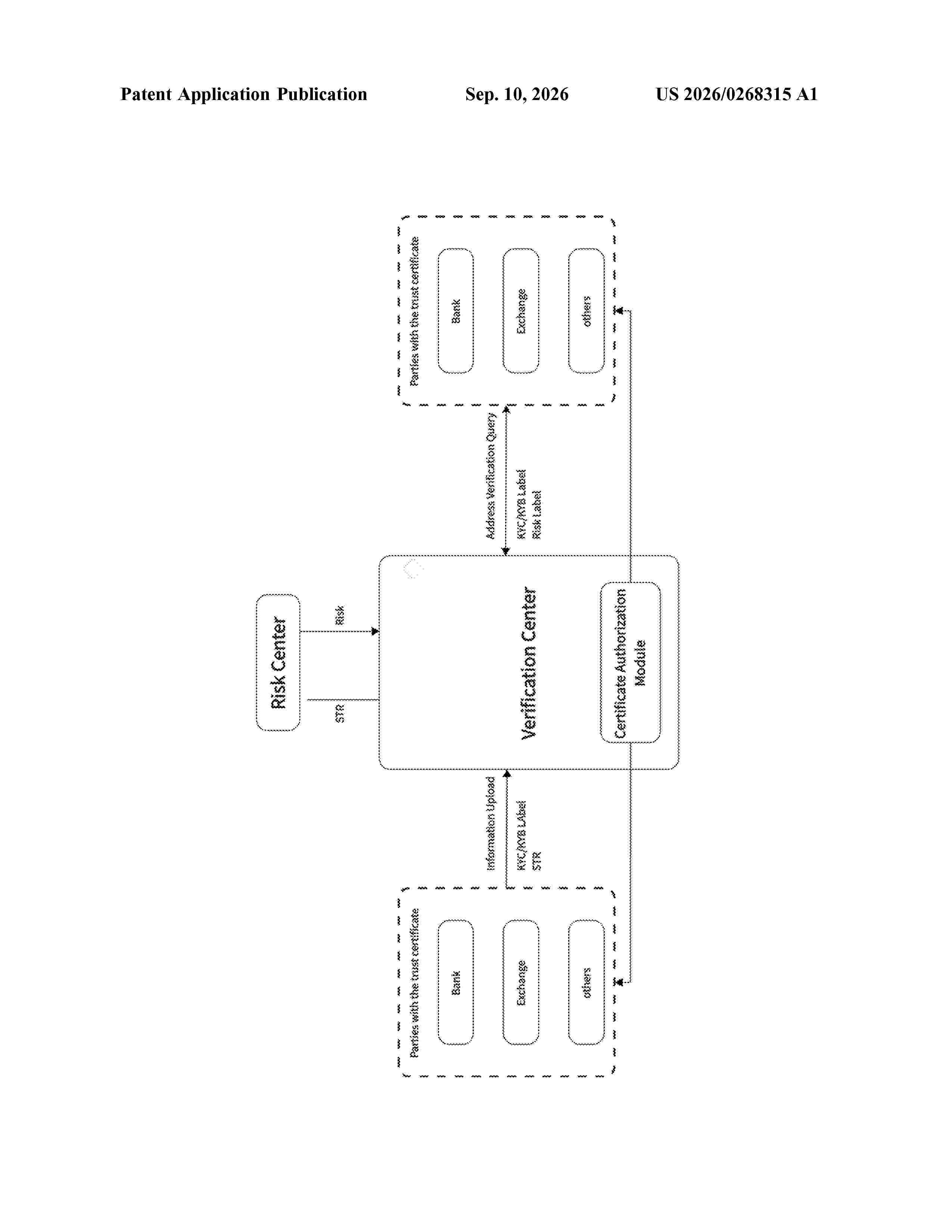
A monitoring and auditing tool of blockchain based financial payment and clearing, comprising a verification center for managing, verifying and querying transactions, a certificate authorization module; the verification center is provided and serves as a centralized center to monitor and audit the blockchain based financial payment and clearing for bridging the regulatory gap in blockchain decentralized system; the Verification Center serves as an international compliance data center, sharing risk intelligence with regulatory institutes worldwide.
Resumen de: AU2025275522A1
A method for implementing loyalty points as digital currency using blockchain includes: receiving first transaction data for a first transaction including a first recipient address associated with a blockchain wallet and a positive loyalty point amount; processing the received first transaction data for the first transaction to add a first new block to the blockchain that includes the first recipient address and the positive loyalty point amount; receiving, after a predetermined period of time, second transaction data for a second transaction including a second recipient address associated with the blockchain wallet and a negative loyalty point amount; and processing the received second transaction data for the second transaction to add a second new block to the blockchain that includes the second recipient address and the negative loyalty point amount.
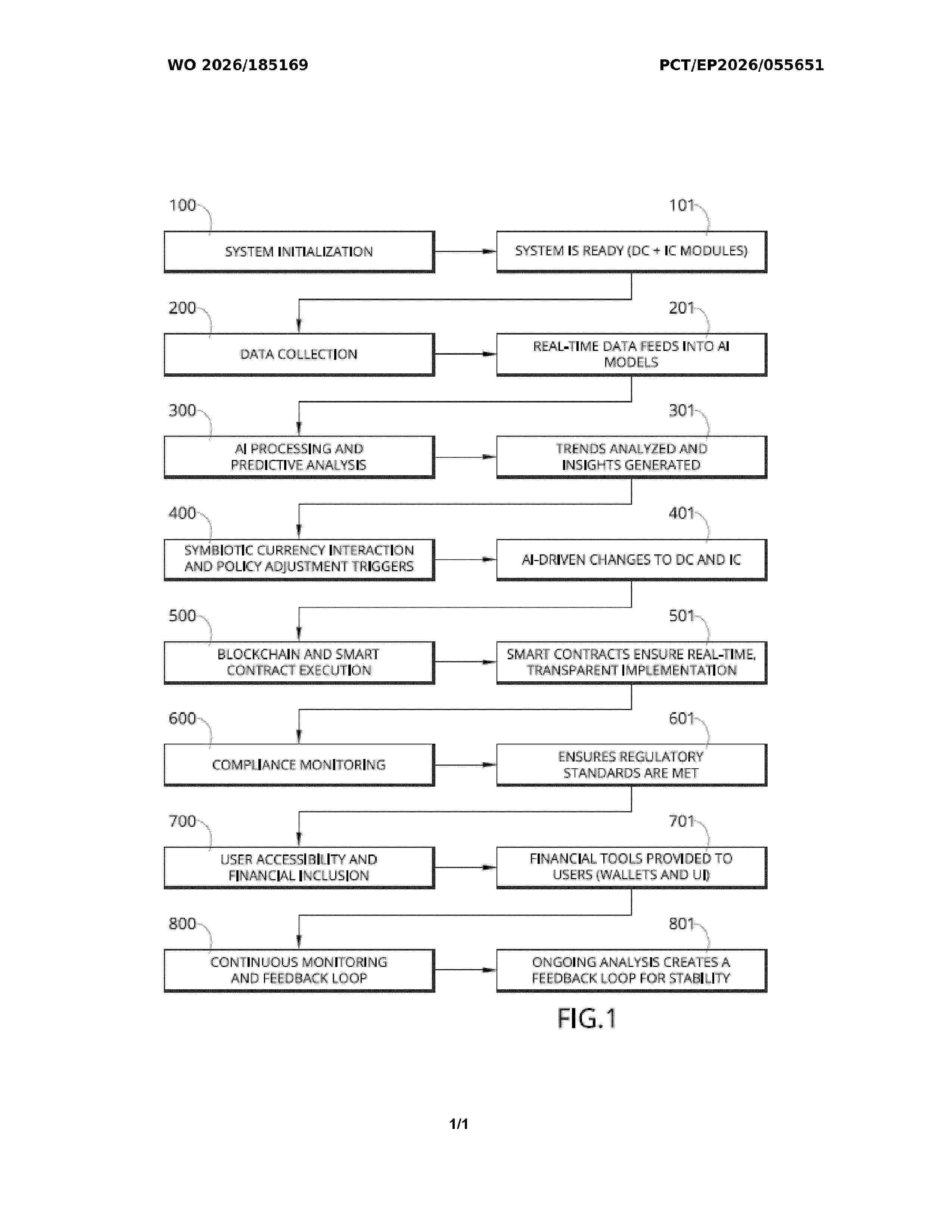
Resumen de: WO2026185169A1
The invention relates to a dual-tiered monetary policy system that utilizes Artificial Intelligence and Blockchain to independently control domestic and international monetary policies. The system comprises a domestic Central Bank Digital Currency (CBDC) and a cross-border currency layer, managed by a GPU-accelerated AI for real-time liquidity adjustments and regulatory compliance. Secure transaction processing is ensured via blockchain infrastructure. The method involves monitoring economic data and managing domestic and cross-border transactions using GPU acceleration, enabling dynamic liquidity adjustment through a GPU-powered blockchain system.
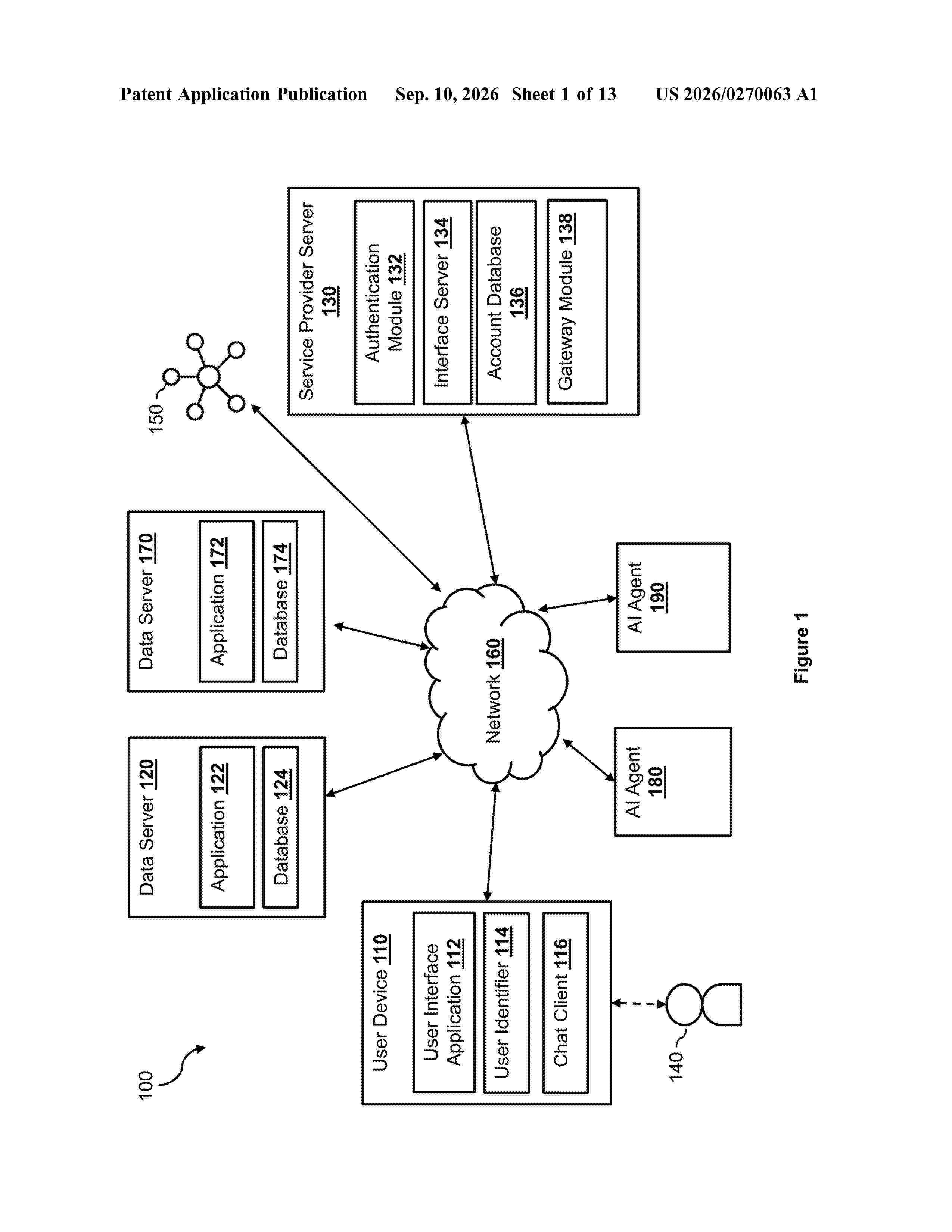
Resumen de: US20260270063A1
0000 Methods and systems are presented for using blockchain technologies to manage the life cycle and authentication of artificial intelligence (AI) agents. When an AI agent is created, the AI agent registers itself with an authentication system. The authentication system creates identity information for the AI agent and store on a blockchain. The identity information is used to track the changes of the AI agent through its life cycle, including upgrading of the binary code, transfer of ownership, change of a delegator, and others. When the AI agent requests for access of one or more resources, the authentication system uses the information stored on the blockchain to authenticate the AI agent before granting the AI agent access to the one or more resources.
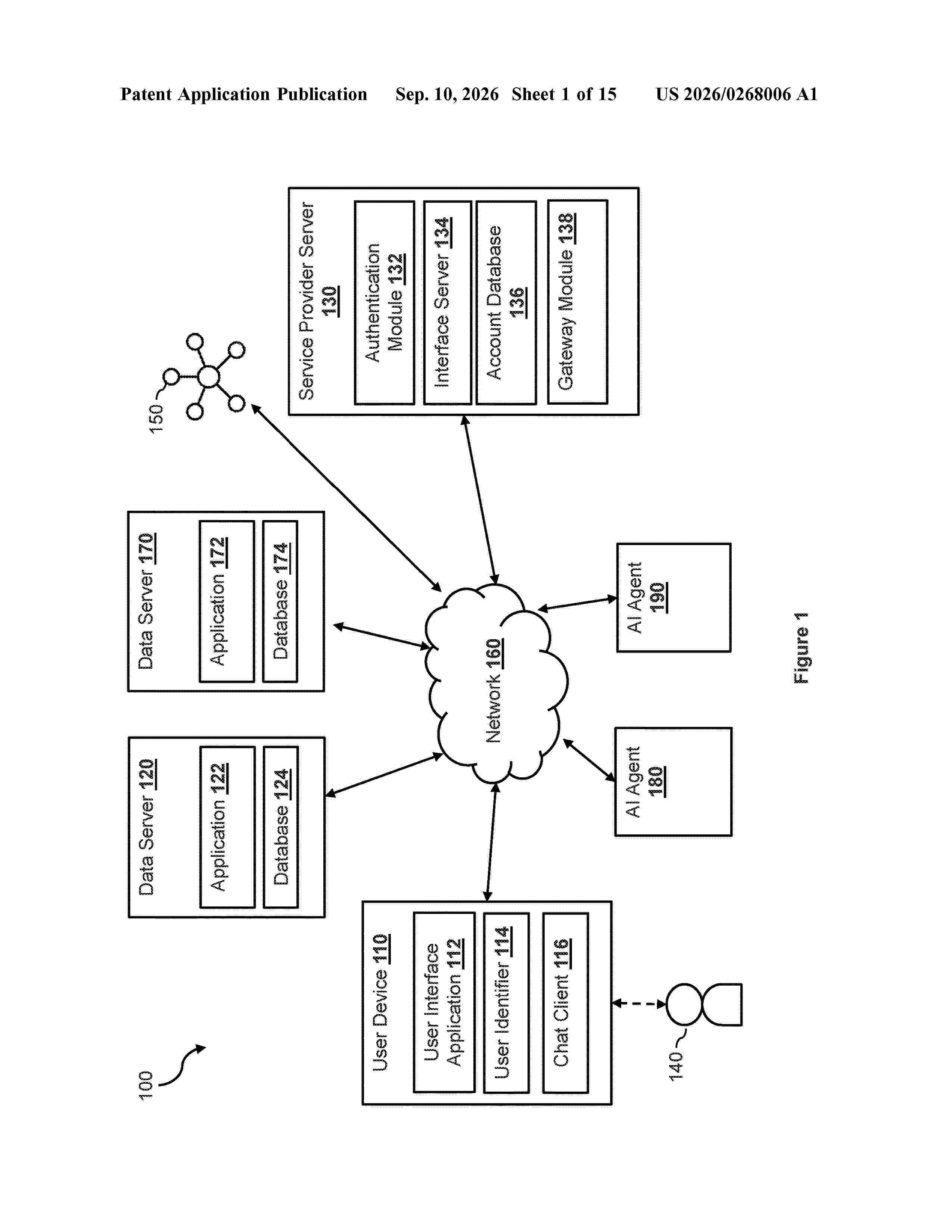
Resumen de: US20260268006A1
0000 Methods and systems are presented for using blockchain technologies to manage the life cycle and authentication of artificial intelligence (AI) agents. When an AI agent is created, the AI agent registers itself with an authentication system. The authentication system creates identity information for the AI agent and store on a blockchain. The identity information is used to track the changes of the AI agent through its life cycle, including upgrading of the binary code, transfer of ownership, change of a delegator, and others. When the AI agent requests for access of one or more resources, the authentication system uses the information stored on the blockchain to authenticate the AI agent before granting the AI agent access to the one or more resources.
Resumen de: US20260270086A1
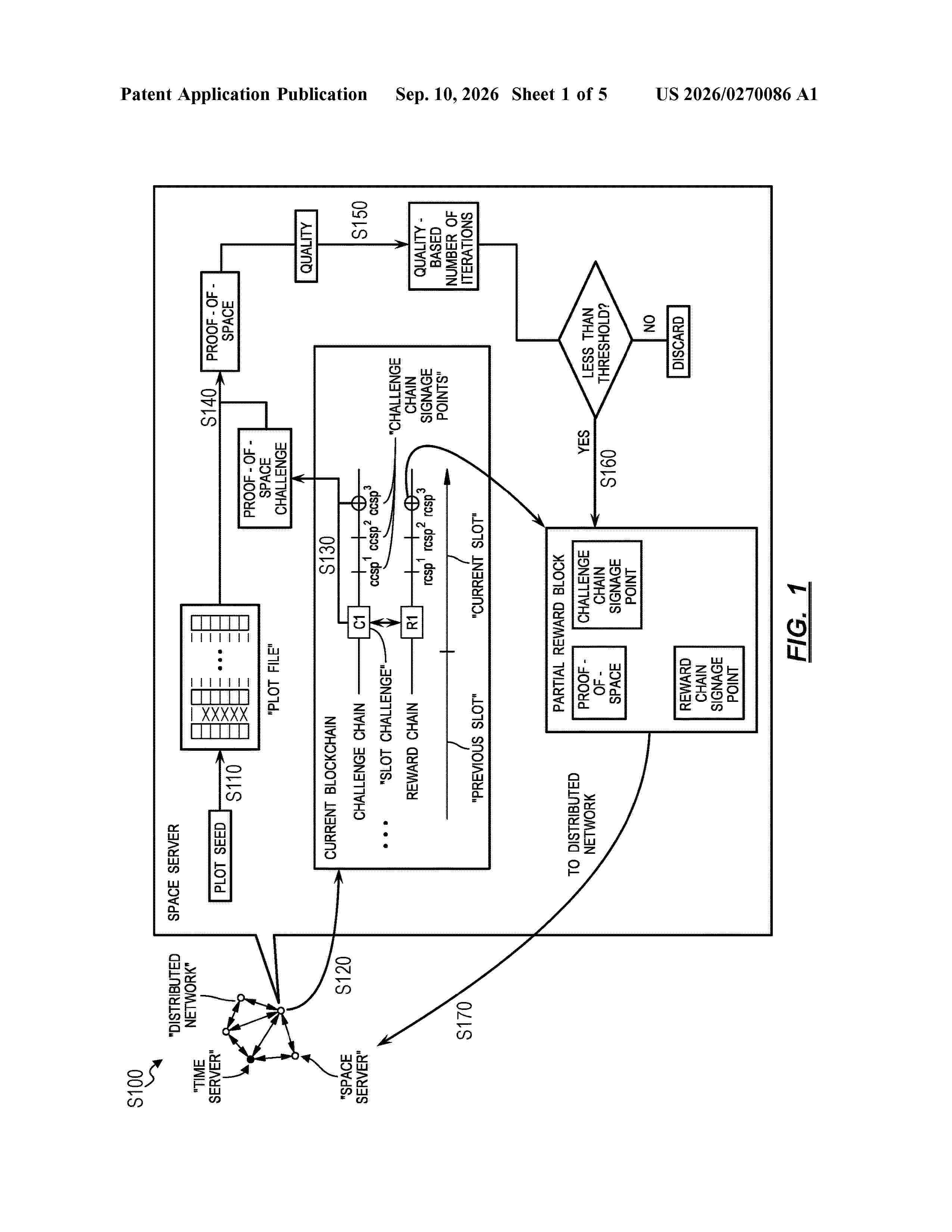
0000 A method for extending a blockchain includes, at a space server in a distributed network: storing a plot file. The method also includes accessing a blockchain: during a current slot in the series of slots, accessing a proof-of-space challenge based on a current slot challenge associated with the current slot and a challenge chain signage point; in response to accessing the proof-of-space challenge, retrieving a proof-of-space based on the proof-of-space challenge and the plot file; calculating a quality-based number of iterations based on the quality of the proof-of-space; generating a block comprising the proof-of-space, the challenge chain signage point, and a reward chain signage point; and broadcasting the block to the distributed network.
Resumen de: US20260268329A1
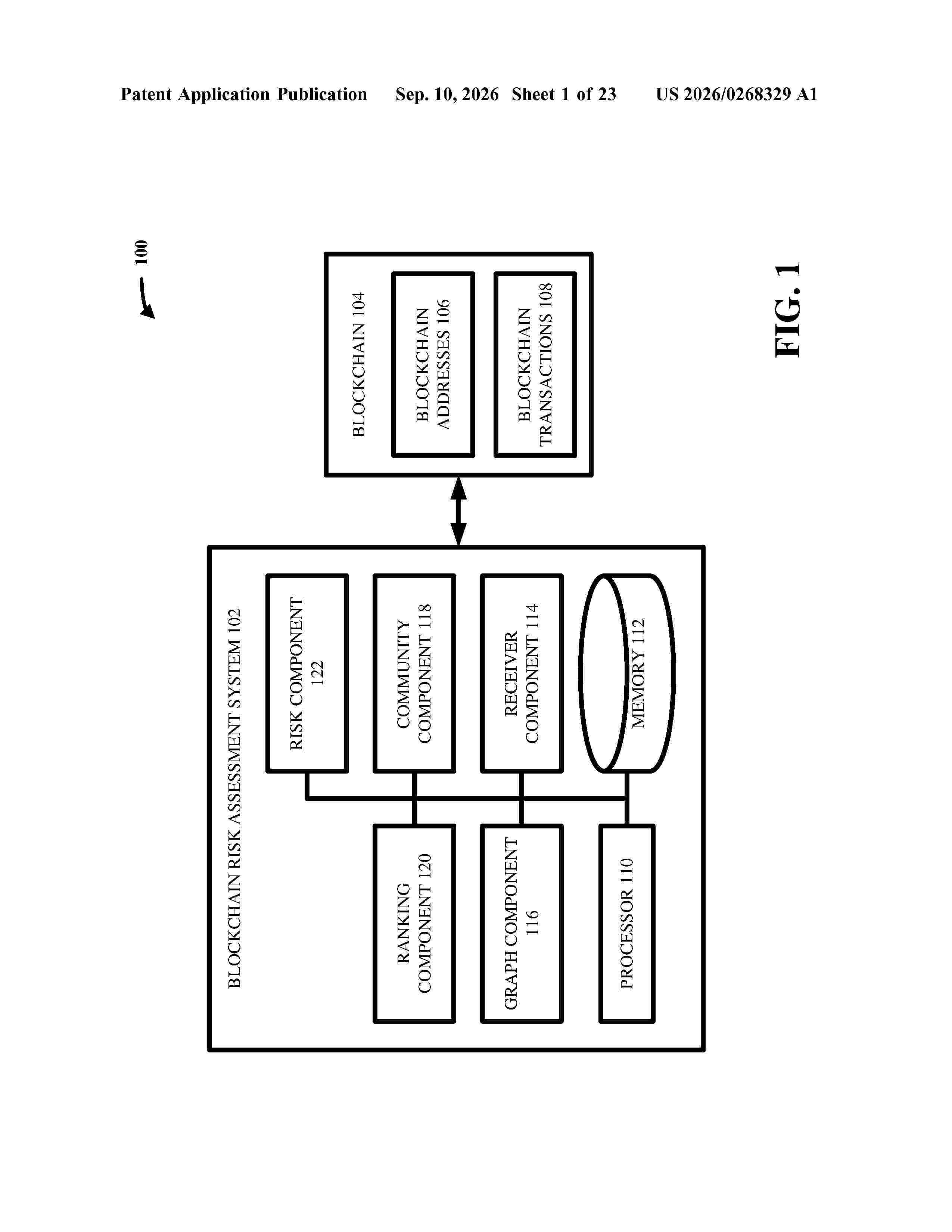
Novel technical ways of analyzing a blockchain system using machine learning are presented, including structures and techniques that can facilitate blockchain address risk assessment via graph analysis. In various embodiments, a system can access a blockchain. The system can build a transaction graph based on analysis of the blockchain. Nodes of the transaction graph can respectively represent blockchain addresses that are recorded in the blockchain. In various cases, edges in the transaction graph can respectively represent blockchain transactions between different ones of the blockchain addresses that are recorded in the blockchain. The system can calculate risk scores respectively corresponding to the blockchain addresses, based on analyzing the transaction graph via at least one machine learning algorithm. These techniques can improve computer operational efficiency by avoiding the execution of unnecessary blockchain transactions.
Resumen de: US20260270311A1
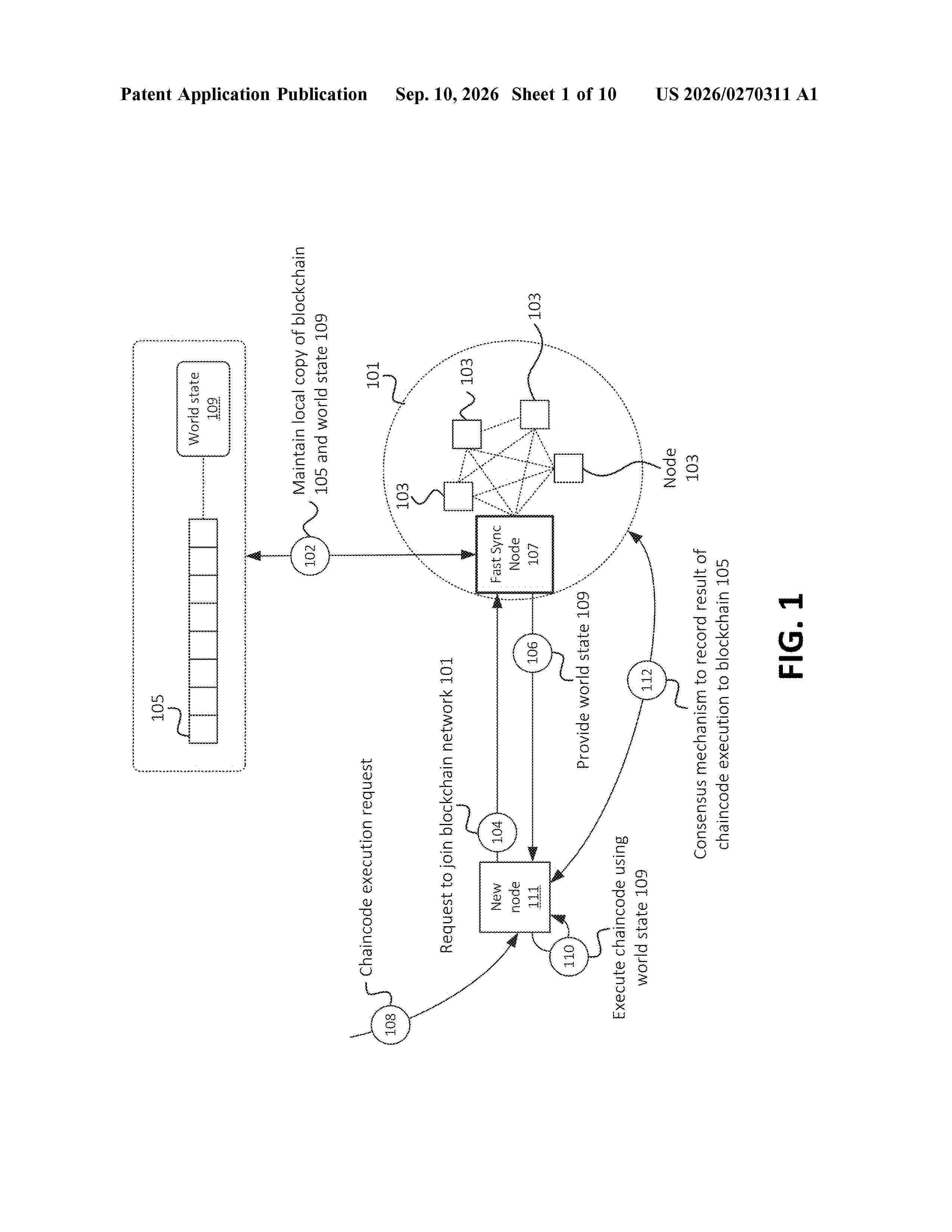
A system described herein may maintain a local copy of a particular blockchain that is associated with a plurality of nodes of a blockchain network. Each node of the plurality of nodes may maintain a respective local copy of the particular blockchain. The system may maintain world state information associated with the particular blockchain; receive a request from a device to join the blockchain network; and provide, to the device and based on the received request, at least a subset of the world state information associated with the particular blockchain. The device may perform blockchain operations, such as executing chaincode, based on the at least the subset of the world state information. The system may provide, to the device and after providing the at least the subset of the world state information, the local copy of the particular blockchain, such as by performing a prioritized synchronization operation.
Resumen de: US20260268344A1
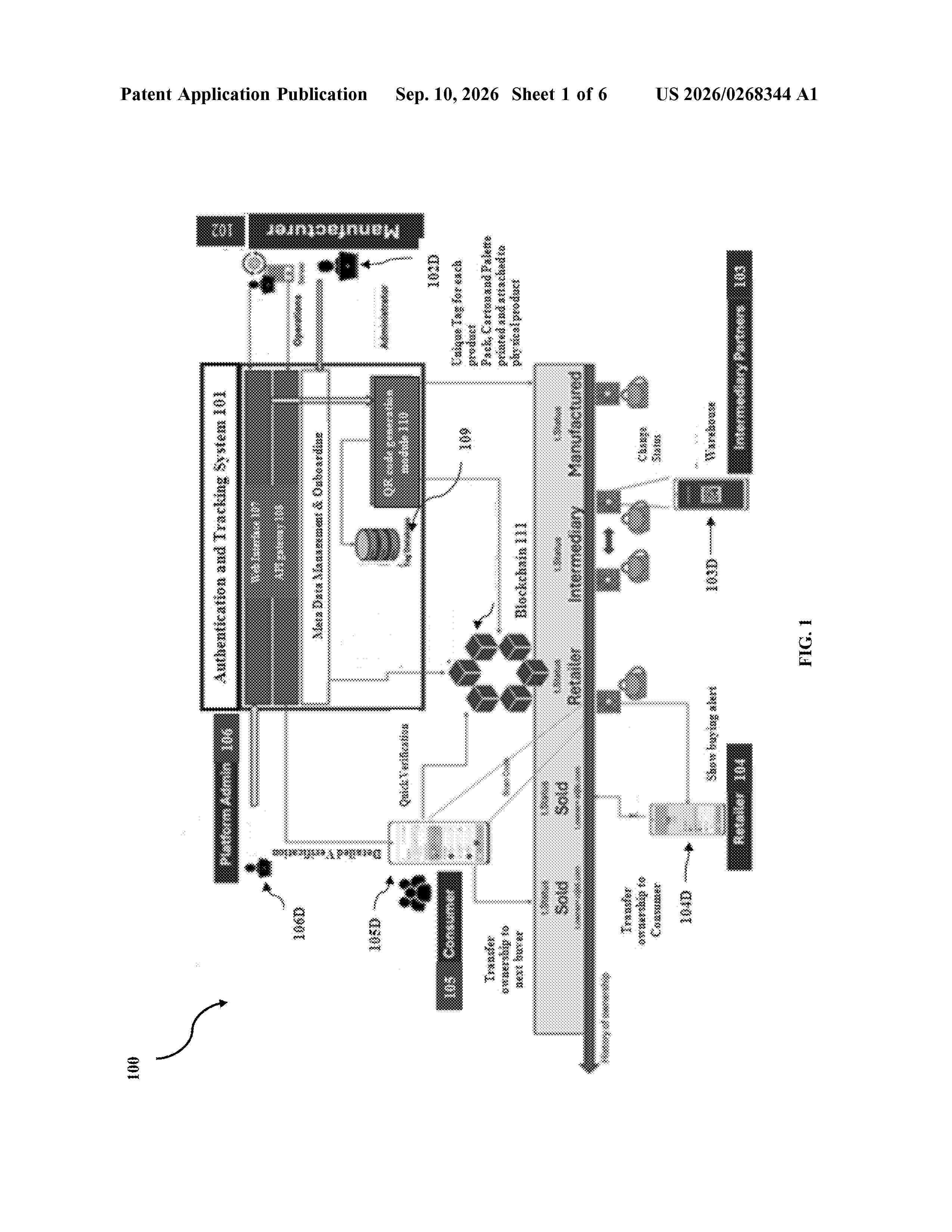
The present disclosure relates to a system and method for counterfeit product identification and authentication using blockchain-integrated QR codes. The system generates unique, privacy-preserving, tamperproof, and unpredictable QR codes, which are cryptographically secured and linked to a blockchain smart contract for immutable tracking. The authentication and tracking system enables real-time product verification by manufacturers, intermediaries, retailers, and consumers, ensuring secure interactions within a predefined workflow. The system prevents unauthorized duplication through AES-256 encryption and SHA-512 hashing, ensuring counterfeit detection. Consumers can verify product authenticity through quick and detailed verification, including geolocation-based validation. Ownership transfers and secondary market transactions are securely recorded on the blockchain, maintaining verifiable provenance. The system further facilitates counterfeit reporting by allowing users to submit evidence. By integrating blockchain technology, cryptographic security, and privacy-preserving verification mechanisms, the system ensures robust counterfeit prevention, enhances supply chain transparency, and fosters consumer trust.
Resumen de: US20260270067A1
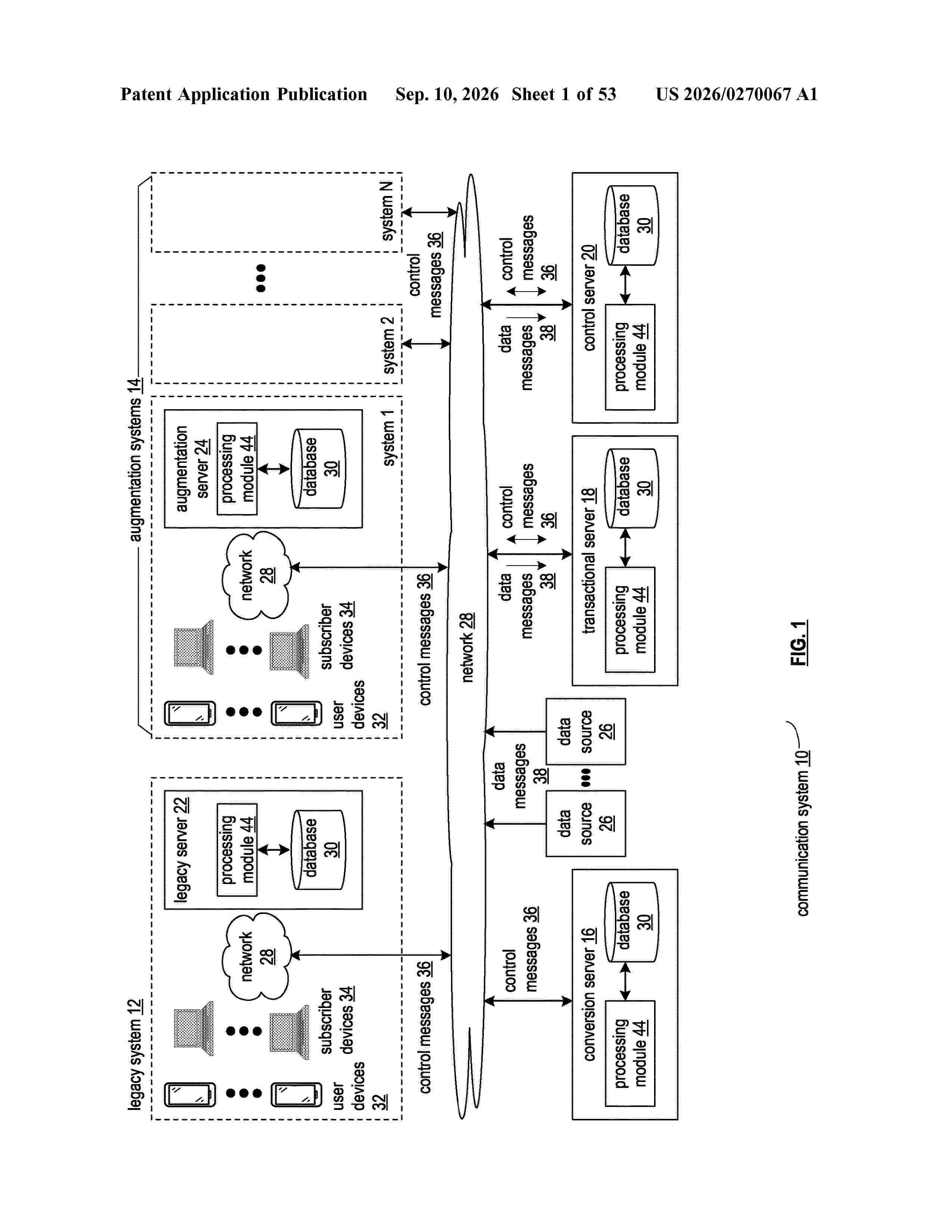
A method executed by a computing device includes determining baseline terms associated with a patent-contingent instrument for a contingency-action token (CAT) for an object distributed ledger. The method further includes establishing CAT content to include the baseline terms and further CAT content to produce the CAT. The method further includes using a securely passing process to generate a new block affiliated with the CAT via a blockchain of the object distributed ledger, where the new block includes the CAT content.
Resumen de: WO2026185603A1
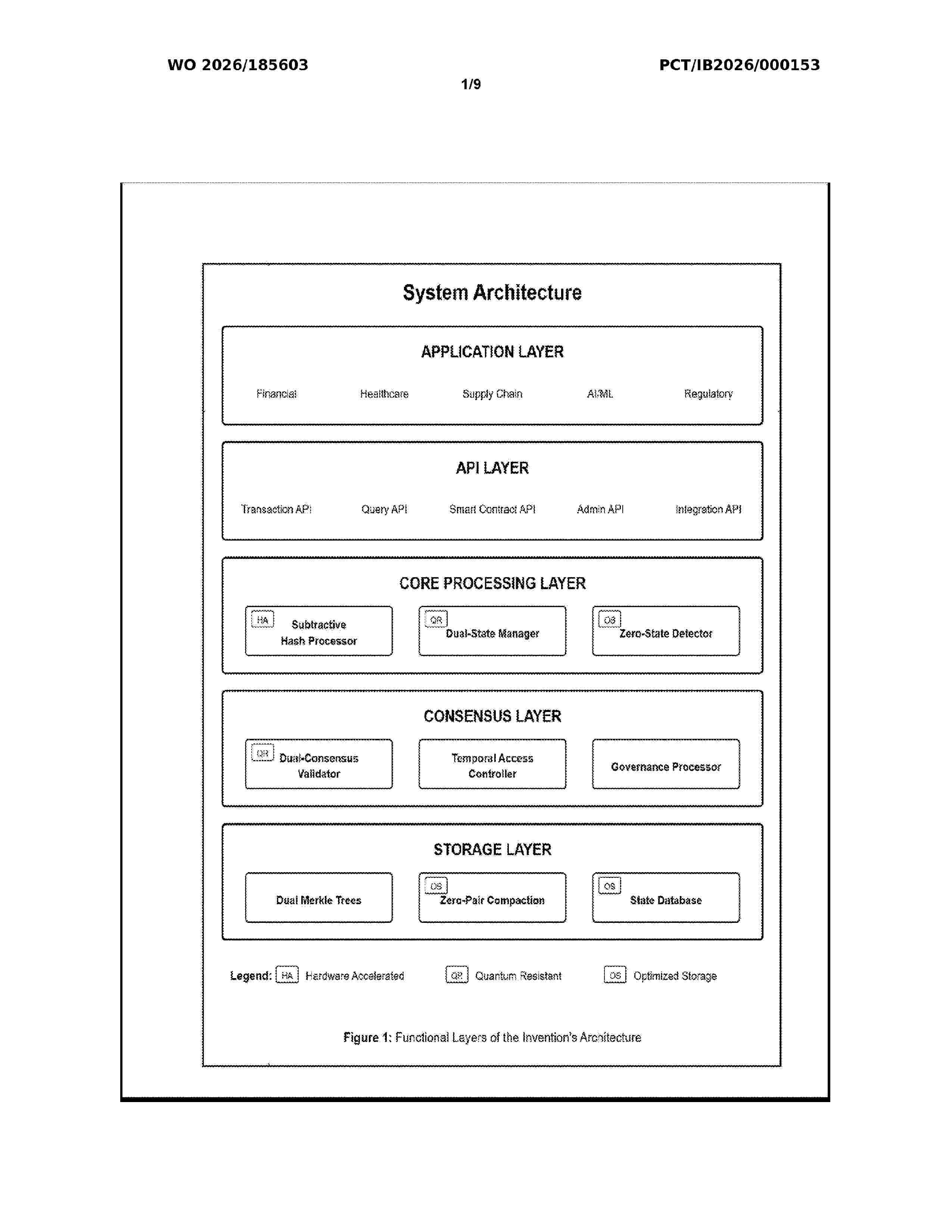
A blockchain architecture implementing a subtractive hash function H(n) = Hash(Block(n) ⊖ H(n-1)) that enables mathematically verifiable bidirectional operations, including transaction reversal and negative accumulation, while maintaining cryptographic integrity. The system enables bidirectional ledger operations applicable to financial technology, smart contracts, health and human services, supply chain management, advanced technology development, enterprise data management, and quantum-resistant digital recordkeeping. This architecture supports improved storage efficiency, operational flexibility, historical data accuracy, and resistance to quantum computing attacks.
Resumen de: US20260267961A1
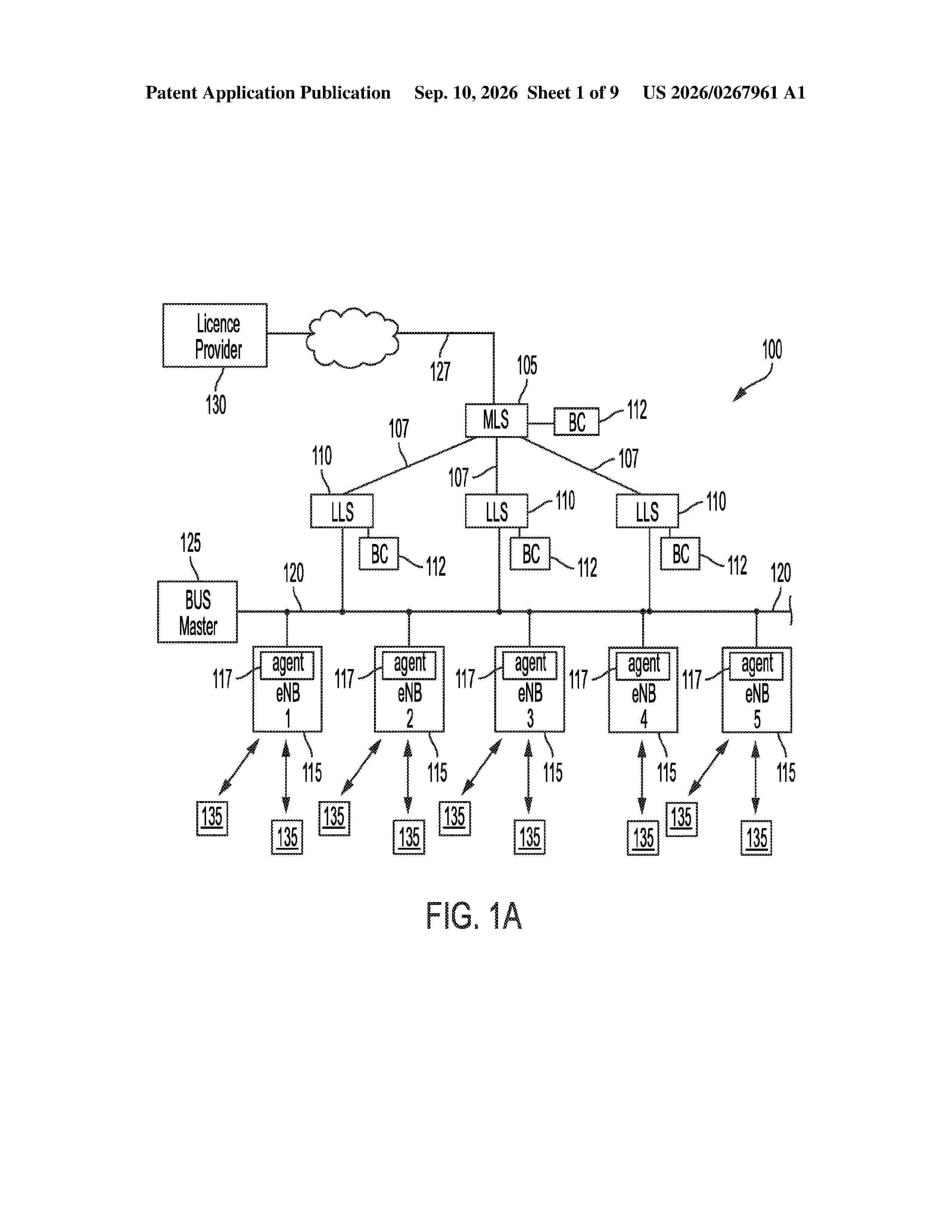
Disclosed is a system for securing a wireless telecommunications network that is capable of distributing licensed capacity (in the form of connection licenses) to respond to localized fluctuations in demand. The system includes a master license server and a plurality of local license servers. The local license servers are coupled to a plurality of virtual wireless base stations over a bus. Each of the local license servers has a blockchain implementation that secures the virtual wireless base stations. For example, the blockchain implementation logs each transaction in which connection licenses change ownership among the virtual wireless base stations.
Resumen de: WO2026185578A1
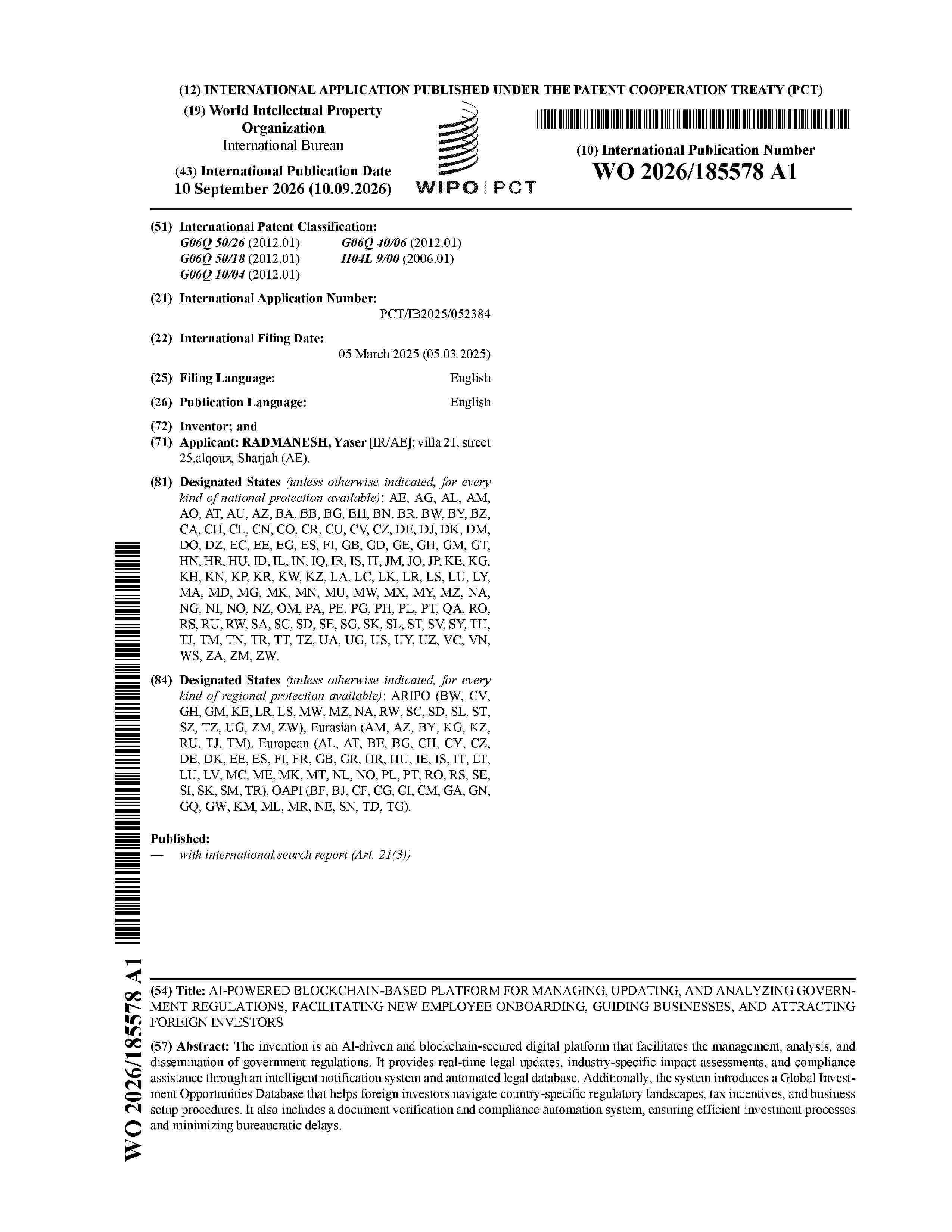
The invention is an Al-driven and blockchain-secured digital platform that facilitates the management, analysis, and dissemination of government regulations. It provides real-time legal updates, industry-specific impact assessments, and compliance assistance through an intelligent notification system and automated legal database. Additionally, the system introduces a Global Investment Opportunities Database that helps foreign investors navigate country-specific regulatory landscapes, tax incentives, and business setup procedures. It also includes a document verification and compliance automation system, ensuring efficient investment processes and minimizing bureaucratic delays.
Nº publicación: US20260270079A1 10/09/2026
Solicitante:
BANK OF AMERICA CORP [US]
Bank of America Corporation
Resumen de: US20260270079A1
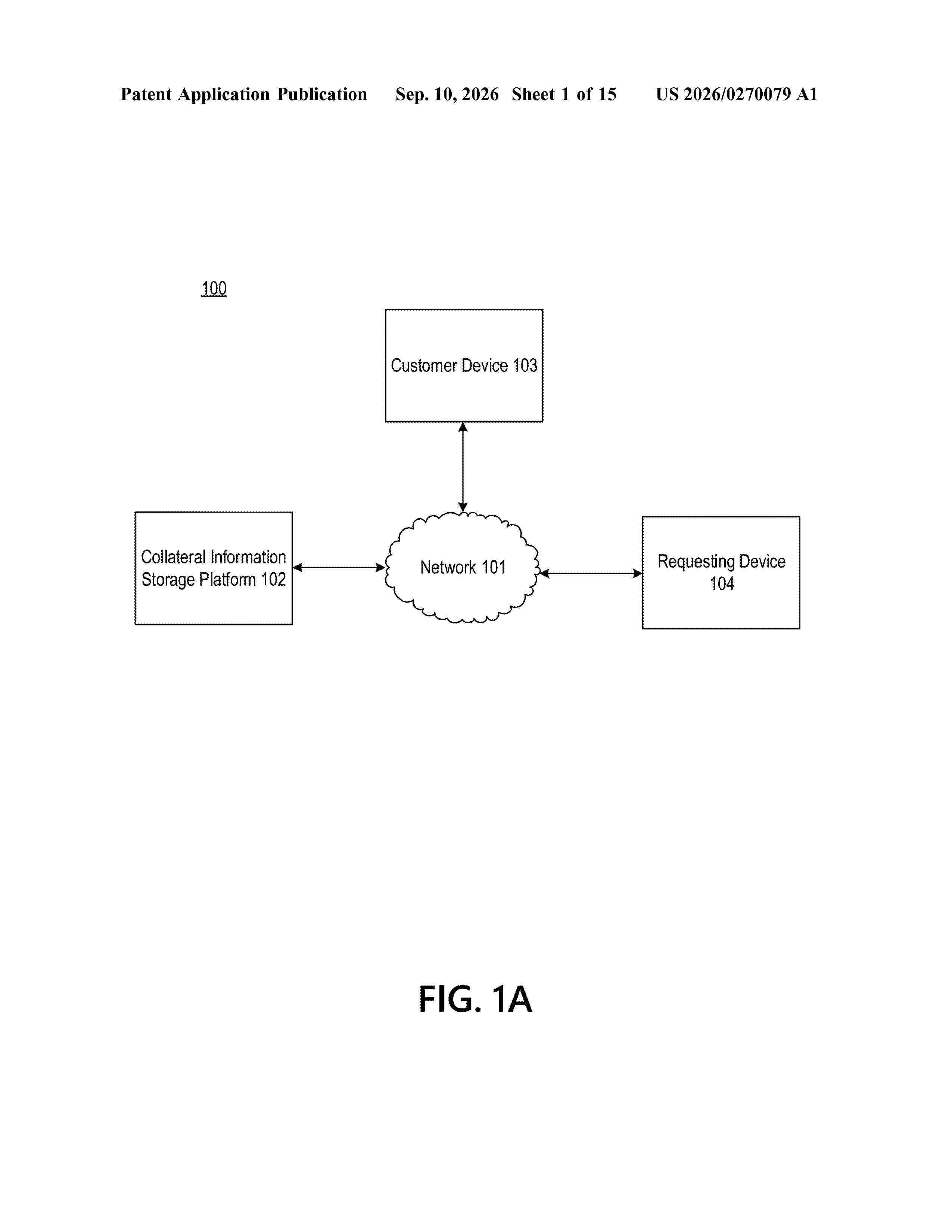
0000 Arrangements for securely storing collateral information associated with an electronic document are provided. A computing platform may receive a document that represents a collateral asset. The computing platform may scan the document to identify text in the document. The computing platform may slice the scanned document into one or more slices. The computing platform may apply a watermarking process to the scanned document and the one or more slices. The computing platform may add, after the watermarking process, the scanner document and the one or more slices to a blockchain environment. The computing platform may send a confirmation that indicates that the scanned document and the one or more slices were added to the blockchain environment.
 BOPI
BOPI
 Sede Electrónica