Si deseas distinguir tus productos, servicios o ambos de los de otra empresa, es posible que necesites una marca o nombre comercial. Descubre qué son, en qué consiste su procedimiento de registro y qué implica.

Información sobre los plazos de presentación de solicitudes de transformación de marcas de la Unión Europea en marca nacional española. Más información


Si tienes un nuevo dispositivo, producto o procedimiento que resuelva un problema técnico o tenga una ventaja práctica, existen distintas formas de protegerlo en España y en otros países. Descubre cómo hacerlo.

¿Tu innovación reside en la estética, la ornamentación o la apariencia de tu producto? Protégela mediante un diseño industrial. Descubre qué derechos confiere el registro y cómo realizar la tramitación.

Las indicaciones geográficas protegen el nombre de un producto originario de una zona geográfica, a la cual le debe una determinada calidad, reputación u otra característica. Descubre qué son, en qué consiste su procedimiento de registro y qué beneficios conceden.

Las patentes publicadas en todo el mundo son una valiosa fuente de información científica, técnica y comercial.

Si eres emprendedor/a o una empresa y quieres potenciar y mejorar la rentabilidad de tu negocio protegiendo de forma adecuada los activos intangibles de tu organización, en este espacio encontrarás lo necesario.


 1890
resultados
1890
resultados
 Última actualización
30/06/2026 [12:07:00]
Última actualización
30/06/2026 [12:07:00]


 Resultados 1325 a 1350 de 1890

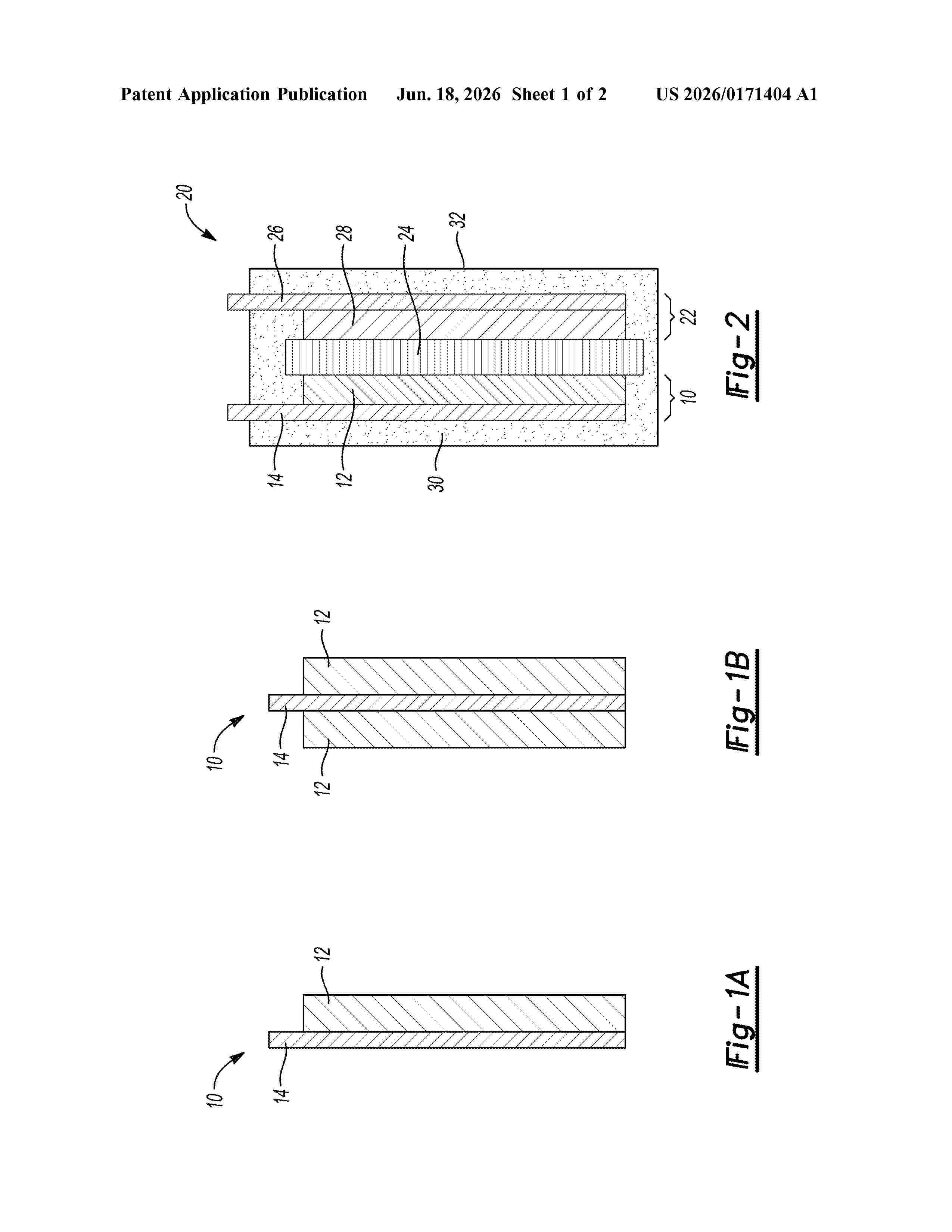
Resumen de: US20260171404A1
A positive electrode active material for lithium-ion batteries is represented by the formula Li1.01+aMn0.50+bNi0.25+cCoxO2, where 0

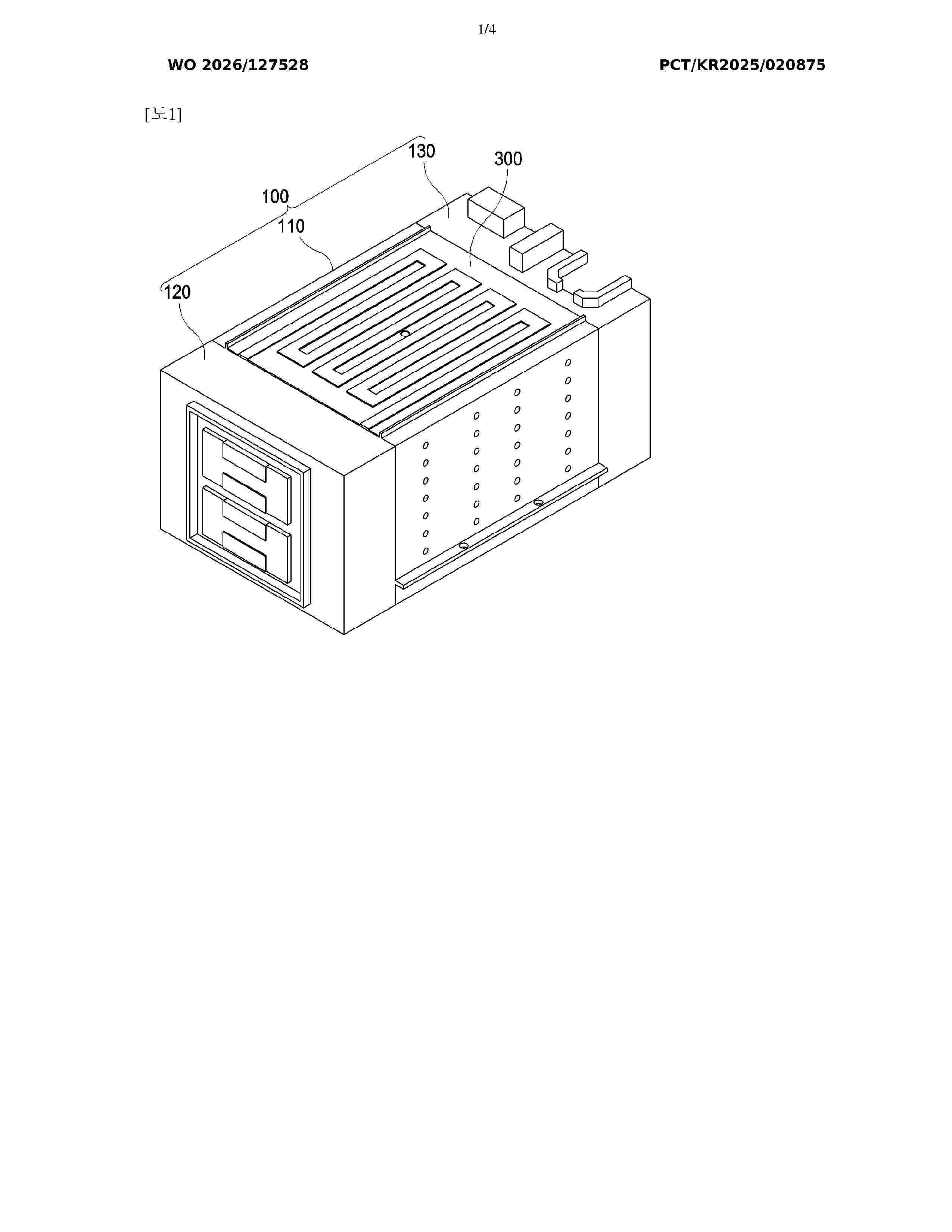
Resumen de: WO2026127528A1
Disclosed is a battery module characterized by comprising: a battery case made of a metallic material and having a battery cell storage unit formed therein; a plurality of battery cells stored in the battery cell storage unit; and a heater attached to the outer circumferential surface of the battery case. Therefore, even though all of the battery cells can be uniformly heated, there is no risk of carbonization and the like caused by separation of a portion of the heater.
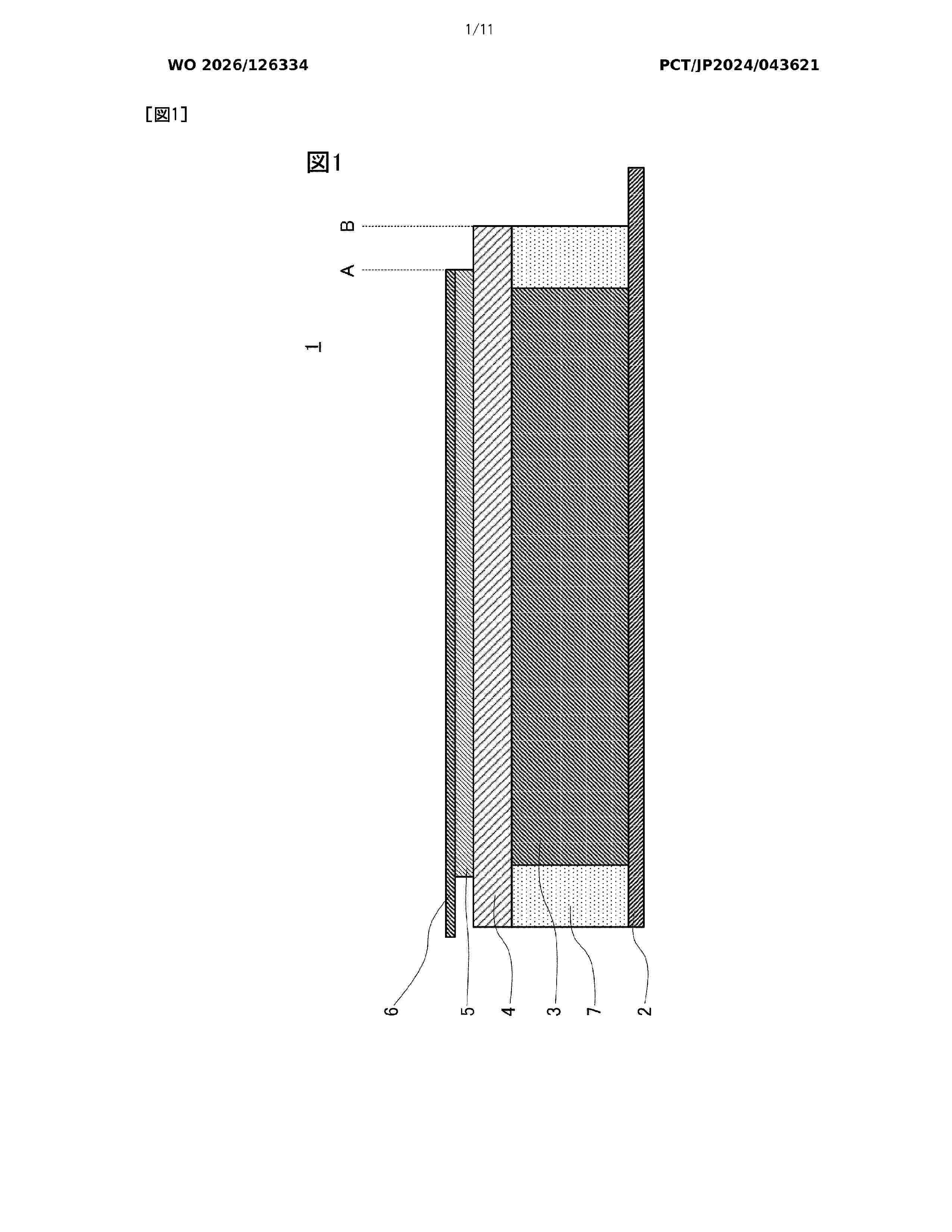
Resumen de: WO2026126334A1
This secondary battery comprises: a positive electrode current collector foil; a positive electrode layer; a positive electrode frame that is disposed on the positive electrode current collector foil so as to surround the positive electrode layer and has electronic insulation properties; an electrolyte layer; a negative electrode layer; and a negative electrode current collector foil. The positive electrode layer is rectangular. The positive electrode frame is divided into a pair of positive electrode frame elements. Each among the pair of positive electrode frame elements is L-shaped so as to correspond to two adjacent side surfaces of the positive electrode layer.
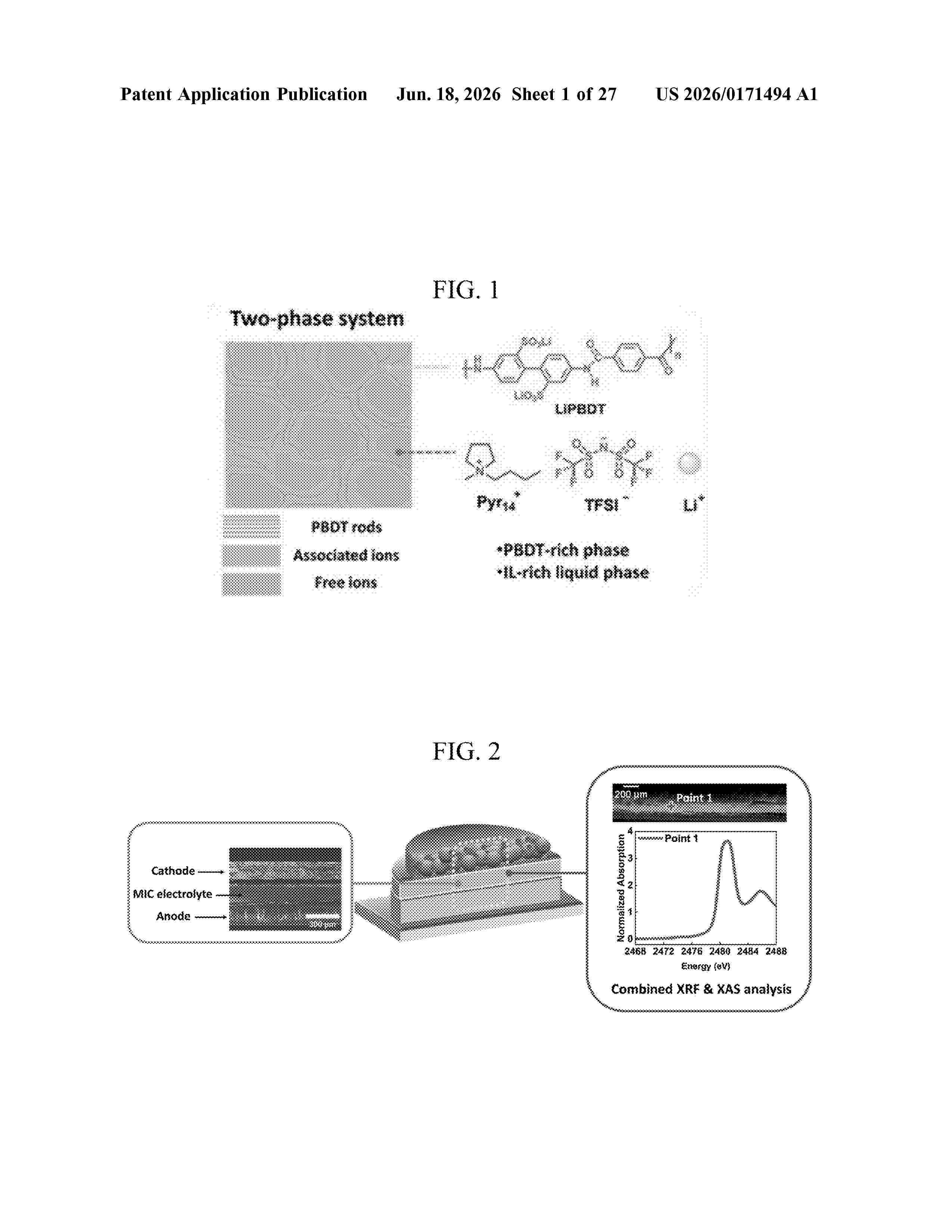
Resumen de: US20260171494A1
Disclosed herein are molecular ionic composite (MIC) polymer electrolytes. The MIC electrolytes described may be formulated to provide enhanced mechanical properties, improved ionic transport, and stable electrochemical performance across a broad temperature range. The compositions and methods presented are adaptable and may be tailored for various battery applications, including but not limited to solid-state lithium batteries or high-voltage lithium batteries.
Resumen de: US20260167051A1
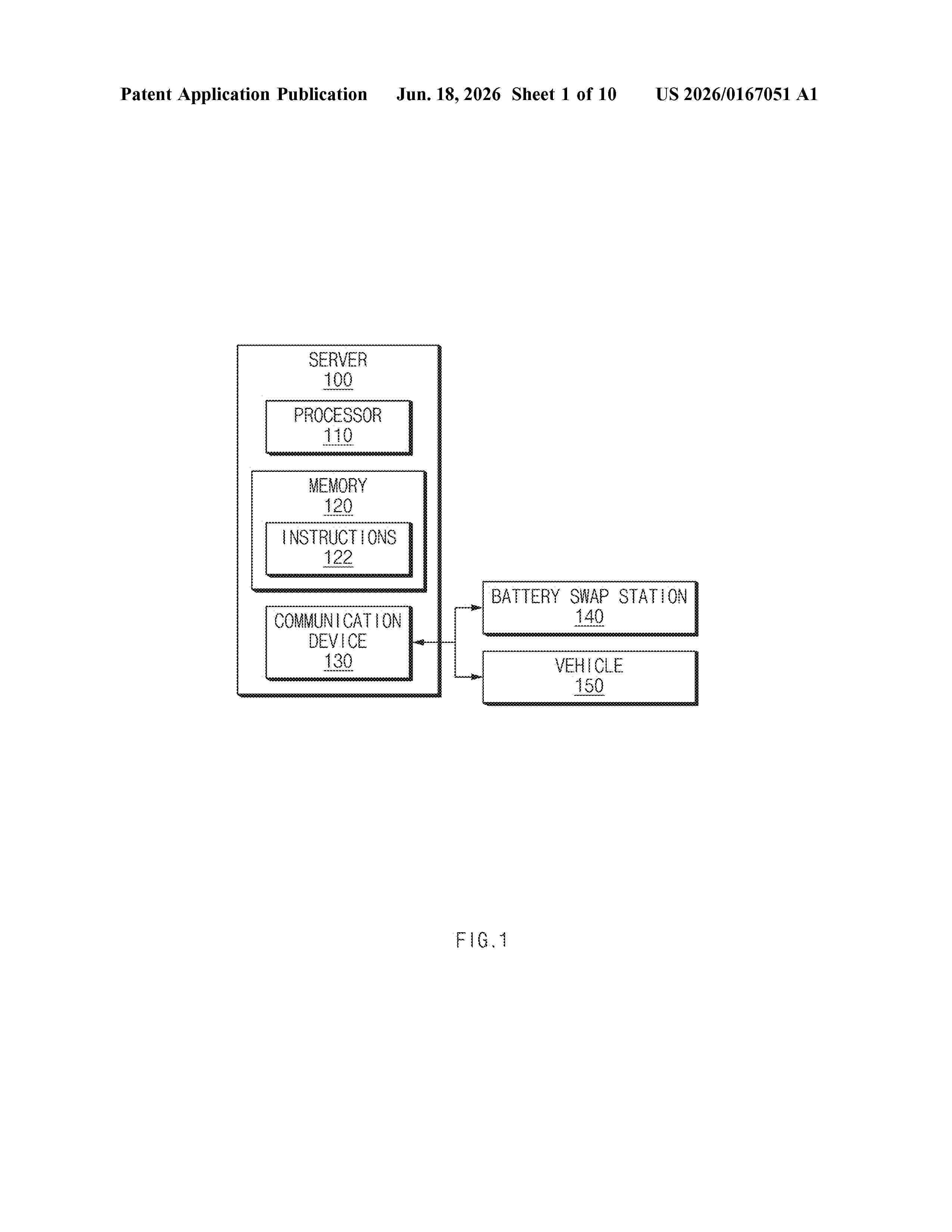
0000 A server includes a memory that stores computer-executable instructions, and at least one processor that accesses the memory to execute the instructions. The at least one processor receives first battery pack information from a vehicle, receives identification information of the battery swap station and second battery pack information from the battery swap station, determines whether a target battery pack associated with the second battery pack information is mountable in or configured to interface with the vehicle based on the first battery pack information and the second battery pack information, and transmits a request to open a slot to the battery swap station to the battery swap station based on a determination that the target battery pack is mountable in or configured to interface with the vehicle.
Resumen de: US20260171517A1
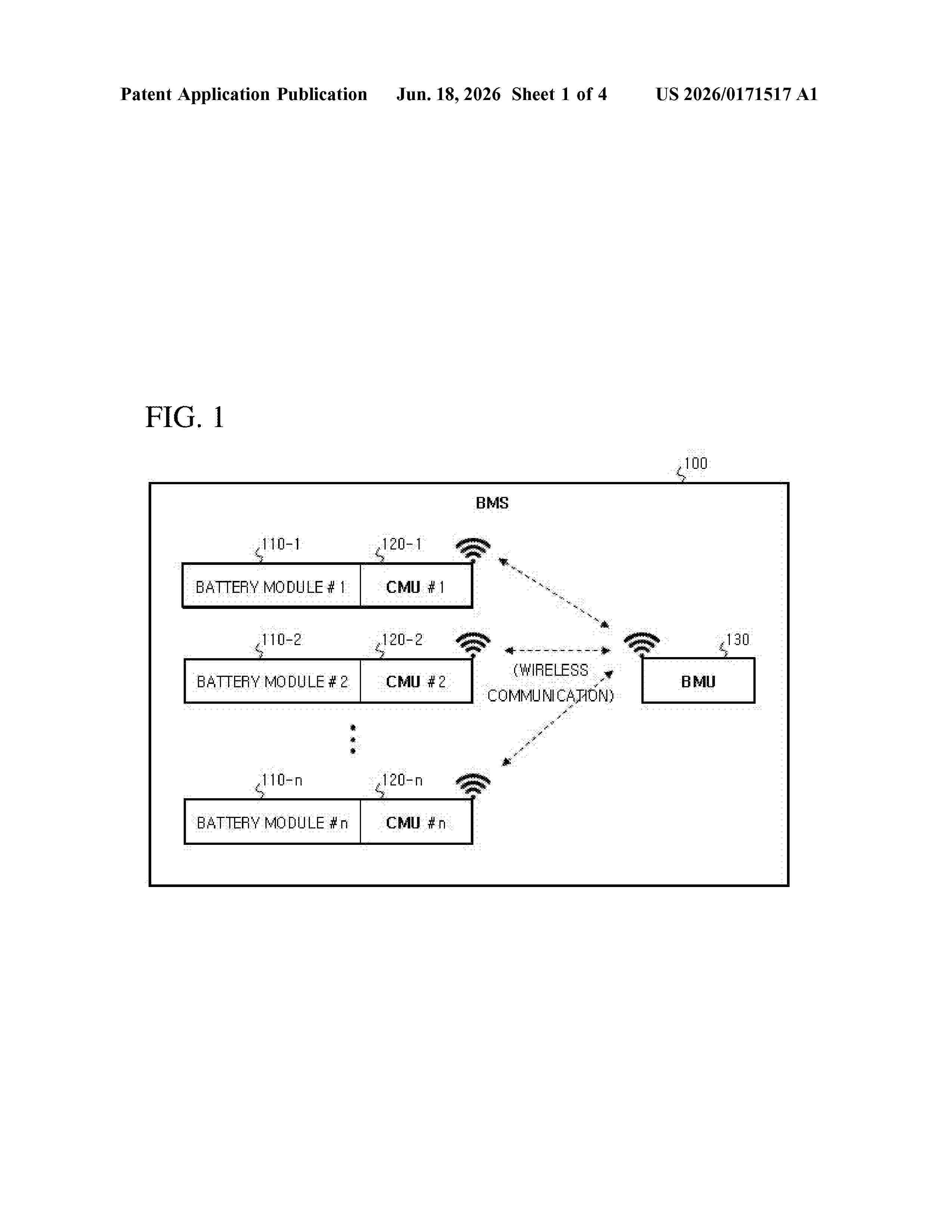
0000 A wireless battery management system includes a plurality of cell monitoring units (CMUs) configured to monitor a plurality of battery cells, and a battery management unit (BMU) configured to perform wireless communication with the plurality of CMUs and manage the plurality CMUs. The BMU requests transmission of cell monitoring information from the plurality of CMUs, and based on a failure of the transmission from any CMU, preferentially requests retransmission of the cell monitoring information from the CMU from which transmission has failed.
Resumen de: WO2026125553A1
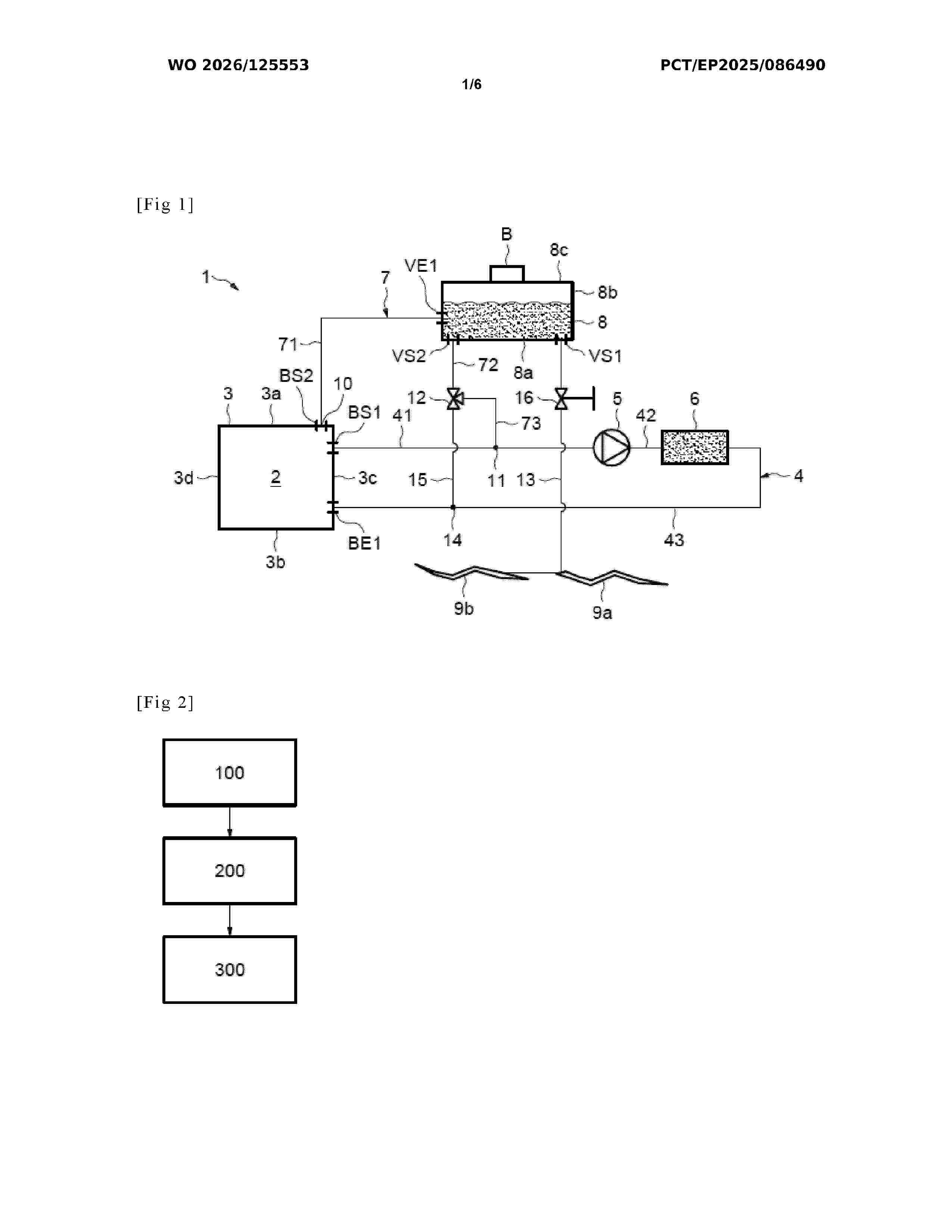
The invention relates to a system for cooling a battery (2), which system comprises: - a main circuit (4) comprising the battery and a pump (5) for circulating a dielectric fluid arranged between a main outlet (BS1) and a main inlet (BE1) of the battery; - a degassing circuit (7) comprising an expansion tank (8) and at least one tank of variable volume, which degassing circuit is connected to the main circuit by a first tapping (10) adjacent to the main outlet (BS1) of the battery or positioned on a secondary outlet (BS2) of the battery, and by a second tapping (11) positioned downstream of the main outlet; and - a three-way valve (12) a first flow path whereof is connected to the expansion tank, a second flow path whereof is connected to the second tapping of the main circuit and a third flow path whereof is connected to a third tapping (14) positioned downstream of the pump and upstream of the main outlet.
Resumen de: US20260171458A1
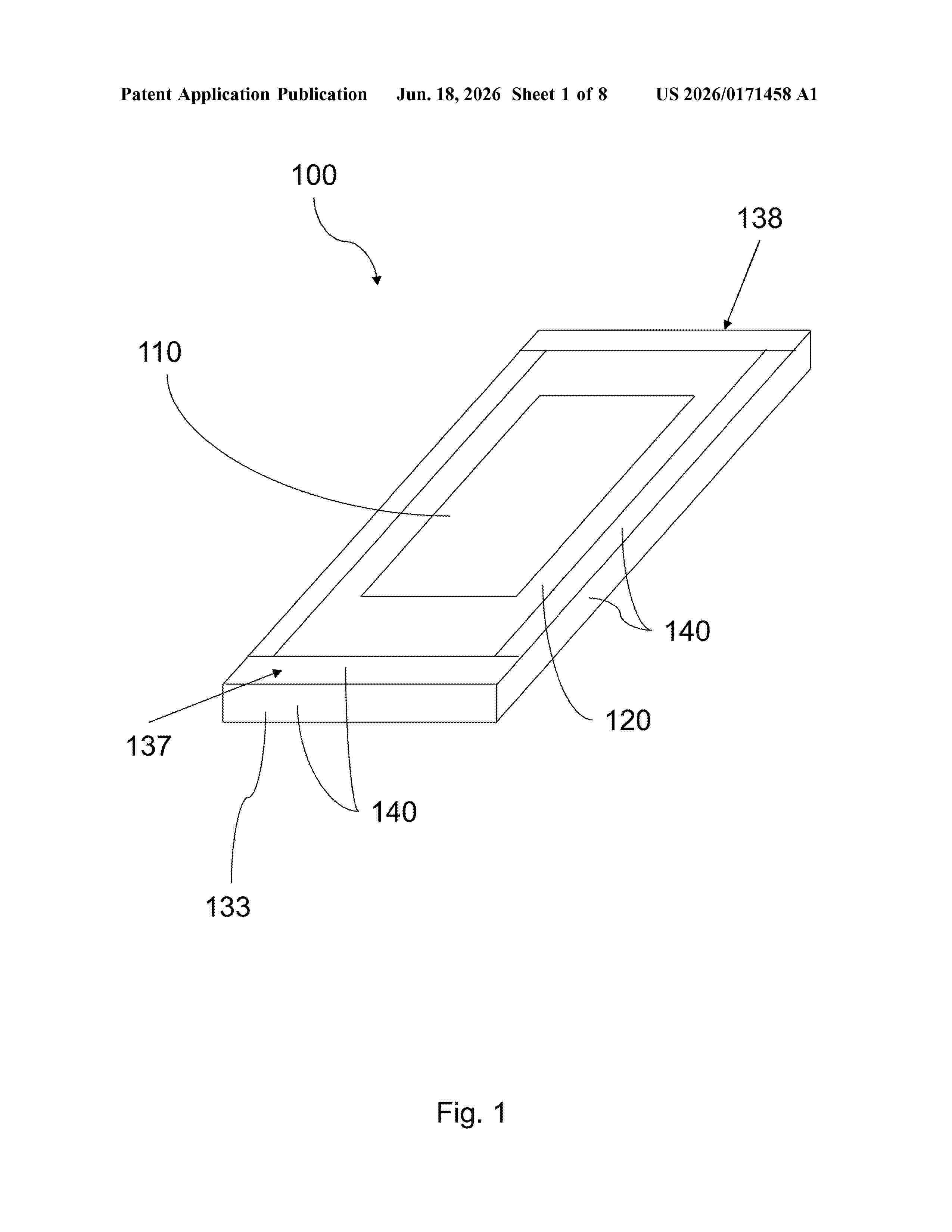
A method of making an anti-thermal propagation cell includes providing a longitudinal base film web with first and second sides, the first side having an adhesive layer. A plurality of insulation pads, each with top and back faces, front and back edges, and left and right sides, is provided. The back face of an insulation pad is attached to the first side of the base film web so that left and right base film strips remain free. The left strip is folded over the left side and part of the top face, and the right strip is folded over the right side and part of the top face. A lidding film web with first and second sides, the first side having an adhesive layer, is provided. The first side of the lidding film web is attached to portions of the top face and the folded base film strips.
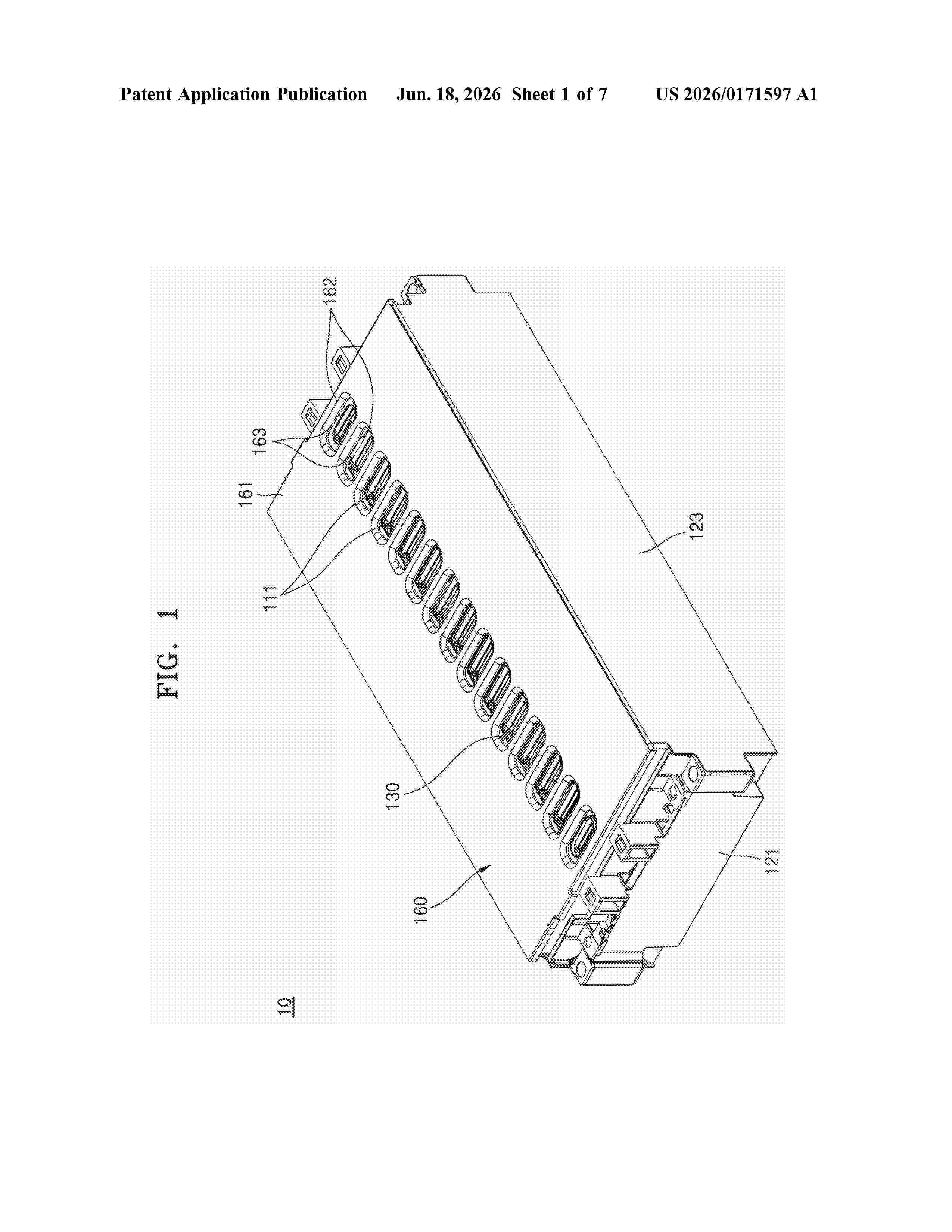
Resumen de: US20260171597A1
0000 A battery module cover and a battery module are disclosed. A battery module cover includes a cover body covering a plurality of battery cells accommodated in a battery module and including a plurality of venting portions exposing each battery vent of each of the plurality of battery cells and a blocking portion formed protrusively from each of the venting portions toward a corresponding battery vent of the battery vents.
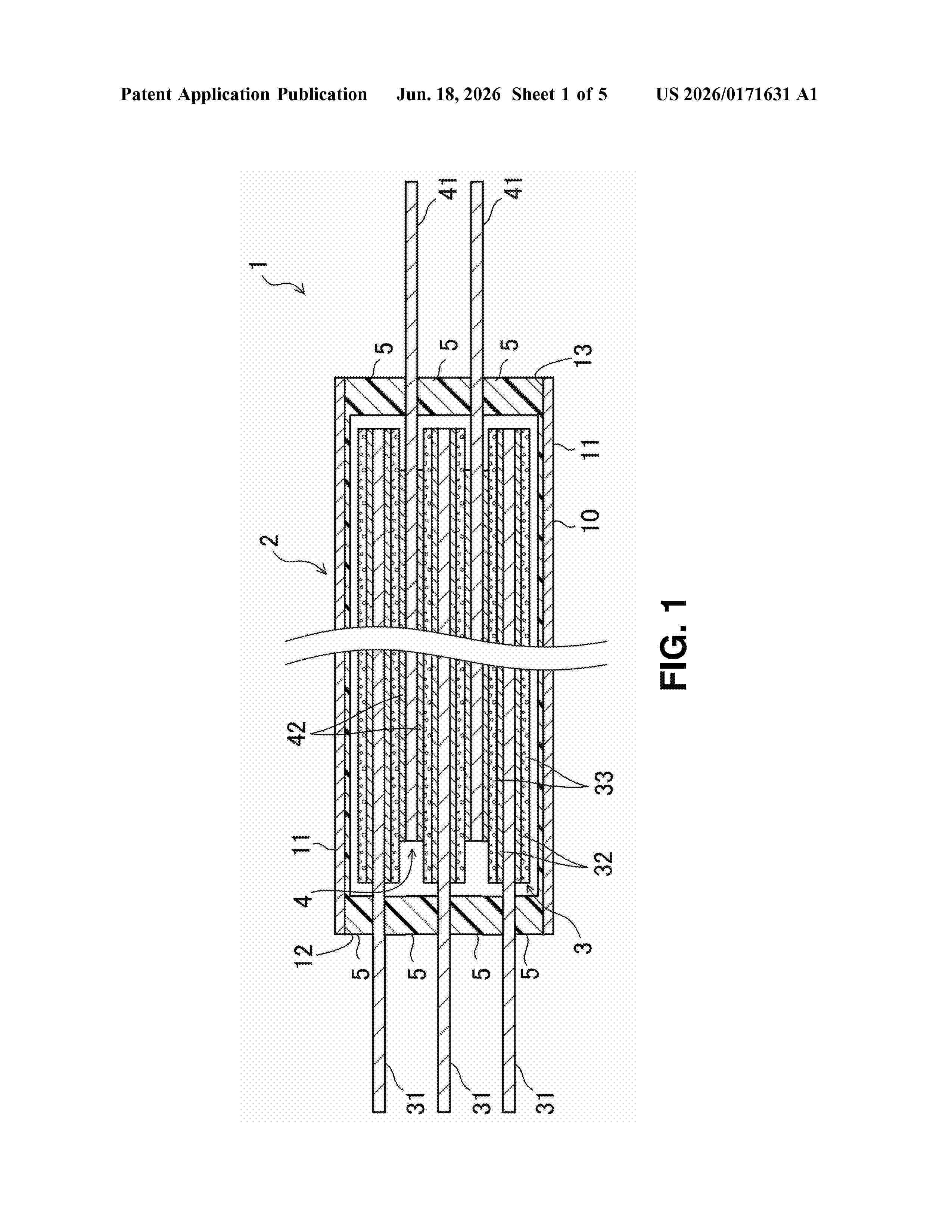
Resumen de: US20260171631A1
0000 A manufacturing method to prevent insufficient welding of resin pieces during manufacture of a battery cell includes stacking electrode sheets in a layering direction, the electrode sheets each including an electrode and a current collector. The electrodes are located in a container, and the current collectors are each connected to the electrode in the container and protrude outward from an opening of the container. The method also includes preheating resin pieces, located between adjacently stacked current collectors, through the current collectors. After preheating is started, pressurizing and heating the resin pieces is started from an outside toward a center in the layering direction at a position of the opening of the container. Resin pieces are welded together between the current collectors, and the opening of the container is sealed.
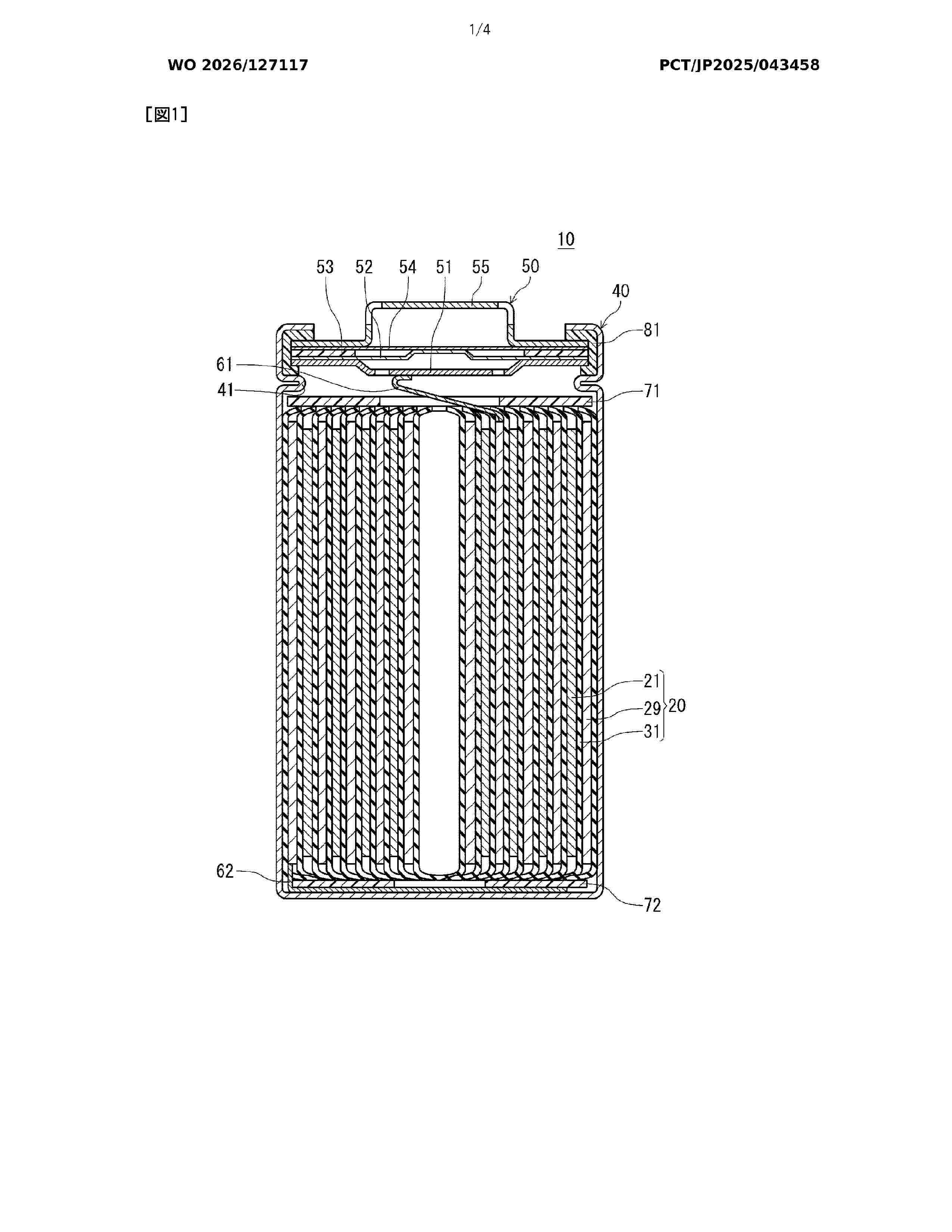
Resumen de: WO2026127117A1
This power storage device is provided with an electrode body. A first electrode plate of the electrode body comprises an elongated sheet-shaped current collector having a first main surface and a second main surface, and a first active material layer provided on the first main surface. The first main surface has at least one first uncoated portion that is partially provided along the longitudinal direction of the current collector and does not have the first active material layer. The first active material layer has at least one first region in which a length in the longitudinal direction of the current collector is 10% or less of the length in the longitudinal direction of the current collector. The first region extends along the width direction of the current collector. The mass per unit area of the first active material layer in the first region is 50% or more and less than 100% of the mass per unit area of the first active material layer surrounding the first region. The total proportion of the first region in the first active material layer is 50% or less. The first uncoated portion and the first region are spaced apart from each other.
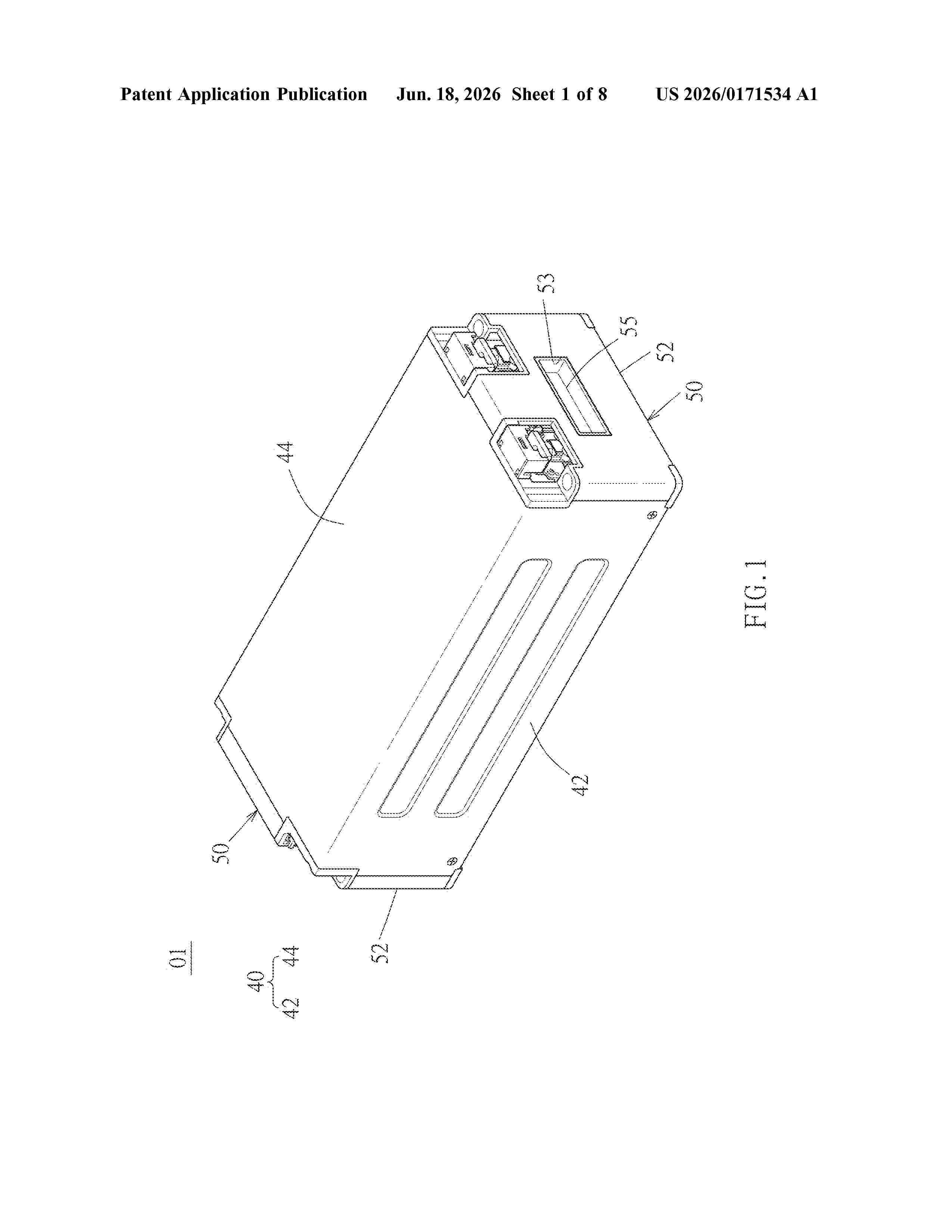
Resumen de: US20260171534A1
The present invention provides a protective structure for a pouch cell battery, comprising a base, a top cover, and two terminal covers, wherein the base supports a battery cell module, the top cover is connected to the base, and the terminal covers are connected to both ends of the base and the top cover. The battery cell module and two bus structures are positioned between the terminal covers, with each terminal cover primarily consisting of an outer shell and an insulating interface, with each outer shell including a central through-hole. Each insulating interface is a shell-like structure made of an insulating and thermally conductive plastic material positioned adjacent to the bus structures and protruding toward the adjacent bus structures to form thermal conduction elements aligned with the respective through-holes, thereby enhancing the heat dissipation efficiency through the terminal covers.
Resumen de: WO2026127429A1
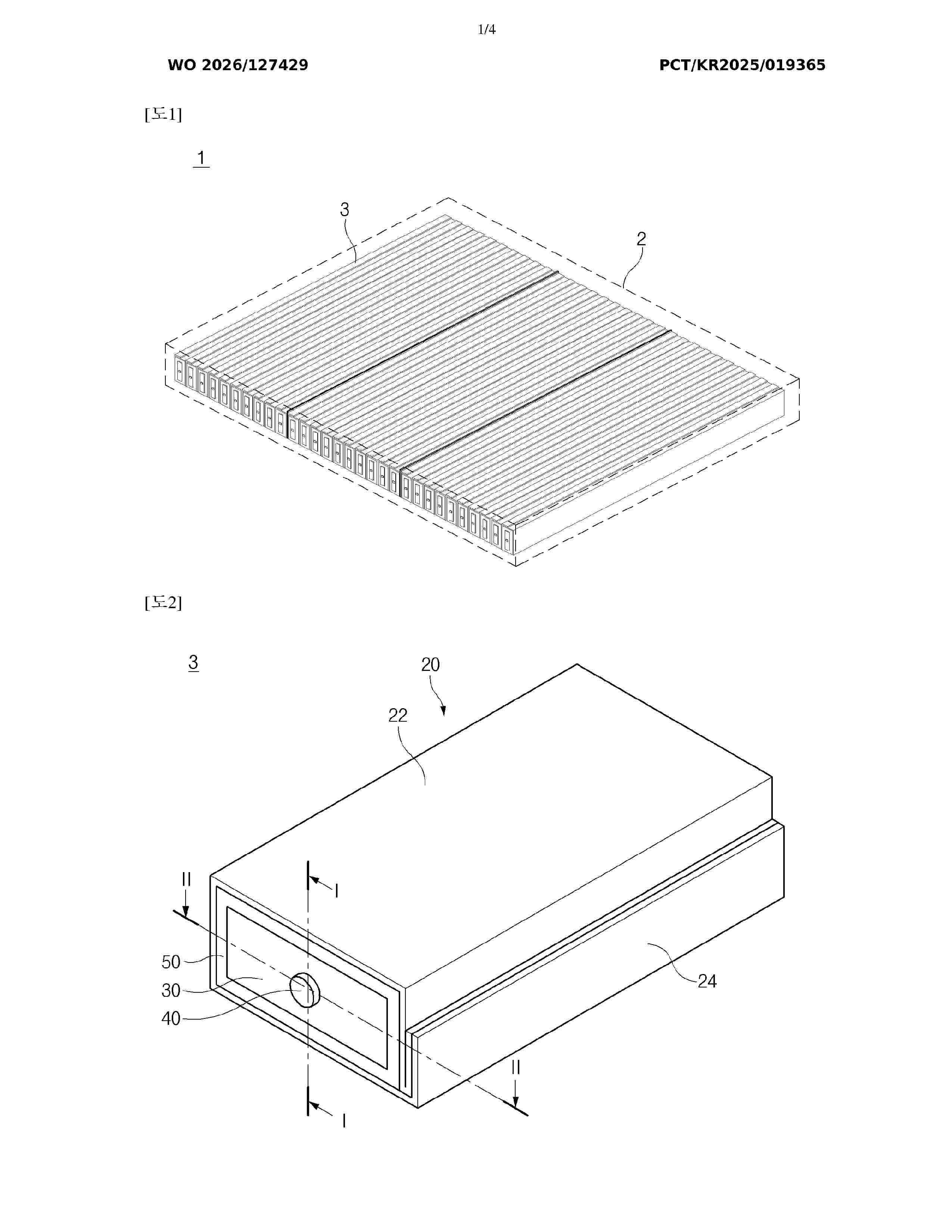
The present invention relates to a secondary battery and a battery box comprising same. According to one aspect of the present invention, the secondary battery comprises: an electrode assembly extending in one direction; a cap covering one portion of the electrode assembly; and an exterior film surrounding the other portion of the electrode assembly. The cap may include: a cover member covering one side along the direction in which the electrode assembly extends; a connection unit provided on one surface of the cover member to couple same to the exterior film; and a heat insulating unit provided on the other surface of the cover member and having a higher melting point than the connection unit.
Resumen de: US20260171492A1
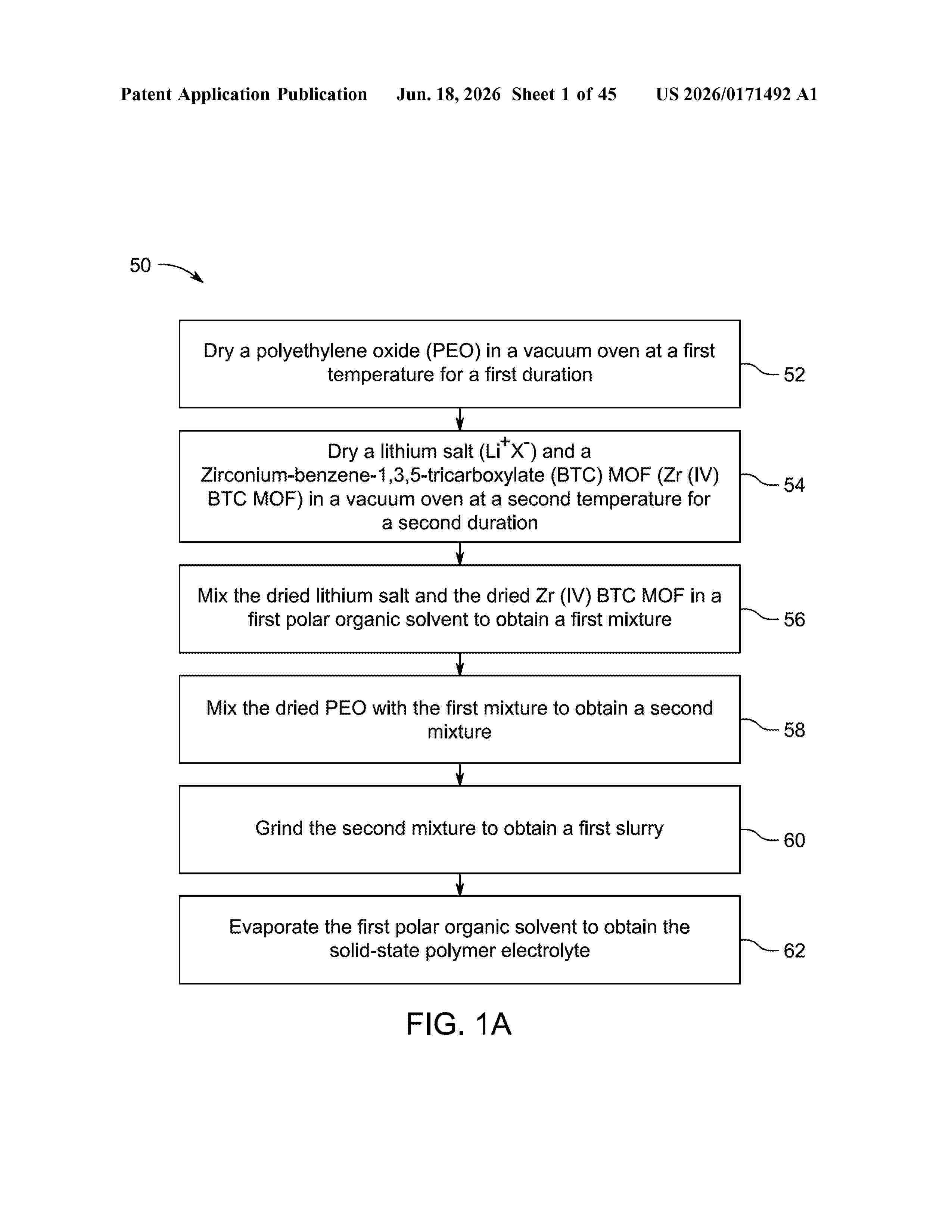
A solid-state polymer electrolyte including, based on the weight of the electrolyte: from 60 to 75 wt. % of polyethylene oxide (PEO); from 20 to 30 wt. % of a lithium salt (Li+X−); and, from 1 to 20 wt. % of a zirconium (IV) benzene-1,3,5-tricarboxylate (BTC) metal-organic framework (MOF). The solid-state polymer electrolyte has an X-ray diffraction (XRD) pattern of MOF-808 and has the general formula Zr6O4(OH)4(BTC)(L)6, wherein L is an anion selected from the group consisting of fluoride, formate (COO−), acetate (CH3COO−), propionate (CH3CH2COO−) and benzoate (C6H5COO−). The solid-state polymer electrolyte may have: an enthalpy of melting (ΔHm) of less than 50 Jg−1; and, an ionic conductivity of at least 30 μScm−1, as determined by electrochemical impedance spectroscopy (EIS) at 20° C.
Resumen de: US20260172984A1
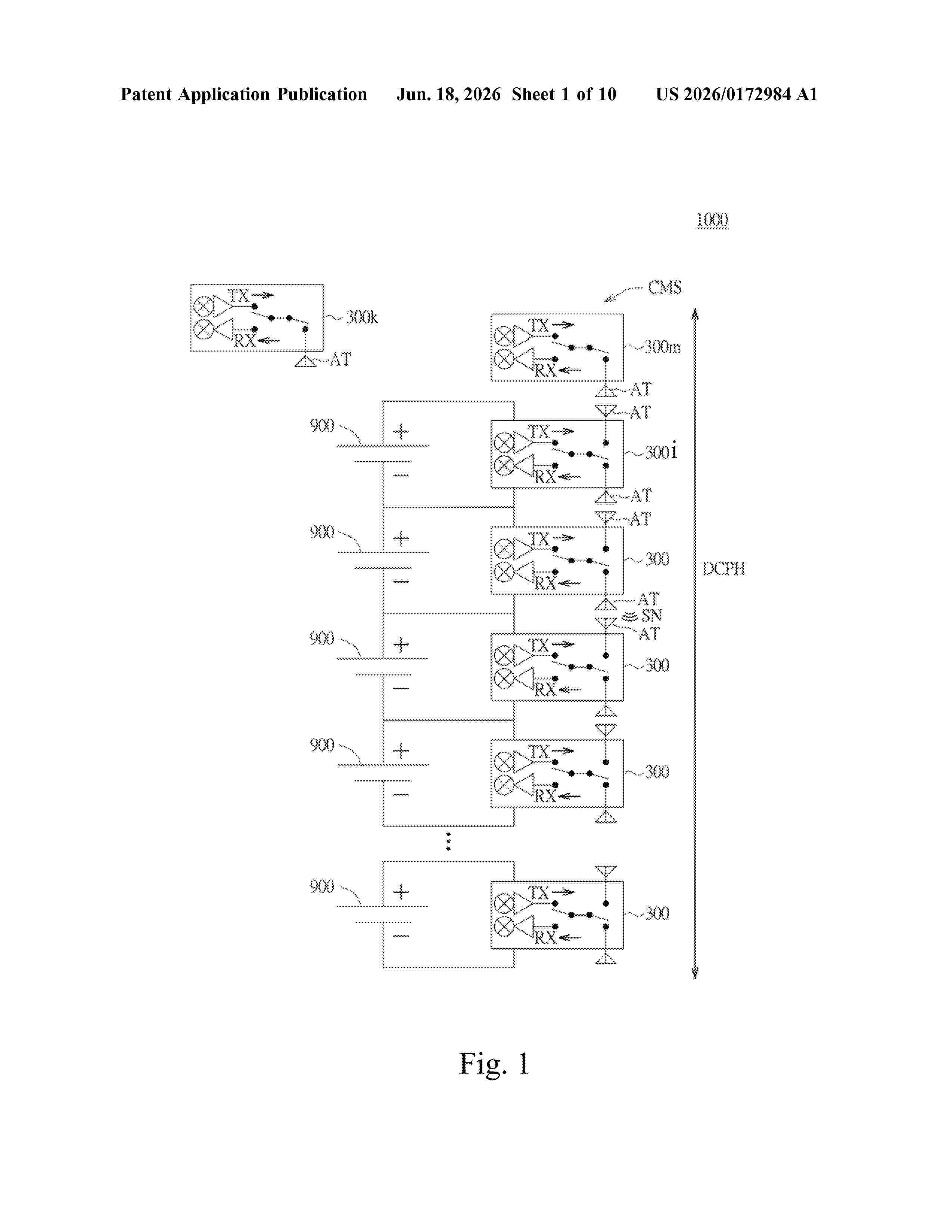
A battery communication system and an operation method thereof are provided. The battery communication system is used to communicate with a plurality of battery units. The operation method of the battery communication system includes the following steps: in a wireless daisy-chain communication path of the battery communication system, a first wireless communication unit sends a transmission signal to a second wireless communication unit adjacent thereto via a wireless communication or a coupling wave; and in the wireless daisy-chain communication path of the battery communication system, the first wireless communication unit and the second wireless communication unit operate an auto-power control (APC) to automatically adjust an output power of the first wireless communication unit.
Resumen de: WO2026128248A1
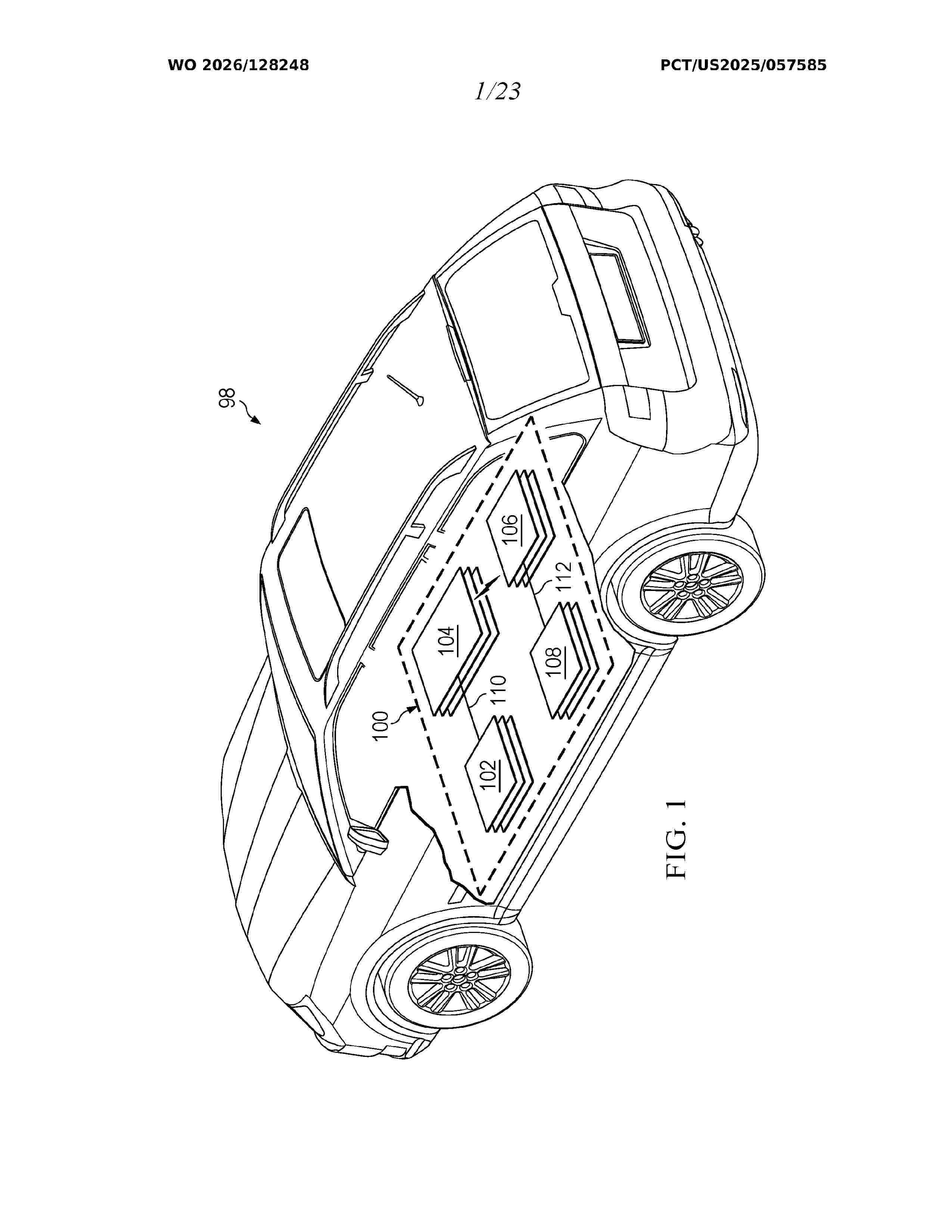
An example device (102-1 or 104-1) comprises; a transceiver, and programmable circuitry coupled to the transceiver and configurable to cause the transceiver to: wirelessly transmit (first instance of 1410) a first message to a first monitor circuit, the first message to prompt the first monitor circuit to perform a first battery measurement upon receipt (1402), and transmit (second instance of 1410) a second message to a second monitor circuit over a wired medium after transmitting the first message so that the first and second monitor circuits synchronously perform battery measurements (1406, 1408).
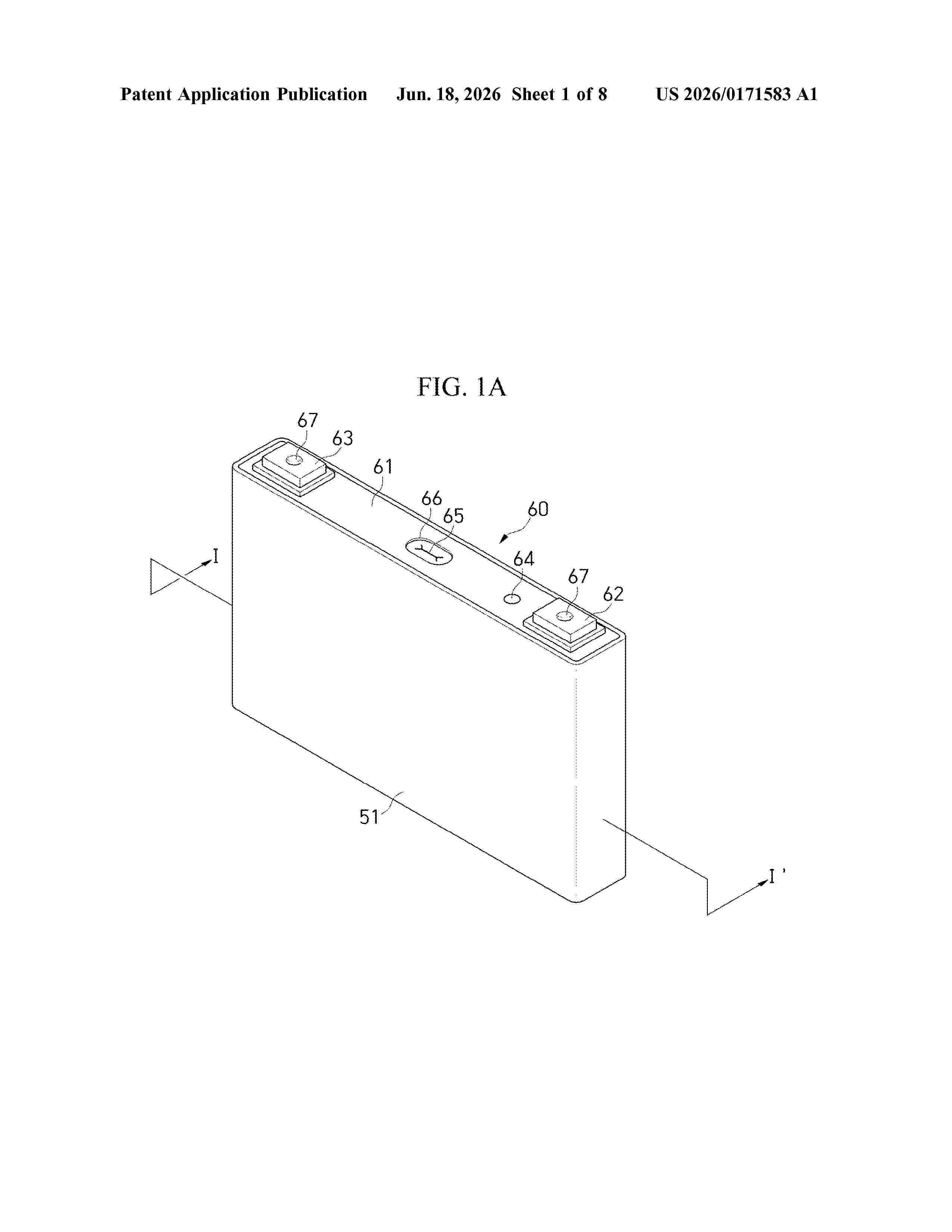
Resumen de: US20260171583A1
Disclosed herein are a battery module and a method of manufacturing the battery module. The battery module includes: a cell stack including a plurality of battery cells; an outer partition forming an external housing; an inner partition fixed to the outer partition and supporting a side surface of the cell stack; a movable end block supporting an outermost battery cell of the cell stack, and configured to move along the inner partition and apply pressure to the cell stack; and a movable partition functioning as an intermediate partition positioned between the outer partition and the inner partition, the movable partition being configured to have a same height as the outer partition and define a first internal space between the outer partition and the movable partition. The movable partition moves along the outer partition and varies a size of the first internal space.
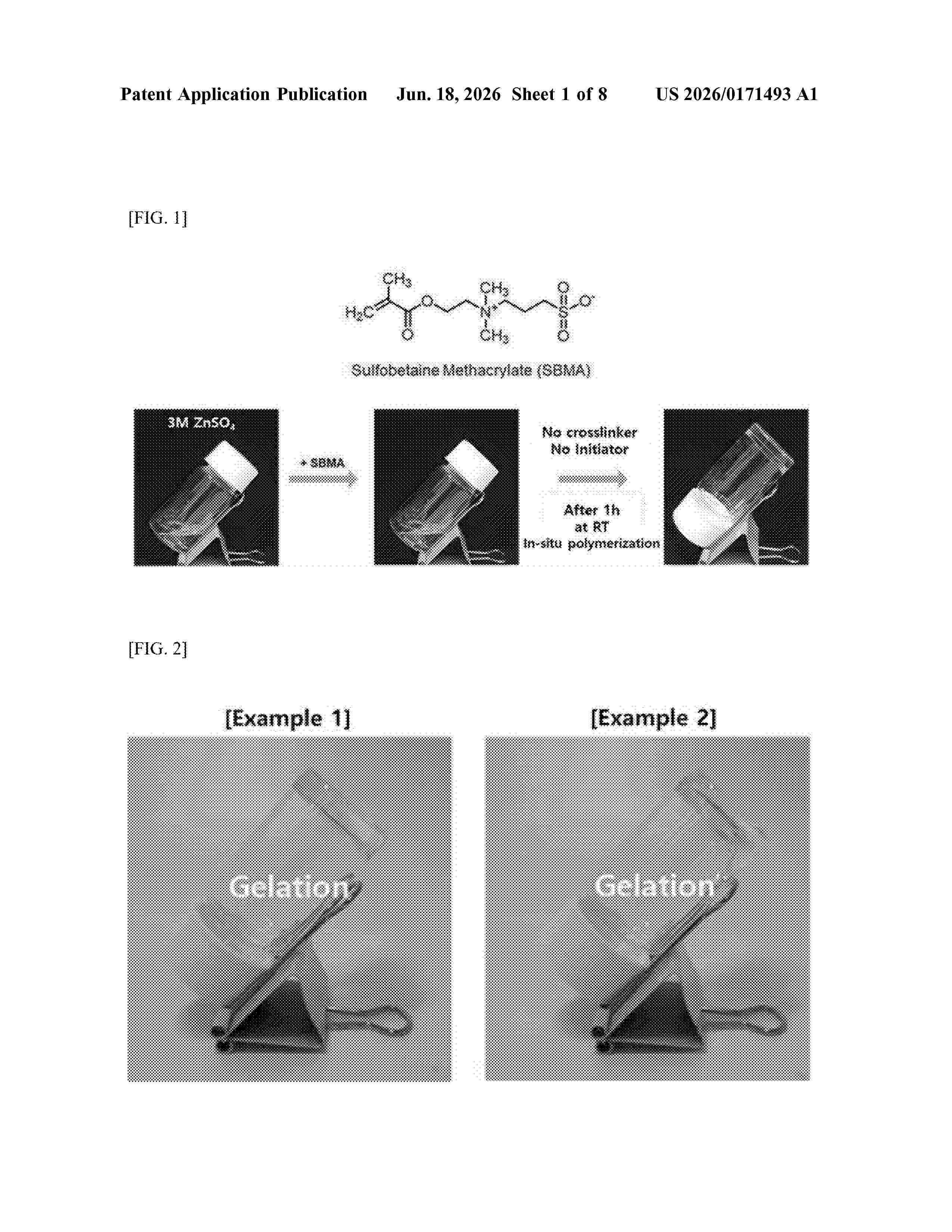
Resumen de: US20260171493A1
0000 The present invention relates to a gel polymer electrolyte self-polymerized at room temperature, a method for manufacturing the same, and a secondary battery comprising the same. The gel polymer electrolyte is a gel polymer electrolyte that is self-polymerized and then self-crosslinked without initiators, crosslinkers, and external energy, and is capable of suppressing dendrite formation with high mechanical properties by controlling the concentration of the self-polymerized polymer. When applied as an aqueous zinc battery gel electrolyte, it induces high stability and electrochemical characteristics, and significantly improves the lifespan of the battery by eliminating interfering residues inside the battery system and compounds causing chemical side reactions, thereby improving the capacity characteristics of the battery.
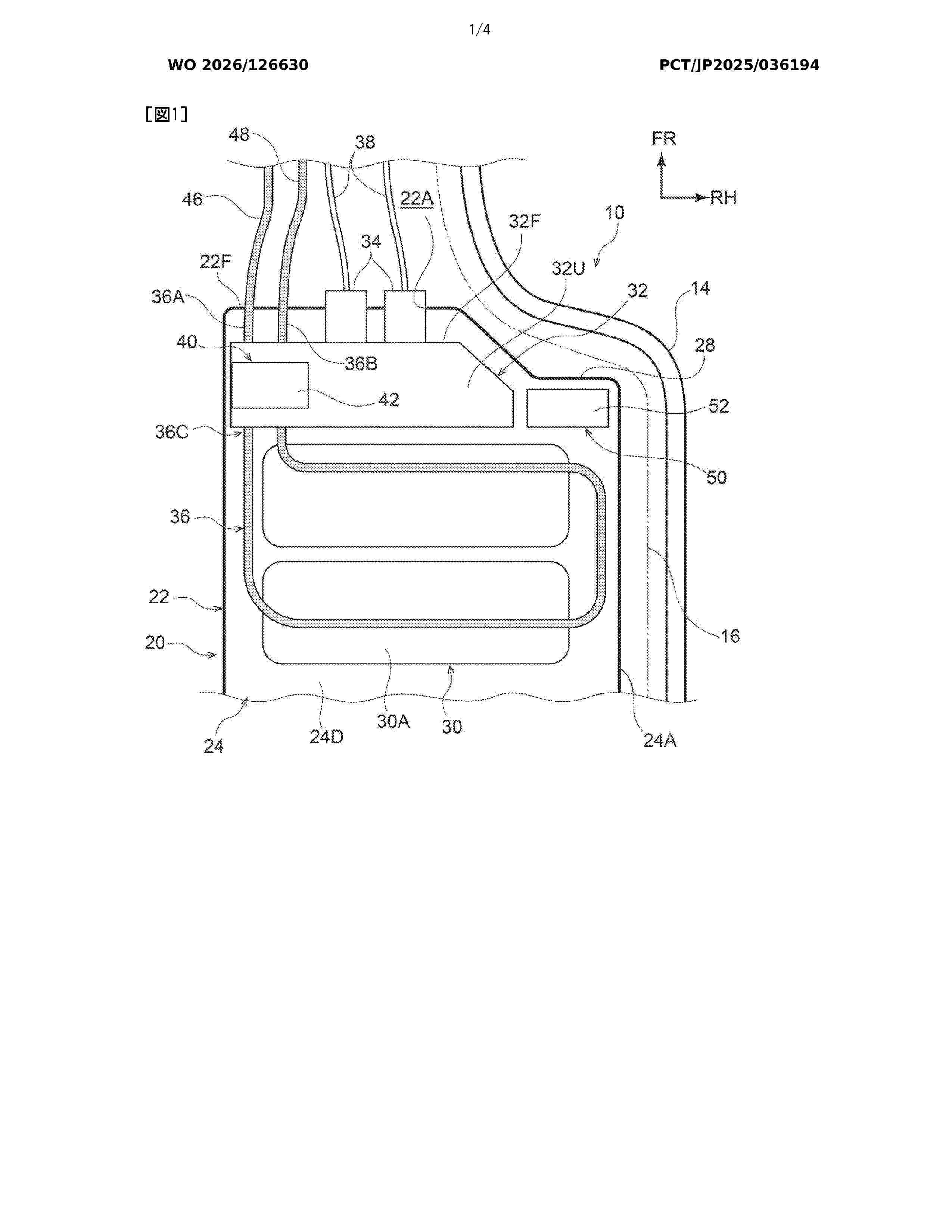
Resumen de: WO2026126630A1
Provided is a vehicle that comprises: a power storage device that has a case that accommodates a power storage module; an exhaust pipe that is adjacent to the case on the outside in the vehicle width direction; an apparatus connector that is provided to the case at an end part on the vehicle front side; a cooling pipe that is routed to make it possible to cool the power storage module; and an inlet and an outlet that allow a refrigerant to flow into and out of the cooling pipe and are provided in the case at the end part on the vehicle front side on the opposite side from the exhaust pipe as seen in plan view with the apparatus connector therebetween.
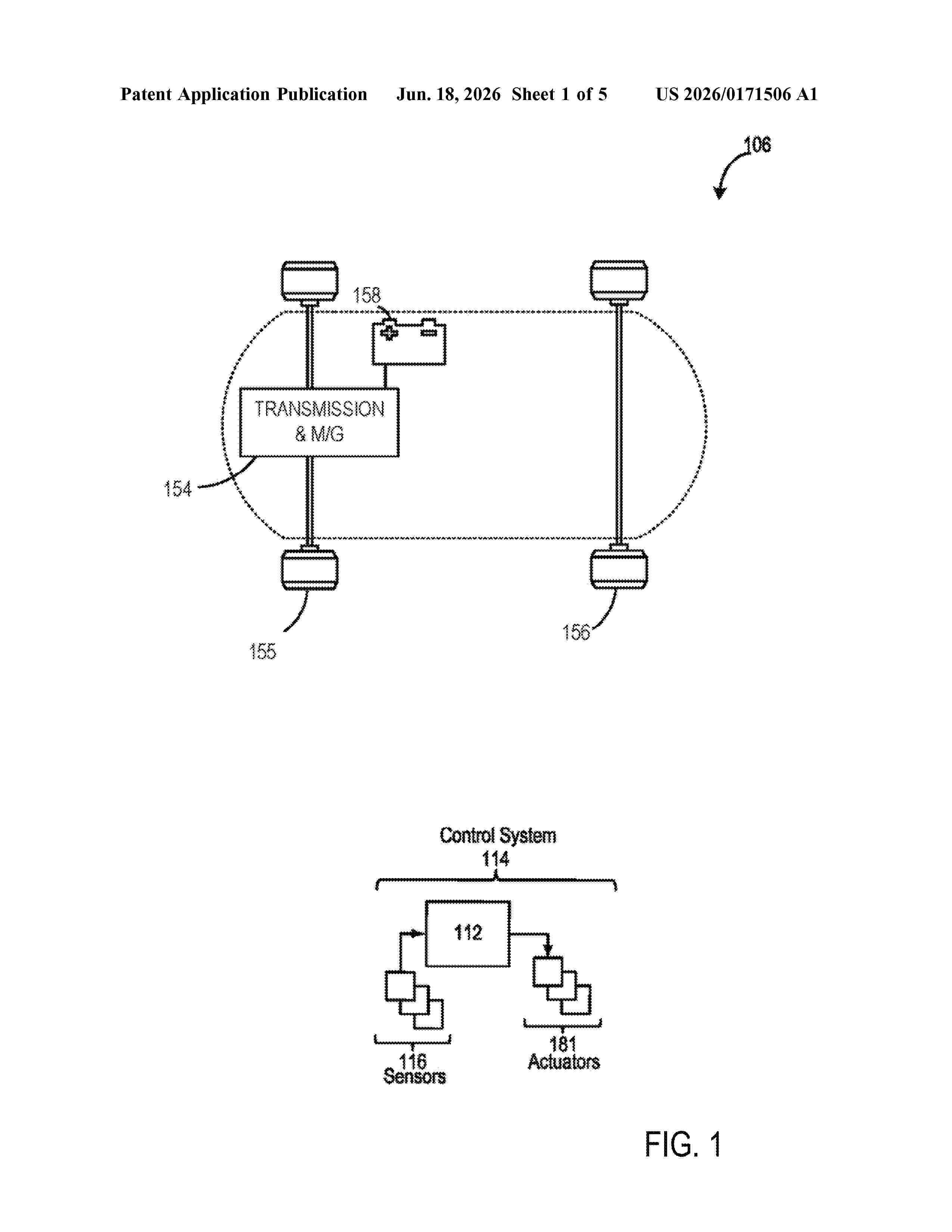
Resumen de: US20260171506A1
Methods are provided for cutting electrodes in a solid-state battery. In one example approach, a method comprises arranging electrodes in a stack, the stack comprising a first and oppositely charged second electrode, wherein the first electrode overhangs the second electrode; laminating the first and second electrodes in the stack; cutting a portion of the overhang around the perimeter of the first electrode with a laser; and removing the cut portion of the overhang from the first electrode so that the first electrode overhangs the second electrode by an amount that is less than or approximately equal to a threshold amount.
Resumen de: WO2026128743A1
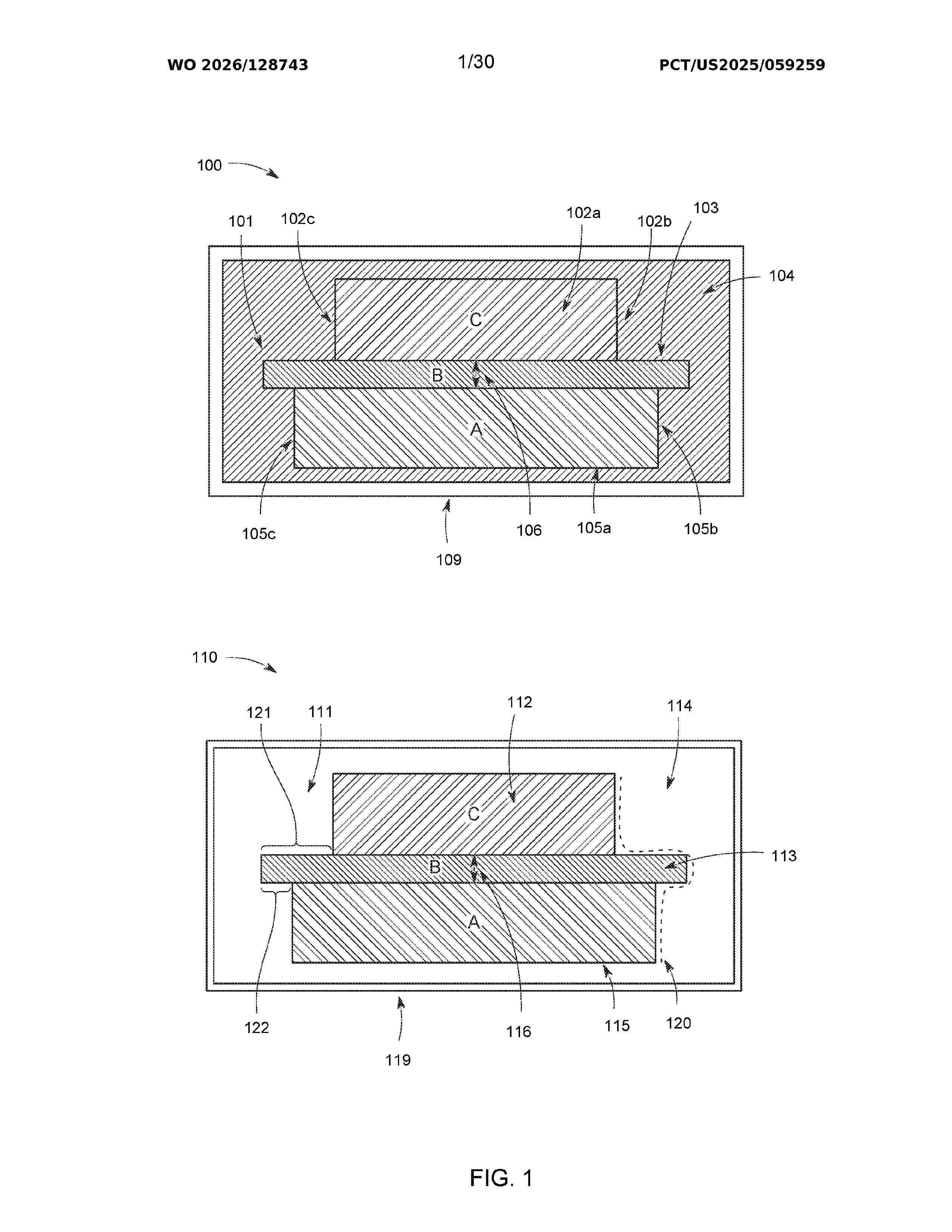
The present inventions relate to methods, devices, systems, apparatuses, controllers, software, and designs associated with packaging of at least one cell assembly in a space efficient manner, while the cell assembly is in the packaging. The space optimization comprises a folding scheme. The packaging of the cell assembly in the enclosure may include heat and/or pressure application onto the packaging, while the cell assembly is in the packaging, e.g., enclosure such as a pouch.
Resumen de: WO2026127453A1
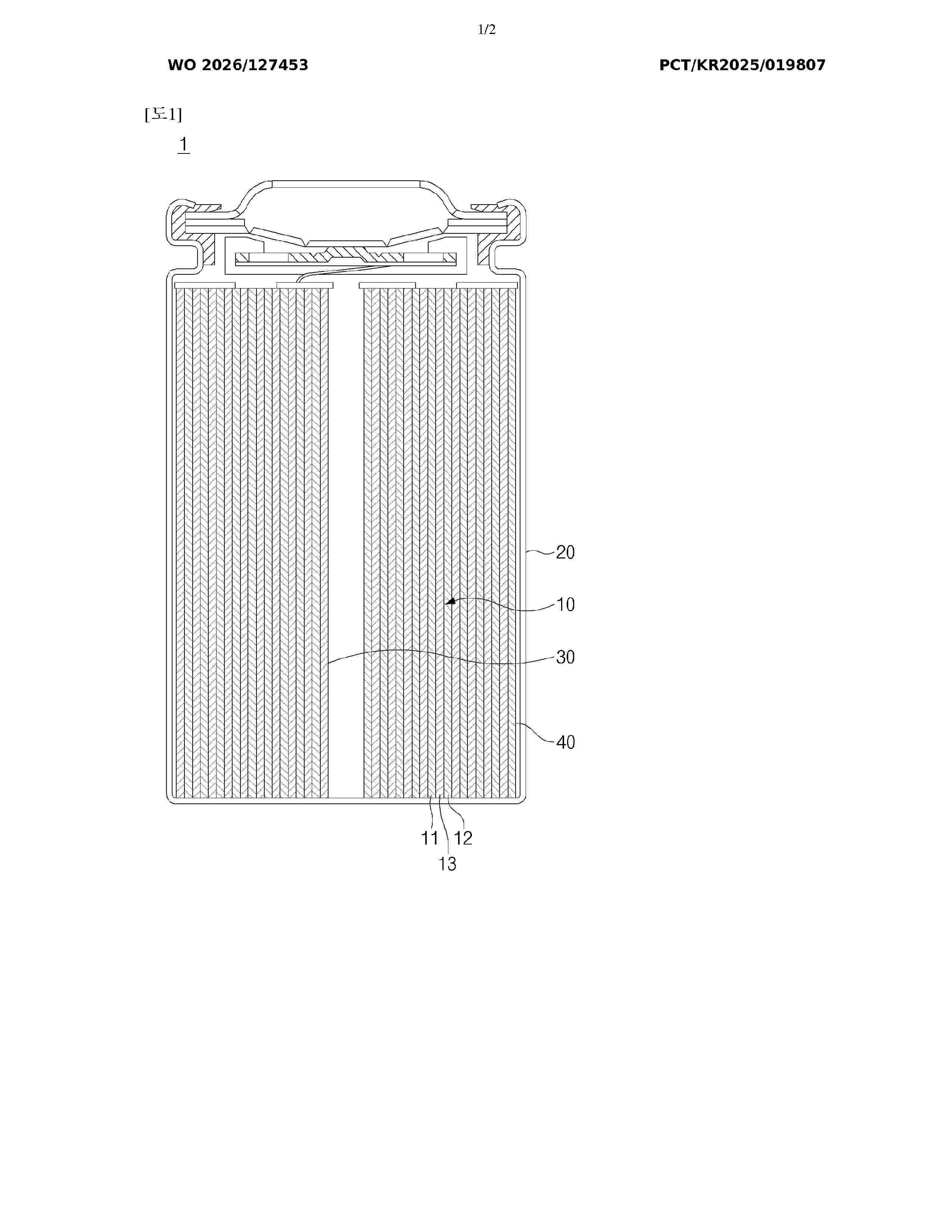
The present invention relates to an electrode assembly and a secondary battery comprising same, wherein, in the electrode assembly, impregnation with an electrolyte solution is facilitated near a central portion of the electrode assembly where compressive stress is high, and a reaction area is increased, thus ensuring that, during rapid charging, intercalation and deintercalation of lithium can proceed smoothly, thereby suppressing the occurrence of lithium plating and enabling a uniform reaction, and enabling problems at the central portion to be improved by improving the unfavorable negative-to-positive electrode ratio (NP ratio) typically caused by stress concentration at the central portion.
Resumen de: WO2026128468A1
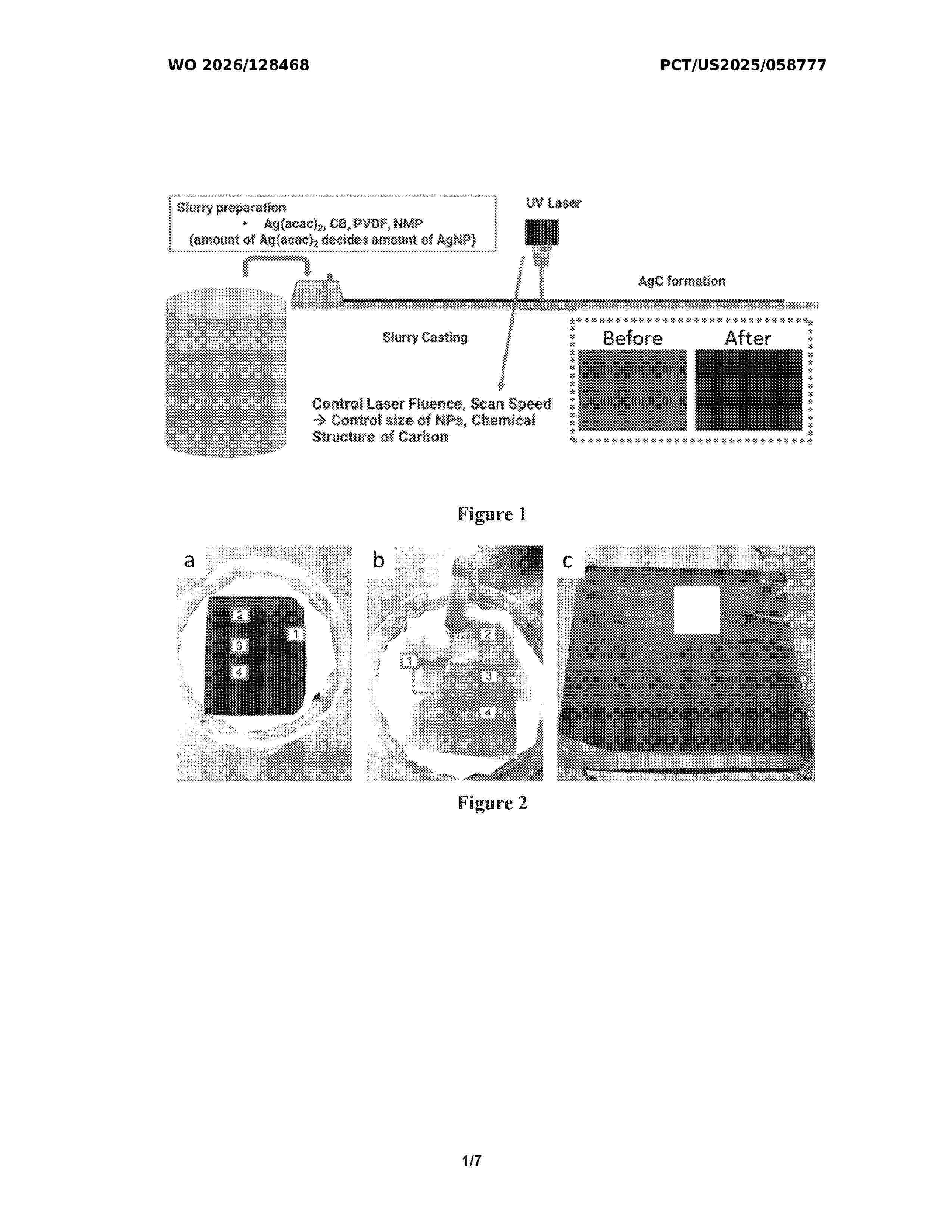
Disclosed herein are composite films as well as methods of making and using thereof.
Resumen de: WO2026126991A1
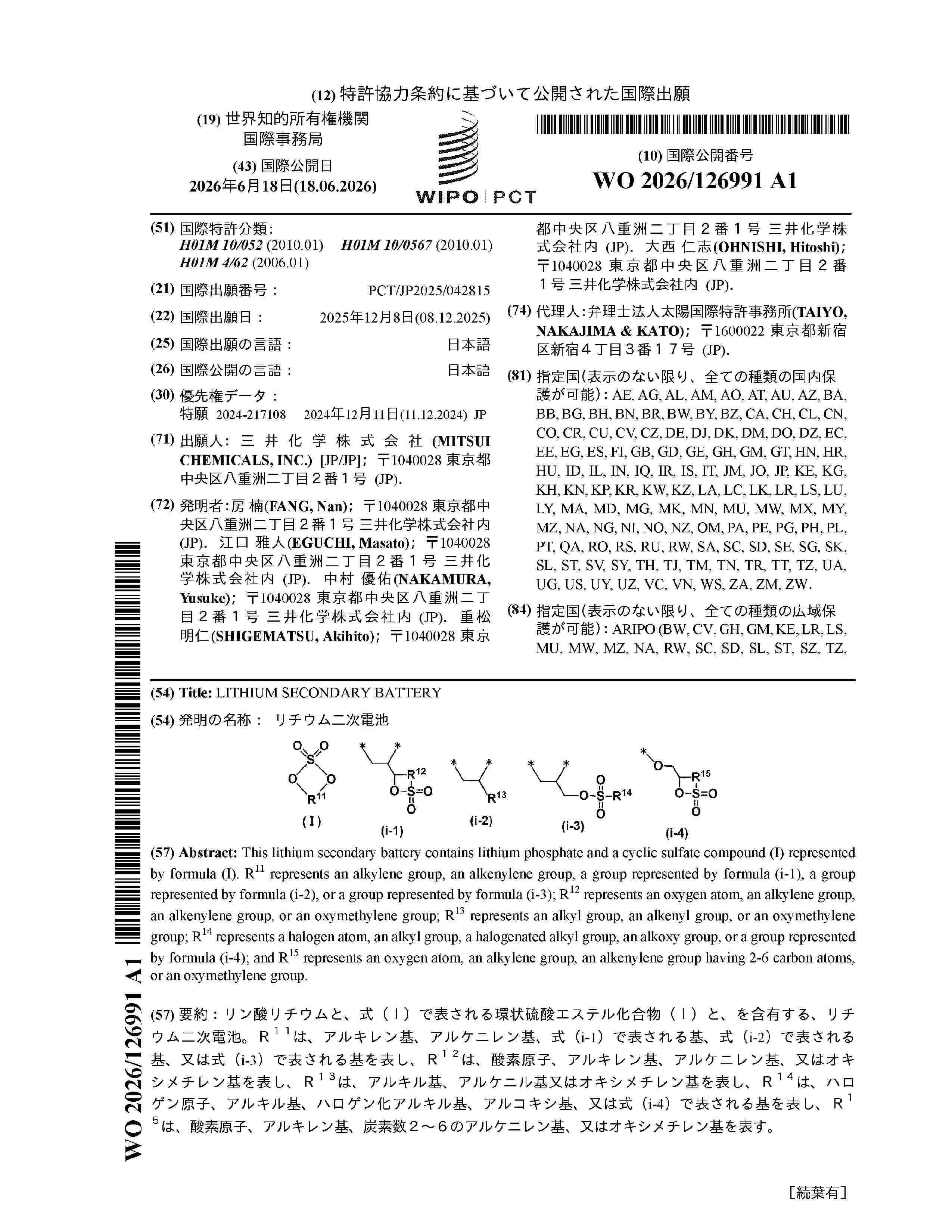
This lithium secondary battery contains lithium phosphate and a cyclic sulfate compound (I) represented by formula (I). R11 represents an alkylene group, an alkenylene group, a group represented by formula (i-1), a group represented by formula (i-2), or a group represented by formula (i-3); R12 represents an oxygen atom, an alkylene group, an alkenylene group, or an oxymethylene group; R13 represents an alkyl group, an alkenyl group, or an oxymethylene group; R14 represents a halogen atom, an alkyl group, a halogenated alkyl group, an alkoxy group, or a group represented by formula (i-4); and R15 represents an oxygen atom, an alkylene group, an alkenylene group having 2-6 carbon atoms, or an oxymethylene group.
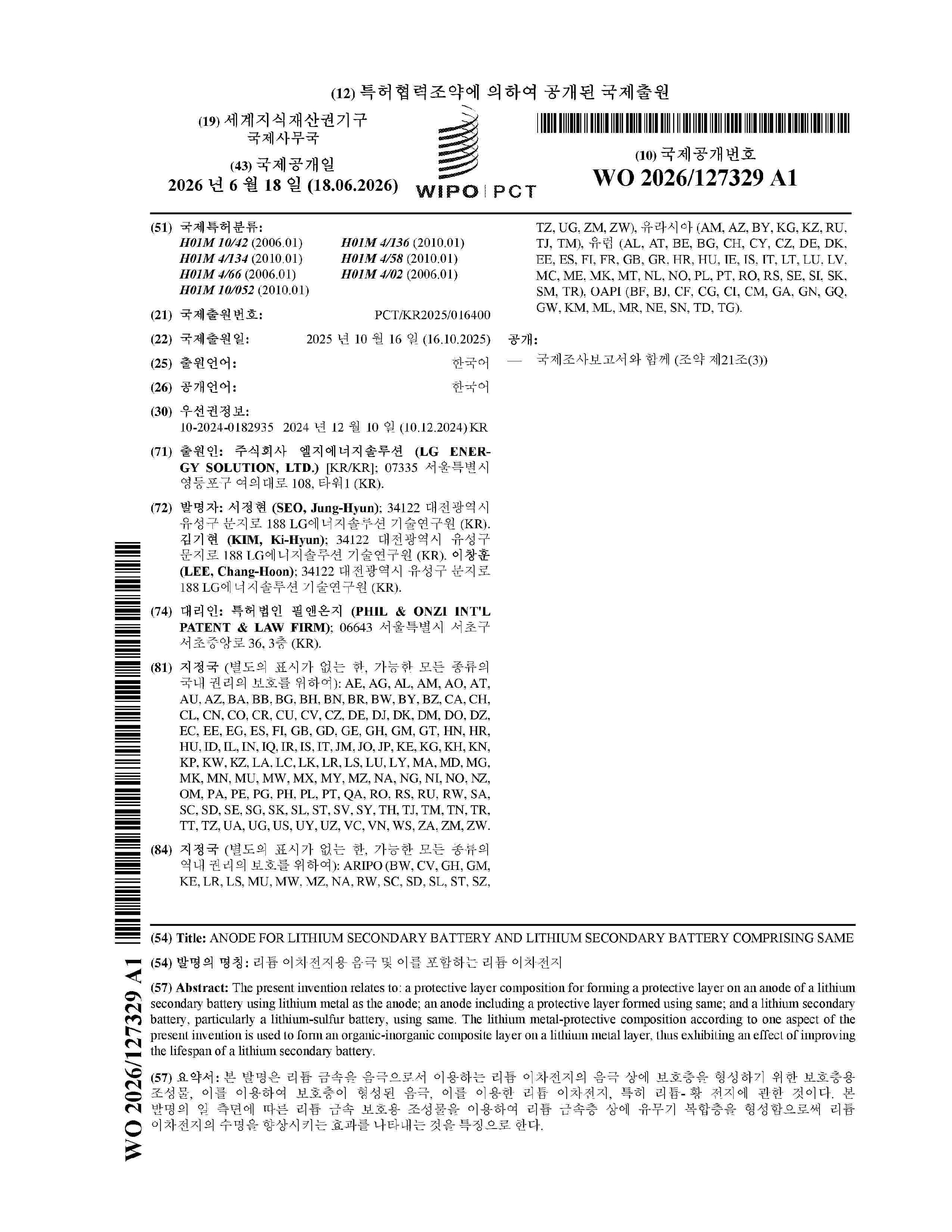
Nº publicación: WO2026127329A1 18/06/2026
Solicitante:
LG ENERGY SOLUTION LTD [KR]
\uC8FC\uC2DD\uD68C\uC0AC \uC5D8\uC9C0\uC5D0\uB108\uC9C0\uC194\uB8E8\uC158
Resumen de: WO2026127329A1
The present invention relates to: a protective layer composition for forming a protective layer on an anode of a lithium secondary battery using lithium metal as the anode; an anode including a protective layer formed using same; and a lithium secondary battery, particularly a lithium-sulfur battery, using same. The lithium metal-protective composition according to one aspect of the present invention is used to form an organic-inorganic composite layer on a lithium metal layer, thus exhibiting an effect of improving the lifespan of a lithium secondary battery.
 BOPI
BOPI
 Sede Electrónica