Si deseas distinguir tus productos, servicios o ambos de los de otra empresa, es posible que necesites una marca o nombre comercial. Descubre qué son, en qué consiste su procedimiento de registro y qué implica.

Información sobre los plazos de presentación de solicitudes de transformación de marcas de la Unión Europea en marca nacional española. Más información


Si tienes un nuevo dispositivo, producto o procedimiento que resuelva un problema técnico o tenga una ventaja práctica, existen distintas formas de protegerlo en España y en otros países. Descubre cómo hacerlo.

¿Tu innovación reside en la estética, la ornamentación o la apariencia de tu producto? Protégela mediante un diseño industrial. Descubre qué derechos confiere el registro y cómo realizar la tramitación.

Las indicaciones geográficas protegen el nombre de un producto originario de una zona geográfica, a la cual le debe una determinada calidad, reputación u otra característica. Descubre qué son, en qué consiste su procedimiento de registro y qué beneficios conceden.

Las patentes publicadas en todo el mundo son una valiosa fuente de información científica, técnica y comercial.

Si eres emprendedor/a o una empresa y quieres potenciar y mejorar la rentabilidad de tu negocio protegiendo de forma adecuada los activos intangibles de tu organización, en este espacio encontrarás lo necesario.


 484
resultados
484
resultados
 Última actualización
15/09/2026 [06:53:00]
Última actualización
15/09/2026 [06:53:00]


 Resultados 150 a 175 de 484

Resumen de: US20260265079A1
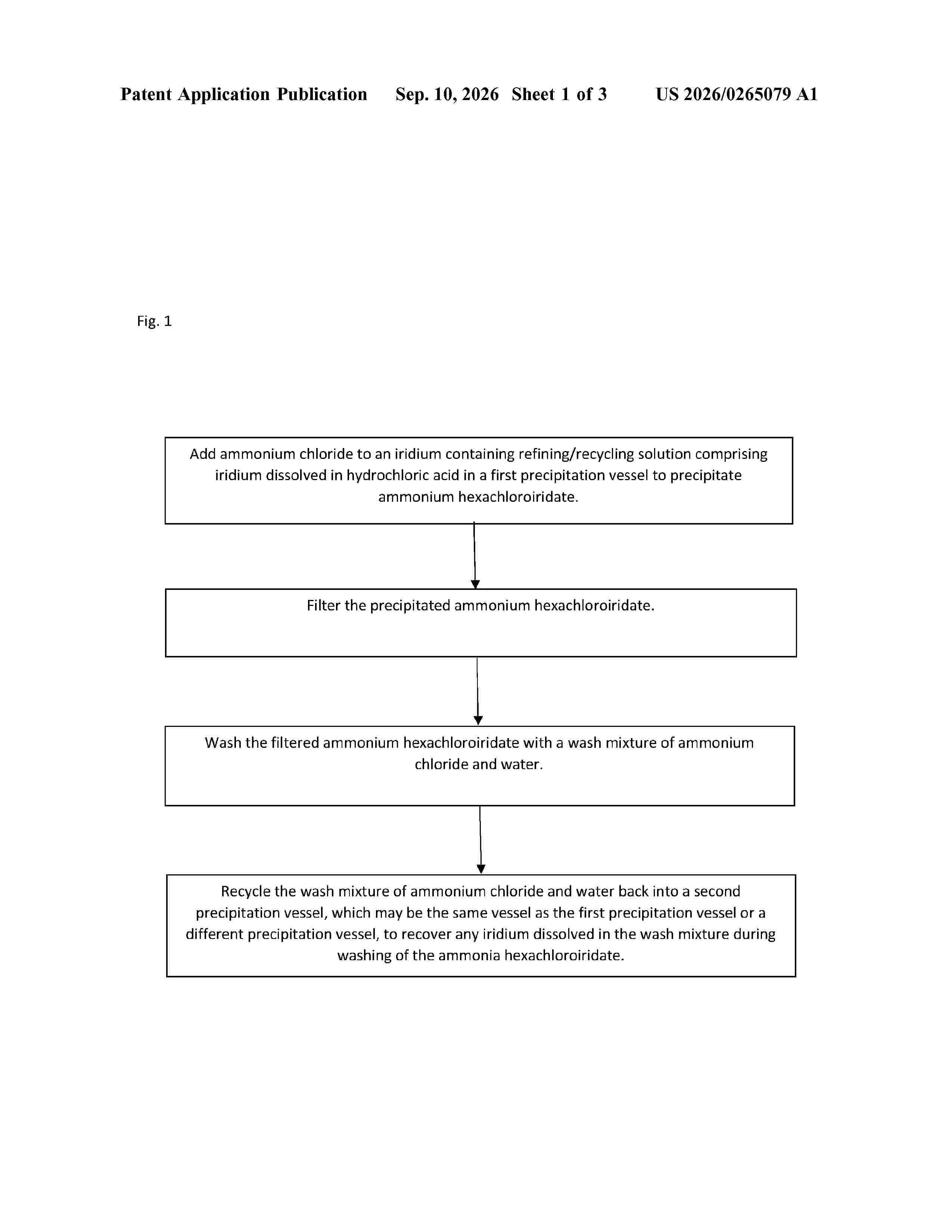
A method of refining/recycling iridium, the method comprising: adding ammonium chloride to an iridium containing refining/recycling solution comprising iridium dissolved in hydrochloric acid in a first precipitation vessel to precipitate ammonium hexachloroiridate; filtering the precipitated ammonium hexachloroiridate; washing the filtered ammonium hexachloroiridate with a wash mixture of ammonium chloride and water; and recycling the wash mixture of ammonium chloride and water back into a second precipitation vessel, which may be the same vessel as the first precipitation vessel or a different precipitation vessel, to precipitate any iridium dissolved in the wash mixture during washing of the ammonia hexachloroiridate.

Resumen de: US20260269288A1
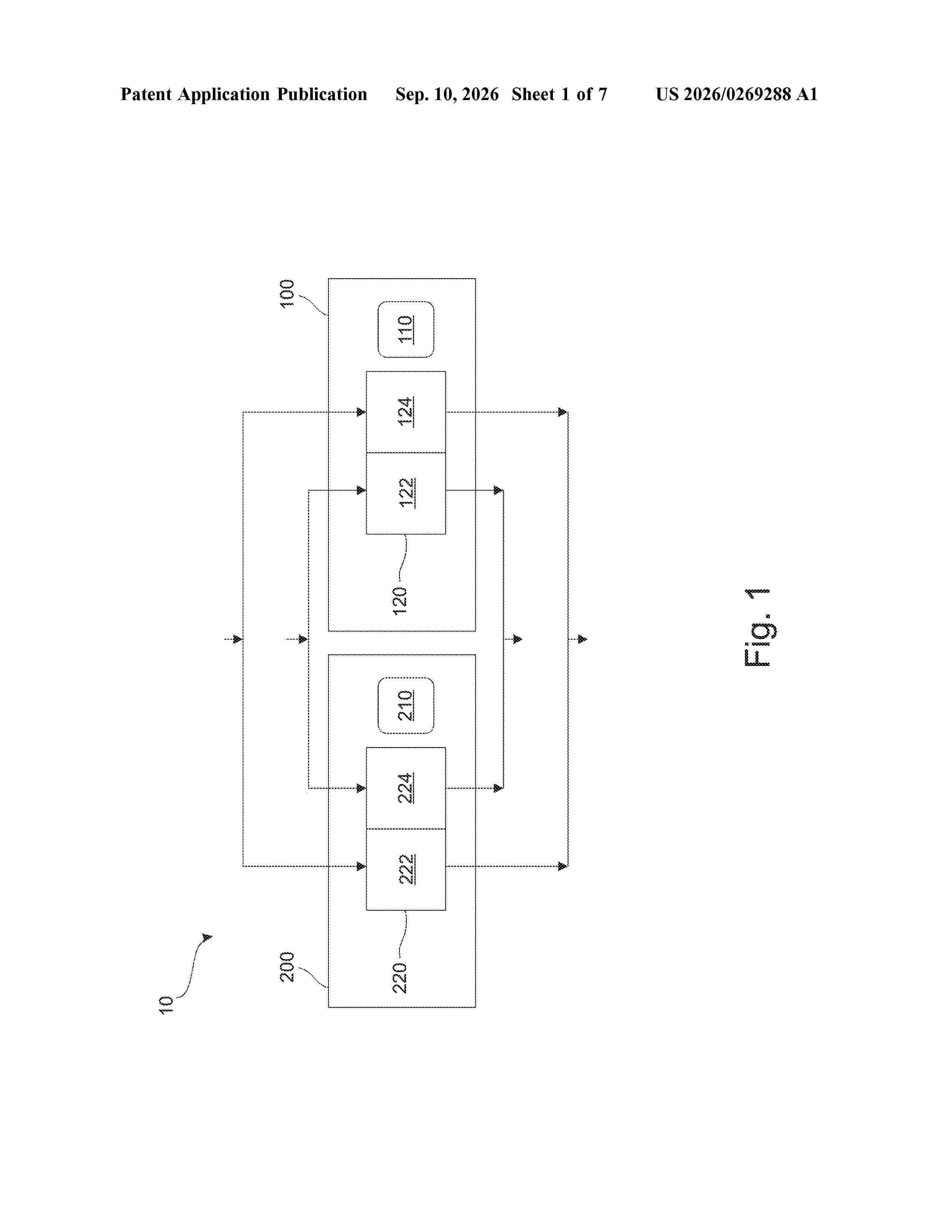
The present invention relates to a fuel cell group (10) for generating electrical energy, comprising a main fuel cell system (100) with at least one main fuel cell stack (120) and at least one auxiliary fuel cell system (200) with at least one auxiliary fuel cell stack (220), wherein the main fuel cell system (100) and the at least one auxiliary fuel cell system (200) are electrically connected in parallel, wherein the main fuel cell system (100) has a main control module (110) for variable control of a variable main operating point (HBP) and the auxiliary fuel cell system (200) has an auxiliary switching module (210) for switching between an off-state (AZ) and at least one specified on-state (EZ).
Resumen de: AU2025225673A1
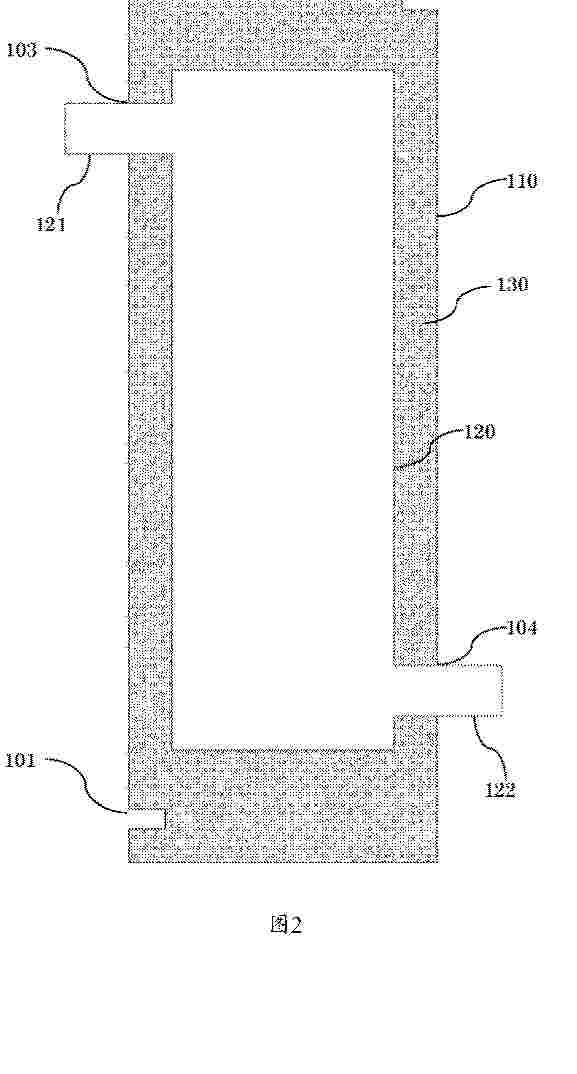
Provided is a fuel cell thermal device (100), comprising: an outer housing (110), which is provided with at least two openings in communication with the internal space thereof, the at least two openings comprising a first opening (101) and a second opening (102); a filler (130), which is arranged in the internal space and has a material with a heating function on the surface or the interior thereof; an inner housing (120), which is arranged in the internal space and is surrounded by the filler (130), and has a space for accommodating an object; a fluid, which flows into the internal space through the first opening (101) and flows out through the second opening (102); and a fluid driving device, which is in communication with the first opening (101) and the second opening (102) via a pipeline, and provides power for the fluid to flow into or out of the internal space. The fuel cell thermal device (100) is configured such that the fluid comes into contact and reacts with the material with a heating function in the internal space so as to generate heat, which is transferred to the inside object via the inner housing (120); or heat generated by the object inside the inner housing (120) is transferred through the inner housing (120) to the filler (130) in the internal space and is carried away by the fluid flowing through the filler (130).
Resumen de: AU2025225881A1
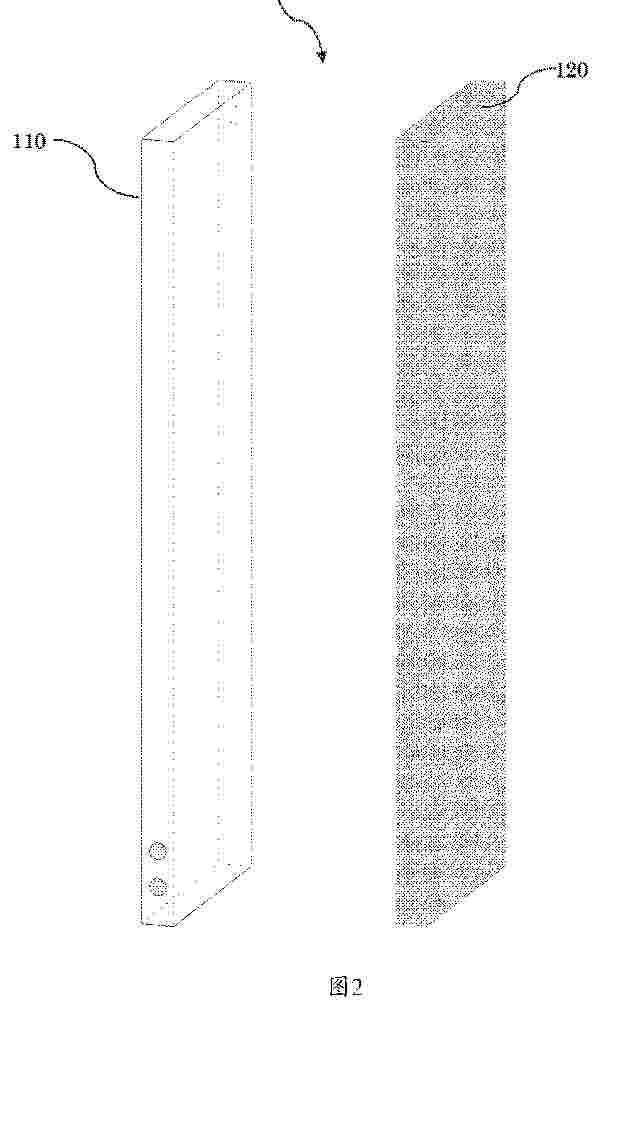
The present invention relates to the technical field of fuel cells, and provides a fuel cell, a thermal apparatus thereof and a manufacturing method. The fuel cell thermal apparatus (100) comprises: a casing (110), which is provided with at least two openings leading to an internal space thereof and comprising a first opening (101) and a second opening (102); a filler (120), which is arranged in the casing (110) and contains on its surface or therein a material having a heating function; a fluid, which flows into the internal space via the first opening (101) and flows out of the second opening (102); and a fluid driving apparatus, which is communicated with the first opening (101) and the second opening (102) by means of a pipe and provides power for the fluid to flow into or out of the internal space. The fuel cell thermal apparatus (100) is configured in such a way that: the fluid is in contact with the filler in the internal space and reacts with same to generate heat, which is transferred, by means of the casing (110), to an object device outside the casing (110); or heat generated by the object device outside the casing (110) is transferred to the filler (120) by means of the casing (110) and is taken away by the fluid flowing through the filler (120).
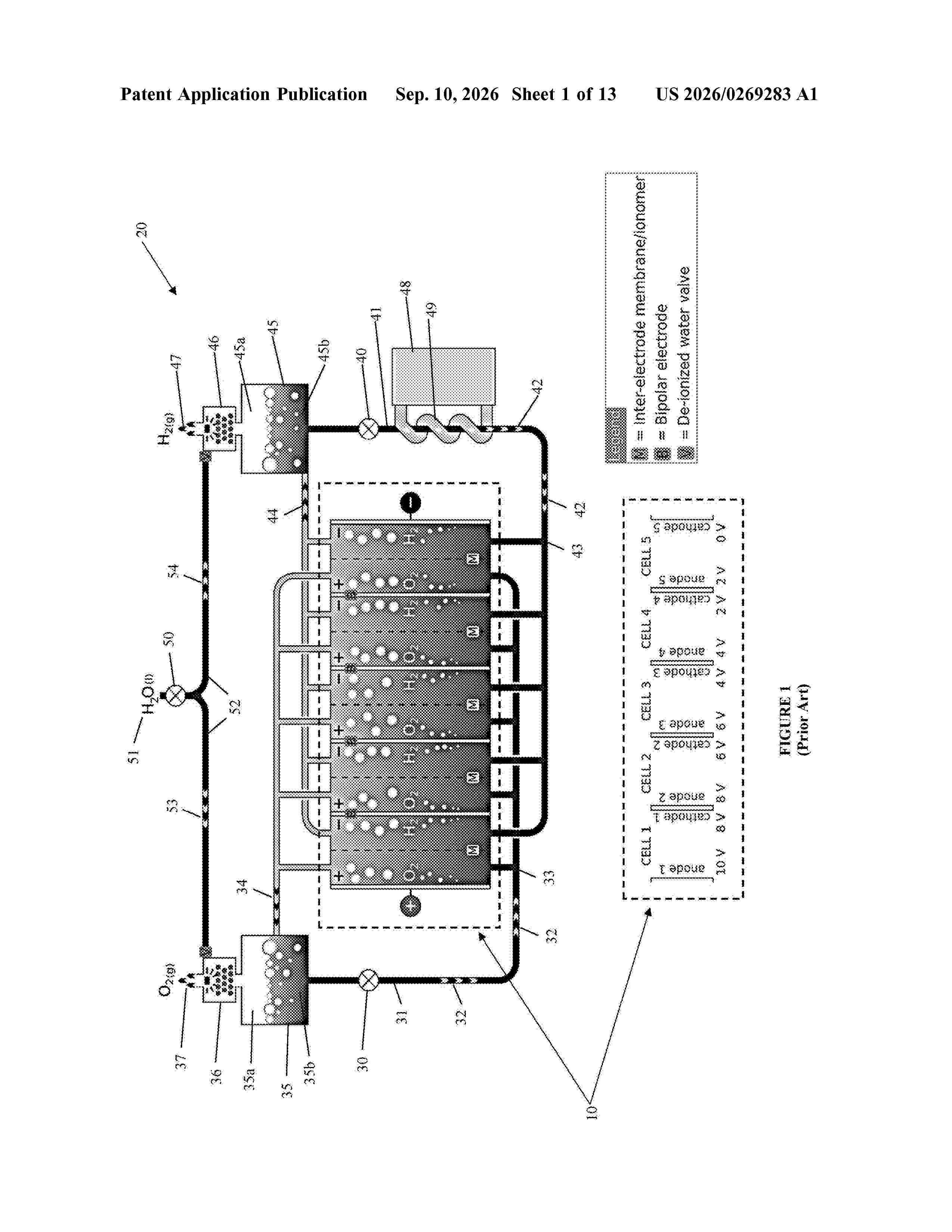
Resumen de: US20260269283A1
Gas pressure equalisation systems, and method of operation, for an electro-synthetic or electro-energy liquid-gas cell or cell stack. The gas pressure equalisation systems includes a first pressure equalisation tank for partially containing a first liquid and a first gas. The first gas is positioned above a liquid first level. A first gas conduit is provided for the transfer of the first gas between the cell or cell stack and the first pressure equalisation tank. In another aspect, a second pressure equalisation tank may be additionally provided for partially containing a second liquid and a second gas positioned above a liquid second level. A second gas conduit is then provided for the transfer of the second gas between the cell or cell stack and the second pressure equalisation tank.
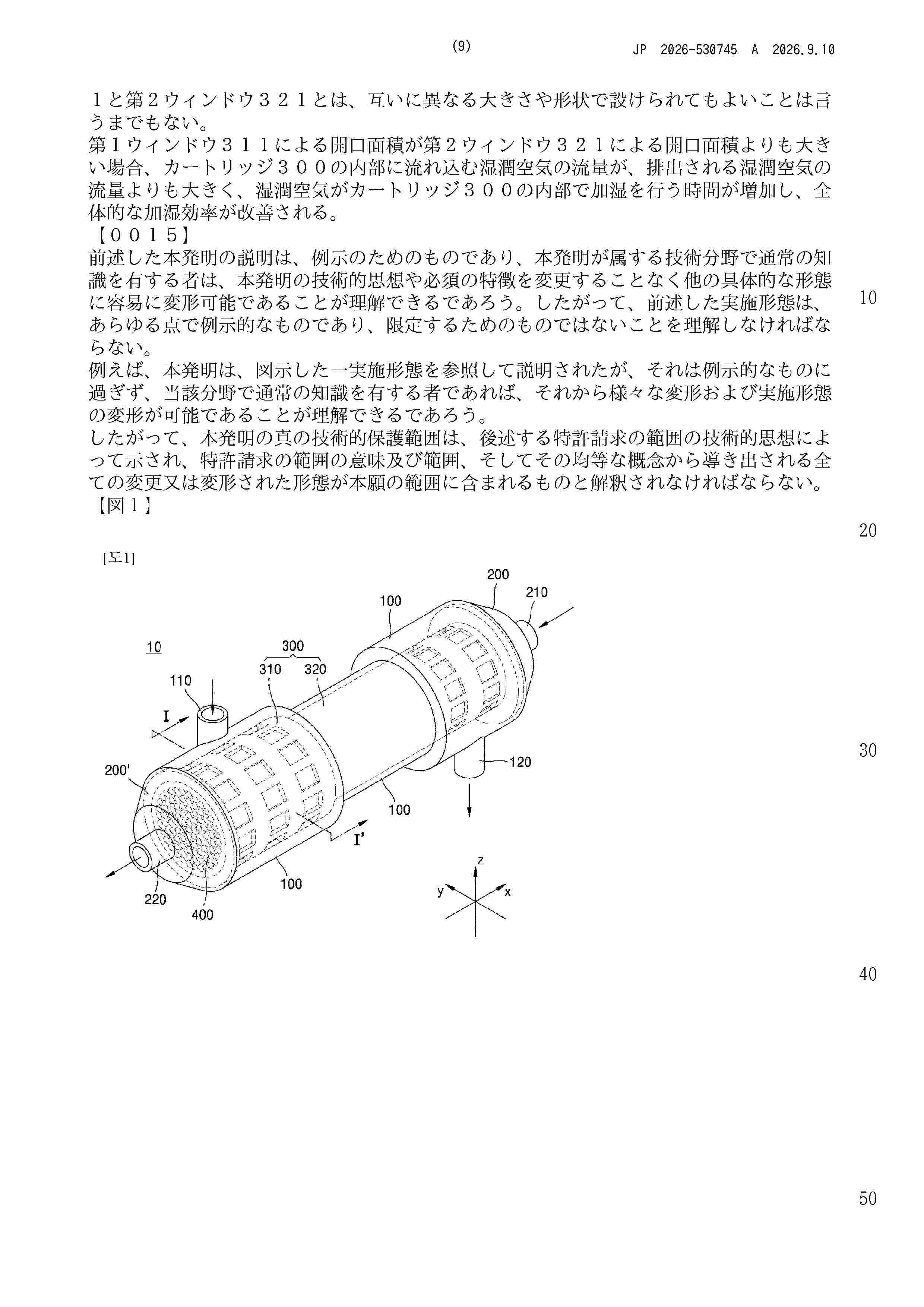
Resumen de: WO2025033979A1
The present invention relates to a technology capable of actively controlling a humidification amount or humidification efficiency of a membrane humidifier for a fuel cell by including a cartridge capable of controlling distortion of a hollow fiber membrane. This technology comprises: a mid-case having a wet air inlet and a wet air outlet and having a cartridge disposed therein; a first cap coupled to one side of the mid-case and having a dry air inlet; and a second cap coupled to the other side of the mid-case and having a dry air outlet, wherein the cartridge comprises: a first inner case; a second inner case connected to the first inner case; and a hollow fiber membrane disposed inside the first inner case and the second inner case, having one side fixed to the first inner case, and having the other side fixed to the second inner case, and the first inner case is rotatable with respect to the second inner case.
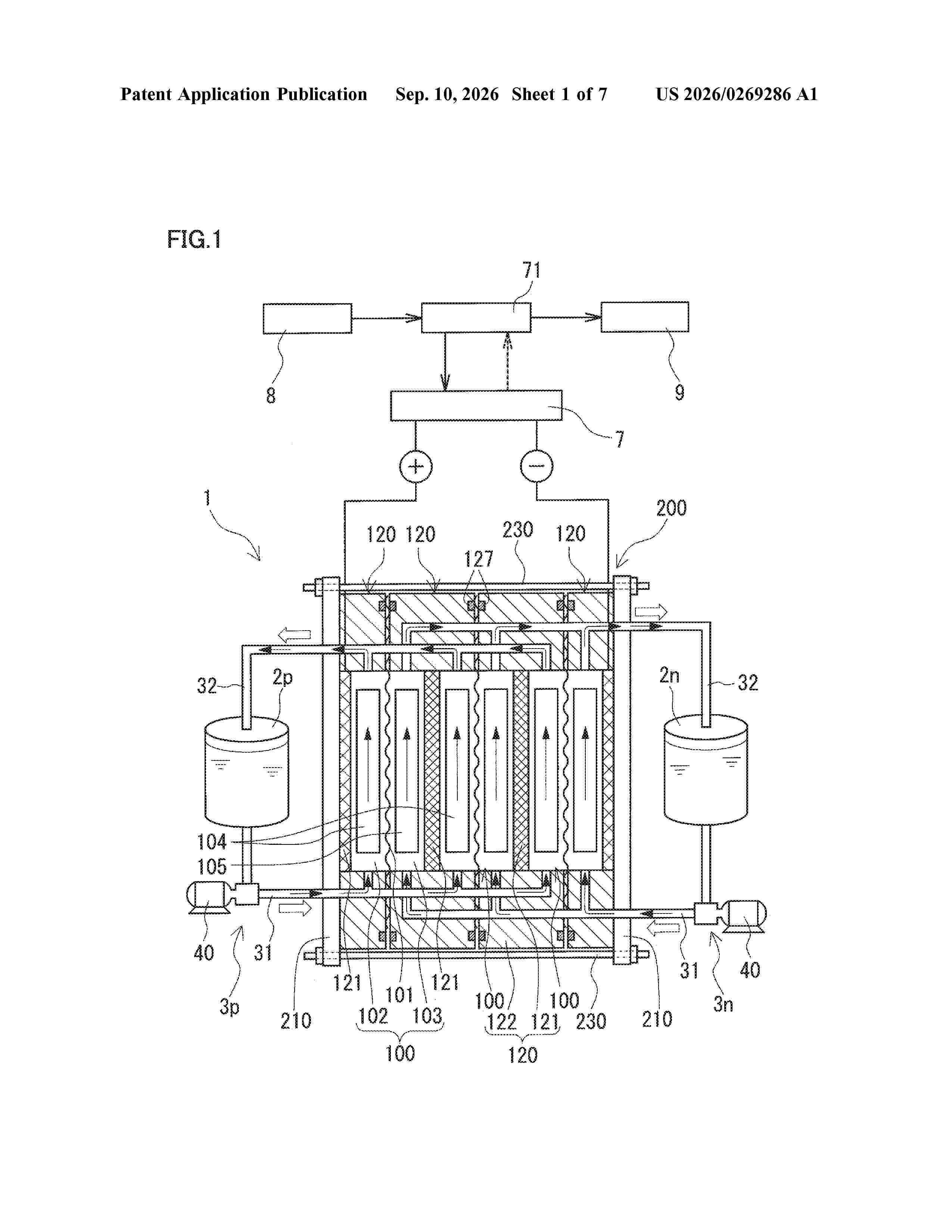
Resumen de: US20260269286A1
A redox flow battery comprises: a battery cell; a tank with an electrolyte stored therein; a pipe that interconnects the tank and the battery cell; and a pump provided at the pipe, wherein the battery cell and the pump are disposed at a level higher than the tank, the redox flow battery has a supply port for introducing a gas into the pipe, and the pipe is provided such that the electrolyte is held in a suction port of the pump when the pump is stopped.
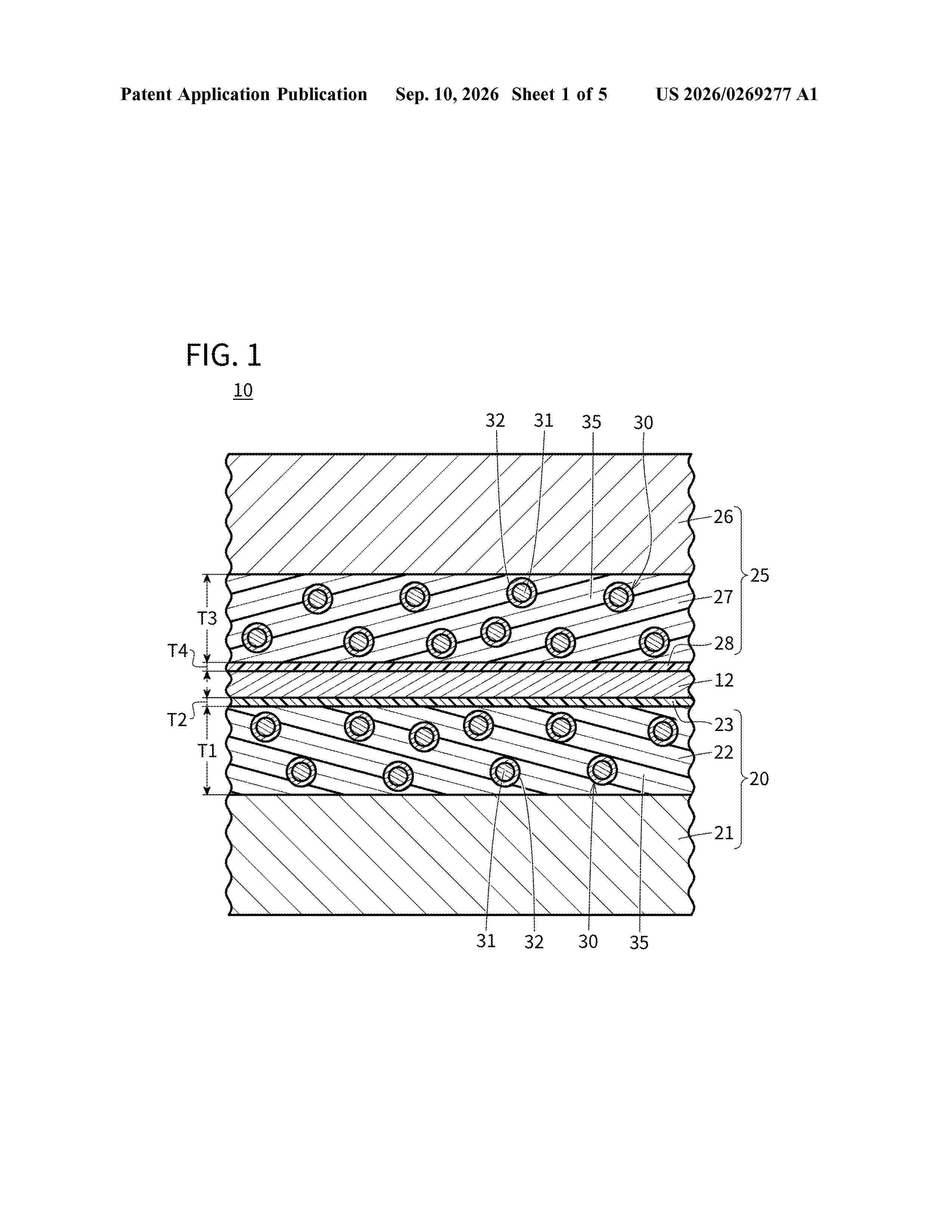
Resumen de: US20260269277A1
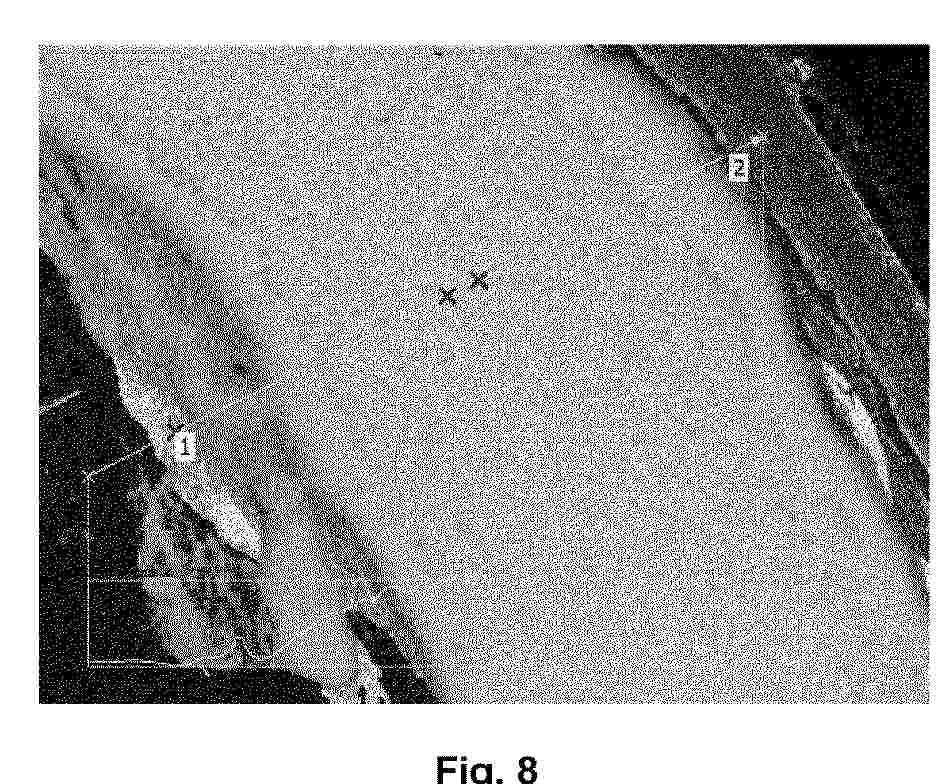
A method for manufacturing an electrode for a membrane electrode assembly includes a protective layer forming step and an analyzing step. In the protective layer forming step, a protective layer (a first protective layer, a second protective layer) is provided on an electrode catalyst layer (a first electrode catalyst layer, a second electrode catalyst layer) provided on one end surface of a gas diffusion layer (a first gas diffusion layer, a second gas diffusion layer). In the analyzing step, radiation is made incident on the electrode catalyst layer through the protective layer. The amount of radiation incident on the electrode catalyst layer is reduced by the protective layer. In this state, an element in the electrode catalyst layer is analyzed.
Resumen de: AU2025241431A1
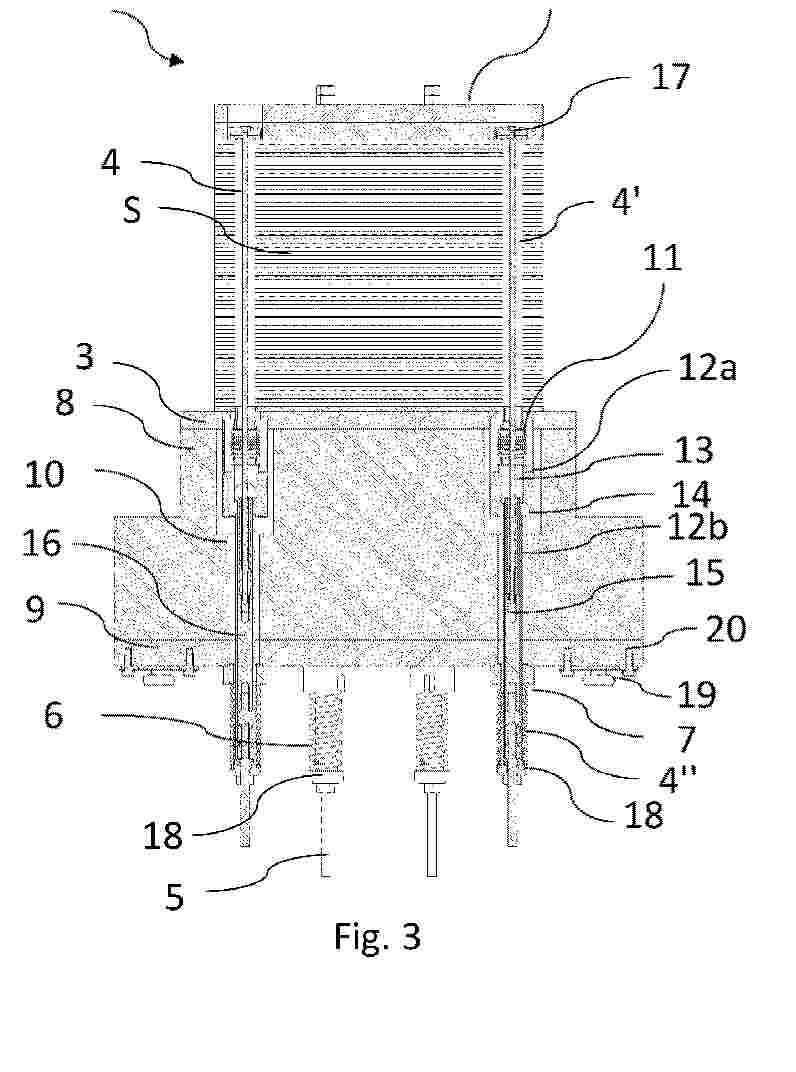
The present invention refers to a stack assembly (27) for a solid oxide fuel cell (SOFC) or solid oxide electrolyser (SOE)device. The assembly (27) comprises: - a housing, - at least one stack arrangement (1) mounted within said housing, the at least one stack arrangement (1) comprising: - a base plate (3), - a top plate (2), - a stack (S) mounted between said base plate (3) and said top plate (2), - at least one sealing element disposed in the at least one stack arrangement (1) to provide a fluid-tight stack assembly (27), - a load applying mechanism with a first tightening unit (5) adapted to apply a tightening load to the at least one stack arrangement (1) in stacking direction. The load applying mechanism comprises a second tightening unit (4) adapted to apply a tightening load to said manifold section of the stack (S). The first tightening unit (5) and the second tightening unit (4) are independent of each other.
Resumen de: EP4803671A1
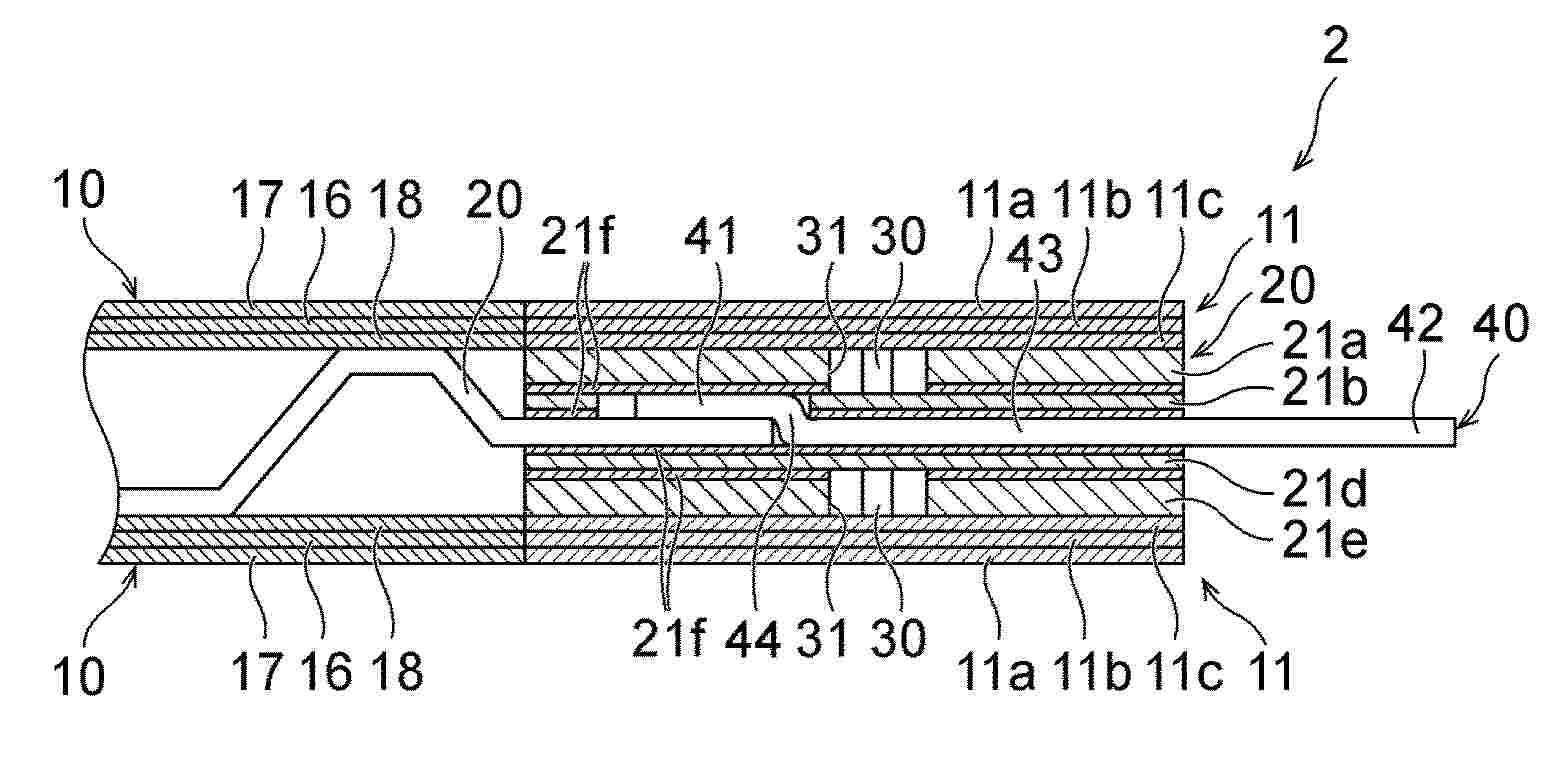
0001 An electrochemical cell stack according to an embodiment includes a plurality of electrochemical cell stacked one on another, and an electric potential measurement terminal for measuring an electric potential of the electrochemical cell. The electocheical cell includes an electrode plate, a flow channel plate, an electrode plate outer frame, a flow channel plate outer frame, and a sealing member. The flow channel plate outer frame is formed by adhering a plurality of sheet members by an adhesive. The electric potential measurement terminal is partially arranged between the sheet members. The electric potential measurement terminal includes a first end portion and a second end portion opposite to the first end portion. The second end portion of the electric potential measurement terminal extends outside the electrochemical cell. The first end portion of the electric potential measurement terminal is connected in a bent state to one main surface of the flow channel plate at a position inside the sealing member.
Resumen de: WO2025093662A1
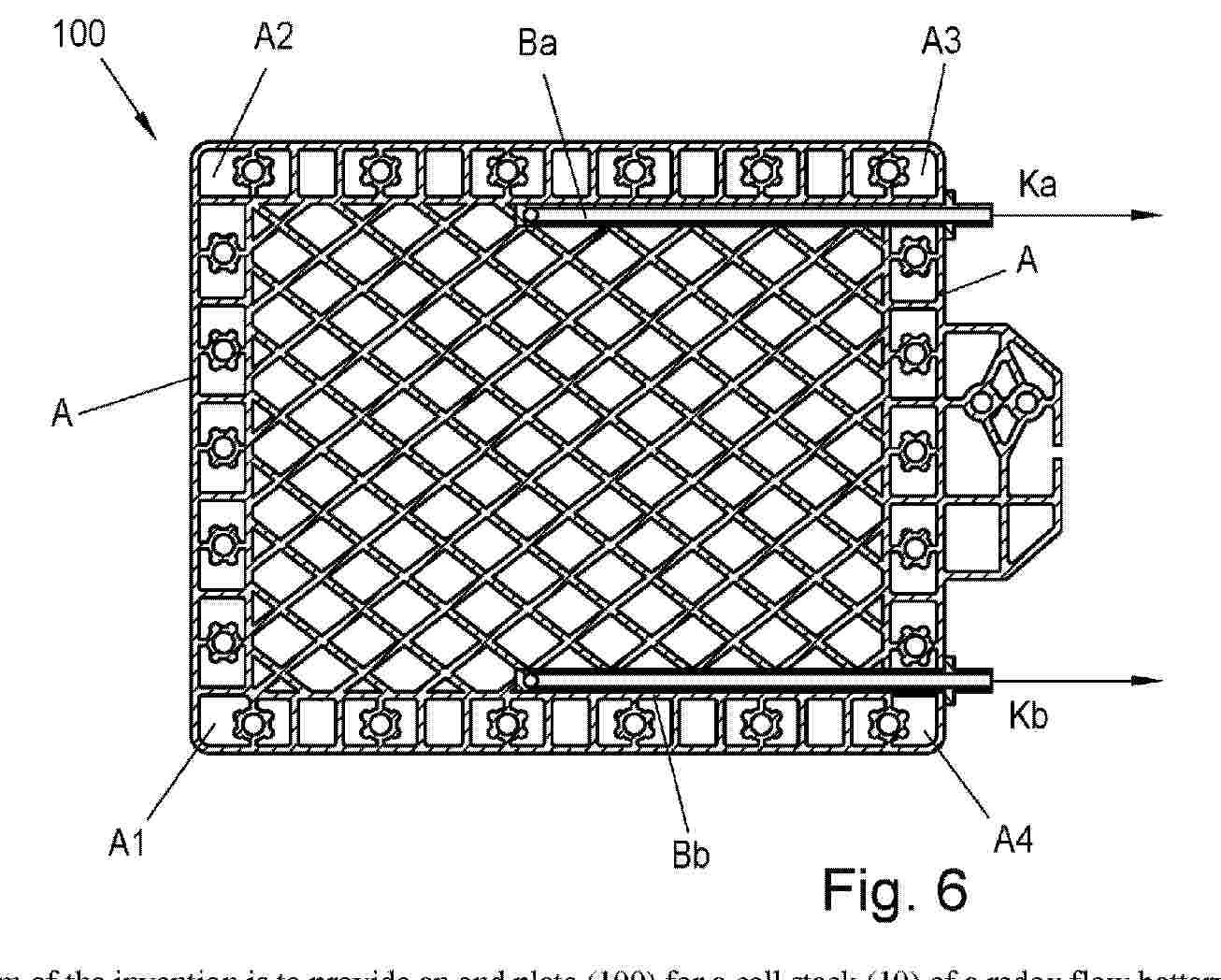
The aim of the invention is to provide an end plate (100) for a cell stack (10) of a redox flow battery (1), said end plate having a higher degree of mechanical and chemical resistance than the known prior art. This is achieved in that a press component (A) is provided for pressing half cells (2a, 2b) stacked in the cell stack (10) of the redox flow battery (1) against each other, and at least one channel component (B) is provided which forms at least one flow channel (K) for supplying or discharging electrolyte liquid (15a, 15b) into or out of the cell stack (10) of the redox flow battery (1), wherein the press component (A) contacts the channel component (B) outside of the flow channel (K) in order to fix the channel component (B) against the press component (A), the channel component (B) is made of an acid-resistant channel plastic, and the press component (A) is made of a press plastic which differs from the channel plastic, said press plastic having a modulus of elasticity of at least 7500 MPa.
Resumen de: JP2026144512A
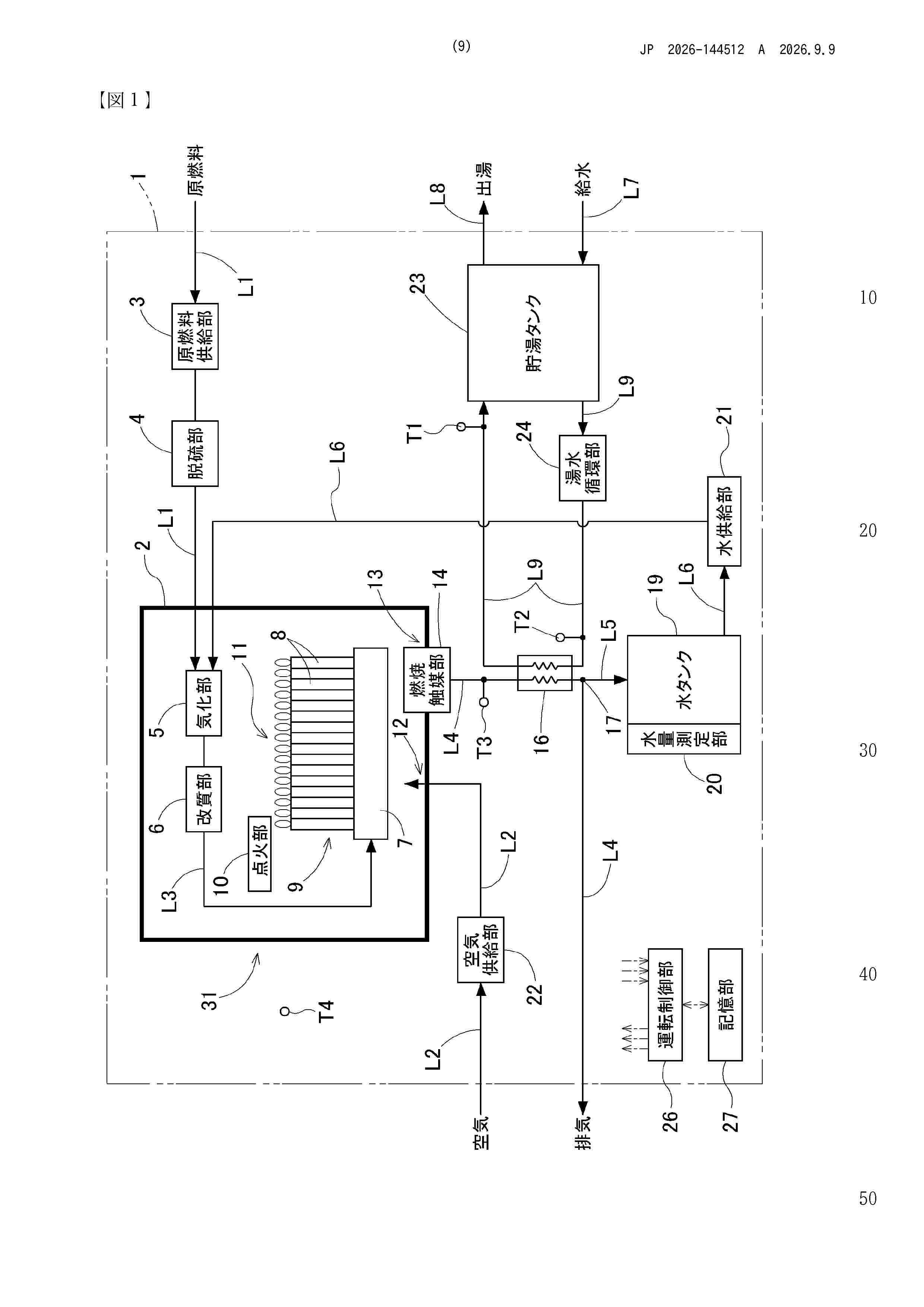
0001 【課題】燃料電池部の発電効率を高く維持しながら貯留水を十分に確保できる燃料電池システムを提供する。 【解決手段】燃料電池システムの運転制御部26は、燃料電池部9の発電量と発電効率との間の第1相関関係、燃料電池部9の発電量と貯留水の増減量との間の第2相関関係、及び、水量測定部20が測定する現在の貯留水の量に基づいて、所定期間の経過後での貯留水の量が目標量になり、且つ、所定期間の間での燃料電池部9の平均発電効率が高くなるように、所定期間の間での燃料電池部9の目標発電量パターンを決定する。 【選択図】図1
Resumen de: JP2026144744A
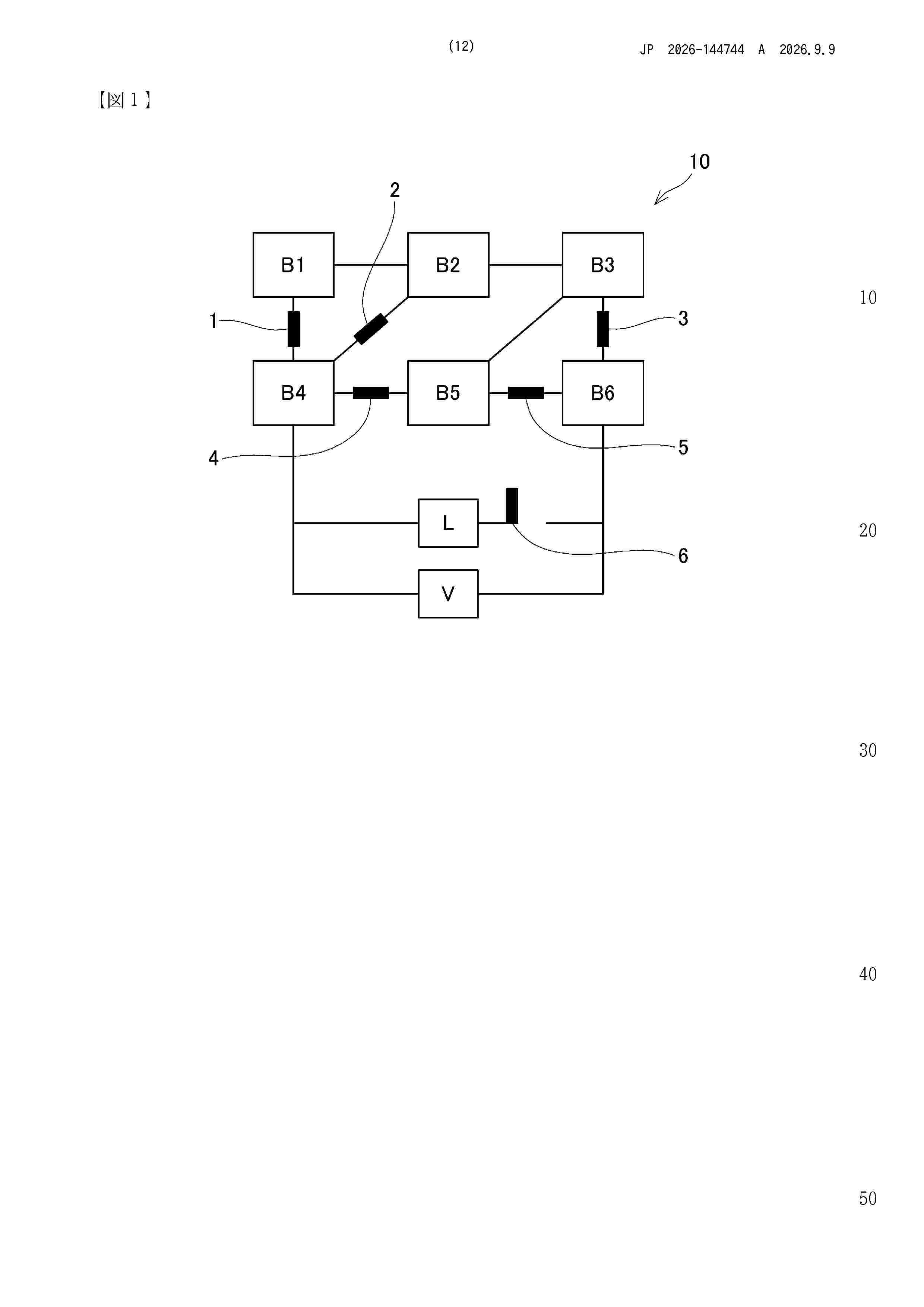
0001 【課題】複数の電池を接続して利用する電池システムの出力電力を安定させる。 【解決手段】 電池システムは、複数の電池と、各電池の間に配置されているスイッチと、各電池の電圧を計測する電圧センサと各電池の電流を計測する電流センサとの少なくとも一方のセンサを備えている。また、この電池システムでは、各電池間の接続が、センサの計測値に基づいて切替わる。 【選択図】 図1
Resumen de: JP2026144163A
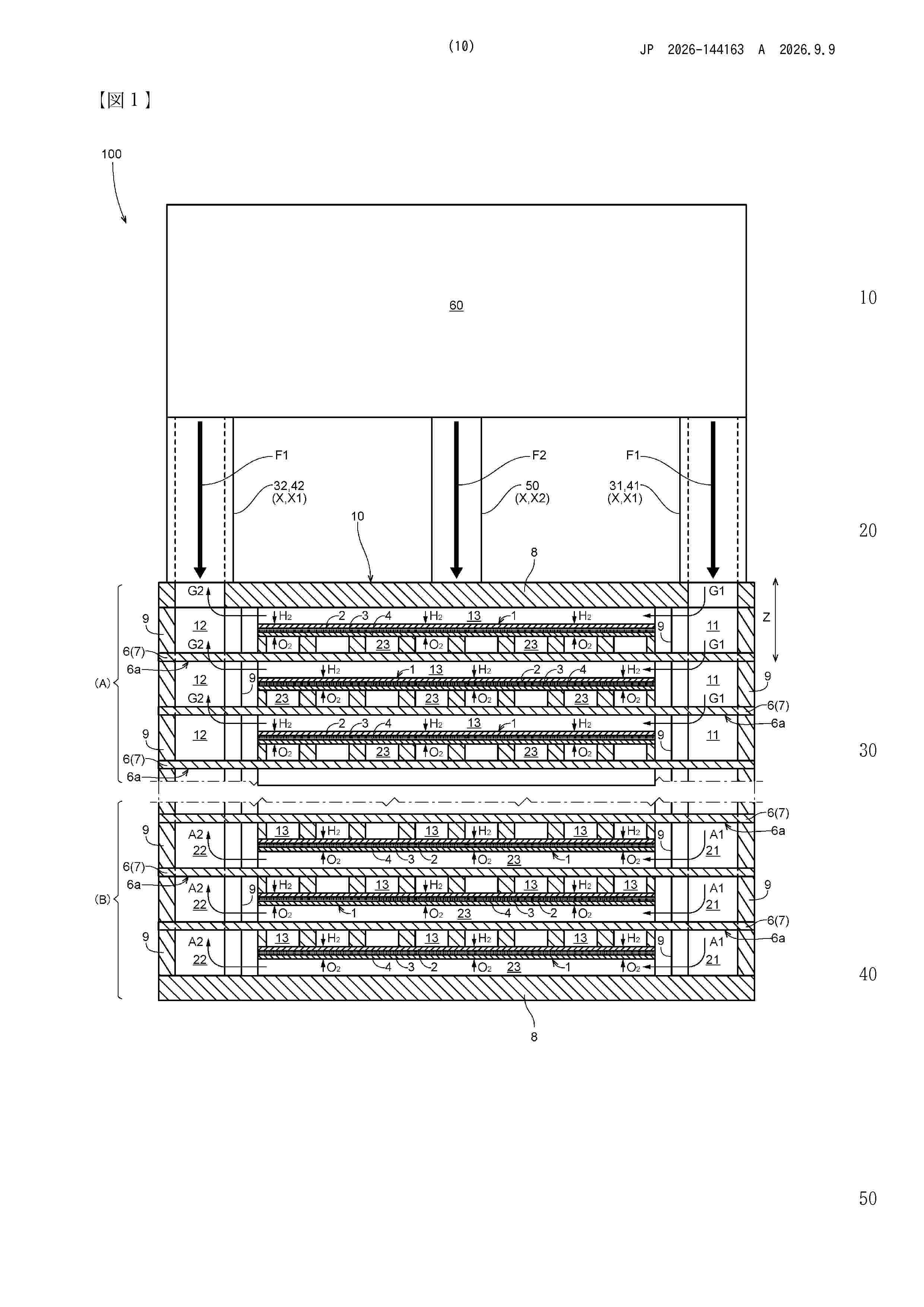
【課題】単セルとセパレータとを所定の積層方向に沿って交互に積層してなるセルスタックを備えた電気化学反応システムにおいて、システム全体の軽量化や簡素化を実現しながら、セルスタックに対して積層方向に沿って押圧力を適切に付加して、シール部やインターコネクタの密着性の低下に起因するシール性やシステム性能の悪化を抑制する。【解決手段】セルスタック10が、積層方向Zを鉛直方向に沿わせて設置されていると共に、ガス処理器60が、セルスタック10の上方側に設置されており、押圧手段Xとして、ガス処理器60の重量をセルスタック10に対して押圧力F1,F2として伝達するガス処理器重量伝達部X1,X2が、セルスタック10とガス処理器60との間に介在されている。【選択図】図1
Resumen de: JP2026144293A
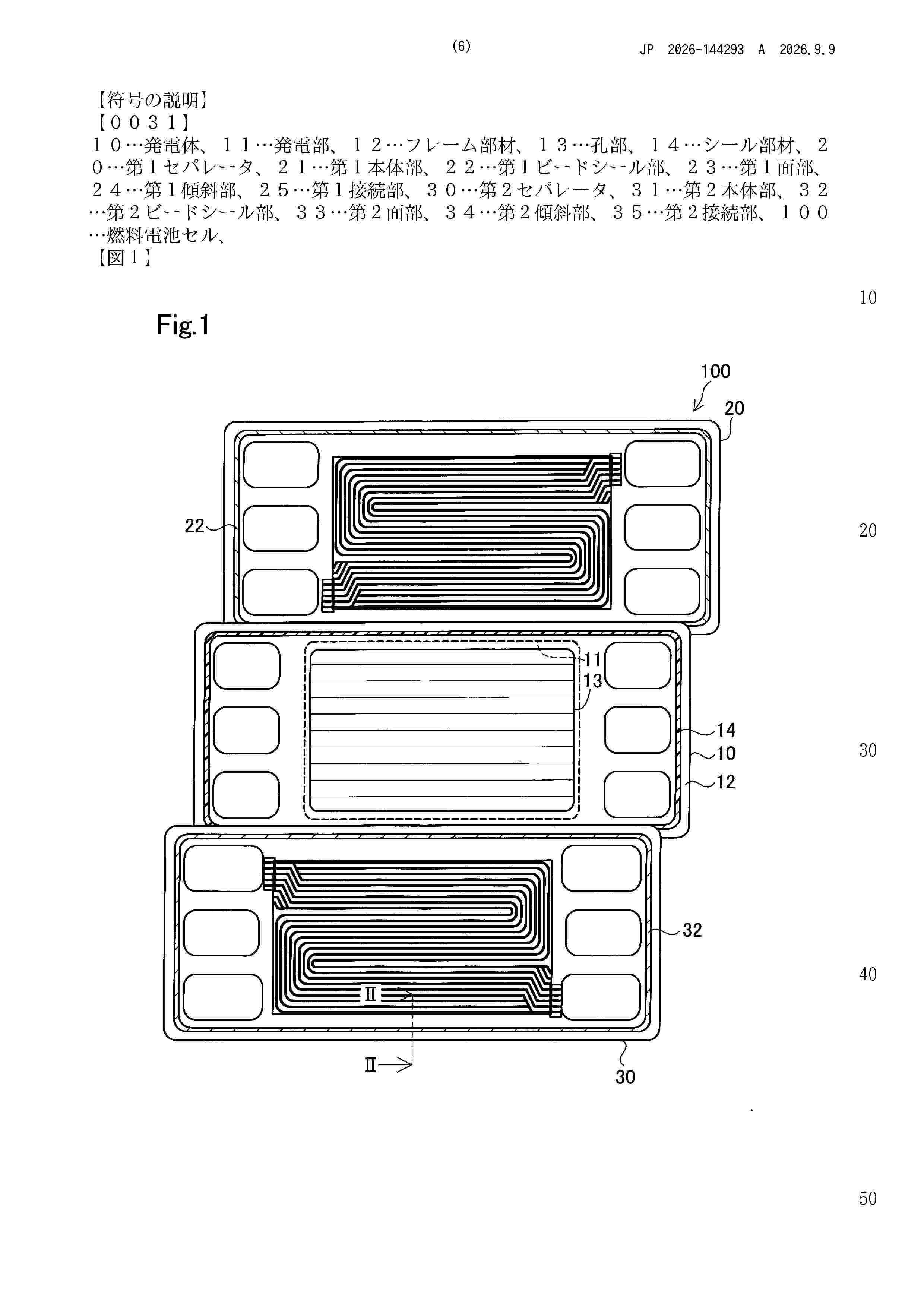
【課題】発電体が損傷することを抑制できる技術を提供する。【解決手段】燃料電池セルは、第1本体部と、発電体に向かって第1本体部から突出する第1ビードシール部とを有する第1セパレータと、第2本体部と、発電体に向かって第2本体部から突出する第2ビードシール部とを有する第2セパレータと、を有する一対のセパレータを備える。第1ビードシール部は、一対の第1傾斜部と、一対の第1傾斜部の間に位置し、発電体に接する第1面部と、一対の第1傾斜部と第1面部とを接続し、発電体に接する第1接続部と、を有する。第2ビードシール部は、一対の第2傾斜部と、一対の第2傾斜部の間に位置し、第1面部に対向し、発電体に接する第2面部であって、第1面部よりも短い第2面部と、一対の第2傾斜部と第2面部とを接続し、発電体に接する第2接続部であって、積層方向において第1接続部と重複していない第2接続部と、を有する。【選択図】図2
Resumen de: JP2026144827A
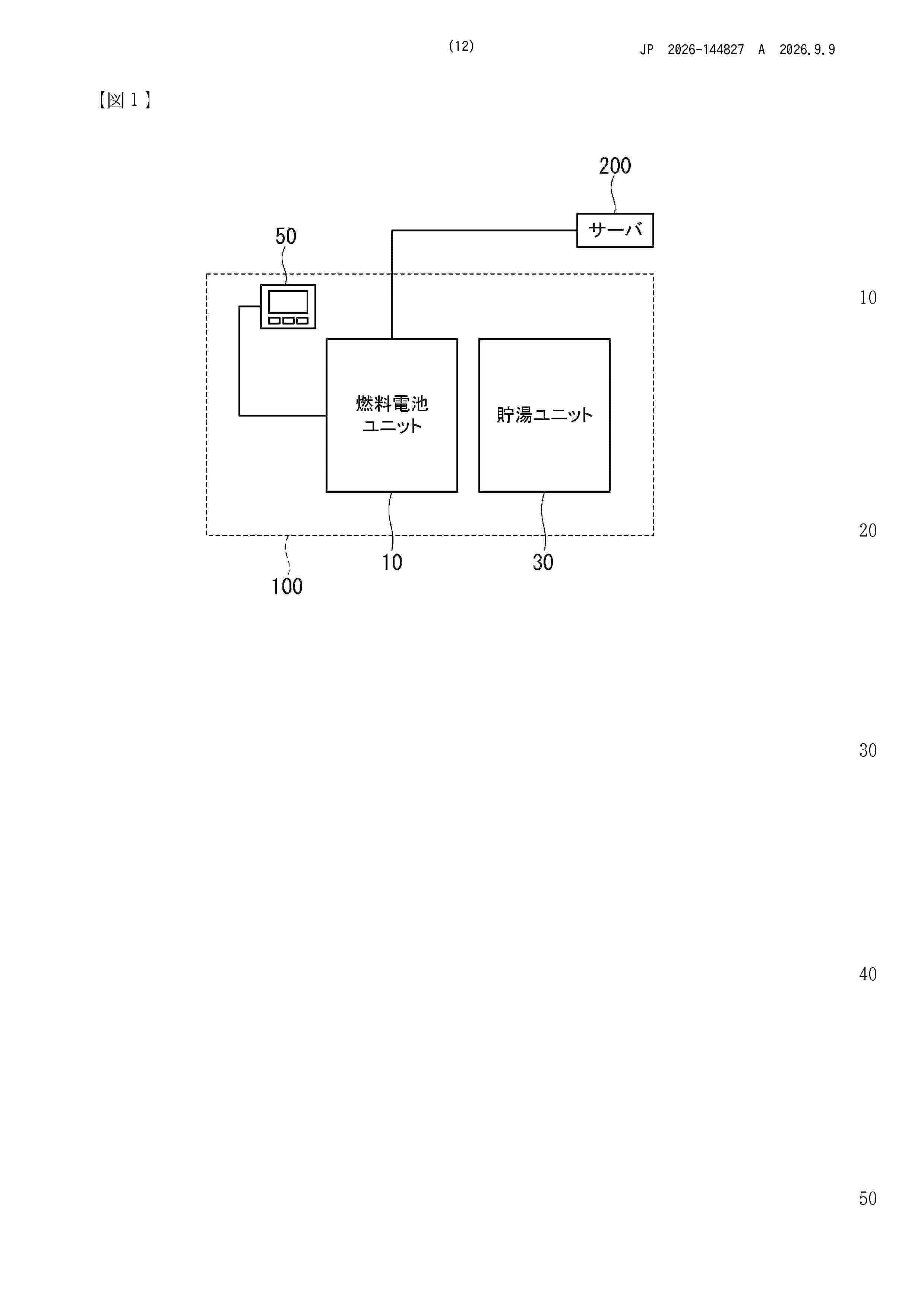
0001 【課題】燃料電池システムに必要なソフトウェア更新を長時間実行できないことに対処する。 【解決手段】本開示の燃料電池システム100は、第1電気設備及び第2電気設備を含む複数の電気設備と、複数の電気設備に対する指示を受け付けるとともに、複数の電気設備の動作状態を表示するインタフェース50とを備える。第1電気設備及び第2電気設備から選ばれる少なくとも1つが燃料電池ユニット10である。第1電気設備が閾値時間以上にわたって運転を継続することによって第1電気設備においてソフトウェア更新部25がソフトウェアを更新できない場合、インタフェース50は、複数の電気設備から選ばれる少なくとも1つの電気設備の運転を継続させるための操作の受付、及び/又は、複数の電気設備のうち停止中の電気設備の運転を開始するための操作の受付を制限する。 【選択図】図2
Resumen de: JP2026144836A
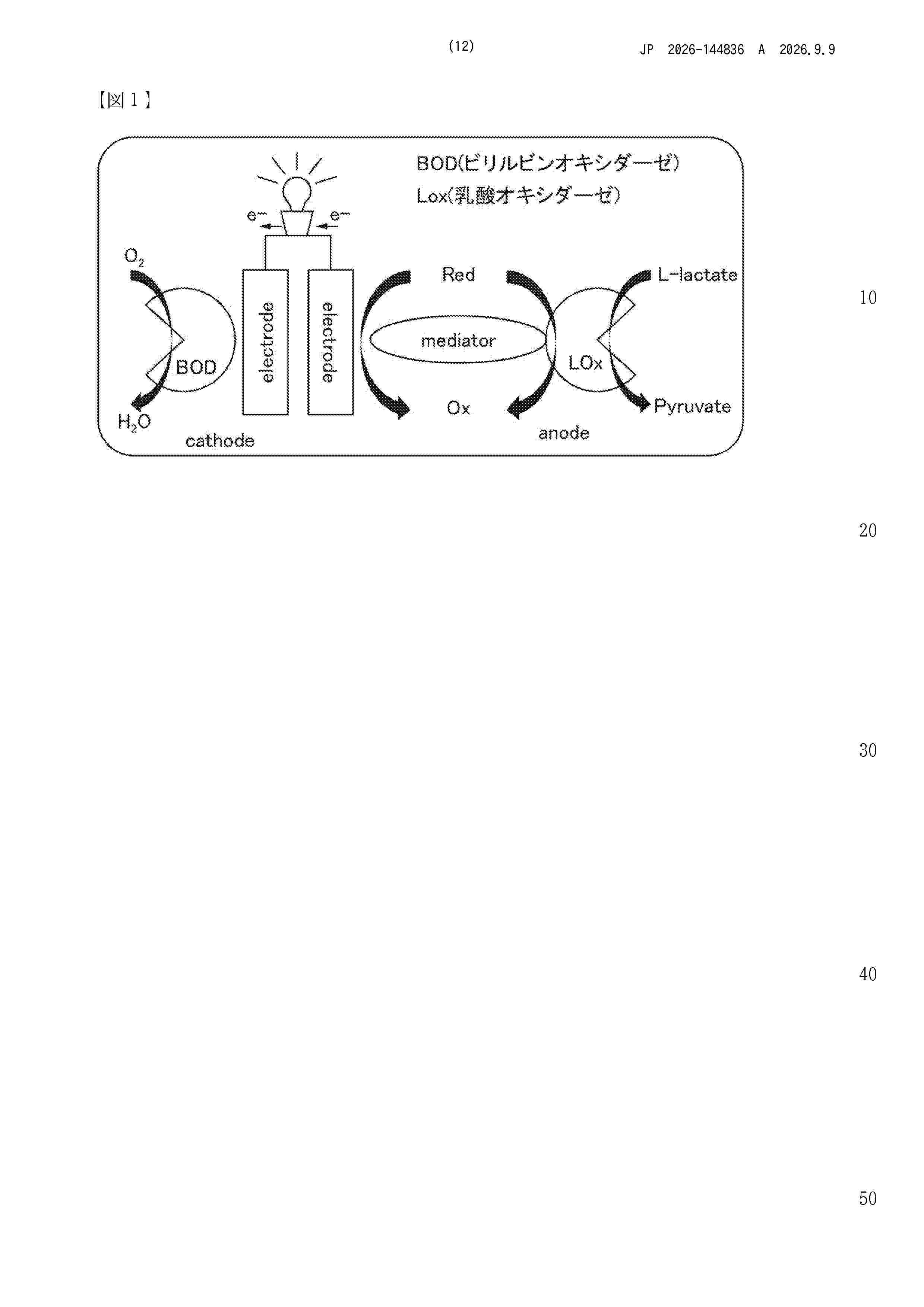
【課題】外部デバイスを使用することなく、単体で発電機能及びモニタリング機能を有する自己駆動型バイオセンサを得ることを目的とする。【解決手段】本開示に係る自己駆動型バイオセンサは、燃料の酸化により発電するバイオ燃料電池と、前記燃料の濃度に応じて視覚的変化を示すディスプレイと、を備える。【選択図】図9
Resumen de: EP4803494A1
A method of preparing an intermediate product for fabricating a composite gasket, the intermediate product being a paste containing a powdered sealing material with additives, a solvent, a binder, and a plasticizer, comprising a step of preparing a powdered sealing material with an additive and a step of mixing the powdered sealing material with a solvent and a binder and a plasticizer, according to the invention is characterized in that in the step of preparing a powdered sealing material, strontium aluminate is used as an additive in a weight ratio of 10% to 60% of the total weight of the powdered sealing material, the strontium alum inate being provided in the form of a powder having particles with a size of 0.2 µm to 1 mm. The object of the invention is also an intermediate product for fabricating a gasket for a layered device, being a paste fabricated with the method of the invention, a method of fabricating a gasket from this intermediate product, and a gasket.
Resumen de: WO2025131954A1
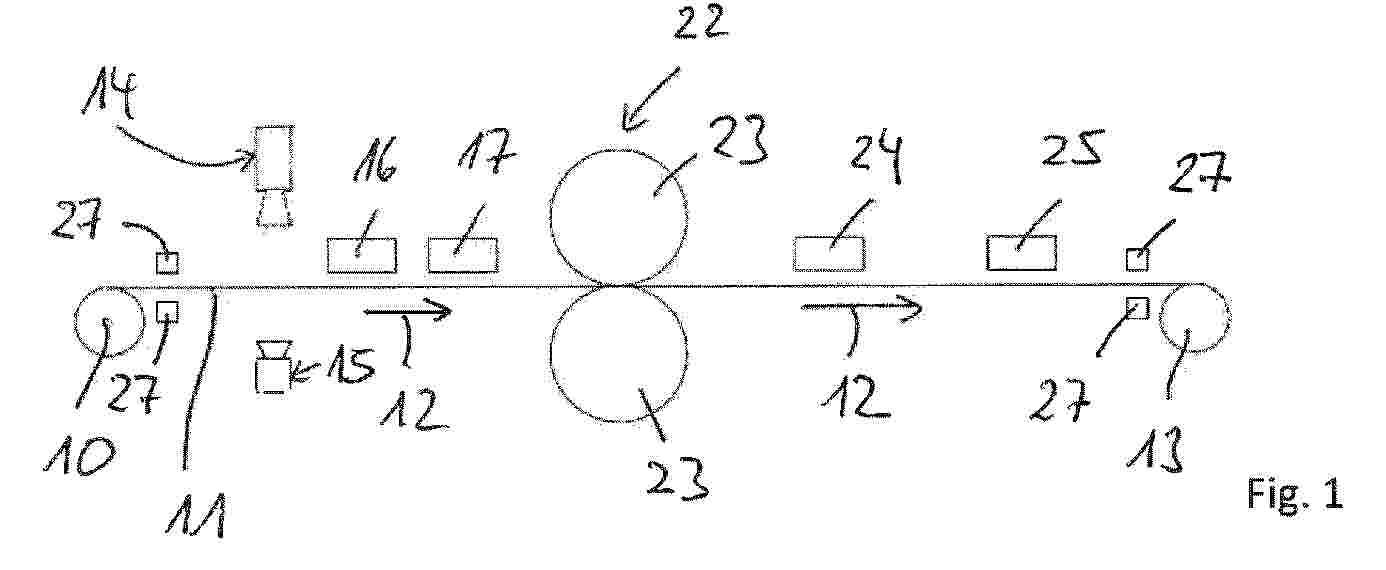
In a method for producing catalyst-coated membranes for a fuel cell or electrolysis cell of an electrochemical device, the respective catalyst-coated membrane carries a first electrode on a first side of the membrane and a second electrode on an opposite, second side of the membrane, said method comprising steps as follows: Providing a carrier foil (11) which is wound up in roll form and intermittently accommodates first electrodes. Providing membrane blanks. Providing carrier foil blanks which accommodate second electrodes. Unwinding the carrier foil (11) which intermittently accommodates the first electrodes and detecting the position of the first electrodes on the unwound carrier foil (11). Arranging the membrane blanks and the carrier foil blanks on the unwound carrier foil, depending on the detected position of the first electrodes on the unwound carrier foil (11), in such a way that there is an arrangement of a first electrode on a first side of each membrane blank and a second electrode on a second side of each membrane blank in a defined relative orientation. Compressing and heating the arrangement composed of the carrier foil (11), the membrane blanks, the electrodes and the carrier foil blanks. Separating the membrane blanks together with the electrodes accommodated by the membrane blanks from the carrier foil and the carrier foil blanks.
Resumen de: EP4804260A1
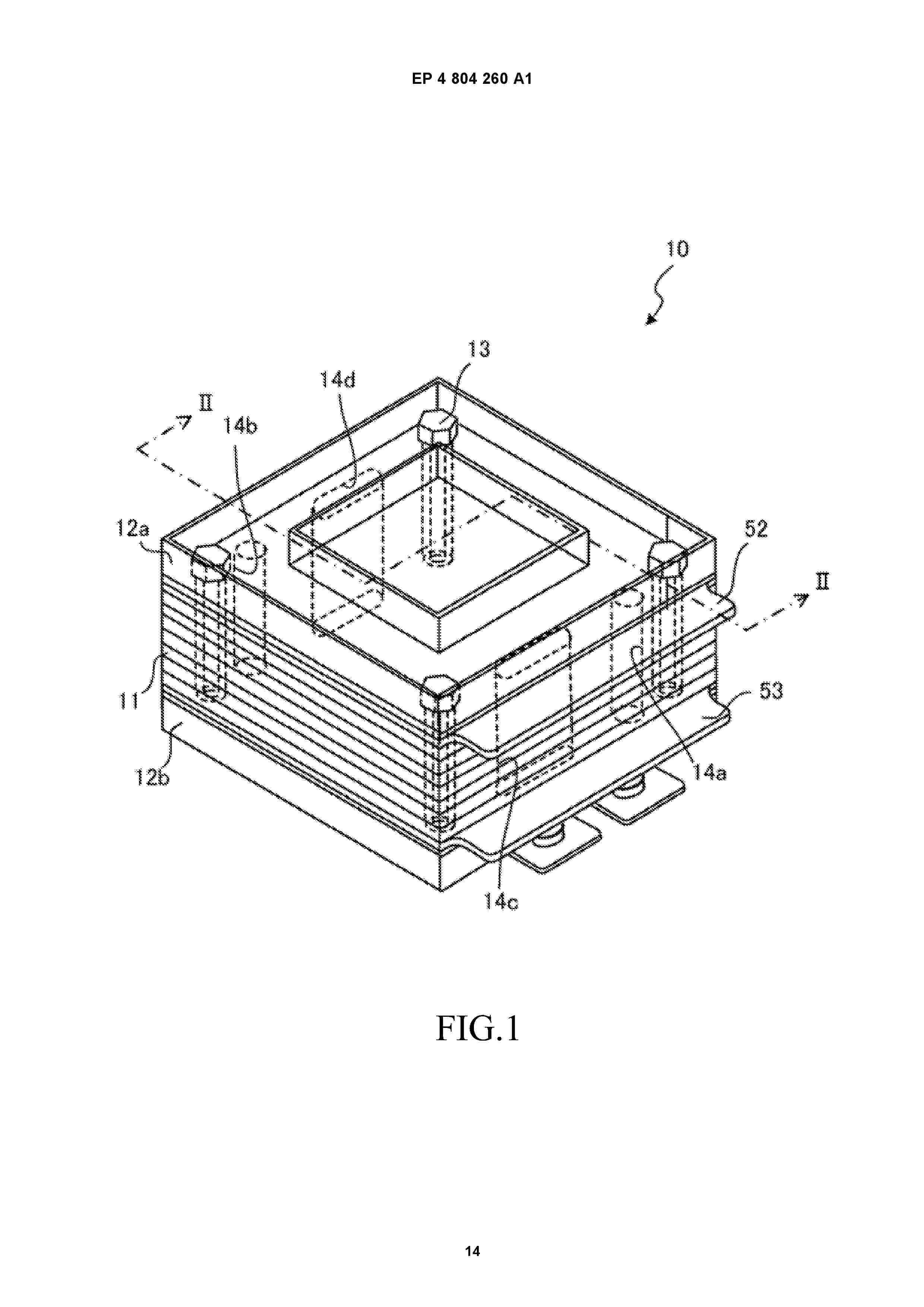
0001 Object To provide an electrochemical cell which exhibits high joint strength between metal members while suppressing warpage of the metal members, an electrochemical cell stack, and methods of manufacturing the electrochemical cell and the electrochemical cell stack. 0002 Means for solution The electrochemical cell includes a cell main body 20 including an air electrode, an electrolyte layer, and a fuel electrode stacked together and shaped, a first metal member 18 joined to the cell main body 20, a second metal member 17 joined to the first metal member 18 by means of welding after being brought into contact with the first metal member 18 in a stacking direction of the cell main body 20 to be located at a predetermined position of the first metal member 18; and a third metal member 16 joined to the second metal member 17 by means of welding, on a side of the second metal member 17 opposite its side joined to the first metal member 18, after being brought into contact with the second metal member 17 in the stacking direction of the cell main body 20 to be located at a second predetermined position of the second metal member 17. A region where metal members are joined by welding is defined as a weld portion 30, and a fusion proceeding direction of at least a part of the weld portion 30 is inclined in relation to the stacking direction of the cell main body 20.
Resumen de: WO2025093133A1
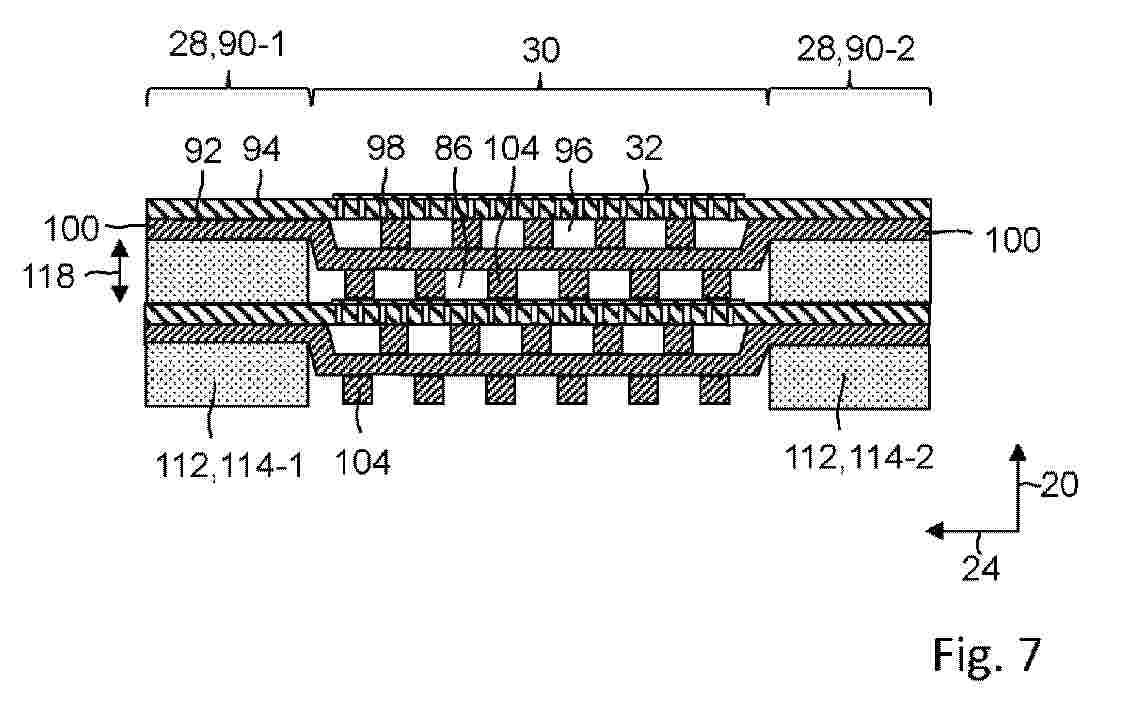
The invention relates to an electrochemical cell assembly, comprising a stack of cell units, wherein each cell unit has a periphery and a central portion surrounded by the periphery, the periphery has a first flange portion (90-1) and an opposite second flange portion (90-2), the flange portions of adjacent cell units overlie one another and are separated by a gap (88-1, 88-2), wherein between two adjacent cell units, there is provided a fluid flow path comprising an inner flow path between the central portions of adjacent cell units and an outer flow through said gaps, and a flow restriction device (112) comprising at least one flow restriction member (114-1, 114-2), said flow restriction device being configured to reduce or prevent fluid flow along the outer flow path.
Resumen de: WO2025093132A1
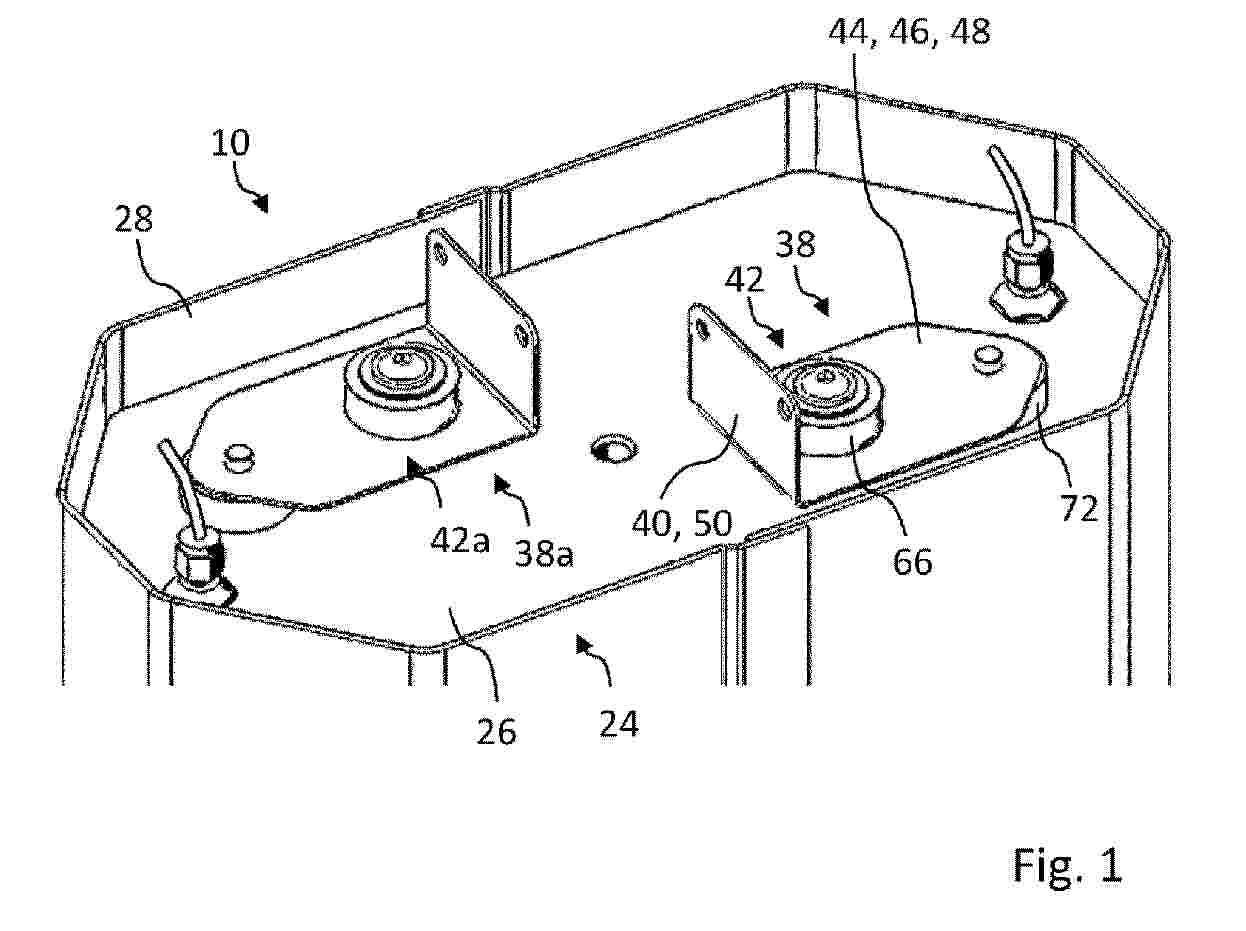
The invention relates to an electrochemical cell assembly (10), comprising a base plate, an end plate (26), a stack (12) comprising a plurality of cell units (14) stacked upon one another, said stack (12) being arranged between said base plate and said end plate, and an electrically conductive power transmission device (38) comprising a connector (40) that is located on a side of the end plate that is facing away from the stack, the power transmission device spanning the end plate and being electrically connected to the stack, wherein the power transmission device is attached to the end plate by a fastening device (42) at a portion of the power transmission device that is located between an electrical connection to the stack and the connector.
Resumen de: EP4803705A1
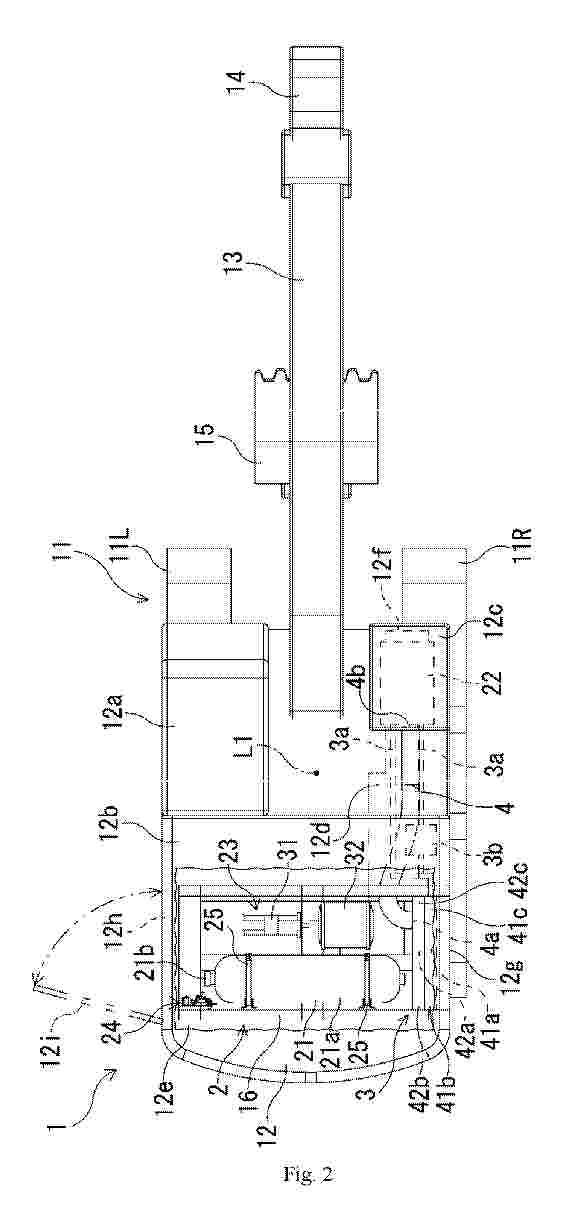
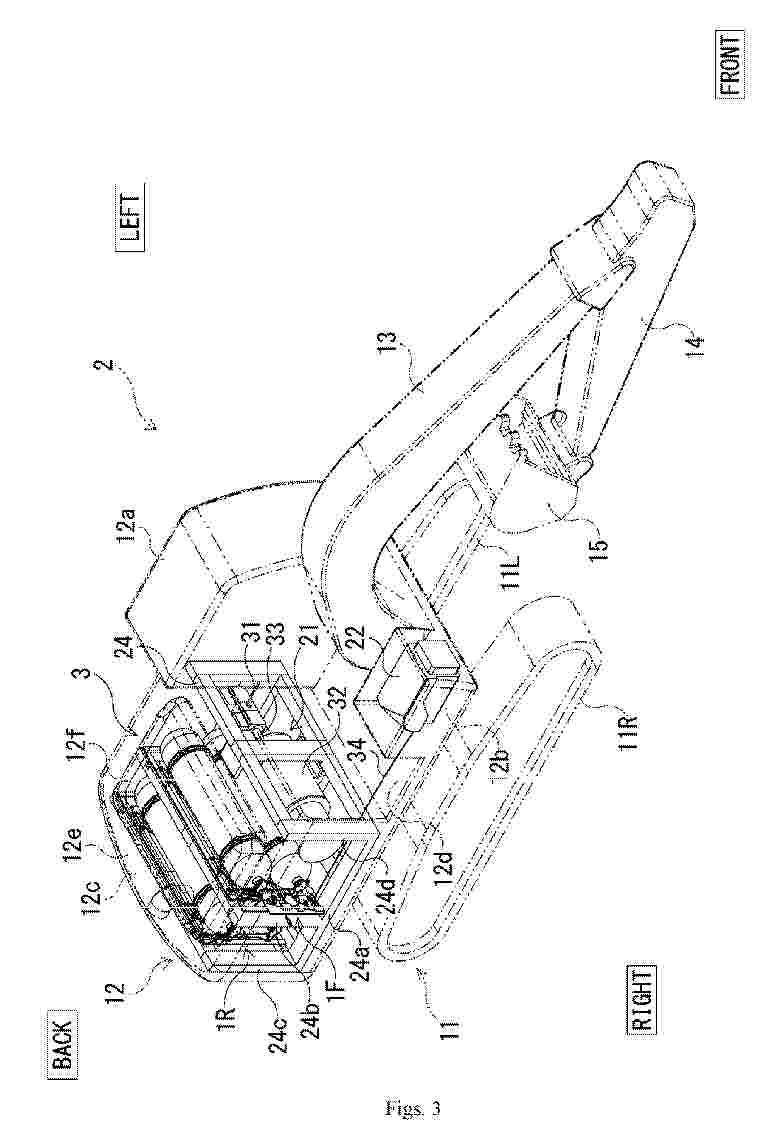
0001 This excavator includes a slewing body rotatably disposed on a traveling device and includes: a hydrogen tank that stores hydrogen; a fuel cell that generates electric power by consuming the hydrogen in the hydrogen tank; and an electric pump device that is driven by the electric power generated by the fuel cell to discharge working fluid. The hydrogen tank and the electric pump device are housed in a housing space within the slewing body. The fuel cell is disposed in the slewing body at a distance from the housing space.
Resumen de: WO2025093190A1
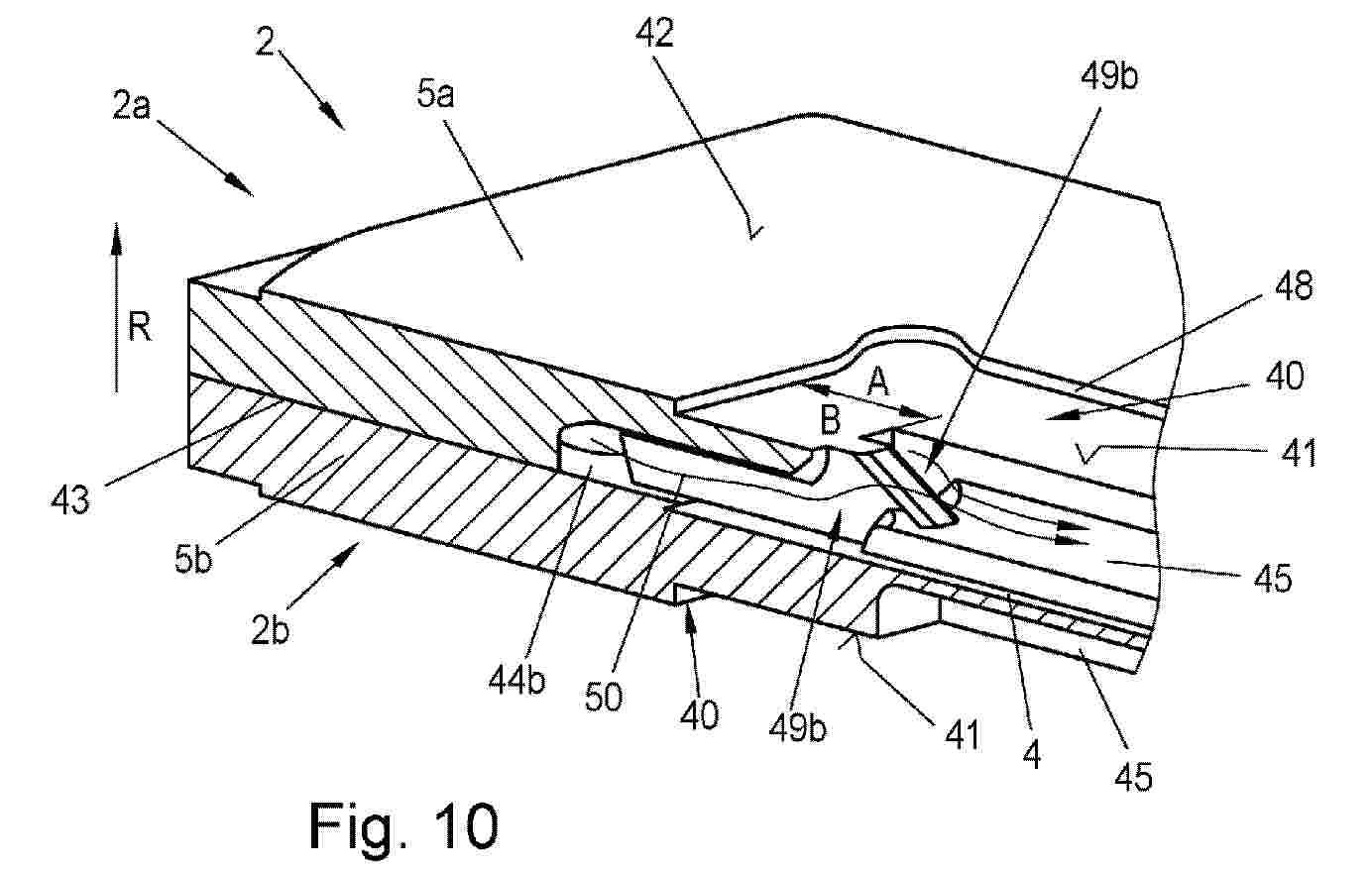
The aim of the invention is to improve the internal sealing tightness in the half-cells (2a, 2b) of an individual cell (2) and between adjacent individual cells (2) in a cell stack (10) of a redox flow battery (1) and to reduce the possibility of potential leakage paths of electrolyte liquids (15a, 15b) while simultaneously reducing the manufacturing complexity for an individual cell (2) and a cell stack (10). This is achieved in that a web (50) is provided in the frame (5a, 5b) for a half-cell (2a, 2b) of a cell stack (10) of a redox flow battery (1), said web dividing the at least one flow channel (44a, 44b) into two flow channel branches; each of the flow channel branches separated by the web (50) is connected to a respective opening (49a, 49b) which passes through the frame (5a, 5b); and the web (50) is arranged in the region of the openings (49a, 49b), wherein a first end of each opening (49a, 49b) is connected to the respective flow channel branch of the at least one flow channel (44a, 44b) at the first end face (43), and the opposite second end of each opening (49a, 49b) opens out into the frame (5a, 5b) in the direction of the recess (6a, 6b) at a distance to the peripheral surface (48) of the depression (40) and is connected to the recess (6a, 6b) in the frame (5a, 5b), said web (50) extending on the first end face (43) at least between the region of the openings (49a, 49b) and the peripheral surface (48) of the depression (40).
Nº publicación: EP4803707A1 09/09/2026
Solicitante:
KAWASAKI HEAVY IND LTD [JP]
KAWASAKI JUKOGYO KABUSHIKI KAISHA
Resumen de: EP4803707A1
0001 This hydrogen tank device includes: a frame body that is plate-shaped and has a rectangular shape as viewed from one side in a first direction; and a plurality of hydrogen tanks mounted parallel to each other on the frame body and each of which extends in the longitudinal direction of the frame body. The frame body includes, on the one side in the first direction, a mounting surface to be mounted on a frame of a construction machine.
 BOPI
BOPI
 Sede Electrónica