Si deseas distinguir tus productos, servicios o ambos de los de otra empresa, es posible que necesites una marca o nombre comercial. Descubre qué son, en qué consiste su procedimiento de registro y qué implica.

Información sobre los plazos de presentación de solicitudes de transformación de marcas de la Unión Europea en marca nacional española. Más información


Si tienes un nuevo dispositivo, producto o procedimiento que resuelva un problema técnico o tenga una ventaja práctica, existen distintas formas de protegerlo en España y en otros países. Descubre cómo hacerlo.

¿Tu innovación reside en la estética, la ornamentación o la apariencia de tu producto? Protégela mediante un diseño industrial. Descubre qué derechos confiere el registro y cómo realizar la tramitación.

Las indicaciones geográficas protegen el nombre de un producto originario de una zona geográfica, a la cual le debe una determinada calidad, reputación u otra característica. Descubre qué son, en qué consiste su procedimiento de registro y qué beneficios conceden.

Las patentes publicadas en todo el mundo son una valiosa fuente de información científica, técnica y comercial.

Si eres emprendedor/a o una empresa y quieres potenciar y mejorar la rentabilidad de tu negocio protegiendo de forma adecuada los activos intangibles de tu organización, en este espacio encontrarás lo necesario.


 1890
resultados
1890
resultados
 Última actualización
30/06/2026 [12:07:00]
Última actualización
30/06/2026 [12:07:00]


 Resultados 1175 a 1200 de 1890

Resumen de: WO2026123489A1
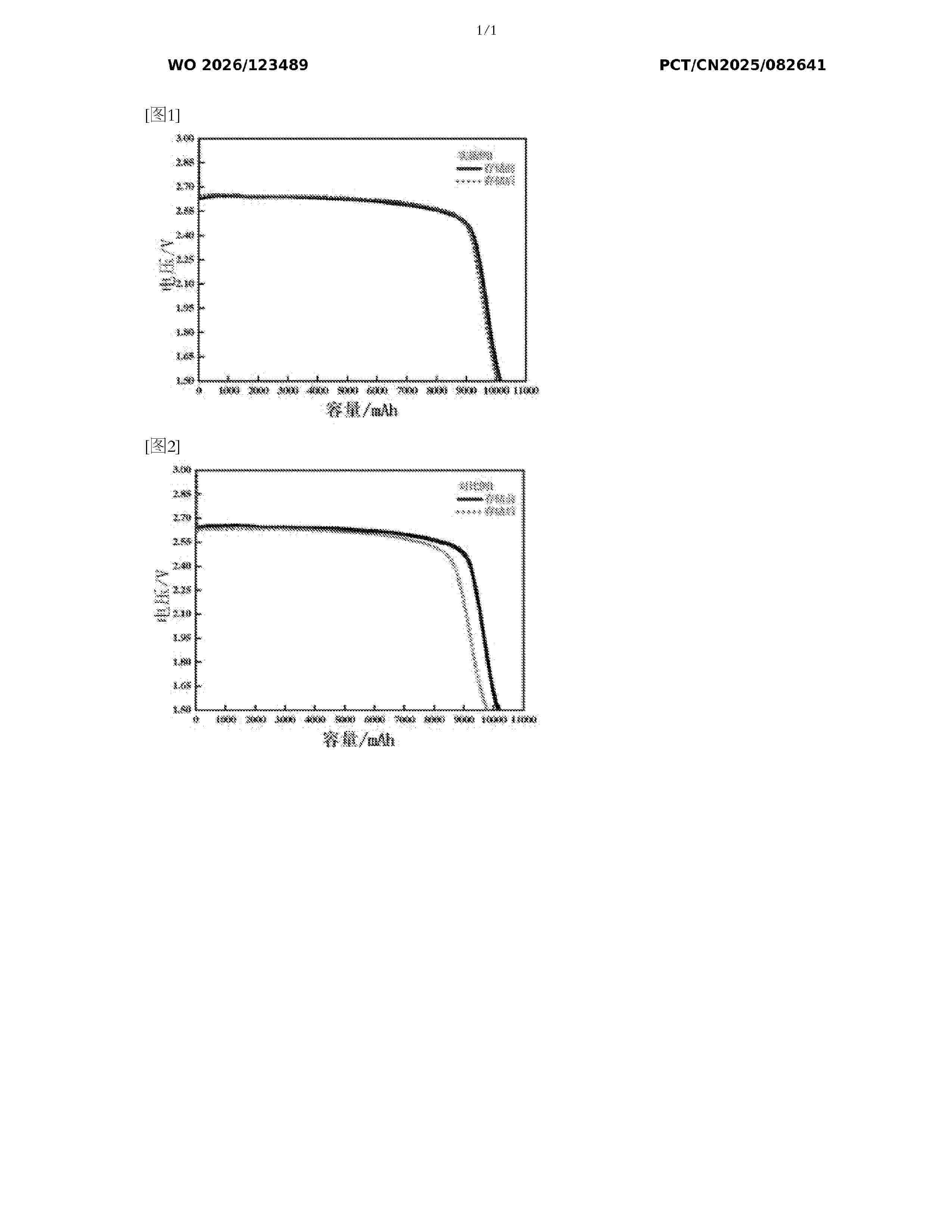
Disclosed in the present application is a lithium/carbon fluoride battery. The battery comprises a positive electrode sheet, a negative electrode sheet and an electrolyte, wherein the positive electrode sheet comprises a positive electrode active material layer comprising a positive electrode active material, the positive electrode active material comprising a carbon fluoride material; and the electrolyte comprises additives, and the additives comprise a first additive and a second additive, with the first additive comprising a double-bond silane compound. The general chemical formula of the double-bond silane compound is R1 bSiaR2 2a+2-b, wherein a is an integer of 1-2, b is an integer of 1-6, R1 is at least one of vinyl, propenyl and butenyl, and R2 is at least one of methyl, ethyl and butyl.

Resumen de: WO2026123660A1
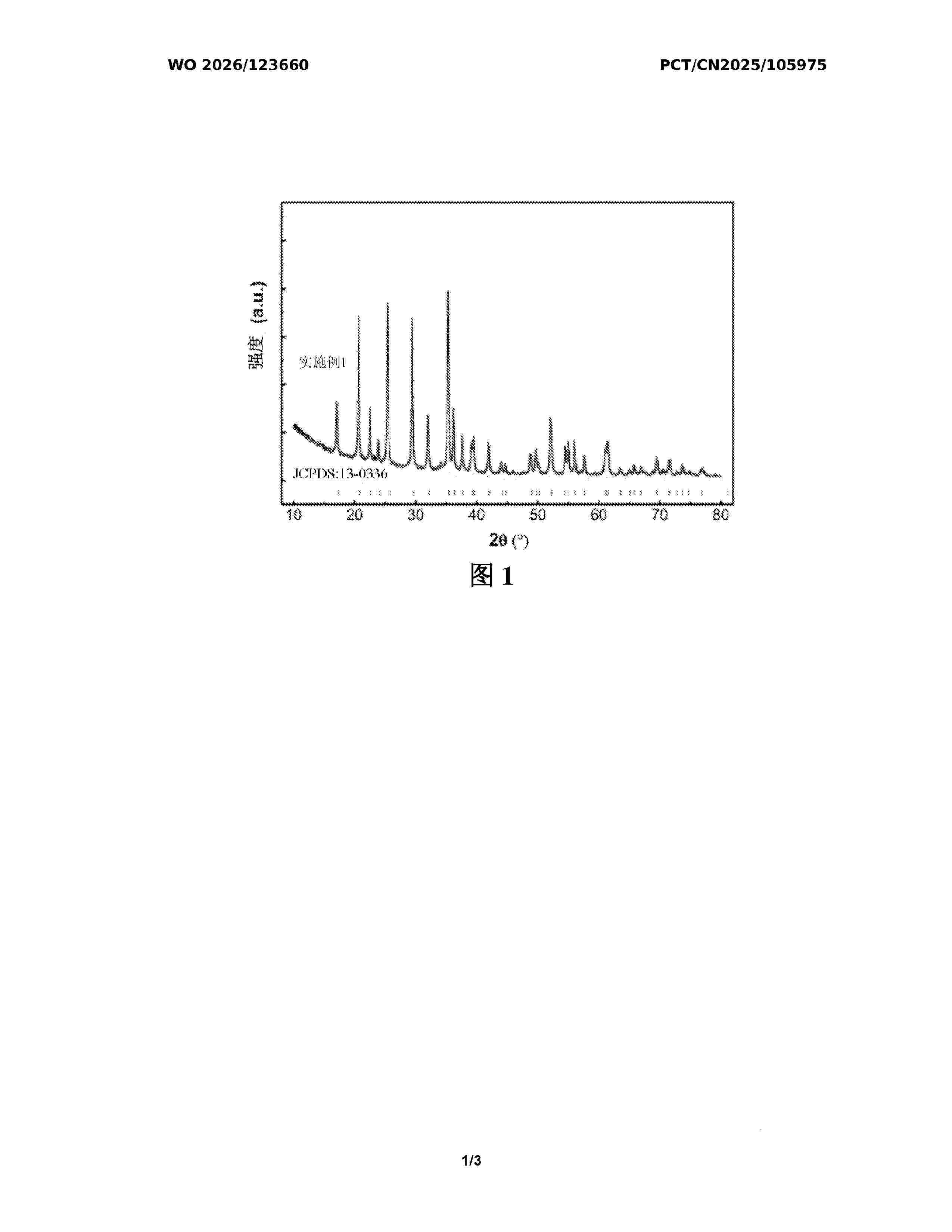
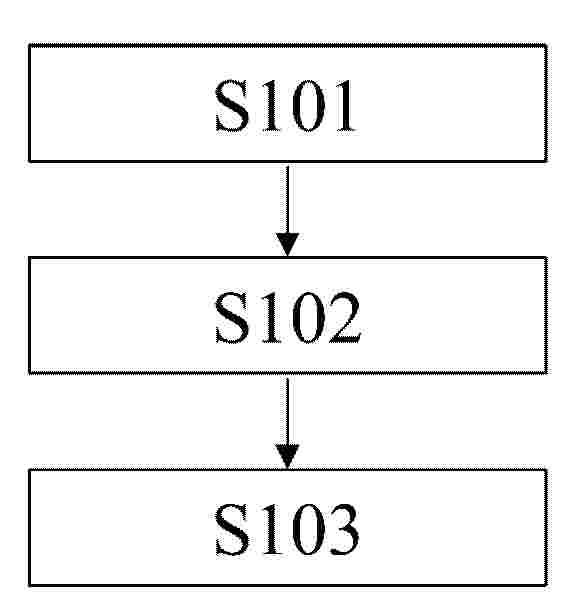
Provided in the present application are a lithium manganese iron phosphate material, a preparation method therefor, and use thereof. The preparation method comprises the following steps: step S1, mixing a manganese source, an iron source, and a phosphorus source with water via ball milling to obtain a first mixed slurry; step S2, subjecting a lithium source, pyrophosphoric acid, and sucrose to ball milling with the first mixed slurry to obtain a second mixed slurry; step S3, subjecting the second mixed slurry to a spray drying treatment to obtain a composite precursor with a microsphere structure; and step S4, calcining the composite precursor with the microsphere structure in an inert gas atmosphere at a calcination temperature of 520-700 ℃ to obtain the lithium manganese iron phosphate material. On the basis of the preparation method of the present application, the problems of low bulk density, low conductivity, low specific energy, and complex process of lithium manganese iron phosphate materials in the prior art can be solved.
Resumen de: WO2026123414A1
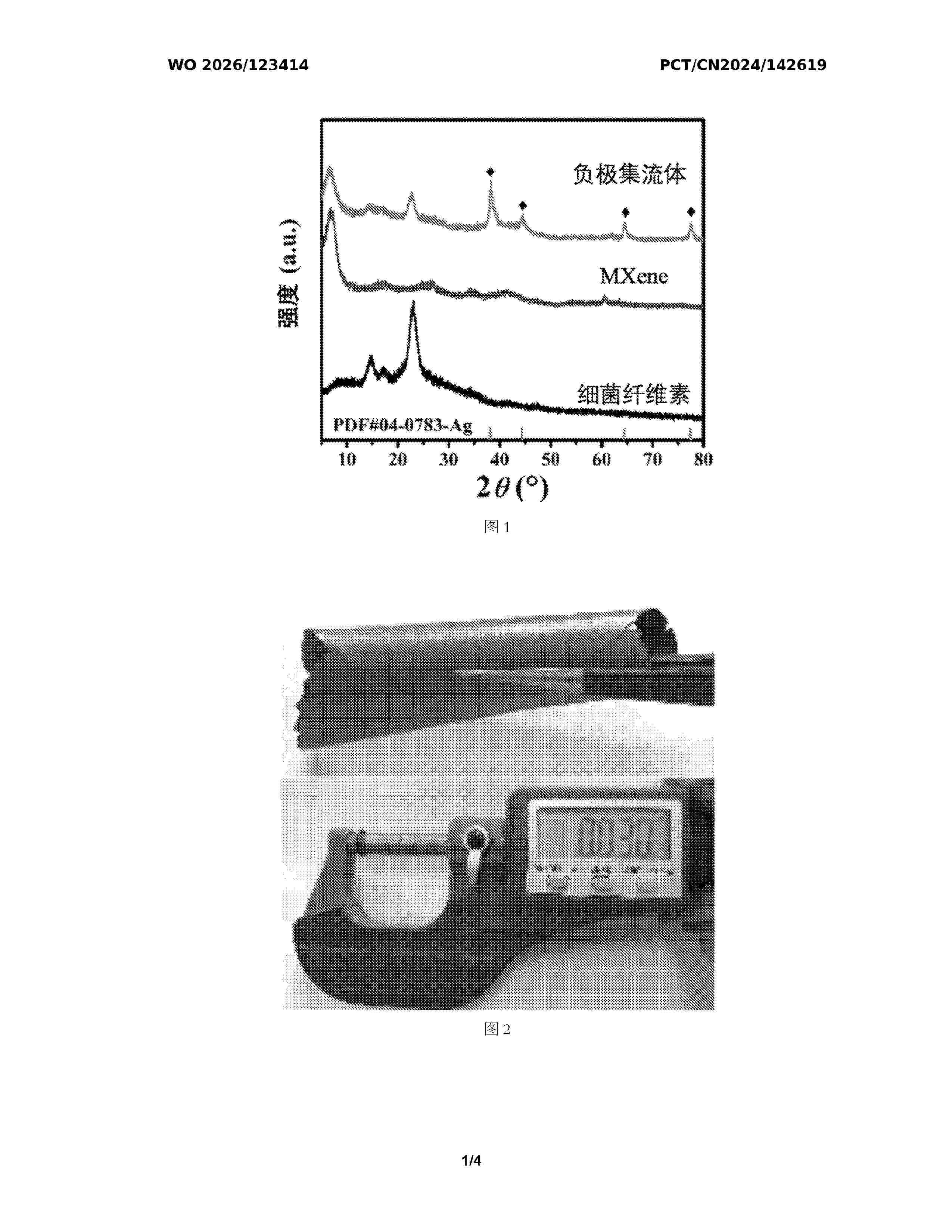
The present application relates to the technical field of secondary batteries, and specifically relates to a composite material and a preparation method therefor, a negative electrode current collector, a metal battery, and an electrical apparatus. The composite material provided in the present application comprises: a MXene material, the MXene material comprising surface functional groups; silver nanoparticles, the silver nanoparticles being grown in situ on the surface of a sheet layer of the MXene material; and modified bacterial cellulose, the modified bacterial cellulose comprising bacterial cellulose and oxygen-containing functional groups modified on the surface of the bacterial cellulose. The modified bacterial cellulose is loaded on the surface of the MXene material, the manner of loading of the modified bacterial cellulose at least comprising: intermolecular interaction between the oxygen-containing functional groups of the modified bacterial cellulose and the surface functional groups of the MXene material. The composite material provided in the present application has excellent lithiophilic performance, and can delay the formation of lithium dendrites, thereby helping to improve the electrochemical performance of a metal battery.
Resumen de: AU2024410005A1
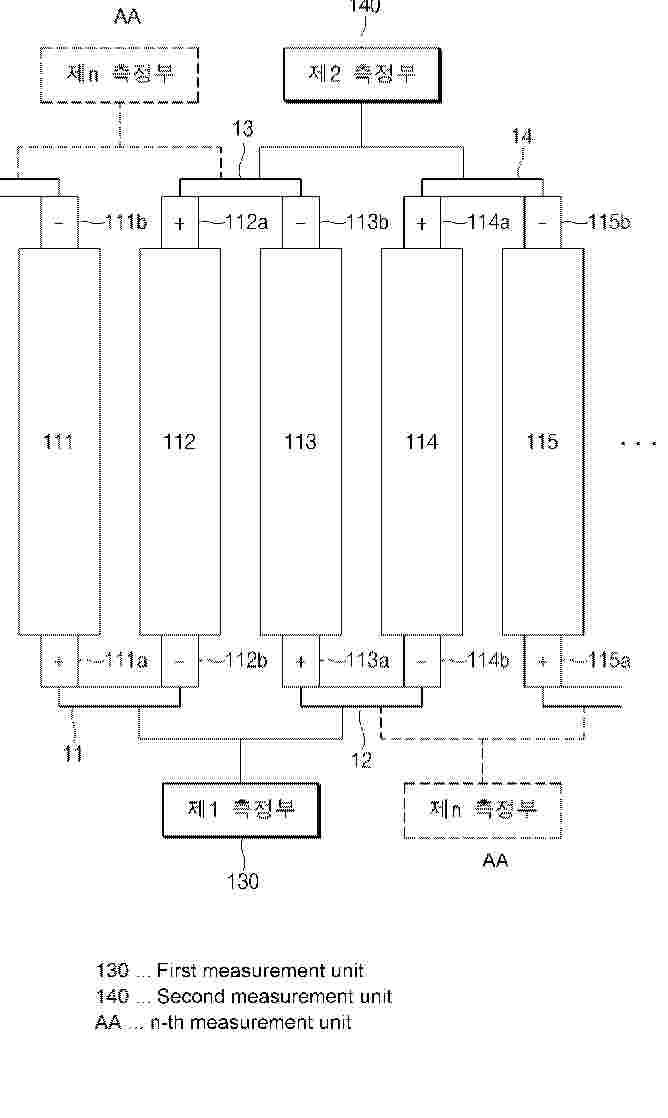
A battery according to an embodiment disclosed in the present document may comprise: a first measurement unit for measuring a first voltage which is the voltage between a first bus bar connecting a first battery cell and a second battery cell and a second bus bar connecting a third battery cell and a fourth battery cell and transferring the first voltage to a management unit; a second measurement unit for measuring a second voltage which is the voltage between a third bus bar connecting the second battery cell and the third battery cell and a fourth bus bar connecting the fourth battery cell and a fifth battery cell and transferring the second voltage to the management unit; and the management unit for calculating the voltage of the third battery cell by performing a mathematical operation for the first voltage and the second voltage.
Resumen de: WO2026124606A1
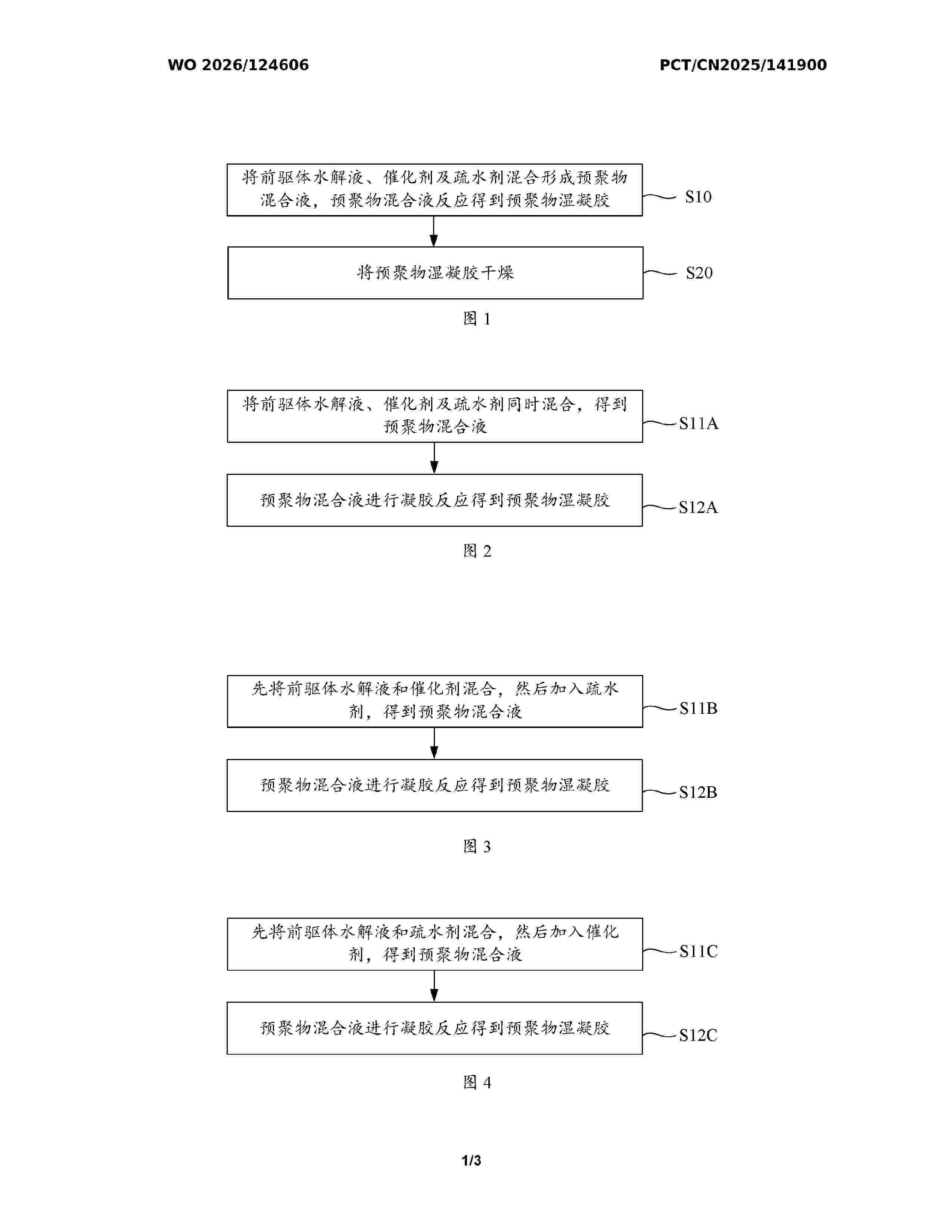
Disclosed in the present application are a preparation method for a hydrophobic aerogel, a composite material and a preparation method therefor, and a battery device. The preparation method for the hydrophobic aerogel comprises: mixing a precursor hydrolysate, a catalyst and a hydrophobic agent to form a mixed prepolymer solution, and reacting the mixed prepolymer solution to obtain a prepolymer wet gel; and drying the prepolymer wet gel. In this way, by directly using the precursor hydrolysate, a precursor hydrolysis step is omitted. During the reaction with the hydrophobic agent, the hydrophobic agent no longer participates in the hydrolysis of the precursor, and participates more in the modification reaction, thereby reducing the consumption of the hydrophobic agent. In addition, in the present application, no separate operation step or device is required for hydrophobic modification, and therefore the preparation method for the hydrophobic aerogel provided in the present application is simpler in operation, more environmentally friendly, and more cost-saving.
Resumen de: WO2026123463A1
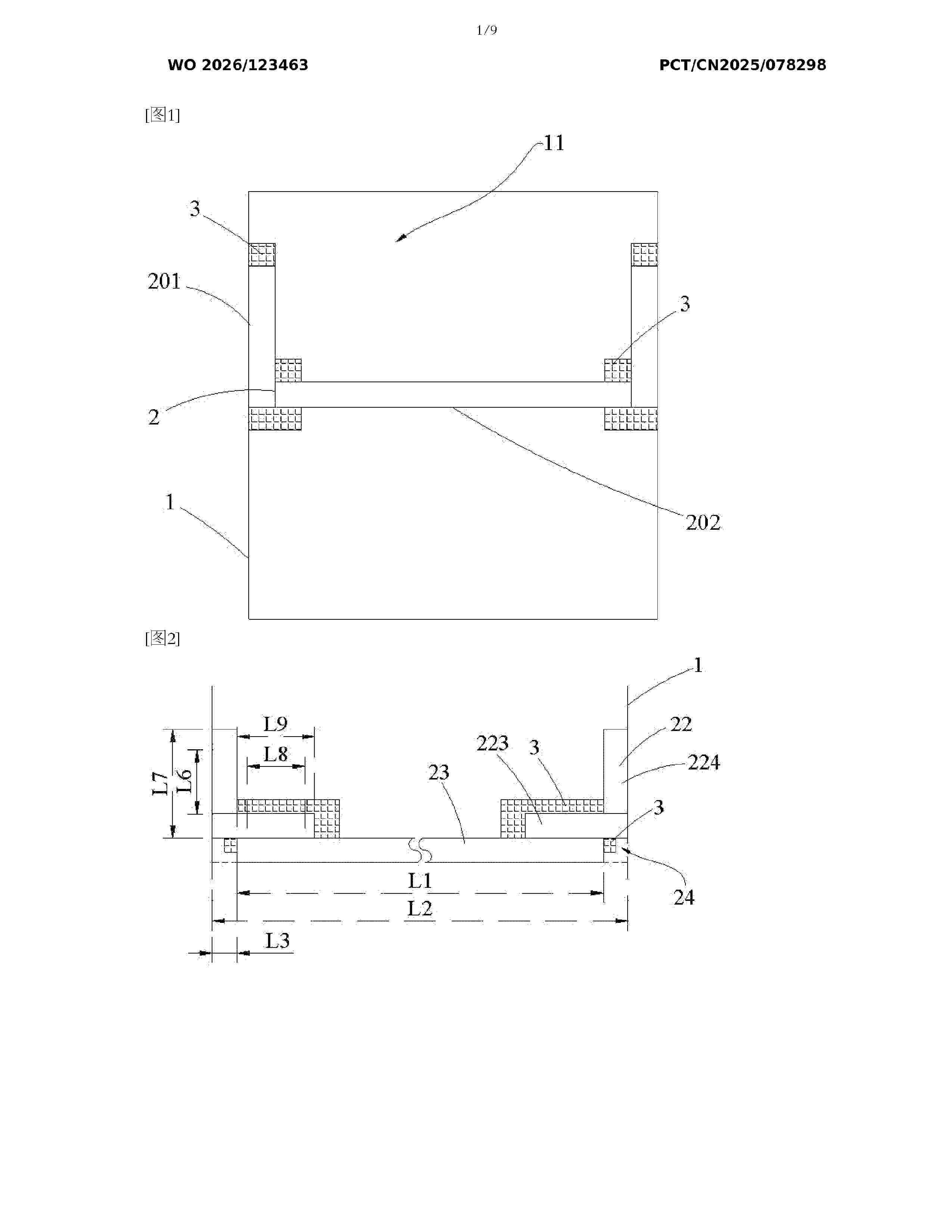
Provided in the present application are a battery and an electric device. The battery comprises a connector and a packaging portion. The connector has an electrode lead-out portion configured for connection to an electrode of the battery and a tab connecting portion configured for connection to a tab of the battery. At least part of the structure of the packaging portion is arranged at the junction between the electrode lead-out portion and the tab connecting portion, and/or at least part of the structure of the packaging portion is arranged at the junction between the electrode lead-out portion and the electrode of the battery.
Resumen de: WO2026123452A1
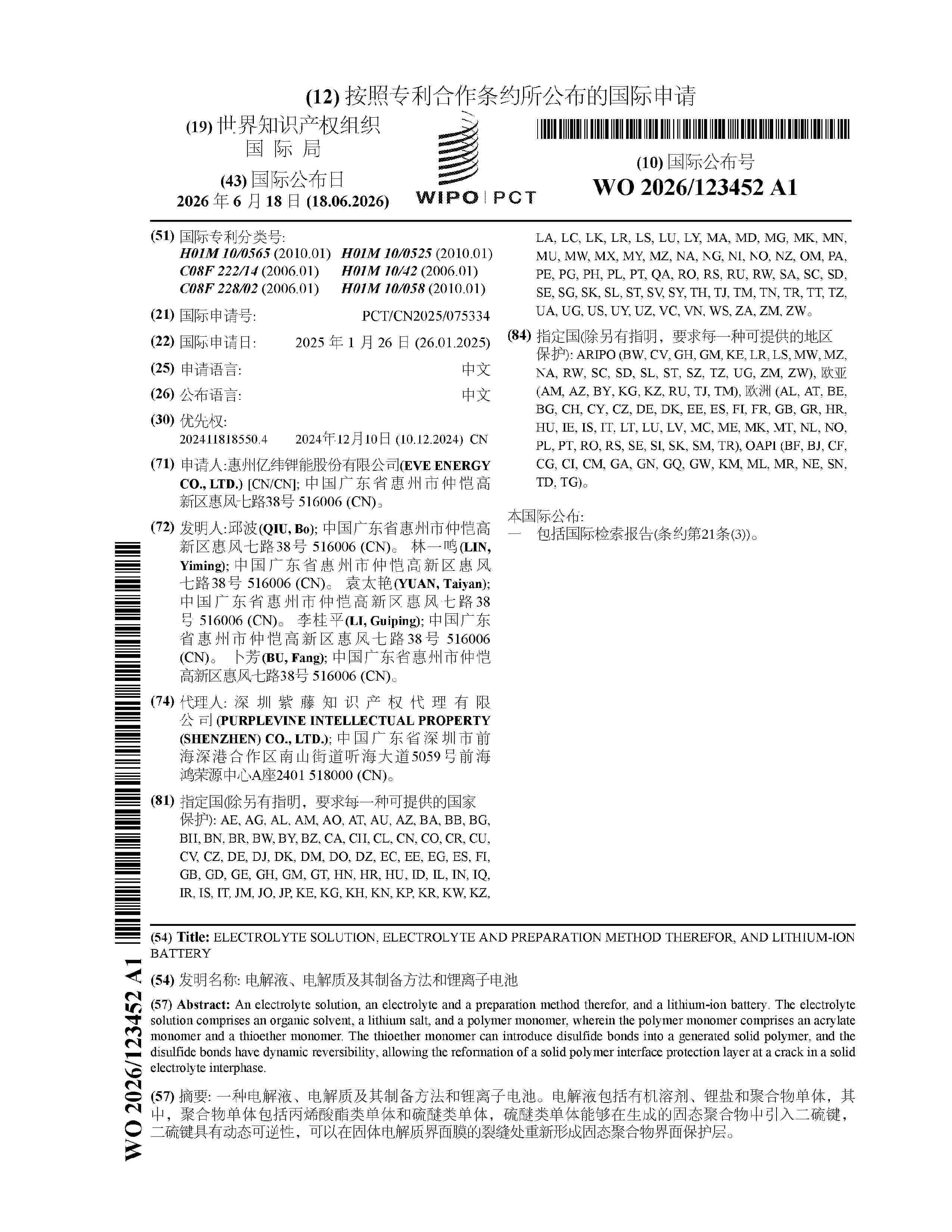
An electrolyte solution, an electrolyte and a preparation method therefor, and a lithium-ion battery. The electrolyte solution comprises an organic solvent, a lithium salt, and a polymer monomer, wherein the polymer monomer comprises an acrylate monomer and a thioether monomer. The thioether monomer can introduce disulfide bonds into a generated solid polymer, and the disulfide bonds have dynamic reversibility, allowing the reformation of a solid polymer interface protection layer at a crack in a solid electrolyte interphase.
Resumen de: WO2026123583A1
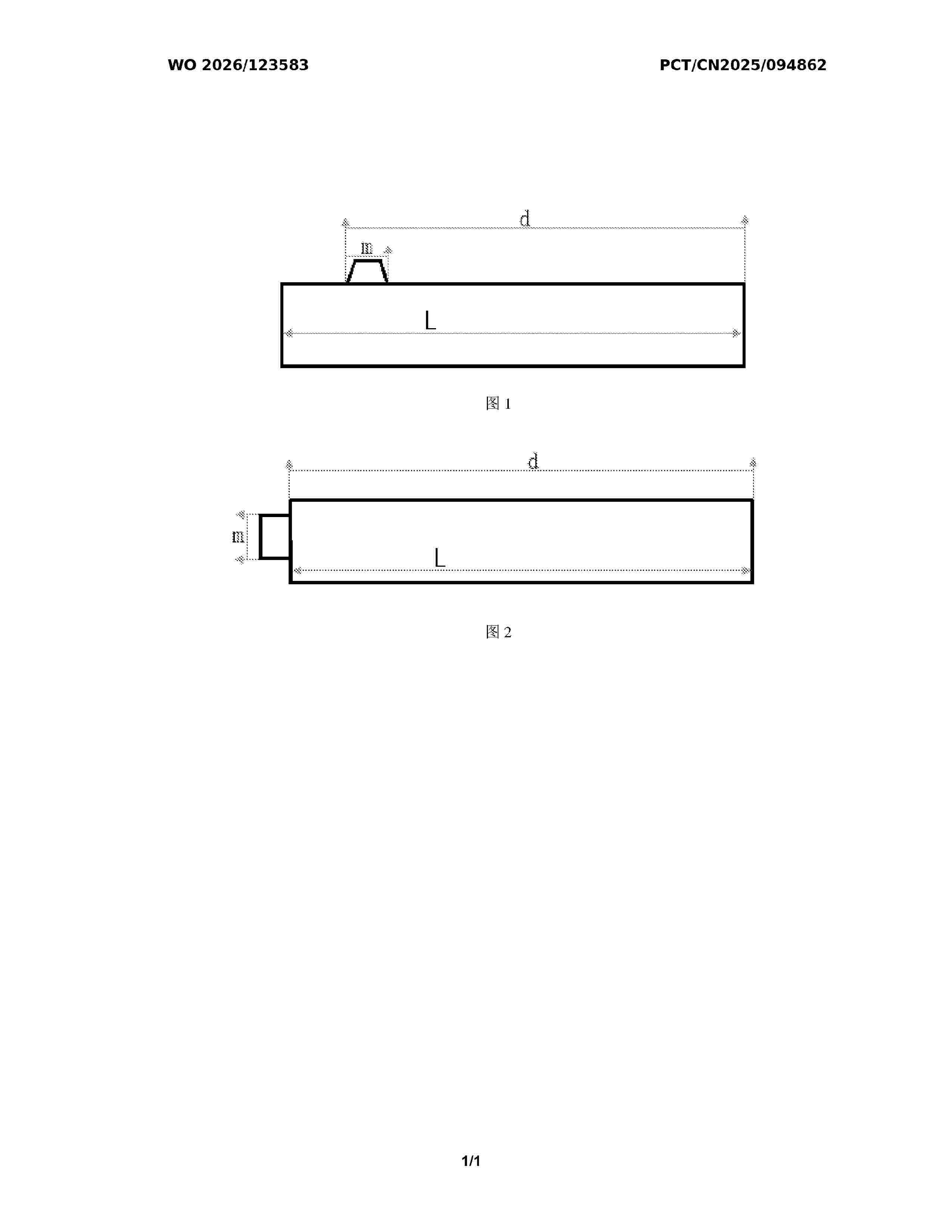
The present application discloses a battery, an electrochemical apparatus, and an electrical apparatus. The battery comprises a battery cell, the battery cell comprising an electrode sheet and a tab provided on the electrode sheet. A negative electrode active material layer of the electrode sheet contains silicon, and the percentage content of silicon in the negative electrode active material layer is b, the unit being %. The longest distance between the tab and an end portion of the electrode sheet in the length direction is d, the width of the connection position between the tab and the electrode sheet is m, and the units of d and m are the same; and b, d, and m satisfy the following relational expression (I). In the present application, by means of comprehensively controlling the values of formula (II), a battery having higher energy density can be obtained, and it can also be ensured that the battery has better battery fast charging performance.
Resumen de: US20260167022A1
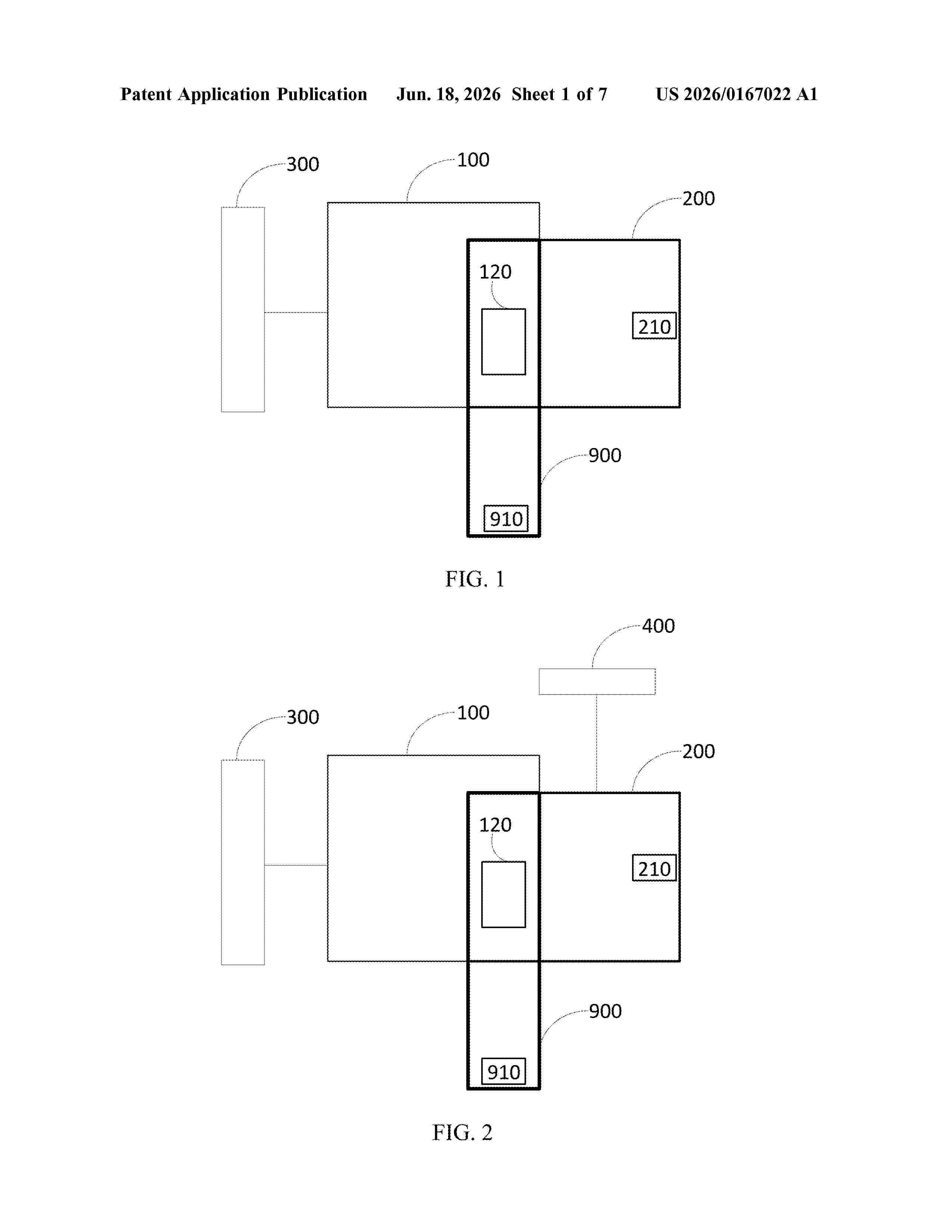
0000 A vehicle integrated domain controller architecture, a vehicle management system, and a vehicle. The vehicle integrated domain controller architecture includes: a low-voltage battery, a battery management module, a low-voltage power distribution module, and a thermal management module, where the low-voltage battery is electrically connected to the low-voltage power distribution module; the low-voltage power distribution module is configured with a low-voltage load access terminal configured to connect to a low-voltage load; the thermal management module is configured with a thermal management load access terminal configured to connect to a thermal management load; and the battery management module, and the low-voltage power distribution module, and the thermal management module share the same controller.
Resumen de: WO2026123631A1
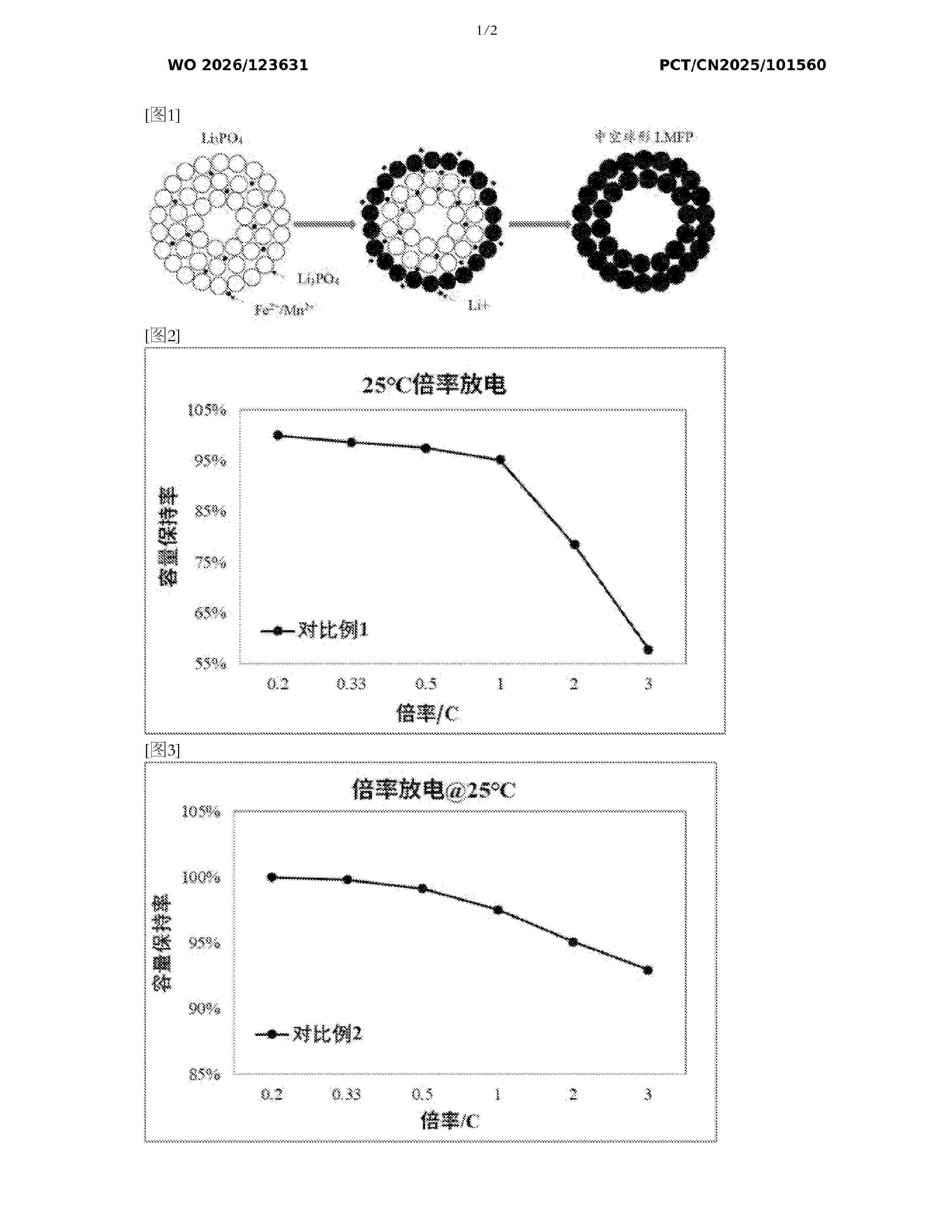
The present application relates to the technical field of batteries, and provides a positive electrode active material and a preparation method therefor, a positive electrode sheet, and a battery. The positive electrode active material comprises a ternary material and lithium manganese iron phosphate, wherein the mass of lithium manganese iron phosphate is A and the total mass of the ternary material and lithium manganese iron phosphate is B, both of which satisfy: 0
Resumen de: DE102025152640A1
Die vorliegende Erfindung offenbart ein Verfahren und eine Vorrichtung zur Vorhersage von Ausdehnungskräften in Batteriezellen und betrifft den Bereich der Batteriezellenprüftechnik. Das Verfahren umfasst: das Sammeln von ersten Ausdehnungskraftdaten eines bestimmten Batterietyps innerhalb eines vordefinierten Gesundheitsbereichs; das Aufstellen einer ersten linearen Regressionsgleichung für den bestimmten Batterietyp auf der Grundlage der ersten Ausdehnungskraftdaten und der im vordefinierten Gesundheitsbereich enthaltenen Gesundheitszustandsdaten; und das Vorhersagen der Ausdehnungskraftdaten über den gesamten Lebenszyklus des bestimmten Batterietyps auf der Grundlage der ersten linearen Regressionsgleichung, die dem bestimmten Batterietyp entspricht, um Designreferenzdaten für Batteriemodule bereitzustellen, die den bestimmten Batterietyp verwenden. Diese Implementierungsmethode kann den Prozess der Erfassung von Daten zur vollständigen Ausdehnungskraft über den gesamten Lebenszyklus vereinfachen und die Erfassungszeit verkürzen.
Resumen de: WO2026124686A1
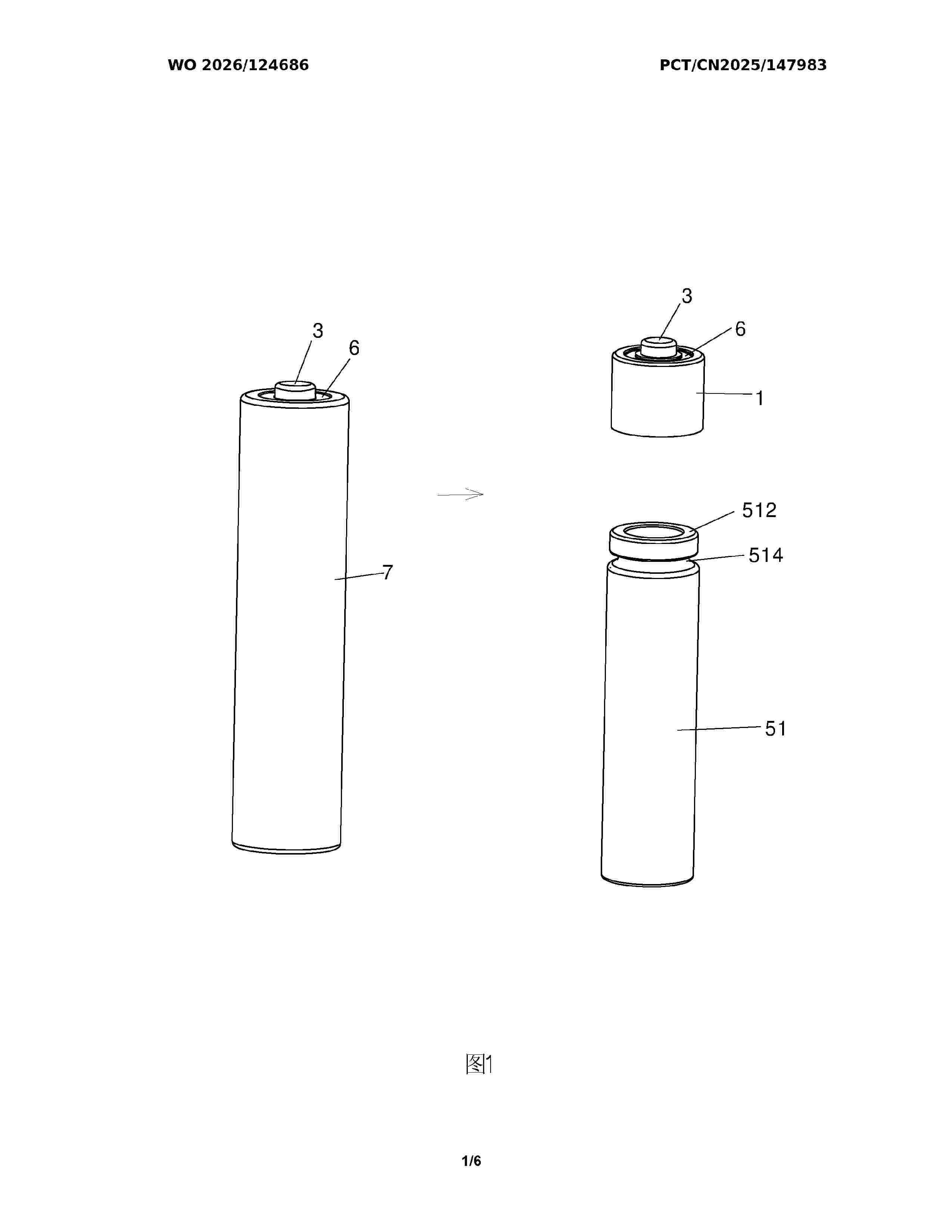
The present application relates to the technical field of lithium batteries. Disclosed are a charging-port-free rechargeable lithium battery and a manufacturing method therefor. The lithium battery comprises a first negative metal housing, a voltage adjustment circuit board, a low-voltage positive cap, a high-voltage positive connector, a lithium battery cell, a low-voltage positive and negative insulating separator and an insulating housing. A first flange is provided inwards at the upper end of the first negative metal housing; a negative copper ring and a positive copper ring are provided on the upper surface of the voltage adjustment circuit board; the voltage adjustment circuit board is welded to the inner side of the first flange on the first negative metal housing by means of the negative copper ring; and the high-voltage positive connector is arranged on the inner surface of the voltage adjustment circuit board. The lithium battery in the present application can stably output a low voltage, and the voltage adjustment circuit board is welded to the inner side of the first flange, such that the electrical connection performance is very reliable, and sealing is achieved by means of solder; there is no need to provide an insulating support below the voltage adjustment circuit board for support, thereby omitting the insulating support, and reducing a height space occupied by the voltage adjustment circuit board; and the capacity of the lithium battery cell is increased by
Resumen de: US20260171489A1
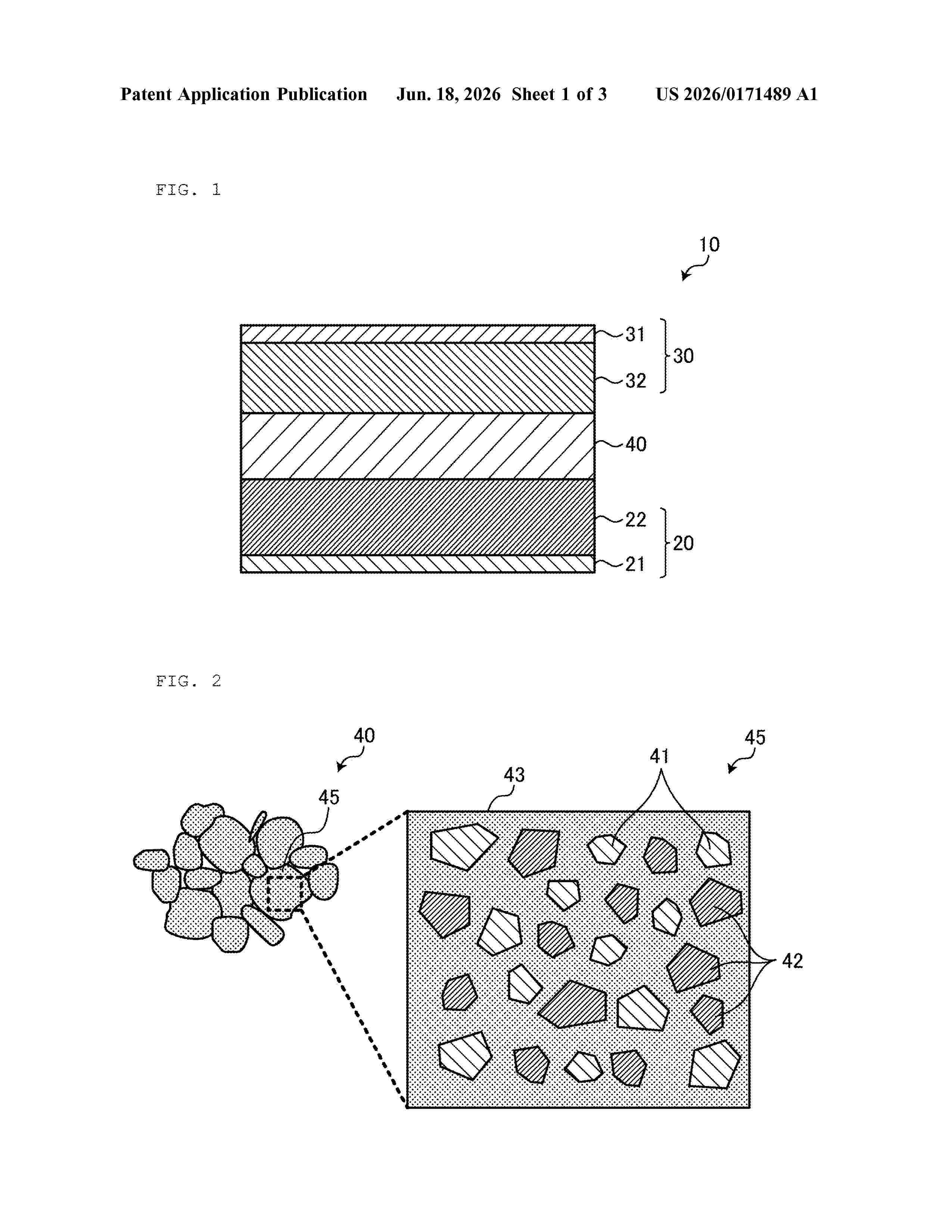
A solid electrolyte that includes: a first crystallite in a primary particle and having a first crystal structure; a second crystallite in the primary particle and having a second crystal structure that is different from the first crystal structure; and an amorphous phase, the first crystallite and the second crystallite each contain lithium, the first crystal structure is a hexagonal crystal, the second crystal structure is an orthorhombic crystal, and the crystallite size of the first crystallite and the crystallite size of the second crystallite are each 50 nm or less.
Resumen de: WO2026123771A1
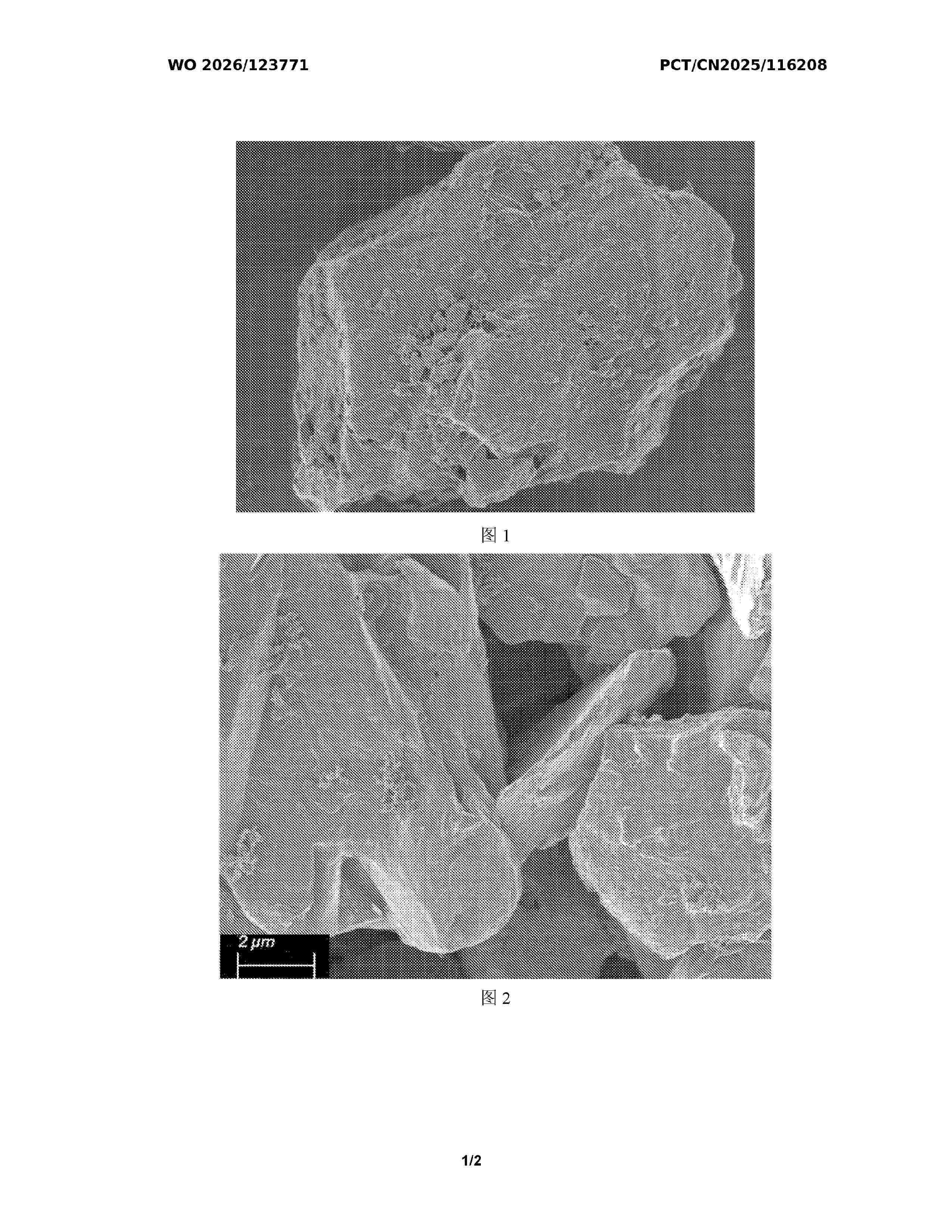
The present application provides a silicon-based negative electrode material having an artificial SEI film, and a preparation method therefor and the use thereof. The silicon-based negative electrode material comprises a silicon-based material, and a carbon layer and a conductive artificial SEI composite layer which are arranged on the silicon-based material, wherein the carbon layer is located between the silicon-based material and the conductive artificial SEI composite layer; and the conductive artificial SEI composite layer is obtained by reacting a reactive precursor with a reactive conductive material. In the present application, by means of the design of a three-layer structure and interaction between the layers, the uniform, tight and stable coating of a nanometer conductive material is achieved, the utilization rate of the conductive material is improved, the silicon-based negative electrode material has low expansion, a high capacity, and a good conductivity and cycling stability, and the cycle performance of a lithium-ion battery comprising same is improved. When the silicon-based negative electrode material is used for manufacturing a negative electrode sheet and a battery, an extra nanometer conductive material does not need to be added, thereby simplifying a manufacturing process for the battery and significantly reducing the use cost of the silicon-based negative electrode material.
Resumen de: WO2026123534A1
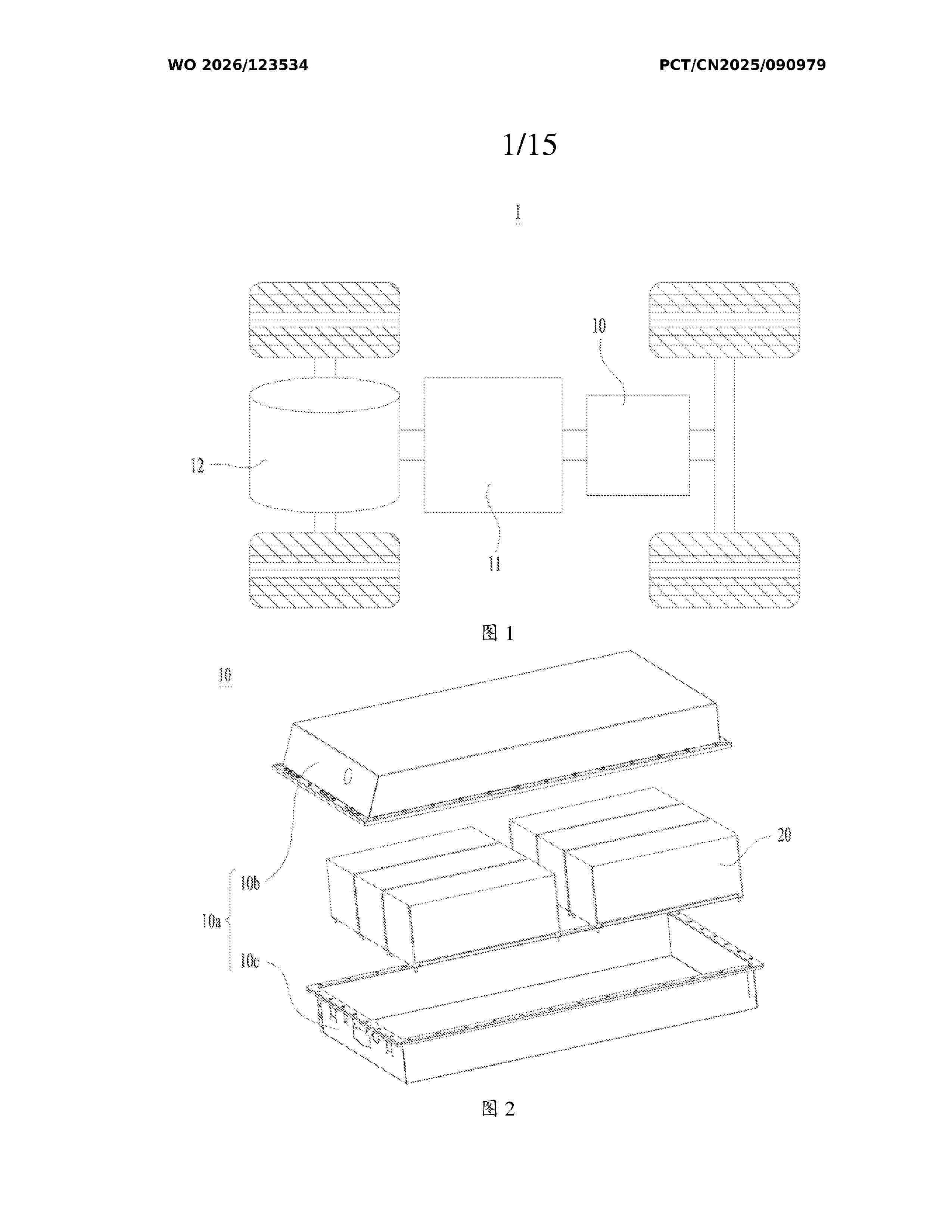
The present application provides an electrode assembly, a battery cell, a battery apparatus, an electrical apparatus, and a manufacturing method. The electrode assembly comprises a first electrode sheet, a first solid-state electrolyte layer, a second electrode sheet, and an insulating layer. The first electrode sheet comprises a first main body portion and a first tab. The first main body portion is provided with the first solid-state electrolyte layer. The first electrode sheet and the second electrode sheet have opposite polarities. The second electrode sheet comprises a second main body portion. The area of the second main body portion is greater than the area of the first main body portion. The first solid-state electrolyte layer is located between the first main body portion and the second main body portion. The second main body portion comprises a thinned-edge portion extending in a circumferential direction. The insulating layer is disposed at the thinned-edge portion. The insulating layer has a notch. The first tab is disposed corresponding to the notch.
Resumen de: WO2026123529A1
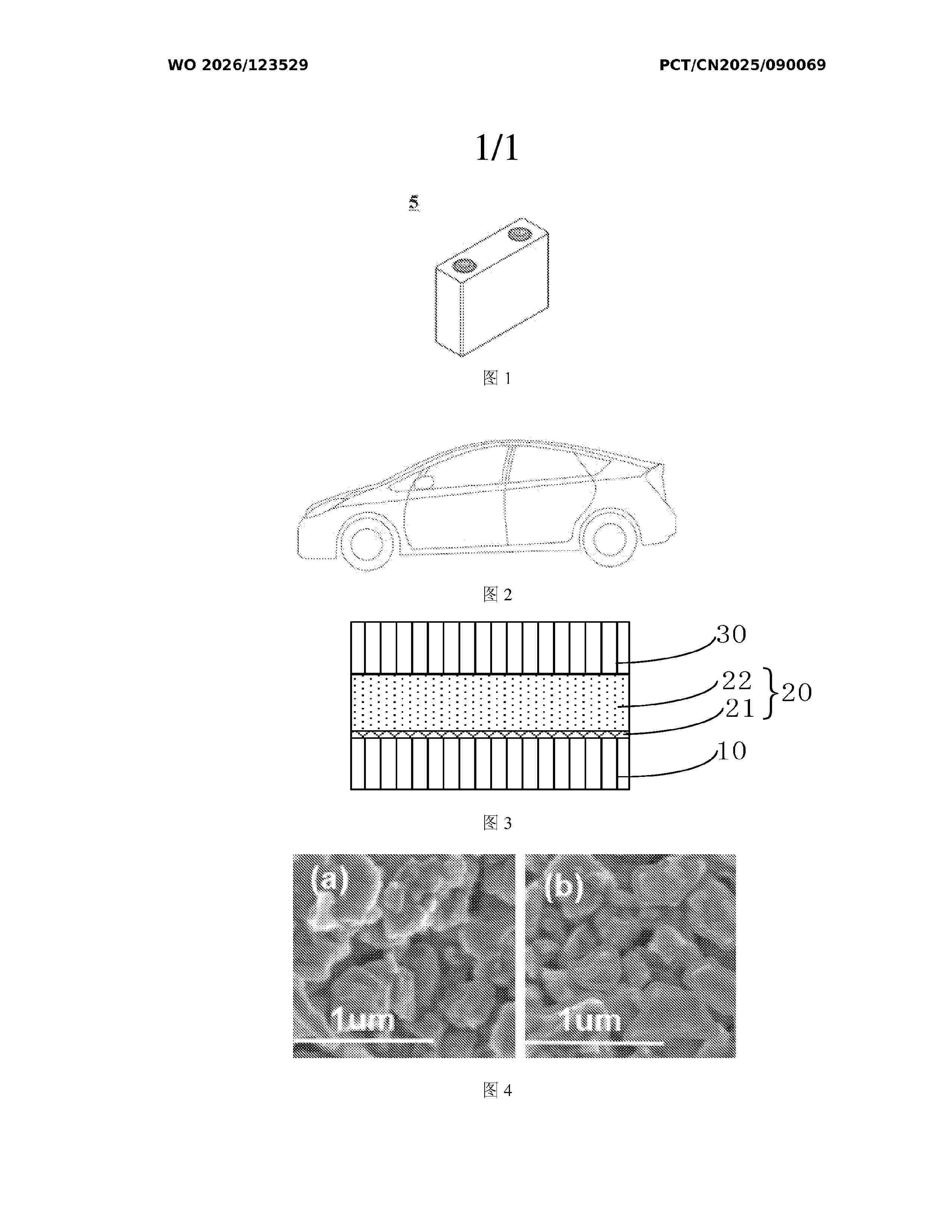
A solid-state battery cell, a battery device, an electric device, and an electrolyte sheet and a preparation method therefor. The solid-state battery cell comprises an electrolyte sheet and a negative electrode sheet. The electrolyte sheet comprises: a solid-state electrolyte base layer; and an electron blocking layer, which is arranged on the side of the solid-state electrolyte base layer close to the negative electrode sheet and comprises electron blocking particles, wherein each electron blocking particle comprises a core and a coating material provided on at least part of the surface of the core, the core and the solid-state electrolyte base layer separately comprise a solid-state electrolyte material, and the coating material comprises one or more of LiF and Li2S.
Resumen de: WO2026123547A1
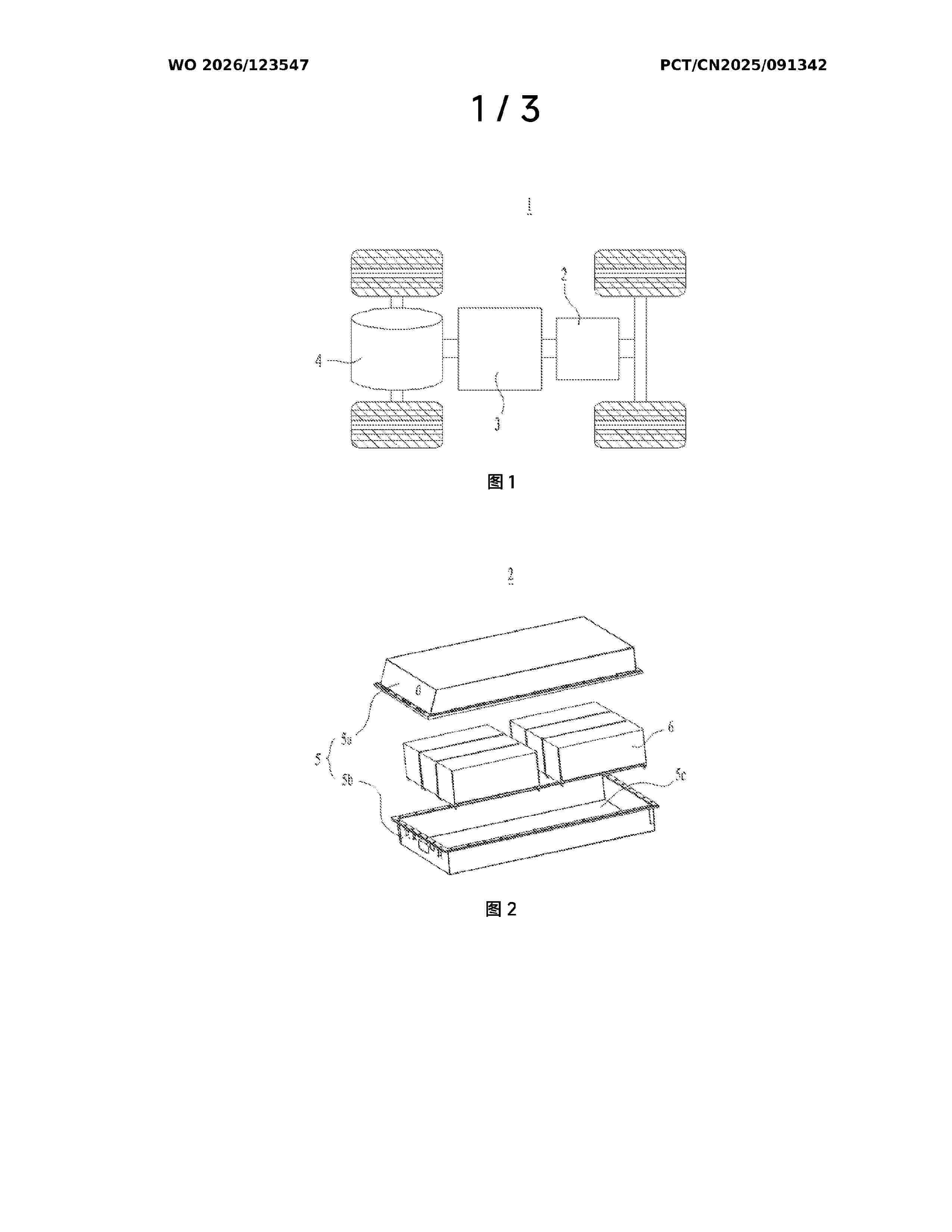
Disclosed in the present application are a solid-state battery cell and a preparation method therefor, a battery device, and an electric device. The battery cell comprises an electrode assembly. The electrode assembly comprises a main body portion and a tab portion extending from the main body portion. The main body portion comprises a positive electrode sheet, a negative electrode sheet, and a solid-state electrolyte membrane that are stacked. The solid-state electrolyte membrane is located between the positive electrode sheet and the negative electrode sheet. The main body portion is covered with an adhesive film having an elastic modulus of 1000 N/mm2-10,000 N/mm2. The battery cell provided by the embodiments of the present application exhibits an improved cycle performance.
Resumen de: WO2026126365A1
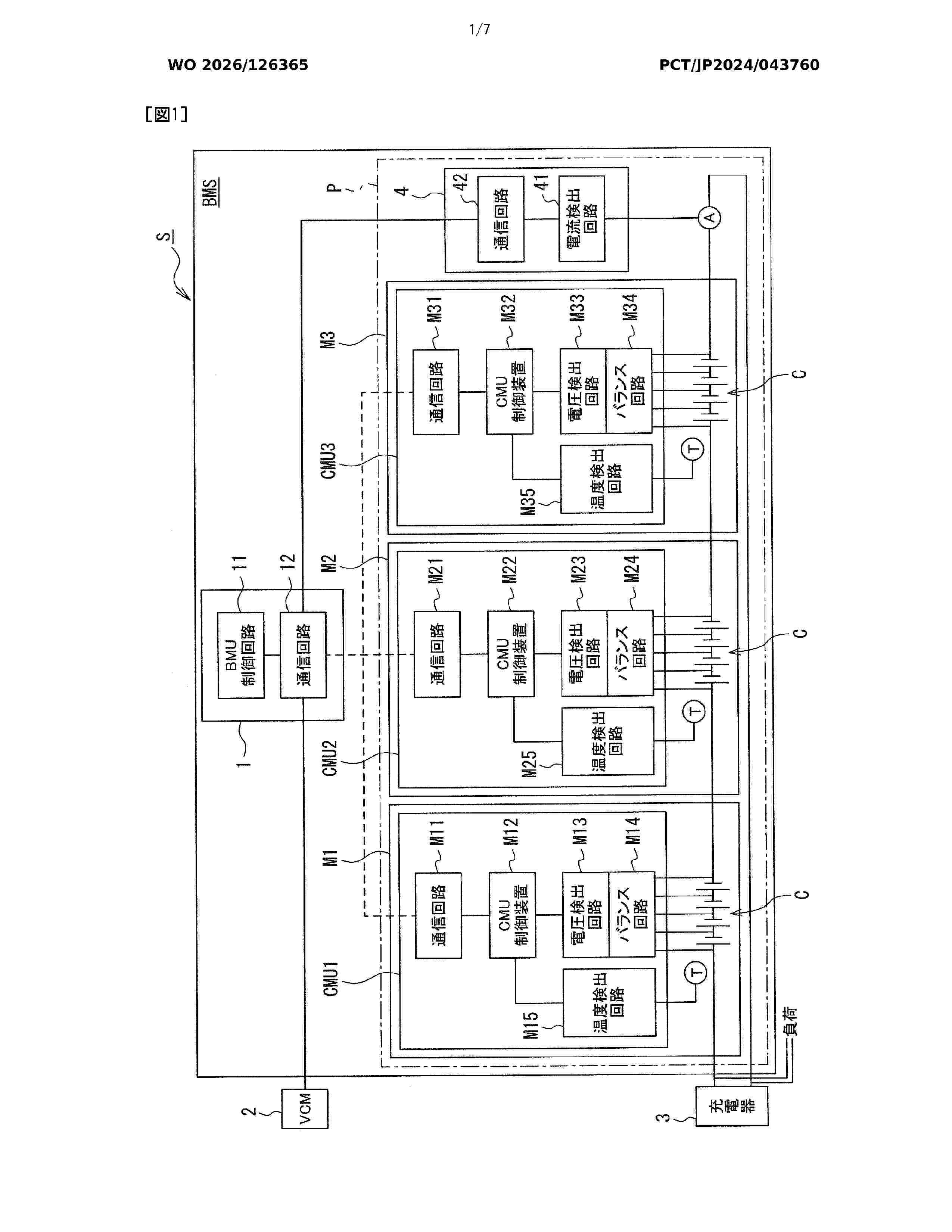
The present invention avoids influence by errors in communication between lower-level units and an upper-level unit and suppresses the cost of taking measures to avoid influence by such errors when functions are divided between the lower-level units and the upper-level unit and an SOC estimation function is delegated to the lower-level units. The present invention comprises: lower-level units (CMU) that are associated with and control respective battery modules (M) that have a plurality of battery cells (C); an upper-level unit (BMU) that oversees the lower-level units (CMU); and a current sensor (A) that detects the values of the current passing through the battery modules (M). The upper-level unit (BMU) calculates an integrated current value from the current values detected by the current sensor (A) and transmits the integrated current value to the lower-level units (CMU), and the lower-level units (CMU) compute initial SOC values for the battery cells (C) on the basis of voltage values for the battery cells (C) and update the initial SOC values on the basis of the integrated current value received from the upper-level unit (BMU).
Resumen de: WO2026125960A1
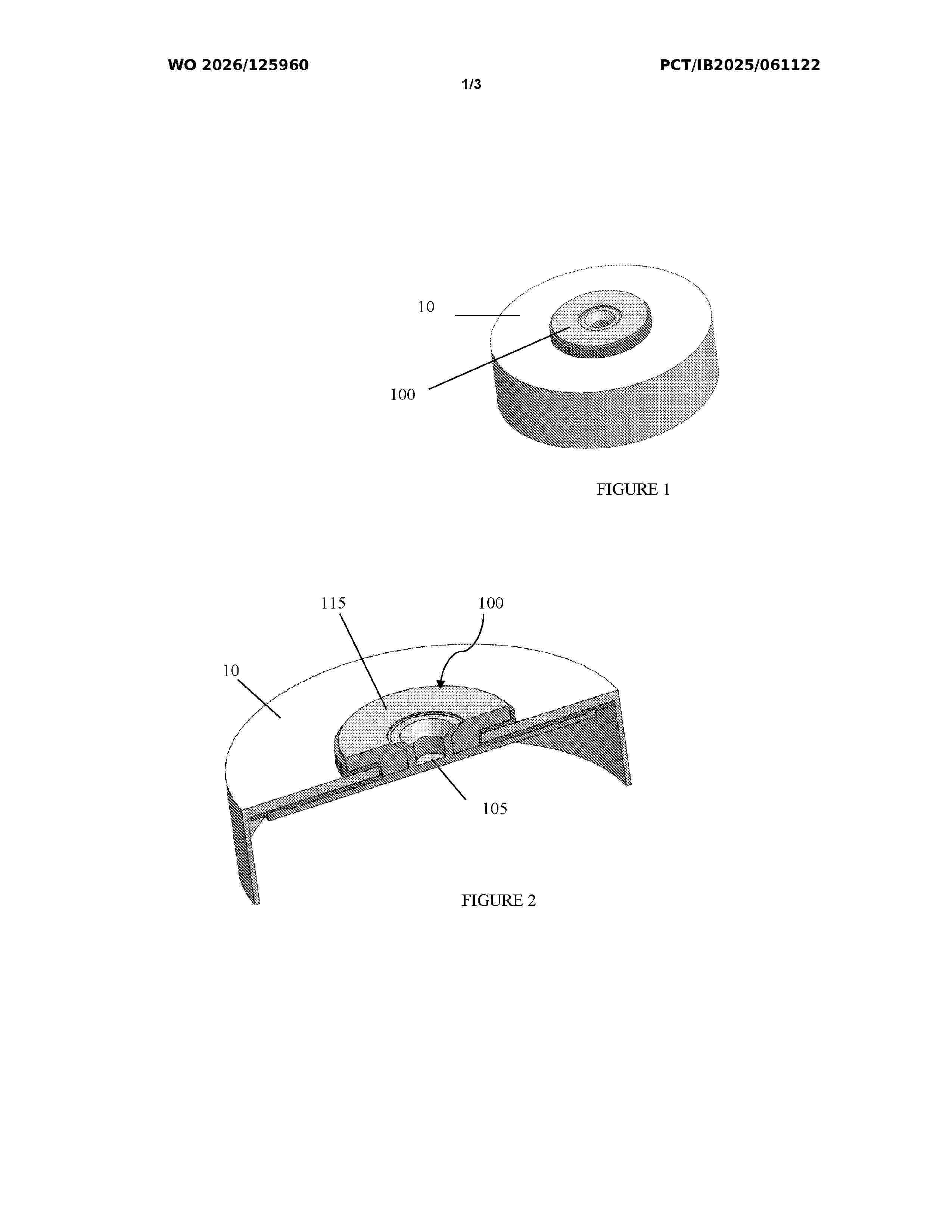
The present dislsoure envisages a two-part terminal assembly for a secondary battery cell. The terminal assembly (100) includes a housing with a first end, second end, and a jelly roll inside. The first terminal part (105) has an inclined opening (109) at the upper portion of the first end, and a hollow cylindrical body (107) with a sealing rim (111) at the lower portion of the first end. The second terminal part (115) includes a flange (118) resting at the upper portion of the first end, and a hollow cylindrical body (116) with its lower portion connected to the upper surface of the sealing rim (111).
Resumen de: WO2026127672A1
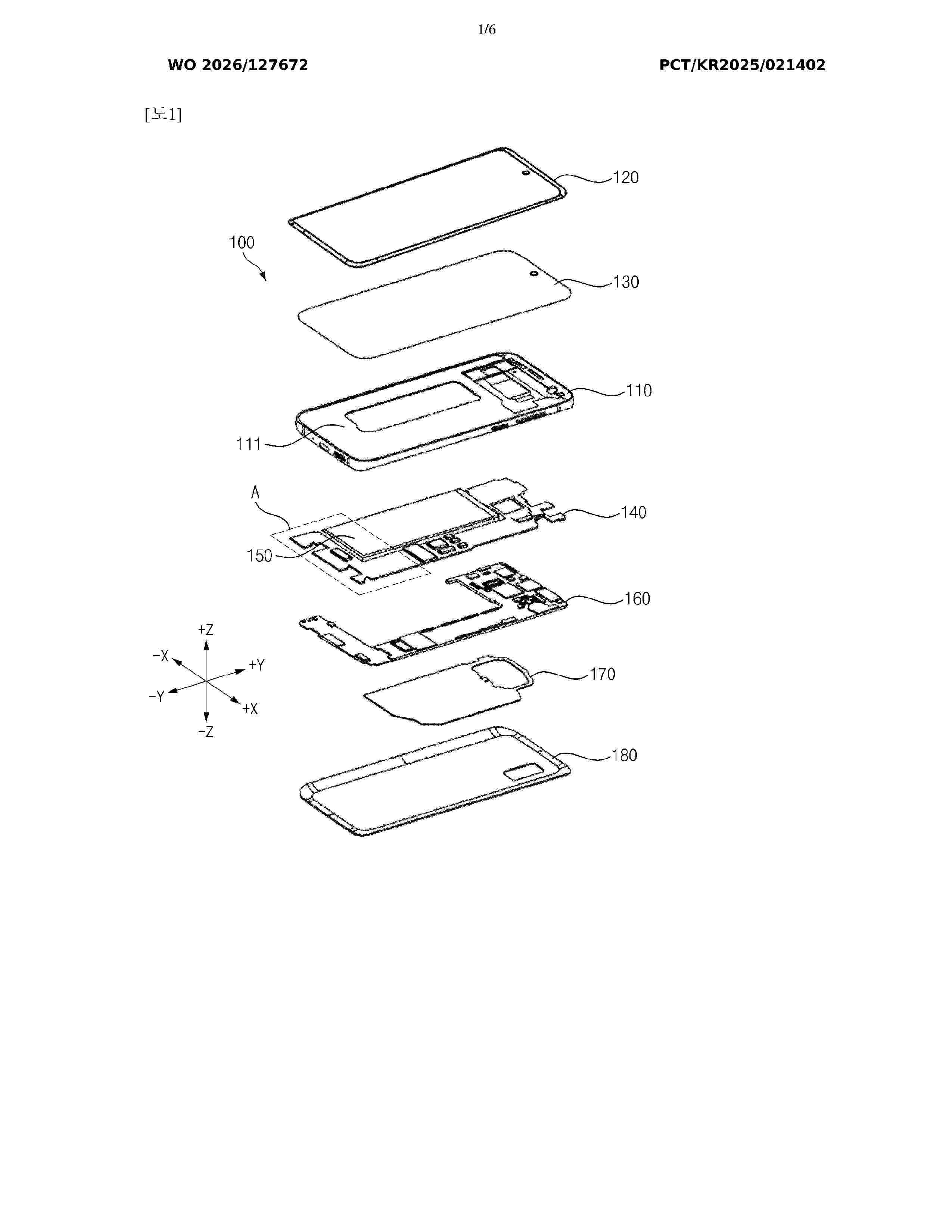
Provided is an isotope battery stack comprising: a plurality of isotope battery units stacked in a first direction; at least one cooling hole passing through the plurality of isotope battery units; and a refrigerant supply unit capable of supplying a refrigerant to the cooling hole. The isotope battery stack according to embodiments of the present invention has excellent heat dissipation and cooling performance.
Resumen de: DE102026115676A1
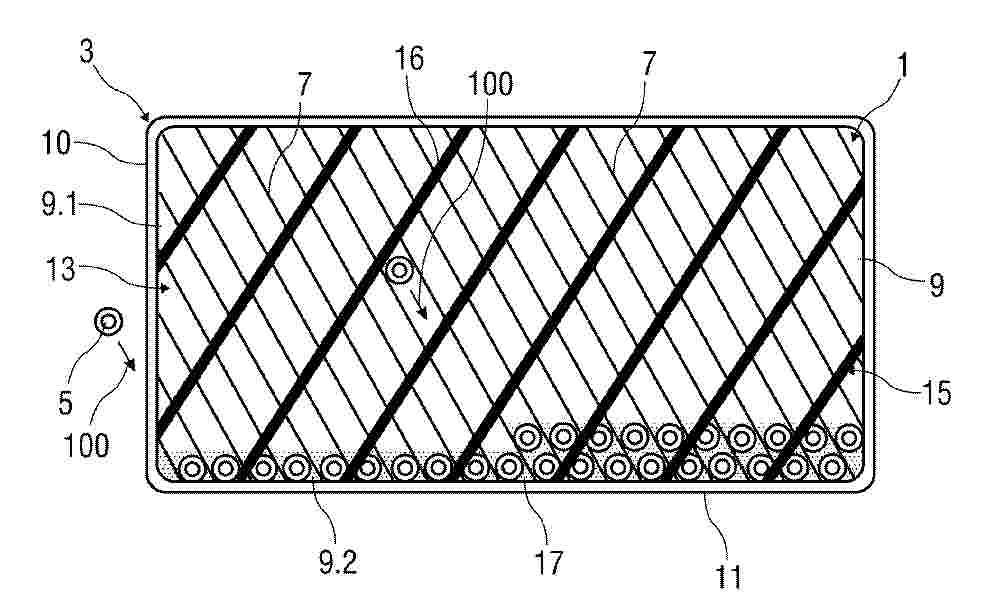
Die Erfindung betrifft ein Verfahren zur Herstellung eines elektrischen Energiespeichers (1) und einen elektrischen Energiespeicher (1), umfassend ein Gehäuse (3), in welchem eine Mehrzahl an Einzelzellen (5) angeordnet ist, wobei eine Anzahl von Kühlrippen (7) derart parallel zueinander in dem Gehäuse (3) angeordnet wird, dass eine Anzahl von Kanälen (9) gebildet wird, wobei zwischen Kühlrippenenden von zwei benachbarten Kühlrippen (7) eine Kanalöffnung (10) zum Einführen der Einzelzellen (5) in den Kanal (9) gebildet wird, wobei die Einzelzellen (5) durch die mindestens eine Kanalöffnung (10) in den mindestens einen Kanal (9) eingeführt und angeordnet werden, welcher durch zwei benachbarte Kühlrippen (7) gebildet ist/wird.
Resumen de: WO2026127645A1
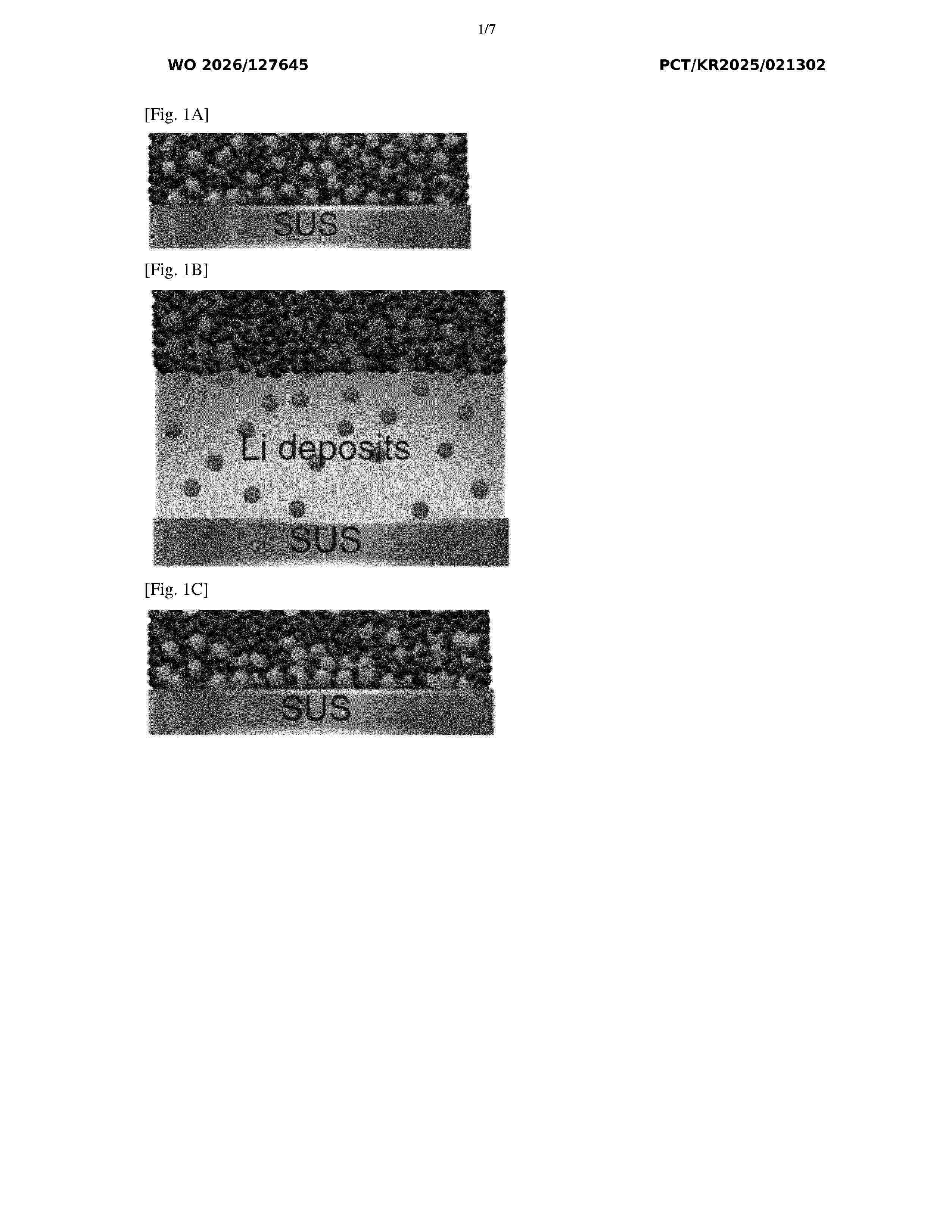
A nanocomposite interlayer including a carbonaceous material, nanoparticles including metals or metalloids, at least one polymer binder, and a pH adjusting agent is provided. The carbonaceous material includes amorphous carbon, graphite, graphene, reduced graphene oxide, carbon nanotube, or combinations thereof. An anodeless battery including a positive electrode, a negative electrode current collector, the nanocomposite interlayer on the negative electrode current collector, and an electrolyte, and a method of operating the anodeless battery is also provided.
Resumen de: WO2026127681A1
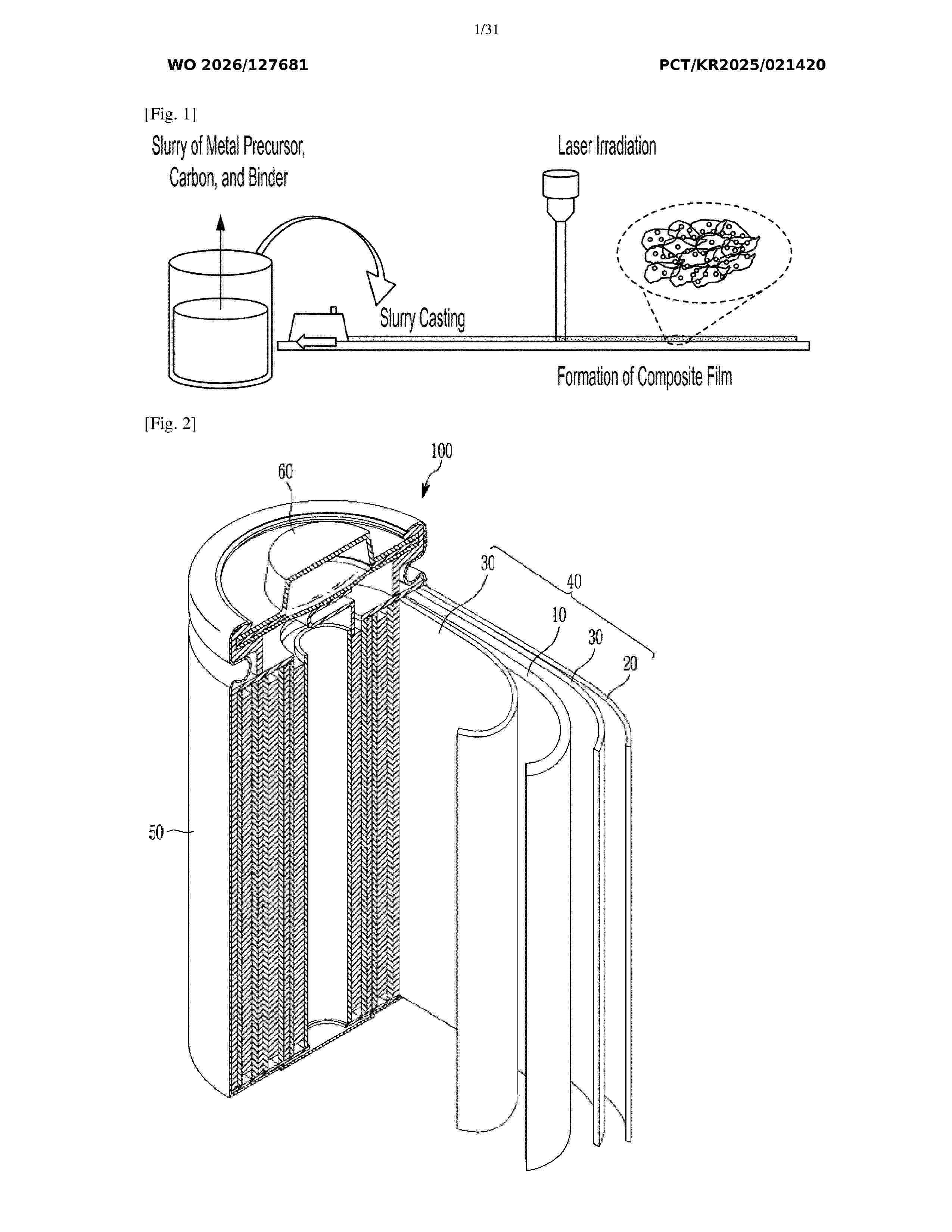
An interlayer including a silver-free nanocomposite, a matrix, and a binder, a method of making the interlayer, and a lithium metal battery (LMB) including the interlayer are provided. The nanocomposite includes nanoparticles and a carbonaceous material, the nanoparticles include metals, metalloids, alloys thereof, compounds thereof, or suitable combinations thereof, and the matrix includes a bulk carbonaceous material.
Resumen de: WO2026127683A1
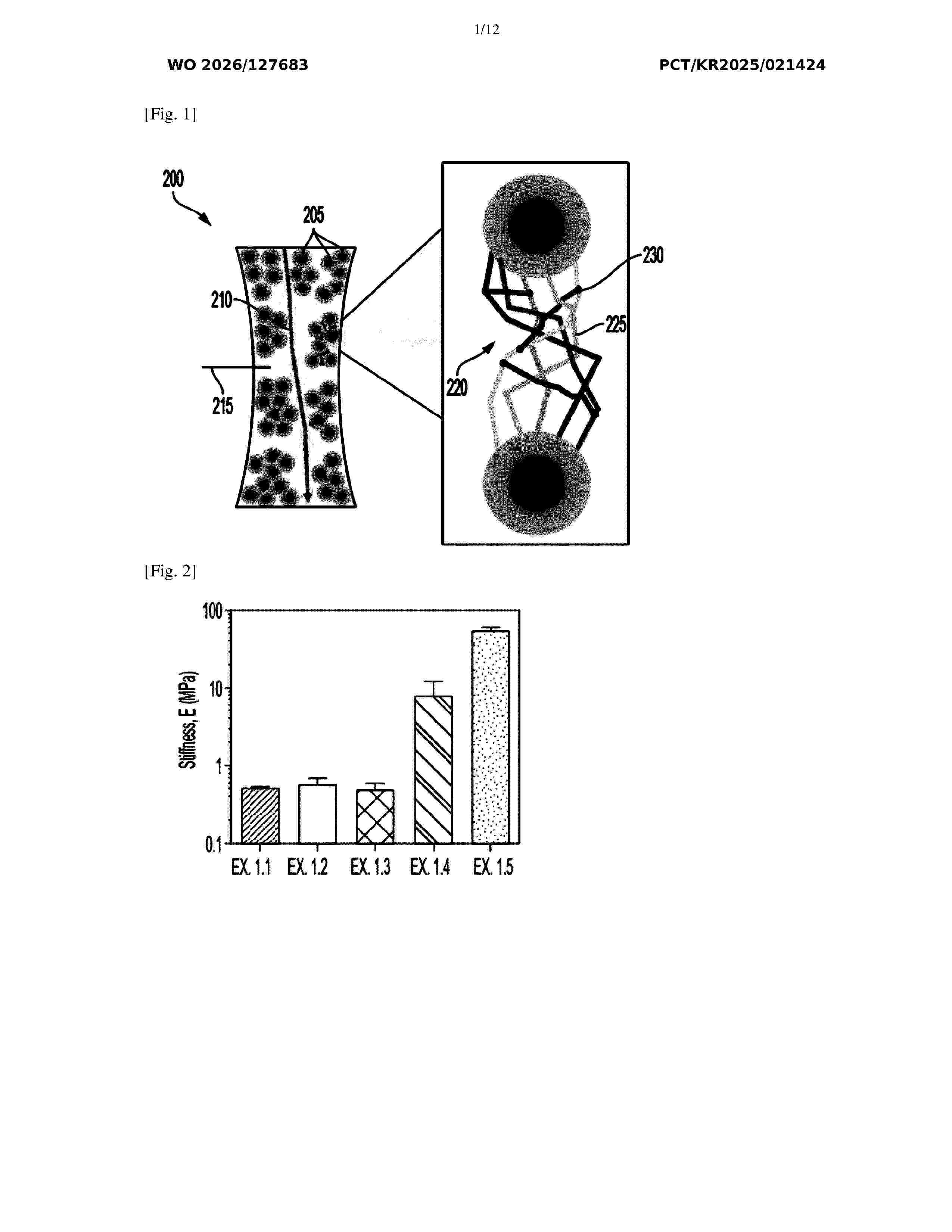
A polymerizable polymer composition, an entangled polymer including the polymerized composition, a composite solid electrolyte including the entangled polymer, an all-solid-state lithium metal battery including the composite solid electrolyte, and a method of preparing the polymerizable polymer composition are provided. The polymer composition includes first and second monomers, an unsaturated hydrocarbon, nanoparticles, a metal salt, and a stabilizer. The first and second monomers have first and second moieties, respectively, the unsaturated hydrocarbon has a third moiety, the surface of the nanoparticles has a coating having fourth moieties. The entangled polymer further includes ion transport pathways and chemical bonds between any of the first, second, third, and fourth moieties.
Nº publicación: WO2026127440A1 18/06/2026
Solicitante:
LG ENERGY SOLUTION LTD [KR]
LG ENERGY SOLUTION, LTD.
Resumen de: WO2026127440A1
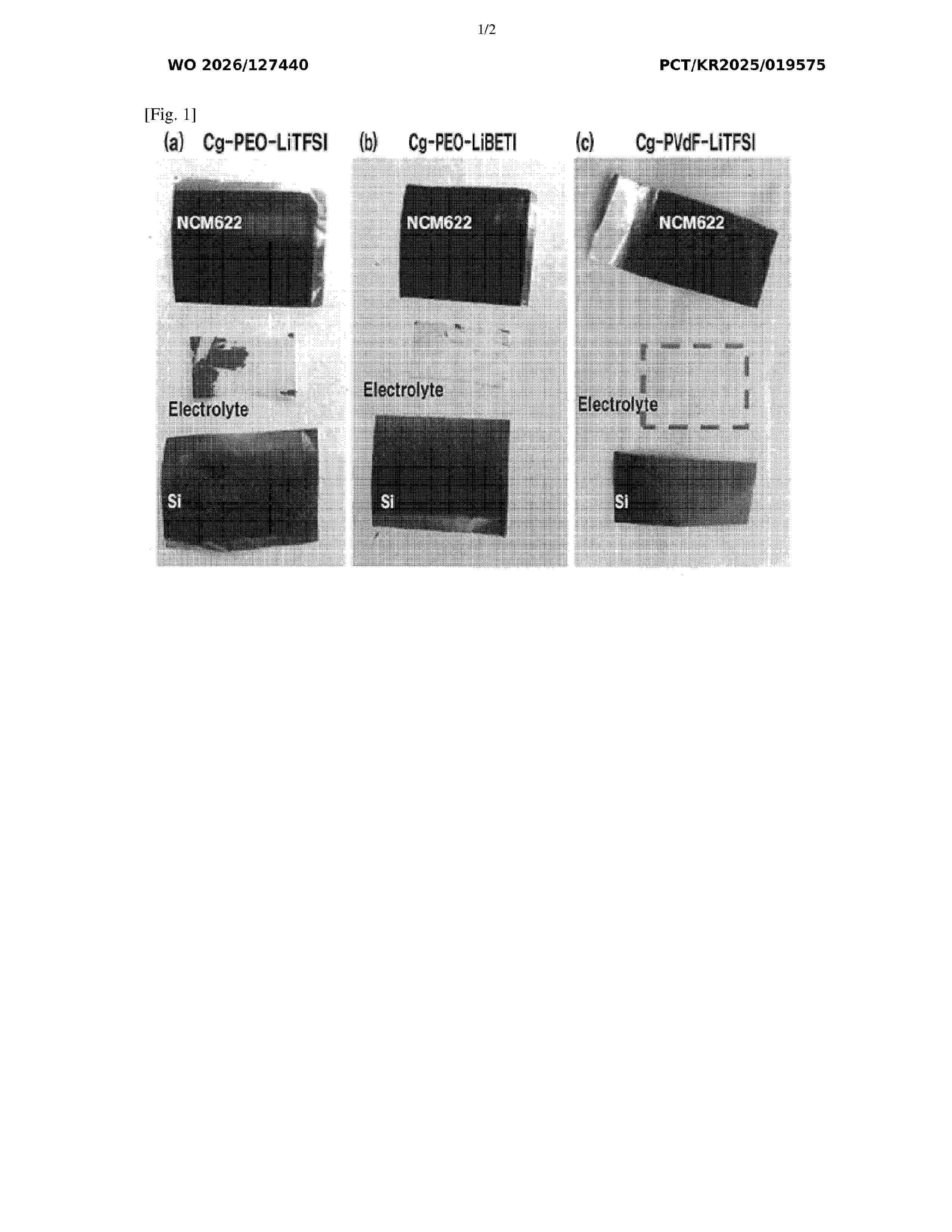
The present invention relates to a method for preparing a pre-lithiated anode for a lithium-ion secondary battery. The present invention relates further to a lithium-ion secondary battery comprising the pre-lithiated anode. The present invention relates further to the use of a solid electrolyte in preparation of a pre-lithiated anode for a lithium-ion secondary battery.
 BOPI
BOPI
 Sede Electrónica